Well, here I am again, with the best stuff from this month in both my real life and in my reading and music world. ~Elizabeth
Sabbatical. I took two full weeks off the internet at the end of January and beginning of February. It was magnificent. I honestly did not miss the internet at all, and I got a ton of reading done.
Skywatching. I wrote about my excitement over seeing Venus for the first time here.
Laughter. This very sheet-y story had me laughing for days. Days. (Make sure you read the comments.)
Cool season in Cambodia. I have to say that overall, February was still pretty cool.
Tea. I’ve discovered Twinings English Breakfast Tea, and I must say it’s far superior to Lipton.
A day-long date with the hubs. A friend gave us some gift money to spend on a date, so we went out for the entire day (!) to celebrate both Valentine’s Day and my husband’s birthday.
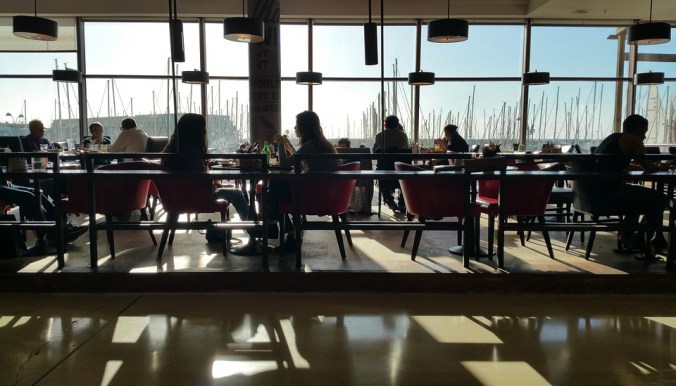
Jars of Clay. This is the coffee shop where I go most Wednesday afternoons to write (on my brilliant husband’s suggestion). It’s recently been remodeled and is now even cozier and more comfortable for working.
Spiritual direction sessions. I met with someone for spiritual direction during our two-week sabbatical. It gave me the courage to address a few things in my life, to place better boundaries around work, ministry, and technology, and to reconnect with God. I wasn’t dealing with any “new” issues; I was merely forgetting to apply the Gospel to all my old issues. (This felt like both good news and bad news at the same time.)
Sunday Screen Sabbath. After finishing my two-week technology break, I felt convicted to take a weekly break from screens and from the internet. I’ve felt this nudge before but never been brave enough to follow through. Now that I’ve tried it, however, I want to keep fasting from the internet for 24 hours once a week. The first Sunday was the hardest, but the tech break became easier with each successive Sunday.
A “Prayer for the Nations” Sunday at our international church. We focused on various geographical locations and prayed about four main areas: governments, churches, migrants and refugees, and families. The flags of about 35 countries had been set up around the room, and during the offering song people were encouraged to grab a flag and wave it around as we sang and prayed, in an Old Testament-inspired “wave offering.” I watched teens from different countries grab their own flags. I watched visitors from different countries grab their own flags. I watched my own daughters grab their flag, and I burst into tears, for that is literally the flag I grew up under, as a daughter of a U.S. Army officer. We all want to see revival and spiritual flourishing in our own countries, even as we leave those countries to serve God in Cambodia. Later in the service we sang “How Great is Our God” in six different languages, including Khmer. It was an overwhelmingly beautiful picture of all nations, all tribes, and all tongues bowing down before God in heaven. I cried for the sheer beauty of it. In fact, I had to sit down when the service was over to cry some more and contemplate the truth of our final destiny with Christ.
BOOKS FOR CHILDREN AND ADULTS (PLUS ONE MOVIE)
The Horse and His Boy by C.S. Lewis. This was the last of our Narnia adventures for a while (we worked our way through all seven of them over the last year). I don’t remember this installment being one of my favorites, but I have to say that this time through I loved it (then again, how can anyone say anything less when it comes to Lewis???). My favorite quote is “’Child,’ said the Lion, ‘I am telling you your story, not hers. No one is told any story but their own.’”
The Penderwicks by Jeanne Birdsall. We started this book right after we finished Narnia, and we LOVE it. It’s so fun and funny. One of my kids was gone for a few days this month, though, and we didn’t want to read ahead in The Penderwicks without everyone present, so the rest of us started up The Moffats again — another delightful children’s story.
This month I realized that although I had read fairy tales to the boys when they were younger, I never did read any to my girls. We have so many other books we’re always reading, and sometimes fairy tales contain magic, and sometimes the happily-ever-after endings grate on me because they seem too perfect. But I got two of Sonlight’s recommended fairy tale books, and lo and behold, my daughters LOVE them. Fairy tales are an important part of western culture that I need to make sure my little TCKs know, but moreover, reading these fairy tale endings reminded me why people have been drawn to these stories for ages – we are all still longing for our final happily-ever-after with King Jesus, and fairy tales point to that longing.
One of my favorite things to do on my own is to read children’s literature. Basically I just thumb through all the Sonlight readers we have laying around, and I pick one. This month in my extra free time I was able to devour The Westing Game by Ellen Raskin, The Potato Chip Puzzles by Eric Berlin, and The Sherwood Ring by Elizabeth Marie Pope. The first is a delicious mystery that’s also a study in character, the second is a mystery that’s just plain fun, and the last is a subtle, sweet story set in American Revolutionary times. I also started Cold Sassy Tree (a non-children’s novel set in the post-Civil War South) by Olive Ann Burns but have only made it half-way through. Of all of these books, The Westing Game is my favorite.
Boundaries by Dr. Henry Cloud and Dr. John Townsend. My husband has been recommending this to me for quite some time now. In addition to helping me identify areas in my work and parenting that need stronger boundaries, this book also taught me that boundary problems are not just for people like me, who have a weak “no.” People who make their demands felt too strongly and cannot hear no also have boundary problems. The chapter on self-control issues was unexpected and convicting, but also appreciated. It explained that when we can’t say no to ourselves, whether it’s food, money, sex, time, alcohol — whatever our problem is – that is also a boundary issue.
Misunderstood by Tanya Crossman. This brand new book on Third Culture Kids was written by a personal friend of ours. Its title encapsulates the main feeling of today’s TCKs: they feel misunderstood on all fronts — whether it’s from people in their home culture or people in their passport culture or even people in their families.
I skipped straight to the home school section, and what I read there was very encouraging. The main challenges faced by TCKs in homeschooling families are a) lack of friends or social network and b) lack of educational help or tutoring. We work hard on both these fronts, by participating in a co-op and by arranging extra times for our kids to hang out with their friends. I’m also always around to answer questions – I was surprised to learn that some TCKs whose parents are in full time ministry must do their lessons basically on their own, with no outside help besides having the answer key to look off of. (The good news for full time working parents who homeschool is that if they hire a tutor for their kids, things can still work out educationally speaking.)
I also noticed myself in the portrayal of long-term TCKs who become resistant to new people entering their circles. The longer I’m here, the less energy and time I have to welcome new people into my life. I’m still not sure how I feel about that yet.
The Living Cross by Amy Boucher Pye. To be fair, I haven’t read this yet. It’s my Lent study for this year (the last 2 years I worked through a book specifically designed for Lent). I know Amy through blogging and enjoyed her first book Finding Myself in Britain, and I’m looking forward to the subject material of forgiveness, as I often find forgiveness to be a mystery, whether it’s of myself or of others.
Fiddler on the Roof. We watched this movie with our kids one Saturday morning. I hadn’t seen it since I was 18, and nearly 18 extra years of life really make a difference in understanding a story. This time, I cried through many of the scenes, especially “Sunrise, Sunset” (because my children are growing so fast), “Do You Love Me?” (because that’s what sacrificial love looks like), and the final “God-be-with-you” blessing of Chava by her Papa (because that’s what parents do, even when they disagree with their children’s choices).
On a related note, I recently read some advice that said that if you read Little Women as a teen or young girl, you’ll most likely identify with Jo. If you read it in your twenties or as a young mom, you might identify with Meg. But if you wait long enough to re-read it, you just might understand the story from Marmie’s point of view. Similarly, it was mentioned that if you read Lucy Maud Montgomery’s books as a young person, you’ll identify with Anne (of course), but if you read it later in adulthood, you might understand better why Marilla and the other adults in the story were so frustrated by Anne’s antics. I just found that interesting in light of the fact that I had just re-watched Fiddler on the Roof and experienced it completely differently than I did as a teenager. It also made me think I really need to re-read Little Women and the Anne books!
BLOG POSTS
Living Overseas and Fear: Learning to Banish Love’s Twin by Lisa McKay. I love everything about this post. It’s dense and meaty but every sentence is important, and it’s for everyone, not just people living overseas.
The Gift of Need: MKs and Isolation by Michele Phoenix. I’m not an MK, but I saw myself in this article way more than I’d like to admit. Another top pick for the month.
Every Sin is the Lesser of Two Evils by Joshua Gibbs. This will make you question where in your life you are tolerating compromise.
Questioning Your Calling by Jerry Jones. “’Calling’ gets tossed around flippantly — sometimes carelessly.” This article offers basic yet profound truth in a practical package, as usual for Jerry. The cross cultural wisdom at his own site is also excellent.
Thoughts on Sharing Our Stories by Marilyn Gardner. A call to honesty and humility in the way we tell our own stories and the stories of others.
Remember how I raved about Helena Sorensen’s Shiloh series last year? Well, the Velvet Ashes book club read it this month, and if you’re wanting a taste of the book before you decide to read it, or simply want to discuss it or discover what others think of it, check out this blog series: Part 1, Part 2, and Part 3. The last part dips into Helena’s writing process, which I found entirely refreshing and grounding.
QUOTES & POEMS
This quote from G.K. Chesterton. And here, another similar quote from Chesterton. Both on home and belonging and feeling lost.
Love (III) by George Herbert. Probably my most favorite poem of the month, along with Guite’s. This is a perfect description of perfect love and how we cower back in fear of it, and it’s nearly 400 years old. I’m always amazed when such
Mary (Theotokos) by Malcolm Guite. I didn’t read Guite’s poems for a while – I avoided them because I was busy and these poems require a lot of concentration to fully absorb. But I love this one (even though it was written for the Christmas season).
As referenced by Amy Young in The Question Heard Round the World: C.S. Lewis wrote in Pilgrim’s Regress “Be sure it is not for nothing that the Landlord has knit our hearts so closely to time and place – to one friend rather than another and one shire more than all the land.”
SCRIPTURES & RESPONSES
Philippians 3:3: “We rely on what Christ Jesus has done for us. We put no confidence in human effort.”
Philippians 3:8: “I no longer count on my own righteousness.”
(I got really into Philippians this month — many more verses are recorded in my journal.)
(I also got really into the Transfiguration this month, thanks to Michael Card’s commentary on Mark. Card’s book also inspired this post.)
Psalm 145:3: “Great is the LORD! He is most worthy of praise. No one can measure His greatness.” No one can measure His greatness – can we even imagine what that means??
Proverbs 12:12: “Thieves are jealous of each other’s loot, but the godly are well-rooted and bear their own fruit.” (I wrote here about how that verse made such an impact on me.
From a recent lesson by Ann Greve (these are not exact quotes): In John’s gospel, soldiers come looking for Jesus in the Garden of Gethsemane. When Jesus answers, “I AM he,” everyone falls to the ground – including Judas. This is a picture for us of the power that Jesus really had over his captors.
It also reminded me of three sections in Lewis’s The Horse and His Boy. Firstly, there’s a point at which the main character encounters Aslan and wordlessly slips off his horse to bow down and worship him, without really even knowing why he feels compelled to do so. At another point, a talking horse meets Aslan for the first time and trots right up to him to announce that he can eat her if he want, that she’d rather be eaten by him than fed by anyone else. These two characters instinctively know Aslan’s glory. But later, a proud, arrogant fool of a prince refuses to bow before Aslan and is warned, and warned again, and then punished for his refusal. And that reminded me of Philippians 2:10: “That at the name of Jesus every knee should bow, in heaven and on earth and under the earth, and every tongue confess that Jesus Christ is Lord, to the glory of God the Father.” Every knee. Every tongue. Like the men in the Garden, and like the characters in Narnia who bow willingly — or unwillingly. We will all confess and we will all bow.
Also from a recent lesson from Ann Greve on John 18, when Peter cuts off Malchus’s ear. When we get angry like Peter and act out on that anger without understanding the plan of God, we have a tendency to “run around cutting people’s ears off.” That was such a word picture for me of what Peter was doing, and of what we and I can so easily do, run around in our anger injuring people and doing more damage than needs to be done.
More Narnia and Ann Greve connections: “When God told Moses ‘I AM that I AM,’ He was both revealing and withholding.” Which of course reminds me of my favorite quote from The Horse and His Boy about Aslan only telling people their own stories, not the stories of others — a revealing and a withholding.
SONGS
(Prepare yourself, because I have a lot of new and old songs that spoke to me this month.)
One day my girls were doing sticker art, and I sat down next to them with my beloved Songs of Faith and Praise and started singing. I just love hymns, but too often I forget to take the time to sing them. I specifically chose songs about creation or heaven, because I knew they would like them. These are the songs we sang:
Nearer My God to Thee by Sarah Flower Adams.
There is a Habitation by Love H. Jameson.
On Zion’s Glorious Summit Stood by John Kent. Oh for the days of Bible camp when the entire camp sang this in 4-part harmony.
Have You Seen Jesus my Lord? A more modern camp song.
Can You Count the Stars? by Johann Wilhelm Hey and translated by E.L.J.
We Saw Thee Not by Anne R. Richter. Have you read these lyrics lately? Amazing.
This is My Father’s World by Maltbie D. Babcock. A childhood favorite of mine, and of their maternal grandmother’s. It’s ok to shout those last two songs, isn’t it??
Jubilee by Michael Card. Card’s music is always full of theology, and this (older song) is no different.
Be Kind to Yourself by Andrew Peterson. A song to sing over our children or over ourselves. Was on repeat at our house a lot.
Jesus We Love You by Paul McClure (and Bethel). I heard this at a church I visited. Has been in my head and on my lips all month. The words are good enough to copy here:
Old things have passed away
Your love has stayed the same
Your constant grace remains the cornerstone
Things that we thought were dead
Are breathing in life again
You cause your Son to shine on darkest nights
For all that you’ve done we will pour out our love
This will be our anthem song
Jesus we love you
Oh how we love you
You are the one our hearts adore
The hopeless have found their hope
The orphans now have a home
All that was lost has found its place in you
You lift our weary head
You make us strong instead
You took these rags and made us beautiful
Dwell by Casey Corum (and Vineyard). A beautiful “breath prayer” for any time of day. I heard it at a church we visited.
All Creatures of our God and King by Francis of Assisi and translated by William H. Draper, also from our Sunday morning visit to another church. In my head I can only hear Fernando Ortega’s version.
Come Out of Hiding by Steffany Gretzinger and Amanda Cook (of Bethel). I’ve shared this before, but it was relevant to me again this month.
No Longer Slaves by Jonathan David and Melissa Helser. Oh how often I forget my truest, deepest identity, especially when I‘m too busy “working for God.” But my husband played this for me again this month, and again I put it on repeat.
Here in Your Presence by New Life Worship. “Here in Your presence, all things are new, here in Your presence, everything bows before You.”
Mercy by Matt Redman. I was listening to my little iPod Shuffle when this song came on. I put it on repeat, just could not stop listening. “I will kneel in the dust at the foot of the cross, where mercy paid for me, where the wrath I deserve, it is gone, it has passed, your blood has hidden me.” I pray along with the song, “May I never lose the wonder, oh, the wonder of Your mercy, may I sing Your hallelujah, hallelujah, amen.”
And finally, Beneath the Waters by Hillsong, especially the bridge:
I rise as You are risen
Declare Your rule and reign
My life confess Your Lordship
And glorify Your Name
Your Word it stands eternal
Your Kingdom knows no end
Your praise goes on forever
An on and on again
No power can stand against You
No curse assault Your throne
No one can steal Your glory
For it is Yours alone
I stand to sing Your praises
I stand to testify
For I was dead in my sin