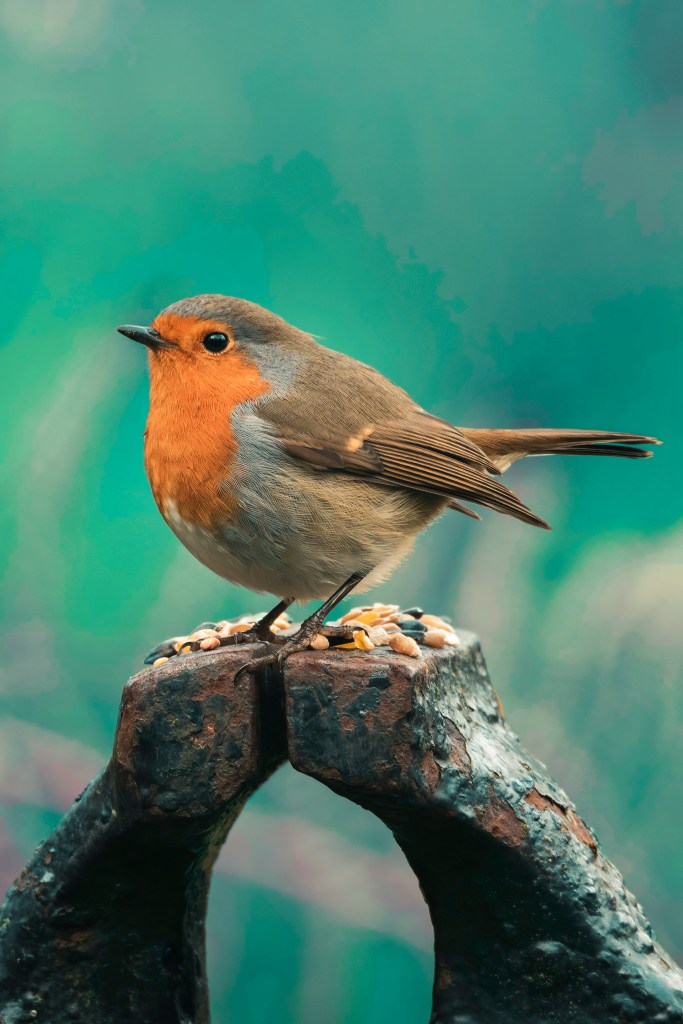
It was just a sparrow. A tiny little bird hopping up and down on the sidewalk outside the coffee shop that day. Why couldn’t I pull my eyes away from it? Why do I love the way it hops so much? (Truth be told, I get distracted by cute little hopping birds a lot now that I’m in my 40s.)
Later it was someone using sign language during a worship service. I couldn’t tear my attention away from that either — how beautiful to use your entire body to worship God.
It’s not lost on me that Jesus cares for us even more tenderly than He cares for these sparrows. Or that the whole point of life is to become living sacrifices, worshiping God with our bodies.
Sometimes I’ll be walking the neighborhood and find myself mesmerized by the broad-winged hawk that nests near our home. The way it soars, the way it rises on the wind, the way it doesn’t have to flap too hard to ride the skies. I can’t stop looking at it either. It’s not lost on me that God renews our strength like eagles — birds of prey like that hawk that soars above my house.
And then there’s the way robins run. They always make me smile.
It wasn’t always like this. It wasn’t always birds. Historically speaking, I’ve always been enthralled by the sight of the moon. I’ve even been known to lose my focus to a particularly striking moon while driving. And I’m delighted by young babies, those soft squishy little people. It’s hard to engage with an adult if a baby is in the room.
Several years ago it was fractals that beckoned me. I couldn’t stop studying them, thinking about them, talking about them, drawing and redrawing them. Fractals are shapes that repeat themselves on both the large scale and small scale.
In math they’re things like the Sierpinski triangle and the Mandelbroit set, Koch snowflakes and Pythagoras trees. In nature they’re things like clouds, trees, snowflakes, and shorelines that have the same repeating structure from far away and up close. (Fun fact: Humans didn’t begin exploring the mathematics of fractals until at least the late 1800s.)
Interestingly, we now know that the human mind is calmed by fractals. It’s part of why nature walks are so healing, so soothing. Our modern lives are so Euclidean, so basic, all these clean lines and corners.
But God’s good creation is fractal in nature — or even hyperbolic, another form of non-Euclidean geometry that shows up in undersea creatures like corals and sea slugs and that also used to captivate me (but whose math humans didn’t discover until the mid 1800s).
What am I really saying here, in obsessing over the math and science of nature? In the end the point isn’t the math and science — fascinating and fun as it is. The point is that beauty is out there. In the good world God made. So gaze upon it. Smile upon it. Let it calm your spirit and your heart and your breath.
God may have made your brain to delight in different things than me. If so, the question to ask is what things? And once you know what God made you to love, delight in it. Don’t ignore it or pass it by. Perhaps you will pause over the simple beauty of a sunset or the painted majesty of pink and grey clouds. Perhaps you will consider the birds and let them charm your heart, enrapture your soul.
Whatever loveliness draws you in, remember that God made you to be distracted by beauty. Let yourself be.
God, I long to follow close behind You, but I often see dully as through a glass. I cannot envision what I am meant to be in You, though I catch glimpses from time to time.
Paul told us to imitate him as he imitated Christ, and You have set examples among Your people of what it means to be a living sacrifice, of what it means to be beloved in Christ.
So make me like Mrs. C., who believes in the power of prayer because it set her free and made her new, who, like You, does not show favoritism and believes healing from the Holy Spirit is for everyone, who has a testimony to tell of Your great power and won’t stop praying till it comes on earth.
And make me like Father T., whose deep knowledge of Your love for him over a lifetime has settled in his breath and in his bones so deeply that when he walks into a room, everything changes. Shoulders relax, souls breathe easier, and people start to grasp that maybe, just maybe, they really are as loved as You say we are.
But most of all, God, make me like me, the me I am meant to be, the one you dreamed of when you knit me together in the dark. May I become my true self in You as You become ever more enfleshed in me.
If it takes a lifetime to become a living sacrifice, take my life and daily pour it out. And if it takes a lifetime to become the beloved one, take my heart and teach me your incomparable, transcendent love.
As a young person growing up in the churches of Christ in the ’90s, I loved the song “Go Tell John” — mainly because it spoke of the power of Christ. My faith was freshly minted and idealistic, and I was convinced I would be willing to die for my Lord and savior.
“Go tell John That the lame have learned to walk That the poor can hear the word of God and the deaf can hear me talk Go tell John That the blind can finally see, oh and Blessed is the man who doesn’t fall away because of me.”
A few weeks ago I was in a nostalgic mood and created a Spotify list with all my favorite Free Indeed songs (IYKYK). Today “Go Tell John” played for the first time on my (3-hour) playlist. And I couldn’t stop the tears from flowing, seemingly out of nowhere.
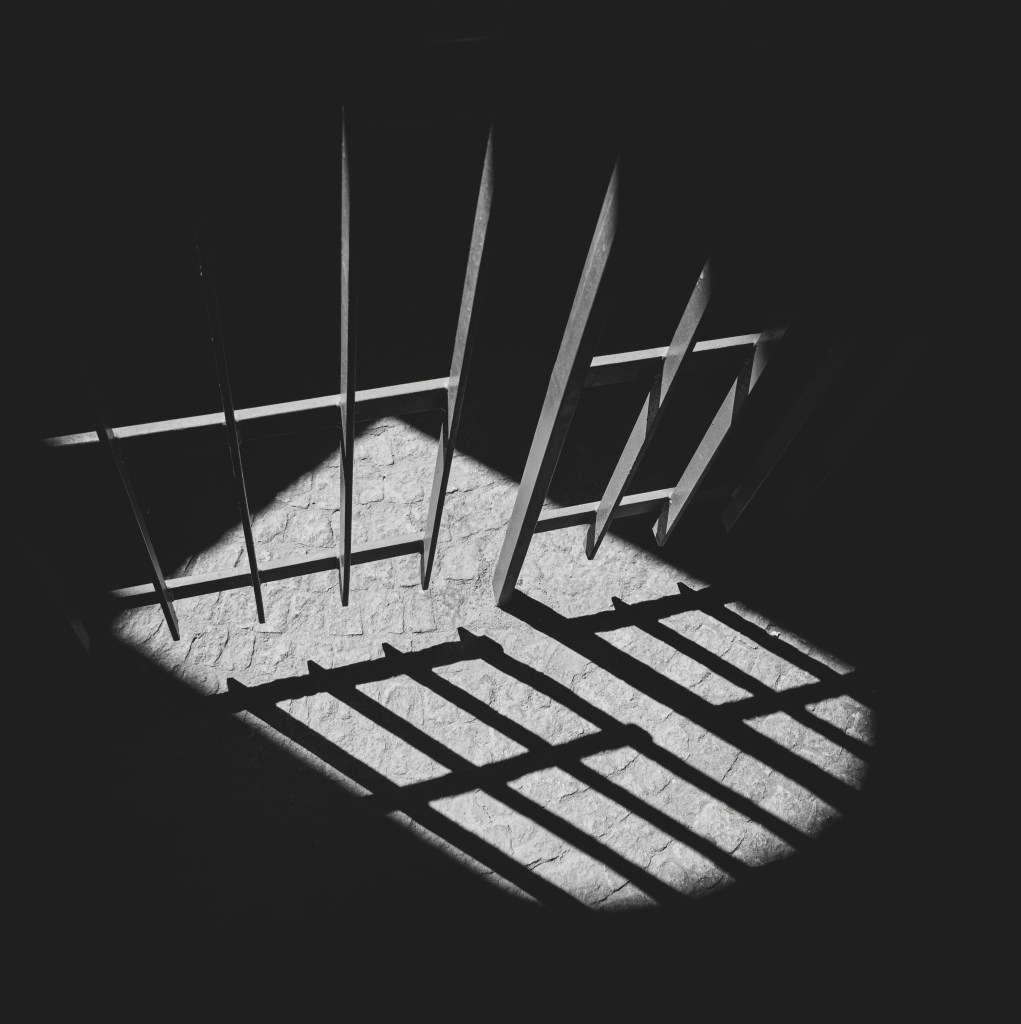
“As he sat there in that prison cell, he knew just how it came about And he knew his life was over and he was never comin’ out But there was just one thing he had to know, he had to make a final plea So he sent his friends to ask the Lord if he was who He claimed to be.”
I’m now a 40-something-year-old who has seen darkness and deep despair. I’ve never been in an actual prison cell, but I’ve been imprisoned by the suffering of both mind and body. And I know that sometimes, we just need the assurance that Jesus is worth it, that He’s worth all the trouble we will face in this world.
“Go tell John That the dead are raised again Go tell John That the lepers now are cleansed Go tell John That the path he chose was right Go tell John That I truly am the light.”
It’s precisely because John’s situation punches the gut so hard that Jesus’s answer is all the more important — and powerful. Doubts, questions, despair, Jesus doesn’t judge. He is gentle with us, promising not to break a bruised reed or snuff out a smoldering wick.
“And blessed is the man who doesn’t fall away because of me.”
Jesus tells us that He is the Messiah, that He IS worth it — if we can only hold onto Him. So hold on, friends. No matter the darkness of your prison cell.
[“Go Tell John” written by Keith Lancaster and John Sublett. Original account found in Matthew 11.]
Though I, like Paul, feel like the least deserving of all God’s people, the worst of sinners— and though I, like Paul, lament my thorn in the flesh and must resign myself that You are not removing it— help me, like Paul, to trust in your grace for me and my many weaknesses and to boast only in the power of Christ.
Help me, like Paul, to press on toward the goal and not get trapped in ruminations over the past or over my inherent inadequacies, but to set my sights on things above, where Christ is seated on the throne. And help me, like Paul, to learn contentment in all situations— even the situation of being me.
For I am who you made me to be. You knit me together in my mother’s womb and saw all my days. You knew I would struggle. You knew I would be incapable in so many ways. And yet You still made me. You still gave me life, still gave me Christ.
You made me complex even as I wish for simple. Still, Your thoughts about me are precious. Help me to trust in your unfailing love, for You are always with me. And You are always good.
Though my sins are many and my regrets are great, You take them far away. You remember that I am dust and fill my life with tender mercies, renewing my strength day by day, hour by hour.
In a world that tells us we don’t need You, I confess that I have always needed You. All I have been given comes from you. All I have been able to achieve comes from You. Even my desire for You comes from You.
Lord, you are Father to your children, and Your love remains with us forever. Let everything within me return Your love. Let everything inside me rely upon Your strength. Let everything that I am praise You all my days.
Saddled with an anxious mind, it’s easy for me to go bleak. Hopeless. Straight to the end of the world. It’s easy to look around at world or national events and think, it’s never been this bad before.
But this is not a new habit of mine. I’ve been fast-forwarding to Armageddon for years. This tells me it’s not about the age in which I live but about the mind I inhabit.
There is, as always, reason to fear. Recently some have said that we are closer to nuclear war now than we have been since the Cold War. (Note: I originally wrote those words in April 2024, shortly after the war in Israel had begun.)
But in times like these I remember what C.S. Lewis had to say in his 1948 essay, “On Living in an Atomic Age,” and I go reread it. You probably already know it, but here it is just in case:
In one way we think a great deal too much of the atomic bomb. ‘How are we to live in an atomic age?’ I am tempted to reply: ‘Why, as you would have lived in the sixteenth century when the plague visited London almost every year, or as you would have lived in a Viking age when raiders from Scandinavia might land and cut your throat any night; or indeed, as you are already living in an age of cancer, an age of syphilis, an age of paralysis, an age of air raids, an age of railway accidents, an age of motor accidents.’
In other words, do not let us begin by exaggerating the novelty of our situation. Believe me, dear sir or madam, you and all whom you love were already sentenced to death before the atomic bomb was invented: and quite a high percentage of us were going to die in unpleasant ways. We had, indeed, one very great advantage over our ancestors – anaesthetics; but we have that still. It is perfectly ridiculous to go about whimpering and drawing long faces because the scientists have added one more chance of painful and premature death to a world which already bristled with such chances and in which death itself was not a chance at all, but a certainty.
This is the first point to be made: and the first action to be taken is to pull ourselves together. If we are all going to be destroyed by an atomic bomb, let that bomb when it comes find us doing sensible and human things – praying, working, teaching, reading, listening to music, bathing the children, playing tennis, chatting to our friends over a pint and a game of darts – not huddled together like frightened sheep and thinking about bombs. They may break our bodies (a microbe can do that) but they need not dominate our minds.
Of course, that reminds me of this George Orwell quote from his 1946 essay, “Some Thoughts on the Common Toad,” which I’ve also shared before:
The atomic bombs are piling up in the factories, the police are prowling through the cities, the lies are streaming from the loudspeakers, but the earth is still going round the sun, and neither the dictators nor the bureaucrats, deeply as they disapprove of the process, are able to prevent it.
And that reminds me of what we learned in homeschool history class. Specifically, what we learned in Chapter 12 of Susan Wise Bauer’s The Story of the WorldVolume 3: Early Modern Times. The setting was London, the 1650s and ‘60s. First there was a long, drawn-out war followed by an extremely unpopular governing regime. Then there was a plague. And finally, there was a disaster that destroyed half the city.
Nearly ten years of the English Civil War—violence, unrest, and oppression. An unpopular religious regime for the next five. Two fifths (forty percent) of London succumbing to the Yersinia pestis bacterium a few years after that. And less than a year later four fifths of London burning to the ground all because the king’s baker had been careless one night.
If I’d been living in London in 1666, at the end of all of that, I would have thought the end of the world was right around the corner. I would have thought Jesus was coming soon. Surely. But I would have been wrong. Nearly four hundred years later, we’re still waiting.
What about Matthew 24 and Jesus’s apparent warnings that the end was happening soon? What about Matthew 25 and the parable of the virgins? Aren’t we supposed to be ready for His return at all times? It could happen at any moment. At least, that’s what I’d heard growing up.
But when our Bible class studied this verse, the teacher explained that it’s not just that we need to be ready for His return to happen soon. We’re also supposed to be ready for it to happen later. To be prepared to stay and wait a long time. The wise ones were prepared for a longer wait — and possibly more suffering — and they were rewarded.
Wars, plagues, and fires. Those are the trials that the English people faced in the 1650s and ‘60s. And they are the trials the modern world has faced in the 2020s. It doesn’t necessarily mean the end of the world is nigh, although it might. But things have always been falling apart. 2026 is no different — though it is personal.
So don’t just be ready to receive Him now. Also be ready to wait. Be ready right now, and be ready later. We don’t know the times, and it’s not our job to know the times. It’s our job to be prepared no matter how long it takes. Even through suffering, even through heartache. It’s our job to settle in and make a life, to raise children and plant gardens, even if we have to wait seventy years, or more.
I remember in 2021 my husband Jonathan was working on a landmark article on codependency and the church. He took a couple months to germinate the seed and complete the essay. And all through that time, I knew I wanted to write about Rose of Sharon.
But he was doing something really important, and we were everywhere surrounded by chaos. I wondered if my desire might be meaningless. So I asked him, “Every day it seems like the world is ending. Should I still write about flowers? How could they possibly matter in the light of all this other stuff?”
You know what he told me? He said, “The end of the world is especially the time to write about flowers.” And then he said something about that C.S. Lewis essay I love so much. (You can search our website for his take on the essay and my take on the essay; apparently we love this essay.)
You know what else? Since I started writing this reflection a couple years ago and then laid it down before picking it back up again recently, my relationship with news-related anxiety has changed. I don’t follow the news so closely anymore. There have been so many brushes with apocalypse that they no longer shock me anymore. It’s seemed like the end of the world so many times that I’ve given up thinking it is.
I’ve tried to order my loves rightly once again. Looking to history, especially London in the 1650s and ‘60s has helped. But so have the words of Jesus in Matthew 25 and the words of Lewis in his famous essay, along with the essays and book listed below. Because someday it will be the end of the world, and there won’t be any question about it. Everyone will know. But until then, God has work for us to do.