Scheduling a Dentist Appointment in a Foreign Country (Or, How I Made a Fool of Myself on a Monday Afternoon)

— By Elizabeth

I have been putting this off. Making that dreaded phone call to schedule dental appointments for our family. I must do this — finding a dentist and doctor in your host country is an important part of the re-settling process.

But calling the dentist here is not the same task it was in America. Here is my story:

The baby is napping. I inform the older children that I must make an important phone call and not to talk to Mommy. I walk into the kitchen, which is swelteringly hot, and close the door. I dial the phone number. Three rings. I hear a Small Voice. I hesitate. What did that voice say?? “Hello, is anyone there?” I hear an Asian accent. I guess it was English words, after all. I can barely hear her. She asks if I’ve been here before. I say no. She asks me if tomorrow is ok. I say, no, 2 weeks from now. (When has a dentist in the States ever offered to see me the next day??) She asks me what we are having trouble with. I say, we just need cleanings, X-rays, and my son may need sealants. I tell her my name and how many people need appointments (5), and she schedules appointments for 2 adults and 1 daughter. No, I say, 2 adults and 3 children. 2 sons and 1 daughter. Ok, she corrects it.

Then she asks for my phone number. To confirm the appointment later.

I do not have this 12-digit number memorized. I say, I need to look in my phone.

I look at my phone. I normally know how to find my number. But I cannot for the life of me figure out how to access it during a call. My phone is sopping wet with sweat at this point. I haven’t seen that before. Neither have I pressed the phone so hard against my ear before. I can barely hear this woman’s voice, and she’s clearly not a native English speaker.

It is at this point in time that one child decides to hit another, that other hits back, and the crying begins. I motion for them to be quiet and leave me ALONE, and I close the door again. I retreat to the bathroom just off the kitchen to try to continue the call.

I tell her, I can’t get my number right now, can I call you back with it? She gives me a number that will reach her personally, and I hang up. I briefly tell the children not to talk, not to hit, and can’t you see I’m busy trying to make this important call?? More crying ensues. I again close the door.

I dial the number she gave me. I hear some Asian words and read “Not a valid number” on my screen. Again I see my phone dripping wet. I try the number again. Same result.

I figure I’ll call the original number again and try to explain myself. I hear a New Voice. I made an appointment 10 minutes ago, I say, but I need to give you my phone number. She tries to make my appointment all over again. I say, I already made that appointment. She sends me to a Different Voice. I say, I already made an appointment and tell her when it should be. I am starting to wonder if I did make this appointment? I ask, is it scheduled? This Voice is louder, clearer, and more authoritative. Yes, it is scheduled. She asks me if I’ve been here before. I say no. I give her my phone number. She asks if they need to call me back?? I say, no, this is the number to call to confirm the appointment, later. Yes, yes, she understands.

Sigh of relief.

Then she asks, is there another phone number I can be reached at?? I say, there is my husband’s phone, but I don’t know the number. Let me look in my phone. I look again. Still no luck finding a phone number while I’m in a call. I am however still finding sweat all over my phone. I say, I can’t give that number to you now. Can I call you back??

No, no, she says, this is fine.

End call.

Giving Birth Across Cultures

Those of you who have spent any amount of time talking to me know that I love birth.  I’ve read and re-read scores of books on natural childbirth, and with the help of my dear husband, have experienced 4.  So I know all about birth.  In America.  I am very much a baby regarding Cambodian-style birth.  I’ve learned a few things about it so far – from our neighbors, from my mother-in-law, and from my teammate Casey.

During language training I learned that the same word construction for giving birth is used for catching a disease. I had to laugh because in my doula training in America we hear over and over again that pregnancy is not a disease. I don’t know yet if this peculiar naming practice indicates anything about the culture’s beliefs regarding health and wellness in childbearing.

I see a lot of malnutrition here.  At our first wedding I noticed a member of the couple’s family who had no teeth and a fairly large goiter (from lack of iodine). I see children whose naturally dark hair has turned red or blonde, a sign of the protein deficiency of kwashiorkor.  There are children whose limbs have wasted away and whose tummies are swollen from marasmus, which is deficiency of both calories and protein. People’s teeth are black or missing. We don’t see this kind of major malnutrition in America.  Most of us enjoy a great deal of good health.

But a mom’s health affects the health of her baby, and breastfeeding, which should be the best form of nutrition for babies, is not extremely common.  Even moms who nurse their babies sometimes feed formula the first few days, depriving their babies of the immune-boosting benefits of colostrum.  Some claim that moms don’t produce enough milk as a result of their malnutrition.  Formula is affordable by the middle class, but not by the poor.  Instead poor moms feed their babies watered-down sweetened condensed milk.

You would think in a developing nation women have no access to pain relief in childbirth.  And if you’re thinking pain relief = the epidural, then you’d be right.  But here it’s shameful to show pain, so women are heavily drugged with narcotics during labor. One woman I met was told she wasn’t pushing well during labor, presumably because of narcotics, according to my teammate.  (To all my doula readers:  This is where the rope or towel pull would come in handy over here.)  Husbands aren’t present at birth so it’s a purely feminine affair.

After birth mom and baby are wrapped tightly to keep warm and prevent aging. Mom especially isn’t allowed to get cold the first 3 months, so she must wear long sleeves.  The downside to this practice is that there is no skin to skin contact between mom and baby, which improves the health of both in early postpartum.  For those first 3 months, though, mom isn’t allowed to do any work – not even climb stairs.  She really and truly rests from the work of pregnancy and childbirth. Dad does the work.

I love the way life here is communal. Everyone lives in community, and the moms are no different.  Some moms go to the countryside to be with their family of origin during the postpartum. This admittedly inhibits initial daddy-baby bonding, but it illustrates the network of helpers available for mom and baby.  We don’t have this same community safety net for independent American women.  In fact, trying to explain to my language tutor what a doula does was quite difficult.  It wasn’t just a language barrier; it was a culture barrier.

Indeed, I came to Cambodia with a core set of values, from a culture I considered to be “normal, natural, right and good.”  But I don’t live in that culture anymore.  I live in a new one.  May this be my prayer:  Father, grant me the grace to see the people in this culture as eternal souls created in Your image.  Let me not judge them as “abnormal, unnatural, wrong, and bad.”  Let me see their culture from their point of view and not my own.  Let me see the good in their culture and remember not to dismiss it with the bad. And let me never see any person as unredeemable.

No Pit So Deep?

— By Elizabeth

During worship this morning, we sang these words:

Ascribe greatness to our God, the Rock,
His work is perfect and all His ways are just.
A God of faithfulness, without injustice,
Good and upright is He.
 

Later during the service, as usual, I took Faith to the unstaffed nursery. And as usual, I talked with other parents. But not as usual, I listened to one parent talk about an anti-trafficking ministry in a particular part of town. There, parents sell their children for the day, often as punishment for irritating the parents. These children aren’t permanent residents of any brothels but they’re abused nonetheless. This ministry offers daytime care for the children and parenting classes as a prevention strategy. One of their goals is to be able provide overnight shelter for the children during holidays.  These children and their parents are technically homeless, so in preparation of the holiday festivities, men, women, and children are cleared off the streets, forced into containers and taken out of the city.  Families are separated.  There are no toilet facilities in the containers. Adults abuse the children during their containment.  Afterwards children must find their parents on their own

Who does that to children? To families? To human beings?  Smells like . . . Holocaust.

After that conversation I met a lady who works with an after-care organization. They provide safe houses and counseling for rescued girls.  One of their after-care facilities is actually next door to us.  Girls living there are mid-teens who have been through the initial rescue and intensive counseling but whose homes are not safe to go back to — often because it was their families who trafficked them in the first place. We’ve noticed how teen boys flock to this house.  The woman who spoke with me today told me that these sexual issues are never fully settled for the girls. The issues return when they have their first boyfriend. The issues return when they get married. The issues return when they have their first baby.

I stood there and cried.

You see, I fell in love for the first time when I was 17. And it was beautiful. I married that same boy when I was 18.  And it was beautiful. We had our first baby when I was 22. And again, it was beautiful.

Sexual slavery did not mar the blessings of love, marriage, and babies for me. The “God of faithfulness, without injustice” was faithful for me.

Is He faithful and just for girls in Asia?

May it be that you – and I – can proclaim, along with Corrie ten Boom, “There is no pit so deep that God’s love is not deeper still.”

A Good Day

– By Elizabeth

I had a good day today.

Yes, it’s true.

I had a good day yesterday too.  And not just “good for Cambodia,” but honest to goodness, downright good.

Last November I climbed a 20 foot pole.  And jumped off it.  (I know you’re all asking yourselves if this is the same non-athletic Elizabeth Hunzinger you thought you knew.)  I climbed it with no fear.  But when I got to the top, I froze.  The transition from crouching at the top of the pole to standing on the top of the pole was incredibly frightening.  It’s the shortest part, about 1 second of motion, but it’s the most difficult.  And I needed Jonathan to coach me through it.  Once I was standing, I felt fine again.

It’s the same in labor.  Transition, that part of labor just before full dilation, is the shortest part.  It’s also the most intense and the place where a mom doubts herself.  She needs help to get through it.  (Jonathan claims that since he did this for me 4 times, I owe him 4 doula fees).

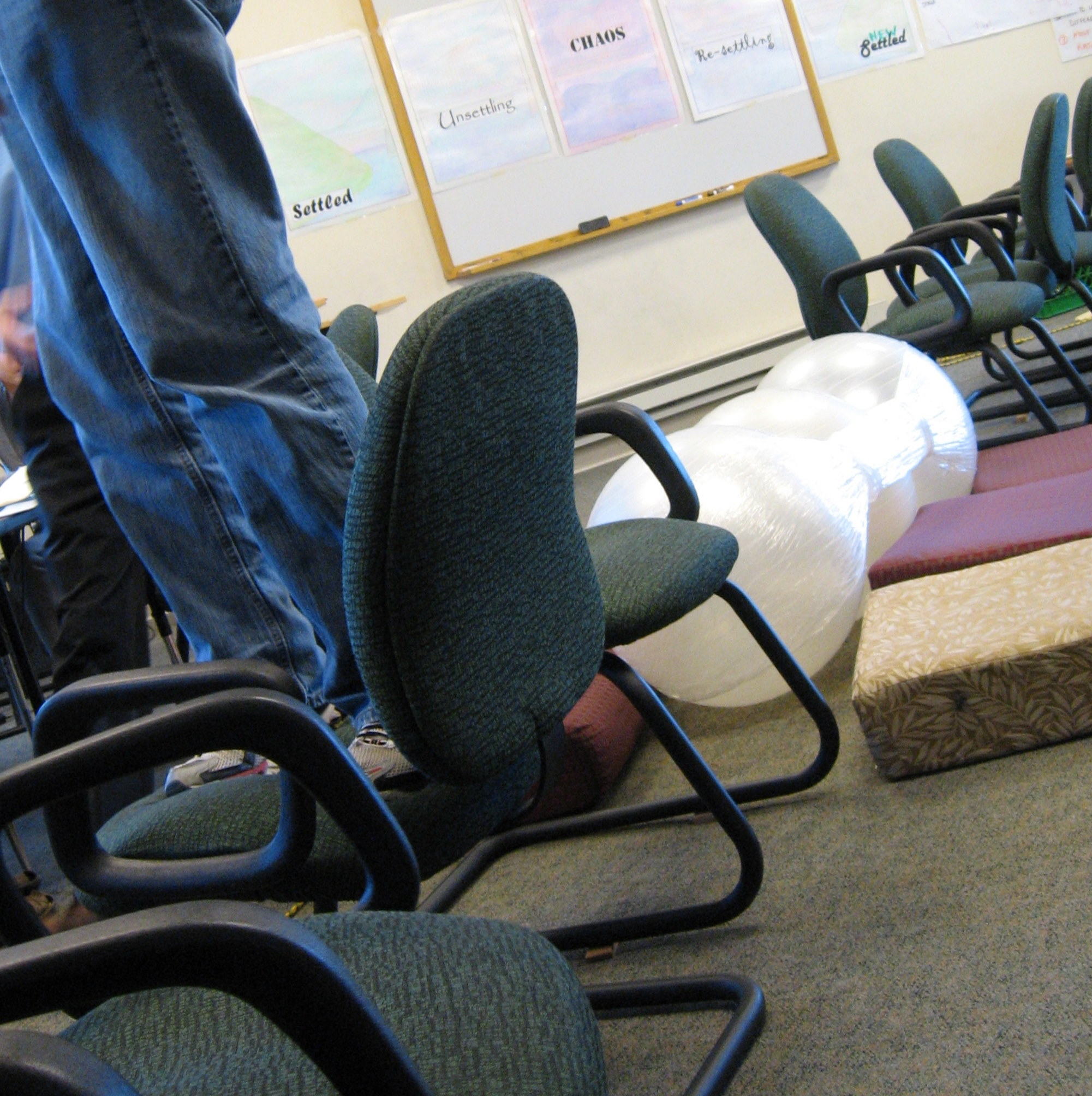
At MTI last fall we learned about the “Chaos Bridge,” which is an analogy for transition (or “transsizion,” as our South African SPLICE leader called it).  We start out settled and stable, move into unsettled with all its farewells, and then into the bouncy bubbly transition.  We start to come out of it while resettling, and then finally reach a new settled state.

When I was neck deep in missionary transition, you supported me with prayers and encouragement.  I couldn’t have made it through without your doula-ing, as all my birthie friends would say.

Transition.  The most terrible part.  The shortest part.  Now I know with certainty that it doesn’t last forever.  And I can assure the next person I see experiencing transition that it does indeed end.  It’s painful, but it won’t last long.  Not much longer now.  I promise.

~~~~~~~~~~~~~~~~~~~~~~~~~~~~~~~~~~~~~~~~~~~~~~~~~~~~~~~

Even though I walk through the valley of the shadow of death, I will fear no evil, for you are with me; your rod and your staff, they comfort me. Psalm 23:4

How Beautiful

– By Elizabeth

How beautiful the hands that served

The wine and the bread and the sons of the earth

How beautiful the feet that walked

The long dusty roads and the hill to the cross

———-

Tonight I sat outside our door and watched my sons scooter, race, and jump in our dead-end street.  I like sitting out there.  It feels peaceful.  I watch people come and go on motos and bicycles, and I watch them turn on the outdoor spicket and rinse their filthy feet before entering their houses.  And I wonder how dirty were the feet that Jesus washed the night before He died?  I see how grimy my sons’ feet get, but they wash their own feet, so I don’t have to.

———-

How beautiful the heart that bled

That took all my sin and bore it instead

How beautiful the tender eyes

That chose to forgive and never despise

———-

I watch the orphanage children play with each other and with my boys.  They smile, and their teeth are black with decay.   I watch a teen girl pry lice out of the orphanage manager’s hair for 30 minutes.  And I think, Jesus was not afraid of these people.  He did not despise them.  Should I?

———-

And as He laid down His life

We offer this sacrifice

That we should live just as he died

Willing to pay the price


How beautiful the radiant bride

Who waits for her groom with His light in her eyes

How beautiful when humble hearts give

The fruit of pure lives so that others may live


How beautiful the feet that bring

The sound of good news and the love of the King

How beautiful the hands that serve

The wine and the bread and the sons of the earth

———-

Yes, it’s true, I love Twila Paris.  She gets it right every time.