Finding Christ in Leviticus

by Elizabeth

hires_leviticus_14.jpg

This image. It captured my attention last weekend, and I couldn’t look away. I was supposed to be listening to Sherry Lile speak on Leviticus 14, but by the time she got to this part of the story, I heard no more words. I saw only this picture.

Leviticus 14 might seem like a strange place to begin a ladies conference entitled “My Heart, Christ’s Home.” The event theme sounds warm and cuddly, but the Levitical chapter is anything but. It begins with the proper way to diagnose and treat skin diseases (yuck) and ends with the instructions for identifying and treating houses with mold (also yuck).

First we talked about how sin is like leprosy — how it can start small and then spread to a much larger area of our lives. And if it’s like the traditionally understood form of leprosy (Hansen’s disease), it causes us not to feel pain.

The problem then, is that we can get hurt even worse. I know for myself, most of the time when I sin, it’s a feeble attempt to protect my heart from further pain. But I only harden it harder and sin ever greater and pull farther and farther away from the Great Physician — even if I can’t, temporarily, feel the pain.

In Leviticus the sufferer of the skin disease must go to the Priest for healing. He can’t do it on his own. He needs help. There’s a parallel here, of course.

Then we moved into the second half of the chapter, the part about the houses. Again the priest must be called in. He is given very specific instructions about removing the contents of the house and checking for spreading mold. Contaminated stones must be removed, too, and taken to a designated place outside town. Sometimes the entire house must be torn down.

Other times the house may be saved from destruction, but it must still be purified. This is where the picture comes in. The priest takes two birds, some cedar wood, scarlet yarn, and some hyssop. One of the birds he kills over fresh water in a clay pot (strange, I know).

He takes the cedar wood, the hyssop, the yarn, and the live bird, dips them in the blood/water mixture, and sprinkles the house seven times. Almost like he’s sweeping away the impurities with a broom.

And then — oh then — he releases the live bird in the fields outside the town, and the house is finally cleansed from its defilement. That’s when this picture popped up on the screen and when I couldn’t take my eyes off it. You know when that happens, right? When words are no longer the best language, when art communicates truth more clearly?

So I went home and told my husband all about it, but without the context of the entire lesson, it’s hard to explain to someone why you’re so excited about a picture of a bloody bird. You just sound like a crazy person.

But here’s the reason I love this picture: these two birds represent the work of Christ for us. Both the sacrificed bird AND the free bird find their fulfillment in Him — in the Cross and in the Resurrection. Because of Christ, we get to go free. Like the bird in the picture, we’re released from the grip of death and given the gift of life.

But that gift did not come without a sacrifice.

hires_leviticus_14

Originally shared on Facebook.

Image used with permission.

What George Orwell and C.S. Lewis can teach us about chaos, creation, and a world living in fear

by Elizabeth

21121793_10159142924775621_990278575_n

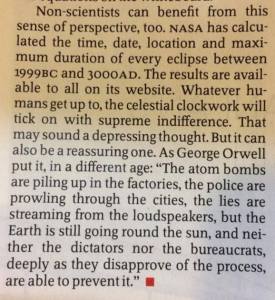
“The atomic bombs are piling up in the factories, the police are prowling through the cities, the lies are streaming from the loudspeakers, but the earth is still going round the sun, and neither the dictators nor the bureaucrats, deeply as they disapprove of the process, are able to prevent it.”

I burst into tears over this George Orwell quote in the bookstore the other day. Let me explain why.

If you know me at all, you know I was crushed over the lack of eclipse viewing on this side of the planet. Crushed. I first started reading about the eclipse in science magazines about a year and a half ago, when I realized with sadness that I would not be able to see it, even though totality was passing very close by my hometown.

As we edged ever closer to the eclipse date, and people became more and more excited, I became sadder and sadder. I would wake up every morning thinking about what I was missing and imagining in my mind’s eye what it would be like to experience that kind of natural reversal. I hear you receive spiritual and philosophical insights during a total eclipse that you rarely get in life apart from extreme grief and loss. I hear that you feel at one with humanity and at one with the solar system. Whether you believe in God or not.

But here’s the thing: I already feel at one with the solar system on a regular basis. Every time I look up at the moon, no matter where it is in its waxing or waning, I imagine where I am in relation to it and to the sun and to the rest of the planets, and I get this enormous sense of awe and wonder. I experience more awe and wonder when I catch a glimpse of a planet with the naked eye. I even get a thrill from ordinary everyday sunsets and ordinary everyday cloud-dotted skies. Understanding the science behind each of these sights does not in the least diminish their wonder for me.

So to miss out on an event that causes people who don’t normally care all that much about the sky to shudder with shock and awe, felt like a devastating loss. I collect those moments of wonder and awe in my life and, like Mary, ponder them in my heart. I store them in the long-term memory of my soul. I am a glory-chaser, and this month I felt I was missing out on something glorious that all my countrymen were going to witness (though I know the descriptor “all” is not entirely accurate here). I have really had to grieve this loss as one of many losses on both sides of the Pacific over the last 6 years.

Then today I found myself at the local bookstore with my kids, perusing the magazine rack. It’s a sort of Saturday morning tradition for us. Magazines are too expensive to buy here, so we just stand around reading articles about space and geography. I was reading an article about that infamous eclipse when I came across these words by George Orwell. They brought to mind parallel (and prescient) thoughts from C.S. Lewis, in his 1948 essay entitled “On Living in an Atomic Age”:

In one way we think a great deal too much of the atomic bomb. ‘How are we to live in an atomic age?’ I am tempted to reply: ‘Why, as you would have lived in the sixteenth century when the plague visited London almost every year, or as you would have lived in a Viking age when raiders from Scandinavia might land and cut your throat any night; or indeed, as you are already living in an age of cancer, an age of syphilis, an age of paralysis, an age of air raids, an age of railway accidents, an age of motor accidents.’

In other words, do not let us begin by exaggerating the novelty of our situation. Believe me, dear sir or madam, you and all whom you love were already sentenced to death before the atomic bomb was invented: and quite a high percentage of us were going to die in unpleasant ways. We had, indeed, one very great advantage over our ancestors – anaesthetics; but we have that still. It is perfectly ridiculous to go about whimpering and drawing long faces because the scientists have added one more chance of painful and premature death to a world which already bristled with such chances and in which death itself was not a chance at all, but a certainty.

This is the first point to be made: and the first action to be taken is to pull ourselves together. If we are all going to be destroyed by an atomic bomb, let that bomb when it comes find us doing sensible and human things – praying, working, teaching, reading, listening to music, bathing the children, playing tennis, chatting to our friends over a pint and a game of darts – not huddled together like frightened sheep and thinking about bombs. They may break our bodies (a microbe can do that) but they need not dominate our minds.

I had read Lewis’s words earlier this month and been sobered, my mind plumbed back into alignment. Orwell’s words were likewise so true that they brought tears to my eyes. Our world is in chaos. We all know this. Globally and locally, everyone you and I meet can see the chaos in both their own country and the countries of others. There’s so much fear, fear from all sides and of far too many things.

But. There is awe and wonder that can outweigh the fear. There is truth that can outweigh the lies. And there are things we can be sure of, the chief of which is that we do not control the heavens. We do not direct their footsteps. We can predict them, and we can describe them — though they lose none of their awe-inspiring power when we do — but we cannot direct them. That is a task only God can manage. We can merely watch — or not.

So let us rest in God, in His creative power and in His unfathomable goodness. Let us take comfort in His nearness and in His grandeur, in His wisdom and in His foolishness. Let us walk with Him, through our tears and through our joys, through our fears and through our distracted and distractible daily lives. And let us remember that, regardless of how we live and regardless of how we die, God is God and we are not, and neither is any world leader who appears to be wresting power from Him — for no one can rob Him of His glory.

~~~~~~~~~~~~~~~~~~

I originally published this on Facebook. On one of the FB shares a friend of a friend (someone I don’t know) commented: “When asked what he would like to be found doing by Jesus on Jesus’s return, Luther said, ‘Planting a tree.’ I think the reason is the same as your quote.” That story was just too good not to pass on to you here.

A Missionary’s Call to the Psalms and a Deeper Emotional Intelligence

by Jonathan

I personally think we missionaries are a smart bunch. Our textbook education is typically high. We’ve been to college, perhaps seminary, and we know some stuff. We’ve figured out how to use our cognition for the King, our intellect for the Incarnated. But while western education is first and foremost intellectual (and that’s not necessarily a bad thing), life is lived and people are loved on the street level, not the lecture hall.

The classic quip about people caring how much you know only after they know how much you care is classic for a reason: it’s true. When we approach a hurting, lost world with brains first, we risk showing a skewed image of Christ. We need our hearts too.

hannah-morgan-37675

Sometimes I Wonder Where We Put Our Hearts
Hearts can seem to get in the way of missiology, and emotions are inefficient. Emotionally detached workaholics may be great at “getting the job done.” They might not make wonderful spouses or parents, but disconnected, task-oriented, stoic workers can be low-maintenance, efficient missionaries.

Conversely, we must remember that emotions are Christ-like. A missions force with low emotional intelligence is bad for missions, not to mention families, teams, and planted churches. When the DNA of new believers and new churches excludes the sometimes messy reality of the heart, it’s not healthy DNA. Furthermore, a disconnected, task-oriented, stoic missions force isn’t much like Jesus.

Have you ever met a man or woman who seems bottled up emotionally, but the minute they start talking about the lost or missions, they start crying? I’ve met many folks like this, and I’m always baffled. When it comes to their families or other interpersonal relationships, they seem distant and cold, but the minute you mention unreached peoples, cue the waterworks. Something is not right about this picture.

It’s awesome they care about the lost, but how is it that all of their emotional capital got put there? Religion should not be the only place in their life where they really feel emotion.

Building Emotional Intelligence
So, how do we add some heart back in? How do we build emotional intelligence in ourselves and our teams? I believe both the Psalms and the life of Jesus can help us find our hearts. John Calvin in describing the Psalms said this: “What various and resplendent riches are contained in this treasury, it were difficult to describe…for there is not an emotion of which any one can be conscious that is not here represented as in a mirror.”

To grow in emotional intelligence and awareness, we must practice. Read a Psalm and the Gospels and try to identify as many emotions as you can. Both involve people, and people feel. Ask yourself, “How do the hands of Jesus reveal the heart of the Father?” If Paul helps us to know the mind of Christ (a good thing), the Psalms show us Christ’s heart. It is the Psalms that Jesus turned to and quoted more often than any other book in the Hebrew Scriptures.

But even more telling, the context in which Jesus referenced the Psalms was almost always when he was in a difficult situation.  Jesus was hated without cause, which the Psalms foretold (Ps. 35:1969:4John 15:25). He quoted Psalm 22 while dying on the cross (Ps. 22:1Matt. 27:46Mark 15:34) and when talking about his betrayal (Ps. 41:9John 13:18). These are just a few of many examples. In stressful situations, when he was under duress or attack, Jesus referred to the Psalms. Maybe that’s when we need to remember the Psalms too.

In our own lives, and in the lives of the people we live among, “bad stuff” is common. Corruption, danger, and loss are the daily realities. And so we need the Psalms. As we watch global instability and fear spread, we need workers with hearts that understand grief and loss. We need workers who know Christ as Healer. We need workers who bring their full hearts to the mission field. Not just their work ethic or their seminarian-intellect, but also their vulnerable, wounded, and healing hearts.

If we connected heart and mind, we’d get kinder, gentler, more sensitive cross-cultural workers. And kinder, gentler, more sensitive disciples.

Making Room for Warrior Poets
The foreign field appeals to warriors, and we amplify this fighting spirit with our dramatic quotes and motivational epigrams. But the unreached peoples of the world also need poets and artists, those who see and speak in different tones, with different cadence and quality.

Too often we think of the “soft” qualities as counterproductive in church-planting work, especially among the least-reached. We recruit hard people for hard fields, and we can’t even imagine the artist or highly emotive worker surviving, let alone thriving. We need warriors, go-getters.

But this approach is wrong, and for the sake of the gospel, we must change it. Tenderness, creativity, gentleness, and whimsy are not soft, esoteric qualities. These are qualities flowing straight from the heart of Christ.

Yes, we should study the mind of Christ, but there is so much more. Christ’s death was not by guillotine, disconnecting head and body. His head was bloodied, his heart was pierced, and all of him was raised.

Let’s make sure that all of him is preached. Let’s make sure that all of him is shown:

  • Jesus the advocate and disrupter, the wild one who defied Rome from underneath.
  • The brilliant intellect who befuddled the learned men.

Let’s make sure we preach his heart too:

  • A heart that felt the sting of death and the tip of the spear.
  • A heart that felt abandonment and despair and cared about a widow’s son.
  • A heart that laughed and wept and wrote in the dirt.

Let’s remember a Christ who loved the Psalms, and let’s imitate him. Let’s connect with the heart of God, and let’s show the world a richer, fuller, more complete image of Christ.

~~~~~~~~~~~~~~~~~~~~~~~~~~~~~~~~~~

Suggested Resources
Emotionally Healthy Spirituality
The Gaping Hole in the Modern Missions Movement
The simple tool I use with 90% of my pastoral counseling clients


Originally published at www.imb.org. Used with permission.

Photo by Hannah Morgan on Unsplash.

That Time Paul Talked About Breastfeeding {Velvet Ashes}

by Elizabeth

1-Thes-2-7-1170x780

My husband and I worked in local church ministry for over ten years before moving abroad to serve for the last five and a half. There’s something I want you to know about this life: you’re going to need a lot of fortitude for the journey. Working with people, in any time and any place, is hard. It doesn’t matter if it’s in your home country or a host country. Working with people is heart-wrenching and soul-filling, and you need endurance.

This is something else I want you to know: in the years ahead, never hesitate to serve out of your feminine strength. A lot of teaching models are filled with masculine metaphors. There’s battle this, and army that. There’s fighting here and soldiering on there. The Bible itself is filled with battle-speak. We are to put on the full armor of God so that we can take our stand against the devil’s schemes. But the same Paul who told us in Ephesians 6 that our battle is not against flesh and blood and that we were to arm ourselves and stay alert and be persistent and stand firm, that very same Paul was not ashamed in his first letter to the Thessalonians to compare himself to a woman.

In I Thessalonians 2:7, Paul, Silas and Timothy jointly describe their conduct among the believers there: “We were gentle among you, like a nursing mother taking care of her own children” (ESV). I was in a training session this summer when I first truly took hold of this verse. We had studied the great faith and love of the Thessalonian church in chapter 1, and now we were in chapter 2 studying the attributes of the men who’d told them the Good News. When we got to the verse about these three men acting like a mother, some of the men seemed to want to brush it off and focus instead on verse 11, where the letter writers compare themselves to good fathers.

But I couldn’t brush Paul’s words off. I remembered how physically demanding it was to be a nursing mother. I had to speak out: “We have this idea of a mother with her nursing baby that’s all sweetness and light. But it’s not. It’s really hard work. You have to feed yourself well, so you can feed your baby. You have to get up at all hours of the night to care for a crying child, and you have to try not to be cranky about all that lost sleep.”

As I spoke, women all around me nodded their heads in agreement, and several told me afterward how glad they were that I had said that. They had lived it, too, and they knew the challenges of mothering. You need a lot of stamina. You don’t sleep through the night for months on end. Sometimes you get painful mastitis or yeast infections. You have to keep up your water and calorie intake. To your embarrassment, you leak milk everywhere. Or you have to work hard to make enough milk. Sometimes you can’t figure out for the life of you how to make this child stop crying, but somehow you have to stay calm while you do it. On top of that, you’re basically tethered to your child because you don’t know when they’ll need to eat again. You sacrifice many things for this child, this child whom you love so tenderly and so fiercely.

Somehow this was something the apostle Paul understood. When we serve people, we have to make sure we’re getting our spiritual nourishment first, before we can pass anything of value on to them. Living and working among the continual, desperate needs of other people can physically and emotionally deplete us. And sometimes other people’s needs interrupt our planned and preferred schedules. Paul knew all this. He lived all this. At the same time, Paul felt incredible affection for the Thessalonians. Paul, Silas, and Timothy loved them so much that they shared not only the good news with them, but their own lives as well (verse 8). And they’d spent plenty of time praising them in the chapter before.

Over the past few months I have been unable to let verse 7 go. I’ve learned that in the Greek, the noun was unmistakably feminine. It was trophos: a care-giver, a person sustaining someone else by nourishing and offering the tender care of a nurse. I’ve learned that it had the connotation of mother’s care, of holding a child close, wrapped in her arms. There is familiarity here. Affection. Tenderness. The verb was thalpo: to cherish, nourish, foster, comfort, nurture, or keep warm. There is action here, decision, deliberate investment. And the phrase “her own children” (heautou teknon) indicates belonging. An inclusion. A turning towards.

All of these feminine-sounding words can illuminate our own roles, wherever God has placed us. They are not weakness. They are not unnecessary or irrelevant or dispensable. They are strength and they are resiliency and they are essential. Whether or not you’ve ever been a nursing mother, you have a yearning for relationship that can solidify your ministry, not undermine it. Whether or not you’ve ever been a nursing mother, you have an instinct to care for people sacrificially. Whether or not you’ve ever been a nursing mother, you have the capacity to lead with endurance.

Paul wasn’t ashamed of these qualities, and neither should we be. It is good and healthy to identify as a woman and serve out of our God-given identity. Of course, men can be nurturers too – just see verse 11. And women can be warriors – just see Deborah. But when I read these verses, I feel so much validation. Validation of my work and validation of my worth. All those years living and ministering as a woman, they weren’t wasted. And as someone who has had a fraught relationship with the Apostle Paul over the years, these verses are yet one more reason I can love both him and his letters, for he wasn’t afraid to lean into the feminine for the sake of the people he was serving. It is something we needn’t be afraid of either.

Originally published here; reprinted with permission.

You Don’t Have to Home School Preschool

Over the years many moms have asked me how to get started in homeschooling.  This post is basically a (prettier) copy of the saved email I send out to people asking about homeschooling preschool. ~Elizabeth

crayon-2009816_960_720

The first thing I always tell parents is that you don’t have to homeschool preschool. I’m not the only one who thinks this. In fact, I don’t know any homeschool moms of more than one child who do homeschool preschool. After you “do preschool” with a four-year-old child and then the next year “do kindergarten” with that same child and realize that kindergarten was just a repeat of preschool, most moms decide to ditch official preschool lessons altogether. That goes especially if you have other children in the home, either older children who actually need lessons, or babies and younger children who need a lot of hands-on care.

Here is what you actually need for the preschool years: a home full of life and love. And books. Lots and lots of books. Kids learn so naturally at this stage, and they’re interested in so many things, that there’s no need to do anything formal. Today I will share my favorite resources for educational theory and practice. I’ll share my favorite books to read aloud with young children. I’ll also include a list of sturdy educational toys that are a good foundation for a home schooling family to own, along with the very first curriculum you might want to buy.


EDUCATIONAL THEORY AND GUIDES

Cathy Duffy’s 102 Top Picks for Homeschool Curriculum. This book guides you through teaching and learning styles. It’s like a self-paced workshop to get you started on your journey.

Teaching from Rest by Sarah MacKenzie. This book is small but worth several re-reads. I also highly recommend her  Read-Aloud Revival Podcast which is one of my favorite home school podcasts.

Here are 7 educational principles from my education mentor in the States.

As your children, I have many more recommended books and podcasts. But these are the ones to start with.


TOYS AND GAMES TO INVEST IN

A soft globe that can’t be pierced by toddler teeth. Only has the most basic details but helpful in the early years. We actually still use ours.

Peg boards. Kids can’t get enough of these things, and even as an adult I love playing with peg boards.

Wedgits starter kit. Wedgits never get old.

Pattern Blocks. Kids love these.

Wooden Blocks. Lots of open-ended play opportunities here.

Catch the Match game.

Cuisenaire Rods. I’m big on manipulatives, can you tell?!

My kids still play with all these toys (except for the peg board, which we did recently retire). They are great for imaginative, open-ended play, either alone or while being read to.

It’s also important to have lots of paper, crayons, colored pencils, and paints lying around, along with glue, tape, and scissors.


BOOKS TO READ ALOUD

In the beginning you just want to play with your kids and read aloud to them. If you have access to a library — great! If you live overseas without good library access, you may have to purchase some of these titles and transport them back in a suitcase. Get used to it — you’ll be doing that a lot once you start homeschooling the elementary years.

Beatrix Potter’s stories — all of them. A wonderful way to introduce your children to advanced language while they enjoy the lush illustrations. As an adult I adore Potter’s stories. It’s better to get them as individual books, but if you can’t, a treasury will work (I usually don’t recommend treasuries because of their bulk).

Mike Mulligan and More by Virginia Burton — we all love these stories, and though it’s a treasury, it’s not bulky.

Make Way for McCloskey. Another non-bulky treasury with the funny stories and beautiful pictures of Robert McCloskey.

Reading Mother Goose rhymes to your young kids is also great for them — it introduces them to poetry, is enjoyable, and gives them some cultural literacy. This is the one we have, but there are other good ones out there.

Reading your kids Fairy Tales is also part of their cultural upbringing. A First Book of Fairy Tales and Hans Christian Andersen’s Fairy Tales are good to begin with.

Anything by Arnold Lobel, especially the Frog and Toad books, Owl at Home, and Mouse Tales. These transition nicely from read alouds to early readers.

I’m not a huge Dr. Seuss fan, but we really like Horton Hatches the EggHorton Hears a Who, and Sneetches on Beaches.

A read aloud book from Usborne that’s a lot of fun is Farmyard Tales. It’s a treasury that’s not too bulky, and the stories are fun for reading aloud and then later reading alone.

Roxaboxen by Alice McLerran. A beautiful story about imagination and community.

Corduroy and Dandelion, both by Don Freeman and both about home and belonging.

The Story of Ferdinand by Munro Leaf. A deceptively small story about nature, introversion, and kind mothers.

The Little Brute Family by Russell Hoban. More grown-up wisdom for the little kids (or is it little kid wisdom for the grown ups?).

Really little kids love Eric Carle books. We don’t have very many of them anymore, but they’re pretty much all good.

For preschool Bible times, I love The New Bible in Pictures for Little Eyes by Kenneth Taylor. Much more comprehensive than most children’s Bibles while including a picture for each story.

When your kids are a little bit older, they will enjoy these non-picture books:

Grandma’s Attic series by Arleta Richardson– fun stories that aren’t too moralizing. Better than Laura Ingalls Wilder and better than Caddie Woodlawn.

My Father’s Dragon by Ruth Stiles Gannett. Fun and easy. There are two more by that author: The Dragons of Blueland and Elmer and the Dragon.

Charlotte’s Web by E.B. White. A classic.

Also popular are Stuart Little by E.B. White and The Cricket in Times Square by George Selden.

Mr. Popper’s Penguins by Richard Atwater is lots of fun.

The Mouse and the Motorcycle by Beverly Cleary is also lots of fun. There are two others in the series: Runaway Ralph and Ralph S. Mouse.

Kids love Gertrude Chandler Warner’s Box Car books. They make great read alouds and then middle grade readers.

Another popular one with older readers is My Side of the Mountain by Jean Craighead George.

Of course we can’t neglect C.S. Lewis’s Chronicles of Narnia. You want them as separate books.

All these stories are just as enjoyable by parents and kids, which is what you want in a home library. To buy these books all at once would be a lot of money; but I didn’t buy them all at once. I bought them slowly over time. The idea here is to give your children a taste for good literature so that they aren’t satisfied with lesser quality stuff.

But you do want to make sure the books you buy are books your family will love — all families are different. If you have access to a public library, you’ll be able to more easily and more cheaply get a feel for which books fit your family. You can get a ton of great book ideas from Gladys Hunt’s Honey for a Child’s Heart (or access the FREE book list at Read Aloud Revival).

When you invest money in good books and games and toys, you’ll want a special place for them, and you’ll want to teach your kids how to take good care of these items so they don’t get lost (or in the case of books, damaged). I like to keep books off the floor, mostly because of the constant risk of flooding in Cambodia.

That’s about it. In the beginning all you need are some of those building block sets, Play-doh (homemade or store-bought; good for open-ended play), the basic art supplies I mentioned earlier, and some good books to read. Take them to the park (if you have public parks — we don’t) and let them play outside. Give them basic chores to do like setting the table and putting their laundry in the bin and picking up their toys. It really doesn’t have to be complicated in the early years. They’re just learning what it means to live in a family.


BEGINNING CURRICULUM (FOR LATER)

As they begin reading and writing around age 5, you’ll want a good math program, a good reading program, and a good writing program. Focus on that for a year or two, then slowly add more “curriculum.” When your kids get older, Usborne and DK Eyewitness do have a lot of good science and history spines (spines are resource books that aren’t too “textbook-y”).

I use Singapore Math in the early years, but Math U See is getting consistently good reviews for being kid- and parent-friendly.

For teaching reading, I like The Reading Lesson because it’s got big print, and you can write and color in it. I’ve also heard very good things about All About Reading.

I also like the Bob Books Set 1 & Set 2 and the Sonlight Kindergarten and Grade 1 readers. Young children get a lot of satisfaction from reading an entire book, and each individual book is not too much work at once — you do not want to overtax the child’s mind.

Pretty much everybody I know uses Handwriting without Tears for handwriting. I think you can also buy the books on Amazon.

A good regular atlas and a good Bible atlas are important resources to have. The Student Bible Atlas is excellent. Nearly any atlas by National Geographic is a good one. I’ve got the World Atlas for Young Explorers. But there’s probably a newer, more updated one now.


Well, that’s the end of my “You don’t have to homeschool preschool” lecture. I hope this has been helpful to you. Feel free to contact me privately if you want more information or to talk about this more in depth.