“Fernweh” and “Heimweh” — words for the one who’s far from home {A Life Overseas}

Elizabeth is over at A Life Overseas today . . .

agriculture-1807581_960_720a

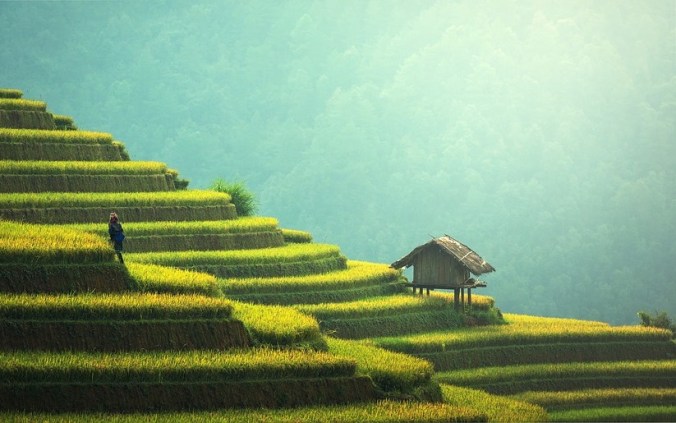
I found a new word on the Facebook profile of a missionary writer, and it’s the best new word I’ve heard in a long time. It’s called fernweh, and it’s a German word that means “a longing for faraway places.”

The feeler of fernweh carries a desire — whether met or unmet — to travel to distant countries, to visit new places, and to have new experiences. Its nearest English equivalent might be the idea of “wanderlust.” When transliterated, fernweh means “farsickness,” in much the same way that heimweh means “homesickness.”

Fernweh and heimweh: these sister words draw me in. Ever since I found them, I cannot get them out of my head, for I live in a faraway place.

At least, it’s far away from the Europe and North America in which I grew up. It was far away, but now it’s near. I find now that the faraway place has become home, and home has become the faraway place.

Finish reading this post at A Life Overseas.

A world in need of water

by Elizabeth

water1.jpg

I once listened to an interview with Linda Sue Park, author of the children’s book Long Walk to Water. I remember being completely struck by her comment that if you don’t have water, you don’t have anything. Water is everything. Even more than food, water is LIFE.

But access to water is something I have always taken for granted. I’ve been insulated from these things. I’ve never worried about where my bathing water or washing water, let alone my drinking water, was going to come from.

Beyond that – I’ve never worried about whether my water is clean. I’ve always had access to clean, safe drinking water, even in Cambodia. And I swim in large, artificial pools of water FOR FUN.  Talk about privilege.

Some time later, I read in Pacific Standard magazine about Colin Kelley’s research on water distribution. How a lack of water is one the factors that can lead to instability in a region. And how experts thought nothing could happen in Syria, it was stable. Nothing — that is — until a drought descended, and the whole region destabilized. Practically overnight.

Kelley’s research shows that the Syrian drought was made 2 to 3 times more likely by “human influences.” Human influences like grazing policies that favored larger farmers, and the ensuing desperate attempt by smaller farmers to access water any which way they could: by digging wells. So ground water became depleted. Wheat crops began to fail. Families started to migrate. And the whole system started to disintegrate.

But this is not the first time human behavior has affected the environment in negative ways. Susan Wise Bauer, in a recent Psychology Today article, says that when ancient Sumerians needed more water to grow their own wheat crops, they simply irrigated their fields with the nearly fresh (but slightly brackish) water of the Tigris and Euphrates rivers. When it became clear that the fields were suffering, they refused to fallow the fields to allow for recovery.

While it led to prosperity in the short run, over time it led to political and economic instability and, eventually, permanent desertification of the area. So no, the modern world is not alone in its abuse of this good earth. And truly, the reach of the curse is far.

But problems like the ones faced in the Middle East can happen anywhere, because lack of access to basic resources like food and water affects political regimes. And people like Colin Kelley work hard to predict the next great shifting of people, power, and resources.

One of those places is the American Pacific region – all the way from Mexico, whose drought in the 1990’s and early 2000’s led many to migrate north, up through California, and into Oregon and Washington.

Agricultural workers already had to cycle through various crop locations each year. But then drought came to California, and workers were fainting in the fields from exhaustion and dehydration. Then they couldn’t make quota. Then fields started to close. And families had to move.

These agricultural workers lead economically precarious lives. Surely drought affects poorer workers much more severely than it affects the middle and upper classes, whose lives are far more cushioned against climate troubles.

And that is the point in the article where I paused. I paused to mourn for the families in California — and the Middle East — who are intimately acquainted with the current drought. I paused to mourn for people who are displaced because of these current droughts. I paused to mourn over the human contribution to these current droughts.

I paused to contemplate how silly my ministry pursuits, or my educational concerns for my children, or my desire for leisure time, might be in the light of people who have no water to drink and no food to eat.

And I paused to long for the day when this current worldly mess will all.be.over.

Then I had to press pause on my pause and put the magazine up, because my children still needed feeding and bathing and tucking in.

But I won’t stop longing for the Day.

——–

Sources:

Sarah Mackenzie’s interview with Linda Sue Park, author of Long Walk to Water, at Read Aloud Revival podcast.

“Droughtlandia” — an article by Jeremy Miller in Pacific Standard magazine.

Research Spotlight on Colin Kelley, also in Pacific Standard magazine.

“Destroying the Planet. We’ve Been Doing It for a Long Time.” — an article by Susan Wise Bauer in Psychology Today magazine.
Grief & Loss

Click here to listen to the audio: Grief & Loss

Recorded at the International Christian Assembly, Phnom Penh, Cambodia, April 2015.

Click here for sermon notes.

matthew-henry-130381-unsplash

When God Won’t Give Me What I Want {A Life Overseas}

by Jonathan

Is he really a “good, good Father”? We sing it often enough, and truth be told, I really like singing and talking about the good character that our Abba Father indeed has.

But sometimes it sounds like we’re desperately trying to convince ourselves. Because sometimes we doubt. And no wonder.

Because sometimes we ask for things that we don’t get it. We ask for more support and we’re still blank. We ask for healing for ourselves or someone we love, and they stay sick. Or they die.

We brush up against storms and trauma and we see horrific things and we question him. Where are you? Why this? Why him or her?

Keep reading over at A Life Overseas

photo-1474739331020-a715a6719403a

When You Stop Loving the Church

by Elizabeth

woman-1246581_960_720

I’ve had a life-long love affair with the church of Jesus Christ. Many of you know that. I’ve talked about it often enough.

But. I almost lost my faith in Christ’s blessed church recently. I was disappointed with His people. Disillusioned even. I felt betrayed by the depravity of mankind.

And then.

I sang the Doxology with my teammates. The words of life set in rich, deep harmonies. Ancient truth, ever new.

Praise God from whom all blessings flow
Praise Him all creatures here below
Praise Him above ye heavenly host
Praise Father Son and Holy Ghost

And then.

I sang Hillsong’s “Glory” with my local church. Words I’d never before heard. Words my spirit desperately needed to hear and to proclaim.

Glory to the risen king, glory to the Son, glorious Son
Lift up your heads, open the doors
Let the king of glory come in
And forever be our God

And then.

I remembered the words of Psalm 29, words that my husband had read aloud earlier that day.

The voice of the Lord twists mighty oaks and strips the forests bare.
In His Temple everyone shouts “Glory!”

And then.

It all came rushing back to me. All along, it’s been CHRIST. Christ is the reason I believed in His church in the first place. Because of Him, and not because of His people.

We are His because of Him, and because of Him, He is our God. Never because of us. For as we used to sing in youth group,

My only hope is You, Jesus
My only hope is You
From early in the morning till late at night
My only hope is You

Human beings were never worthy of my hope. My only hope is in God, and when we’re in God’s Temple, we all cry Glory! Even the believers who disillusion me.

And then.

I remembered more. Standing there with my hands lifted as high to the sky as I could reach, I remembered standing in that same position last year, shouting out Hillsong’s “The Creed” with a shattered heart.

I believe in God our Father
I believe in Christ the Son
I believe in the Holy Spirit
Our God is three in one
I believe in the resurrection
That we will rise again
For I believe in the name of Jesus

And then.

I realized that my strongest experiences of worship don’t usually happen when life is going well. No, it’s when life is going poorly and I’m in the middle of a storm and I still stand and sing GLORY that I most intensely experience God’s nearness and God’s greatness.

And this praise, this powerful act of defiance against evil and against discouragement and against hatred, it’s something no one and nothing can take away from us. It’s our right and our privilege as God’s children, and it can’t be stolen from us.

God alone is worthy of our hope and worthy of our praise. We proclaim it now, and one day in the Temple, we will all join together, saints and angels alike, to shout GLORY. Forever. And ever.

Amen.

This article was reprinted at both Relevant and Faithit.

You can read all the posts in my Church series here.