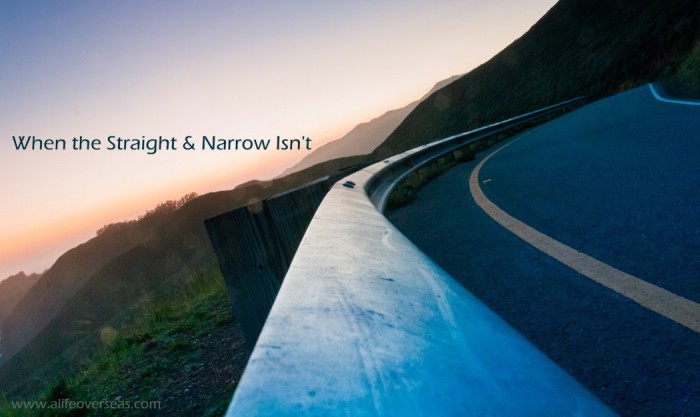
When the Straight & Narrow Isn’t {A Life Overseas}

by Jonathan

My parents had their life all mapped out, and then their baby was born with chromosomal abnormalities and died at home, surrounded by tubes and oxygen tanks, only a month old.

As a teenager, I had my life pretty well planned out (get my pilot’s license, be Nate Saint). But then my mom got cancer and died. And the path of God darkened.

The “plan of God for my life,” the path I was following with full confidence and youthful arrogance, disappeared. Because sometimes the straight and narrow isn’t.

God doesn’t always lead in straight lines.

He is the God of fractals, making beauty and order out of lines that look like a drunk man was drawing during an earthquake. Left-handed.

Continue reading at A Life Overseas.

nE6neNVdRPSIasnmePZe_IMG_1950b

The Fool of God

by Elizabeth

In John 7:37-38 we read that “On the last day, the climax of the festival, Jesus stood and shouted to the crowds, ‘Anyone who is thirsty may come to Me! Anyone who believes in Me may come and drink!'” These statements are followed by an uproar in the crowds.

When I read these verses earlier this week, I realized afresh that people must have thought Jesus was crazy. I certainly would have. Yet He was not deterred: early the next morning, we see Him back at the Temple, teaching the crowds.

It wasn’t enough for Jesus to go to the synagogue as He did in Luke 4, to read the scroll of the prophet Isaiah, and to declare the fulfillment of that Scripture that very day. No, he had to keep.doing.crazy.things.

I am sure if I had been a regular religious person in that time, I would have thought he was nuts, not that He was a prophet — or even less likely, the Messiah. He was always speaking in riddles and parables, and I’m sure even if I HAD been His disciple, I wouldn’t have understood even half of what He was saying. I might have been hopelessly lost, even with the Savior of the world standing right in front of me.

As I thought about this, I remembered Michael Card’s song “God’s Own Fool.” His songs are sometimes deceptively short, but the lyrics are incredibly rich in meaning:

Seems I’ve imagined Him all of my life
As the wisest of all of mankind
But if God’s Holy wisdom is foolish to man
He must have seemed out of His mind
Even His family said He was mad
And the priest said a demon’s to blame
But, God in the form of this angry young man
Could not have seemed perfectly sane

We in our foolishness thought we were wise
He played the fool and He opened our eyes
We in our weakness believed we were strong
He became helpless to show we were wrong

So we follow God’s own Fool
For only the foolish can tell
Believe the unbelievable, come be a fool as well

So come lose your life for a carpenter’s son
For a madman who died for a dream
And You’ll have the faith His first followers had
And you’ll feel the weight of the beam
So surrender the hunger to say you must know
Find the courage to say I believe
For the power of paradox opens your eyes
And blinds those who say they can see

So we follow God’s own Fool
For only the foolish can tell
Believe the unbelievable, come be a fool as well

The Tree That Tells Our Story {A Life Overseas}

Elizabeth is over at A Life Overseas today. . .

CTF

My parents came to Cambodia to celebrate the American version of Thanksgiving with us, and they stayed for the traditional setting up of the Christmas tree. After we finished stringing the lights and hanging the ornaments, and the youngest child had placed the heirloom angel from my husband’s childhood on top, we all sat down to admire the tree.

Then all of us, from the sixty-year old Grandpa, right on down to the four-year old baby of the family, shared what we love about Christmas. When we got to my mom, she said, “I love putting the ornaments on the tree because they tell the story of our family.”

It’s true. As a military wife, she can remember both the year she added each ornament, and the place we lived at that time. The ornaments on her tree tell the story of my family of origin, from a newly wedded couple in El Paso, Texas, to brand new parents in Fort Knox, Kentucky, to a growing family in West Germany, and later a university campus in South Dakota and the Kansas Army post at Fort Riley.

You can read the rest of the post here.

Birth & Art {A Metaphor}

by Elizabeth

Writing is a birth, of sorts.

When I was pregnant with my first child, I decided I wanted to give birth without medication. I was in love with the idea and informed my husband. He was enamored of the idea as well, and he bought books on the Bradley method of natural childbirth for us both to read. It was in those books that we learned about the emotional signposts of labor.

First, there’s excitement: Today’s the day! I’m having this baby today!

Then, there’s seriousness: Let’s get down to the business of birthing this baby. This is hard. I’m uncomfortable. I need to concentrate. And by the way, DON’T touch me.

Finally, there’s self-doubt: I’m done! I can’t do this anymore! This emotional signpost corresponds to transition. Transition is a nice-sounding word for the most difficult part of labor and signifies that birth is coming soon.

Even though I’d studied these signposts, the books still made birth seem easy, and I was confident I could give birth naturally. I was looking forward to it, in fact. The night my water broke, however, the contractions came hard and fast. I doubted whether I could handle the rest of labor. I did indeed survive my first labor, and I gave birth to a precious baby boy that night. But his birth wasn’t without pain.

Eleven months later, I became pregnant again. This time around, I wasn’t so confident. I’d been blissfully unaware of it during my first pregnancy, but during my second, I knew labor was going to hurt. I knew how bad the labor pains could get, and I wasn’t looking forward to the actual birth process. And I was right — it did hurt. Bad. I knew that I could give birth naturally, but I dreaded the pain.

~~~~~~~~~~~~~~~~~~~~~~~~~~~~~~~~~~~~~~~

Writing is a birth of sorts, complete with all the emotional signposts.

First, there’s excitement: I have an (invariably brilliant) idea!

Then, I pitch the idea to someone, most often, my husband. It’s (usually) met with approval.

I’m still excited. Until I start typing, that is, and the words on the screen begin to look like nonsense. They don’t communicate what I want to communicate AT ALL.

That’s when I decide that my “brilliant idea” is total, complete, and utter trash.

I determine that either

          a) the idea itself is bad or

          b) I have no wordsmithing abilities whatsoever and

          c) I should just quit now.

asw

It’s at this self-doubt signpost that I’ve learned I need to close the laptop and put it away until tomorrow — a luxury not afforded one in active labor. Then I keep returning to it, day after day. This is the serious working phase, and requires concentration. I rearrange words, and rearrange them again, deleting whole sentences and even paragraphs, until I can read them out loud with relative satisfaction. Then, I birth it. I hit Publish and launch it out into the world. My hard work is done.

I used to forget this phenomenon between writing projects. I would forget how annoyingly hard the process is. They say Labor Amnesia is the reason people have second and third and fourth and even fifth babies. The pain of labor dissipates — we forget, and are willing to try again. Well, I had Writer’s Amnesia. Each time I attempted something new, I was surprised and frustrated by the difficulty of the task.

I worked hard each time, yet when I was finished, I still had new ideas I thought I could tackle with ease. (How very naïve.) But this same plotline has unfolded so many times now that I’ve come to accept it as part of the writing process. And I keep coming back to the craft because something inside me tells me there is more to be said, more to be written, more to be done.

Writing — and all art — is messy. It’s hard work, and it sometimes hurts. You might not know this ahead of time. The pain and heartache might take you by surprise, might sideswipe you. That is, until you’ve given birth to enough pieces that you can look back and see the pattern in your labors. Now, you know it will hurt. Now, you know the process is long and drawn-out. Now, you know you might regret your “brilliant” idea, and be tempted to give up. But by now, you’ll also know that you can’t give up, even when faced with the self-doubt signpost. Because something inside you propels you forward.

For the artist, for the creative person, conception of an idea is exciting. The gestation, however, is decidedly not. Your idea often grows much heavier than you expected it would. You reach the same emotional signposts each time you labor over an idea. But the beauty of it? Another day, you can birth another idea. And on a day after that, you can birth another idea. The emotions stay the same, but the ideas change. They are new. They are fresh.

They are invitations to create.

A Christmas Prayer {A Life Overseas}

Jonathan recently posted on A Life Overseas. Read the whole post here.

————————————–

“Where is the newborn king of the Jews? We saw his star as it rose,

and we have come to worship him.”

The Star of Bethlehem had a point, an important point. But the star was not the point.

The star fulfilled its role of leading across cultures and religious paradigms, down dusty roads and around a paranoid prince, to the Child. He was the Point, this Son, and he shone brighter. He, the Child-King, deserved adoration from all peoples, in all languages, for all of time.

And the Church, like the star, has a point. But the Church is not the point. Jesus is.

The star inspired a journey, away from comfort and the great “known.” So may the Church.

The star led through danger and politically dicey situations. So has the Church, historically, and so does the Church, presently.

The star challenged prejudice, inviting outsiders in. So may the Church.

The star incited worship, but not of itself. So may the Church.

As we celebrate the incarnation of Hope, 

the birth of the Lamb who was slain before the foundations of the world, 

let us pray for the Church, his glorious Bride, who waits expectantly for his return

and the restoration of all things.

Read the rest of the post here.

20110521212843-d8857bb5a