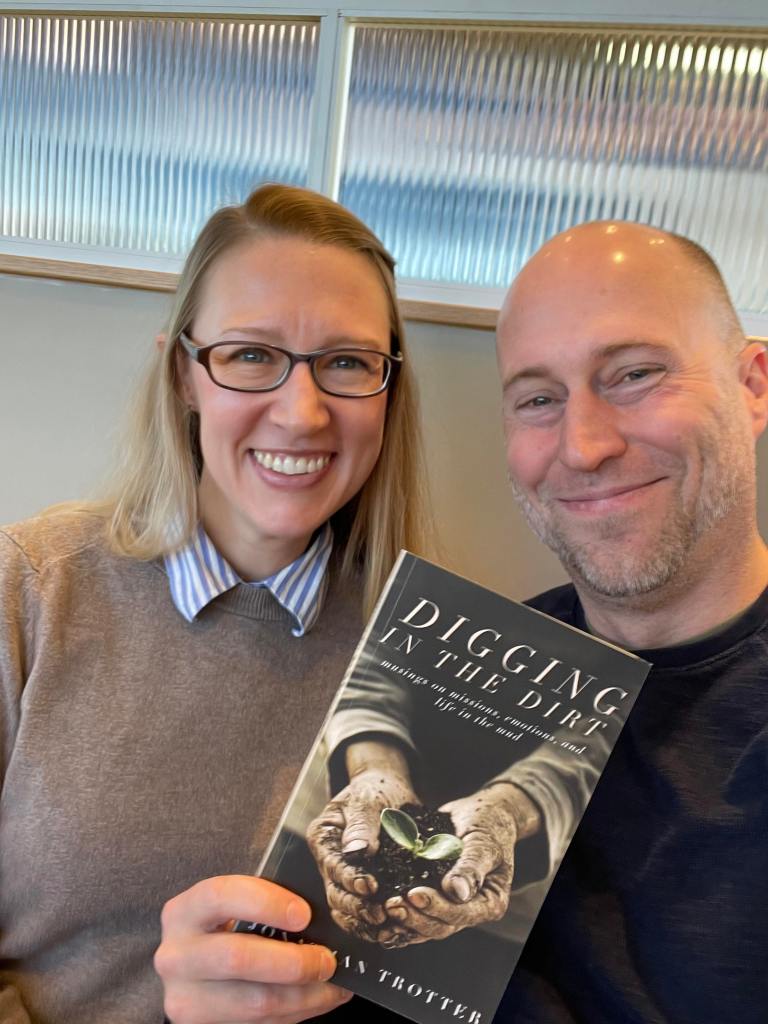
BOOK LAUNCH! Digging in the Dirt is here!

Buy it here!

From the back cover:

Welcome to ground level, to the dirt and the mess.

We like the mountain tops and the sunshine. We like green grass under a clear blue sky. We like victory and breakthrough and answered prayers. But sometimes it rains, the shadows deepen, and life turns muddy. Sometimes God seems quiet. What then? What happens when depression descends, or anxiety hangs like a sword overhead? What happens when loneliness suffocates, the thief steals more than stuff, and you get blood on your shoes?

In Digging in the Dirt, Jonathan Trotter delves into the disasters, the darkness, and the deluge, and he offers comfort, presence, and a gentle invitation to hope.

With humor and prose, with poetry and Top Ten lists, Jonathan welcomes us to the dirt, to the places where we actually live. He invites us to boldly see life as it is, with eyes wide open, and reminds us that even when the digging is scary, we are never alone.

To the ones who are dealing with devastation and distress, welcome. To the ones who need to uproot, to pull out, to clear ground, welcome. To the ones who seek desperately to plant seeds of grace and hope in once barren soil, welcome. To the missionary abroad and the believer at home, welcome. Receive the invitation, and join with Jonathan here at ground level, together.

Come, dig in the dirt.

From the preface:

Hello and Welcome!

I’m Jonathan, and it’s such a pleasure to meet you. I look forward to journeying with you through these pages. Together, we’ll delve into the dirt of life and relationships, of sorrows, pain, and loss. And maybe we’ll plant some things too.

Perhaps, along the way, we’ll see small, green stalks of life and hope begin to poke through, watered with the tears of the journey. Digging like this can be messy, but it can be good too.

These musings will meander from the hot dirt of Cambodia to the sticky mud of American politics. Some of these musings are inspired by international missionary life; some of them are firmly rooted in an American context. But whether you’re American or not, whether you’re a missionary or not, I hope that you find them all a blessing, an encouragement, and perhaps sometimes a challenge. I wrote them for you, and I share them with you with my whole heart.

Start reading Digging in the Dirt wherever you’d like, and feel free to skip ahead or go backwards. Are you a cross-cultural missionary? Start there if you want. Are you interested in developing emotional intelligence, or are you exploring whether or not Christians are allowed to have feelings? Consider starting in the Emotions section. Are you reeling from recent life events that have left you feeling like you’re choking on the mud and muck? First of all, I’m so sorry. Second, breathe a slow, deep breath, look over the Table of Contents, and start wherever you need to start.

Wherever you are, and whatever your story, welcome to ground level, to the dirt. It is here that the real work happens; the good, hard, sweet, healing work. It is my deepest hope that here, among these musings, you may find grace, peace, and a hope that just might be strong enough to crack through the crust.

All for ONE,

Jonathan Trotter
What people are saying about Digging in the Dirt:

A genuine book where no topic is off limits, Digging in the Dirt hits you right where you are regardless of location or vocation. This book is a must-read for anyone who is or is thinking about serving in missions and ministry! – DeAnna Anderson, former Director of the Launch Team for Wycliffe Bible Translators and missionary

Digging in the Dirt is a breath of fresh air for Christians. – Kim H.

Jonathan has such an authentic insight into life on the field, and he addresses the hard things in such a real and tangible way that helps you to know you are not alone. I would totally recommend this book for anyone who is serving overseas, sending someone overseas, or remotely interested in mission life. – Sydney, PI Leader for Southeast Asia

Rarely does an author bring the perspective of a missionary, nurse, theologian, pilot, counselor, parent, and gardener to cross-cultural ministry, family dynamics, depression, grief, politics, and the church, all in one book. Even rarer is a book that combines all of those things in a way that rings authentic and meaningful. Digging in the Dirt manages to do both, bringing thought-provoking and heartfelt lessons out of an incredible range of real-life experiences. – Reuben James

Digging in the Dirt is a must-read for anyone in missions or ministry. It’s refreshingly humble and vulnerable, and no matter what stage of life and ministry you’re in, you’ll walk away with some wisdom and new insight. – B.W., Stateside missions support worker

__________________________________________

Check it out on Amazon here!

*Amazon affiliate links

Return to Life

by Elizabeth

The 2000 film Return to Me is a family favorite. The movie features Bob and Elizabeth, who have been together since high school and who are still very much in love. One tragic night Elizabeth, who was an organ donor, is killed in a car accident. We watch as doctors transfer her heart to Grace, a woman who’s needed a new heart for a long time.

Grace goes nervously into surgery, hopeful for a new life. Bob, blood still on his clothes, goes home to an empty house. It’s an agonizing scene.

Months later, Grace has recovered from surgery. Bob, meanwhile, is having trouble living without Elizabeth and has buried himself in his work. Friends continually try to set him up with other girls, but Bob wants nothing to do with anyone new. He can’t get over the loss of Elizabeth. Then one night during one of these blind dates, Bob meets Grace at the family restaurant where she works. Sparks immediately start flying.

In the following weeks and months, Bob’s heart opens up to new love. But Grace is guarding a secret. Although she doesn’t know that Bob’s wife’s heart beats inside her chest, for some reason she can’t bring herself to tell Bob she’s had a heart transplant. Eventually the two of them figure this fact out, and the revelation is traumatic for both of them. Bob disappears; Grace flies to Italy to paint.

While Grace is gone, Bob realizes he loves her and can’t live without her. He looks for her at the restaurant only to find that she’s gone. He acknowledges, “I miss Elizabeth. I’ll always miss her.” Still, he’s ready to embrace a new life with Grace. He goes in search of her, and their reunion is sweet. The audience can see them building a future together.

One year after having traumatically evacuated Cambodia, I think I understand a little of what Bob meant in his restaurant confession. We left Cambodia in March, just as the pandemic began closing borders. We were relieved to have made it to U.S. soil, and for several weeks we assumed we’d be able to easily re-enter Cambodia in the fall as planned. But by May our visa and passport plans began unraveling, and by June, life as we knew it in Cambodia was over.

I didn’t even get to say goodbye.

2020 became one long grieving session. This might sound strange if you knew me in the early 2000’s when Jonathan felt called to missions and I didn’t. You might remember how I fought the call for so long. But now I felt like Mr. Holland from the movie Mr. Holland’s Opus, in which aspiring composer Mr. Holland longed for fame and renown, but instead ended up teaching music to high school students. At the end of his career, when budget cuts forced him to retire early, he observed, “It’s almost funny. I got dragged into this gig kicking and screaming, and now it’s the only thing I want to do.”

Like Mr. Holland, I didn’t initially want to move to Cambodia, but once I got there, I found a life I loved. I wasn’t ready to say goodbye — but covid said differently. For weeks, I woke up crying. Opening my eyes each morning was a painful reminder of where in the world I wasn’t. In Cambodia I had a strong support system. I lived every day with a sense of meaning and purpose. I had a place in the community and rituals and routines that brought structure to our chaotic cross-cultural life. We had raised our children there, and Cambodia was all they knew.

It was a difficult life, sure, but it was also an exceedingly good one. And I wasn’t sure I would ever stop crying over this loss. I lived in the “if onlys.” If only we didn’t have passport problems. If only we didn’t have visa problems. If only covid hadn’t happened. If only, if only, if only. I thought if I could just get back to Cambodia, I could recapture all my former happiness. In reality, even if I could have returned, I couldn’t have recaptured my old life. Covid made that impossible for seven billion of us.

Then one day my near-constant crying stopped. I thought I had accepted my new circumstances. And I do believe I had accepted that I couldn’t get my old life back. But reflecting now, I realize that I struggled deeply throughout the fall and winter. I had said goodbye to my old life — though not in person and not on purpose. But I still didn’t know exactly what my new life would look like, so it was hard to root myself here. Everything seemed bleak. I didn’t think I could ever be happy again.

We were looking for a home at the time. We knew we had to be out of our temporary housing by the end of December. After several housing disappointments (a story I’ll tell another time), I began to fear becoming homeless (emotions may exaggerate facts, but the intensity of the feelings are real). We didn’t have a church home yet because of covid, so I didn’t have local community to help me through this transition. I knew I couldn’t get my old life back, but I still desperately missed it.

Finally, finally, we found a home that fit our family that was also in our price range. We signed the papers mid-December, which was a bit closer to the deadline than we would have preferred. Still, we were thrilled to have a place of our own. I had no idea it would be such an important milestone in our repatriation process.

We’ve been in our new home for three months now. It fits us so perfectly (I promise I’ll explain in an upcoming post). I live in the daily disbelief that we could have found such a fantastic place for our family to live. We are making it our own, slowly writing our name in the land. Jonathan is working on the yard. We have pictures on the walls. We have rituals and routines, and I’m slowly re-building a support system. Living in our home has helped get me “unstuck” from the grief and helped me to move forward. It has given me a glimpse of what the next season of life might look like.

Cambodia is still a natural part of our conversations, and we frequently talk about our old life. The six of us have so many shared memories, both pleasant and unpleasant. Occasionally I even long for life in Southeast Asia. But I no longer think I can’t live without Cambodia, that life simply cannot go on without Cambodia. I’m beginning to understand what life can look like here on the other side of the ocean. I feel like Bob, who knew that he would always miss his old life, but who now knew that he could also live a new life with Grace.

My old life and my new life, side by side.

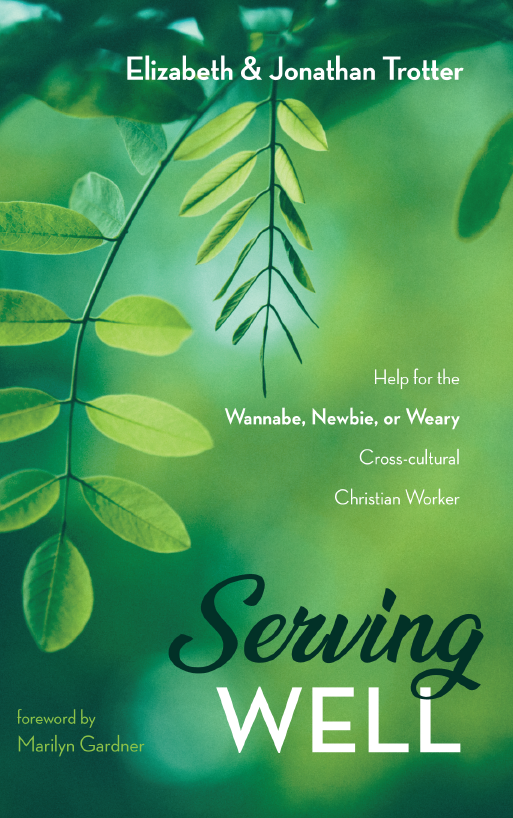
A Book is Born: Serving Well is now available!

It’s here!Screenshot (4)

Elizabeth and I are thrilled to introduce you to our new book, Serving Well. It is our deepest hope that this 400+ page book will encourage and equip cross-cultural folks through the various seasons of life and ministry.

It’s available in print and Kindle version here. Our publisher is also selling the book with a 20% discount here.

You can read the Serving Well press release (with book excerpt) here.


From the Back Cover
Are you dreaming of working abroad? Imagining serving God in another land? Or are you already on the field, unsure about what to do next or how to manage the stresses of cross-cultural life? Or perhaps you’ve been on the field a while now, and you’re weary, maybe so weary that you wonder how much longer you can keep going.

If any of these situations describes you, there is hope inside this book. You’ll find steps you can take to prepare for the field, as well as ways to find strength and renewal if you’re already there. From the beginning to the end of the cross-cultural journey, Serving Well has something for you.


Early Reviews for Serving Well
Serving Well is an important voice in the search for honest, experienced conversation on living and working cross-culturally in a healthy and sustainable way. Dig in!”
– Michael Pollock, Executive Director, Interaction International and co-author of Third Culture Kids

Serving Well is more than a book to sit down and read once. It is a tool box to return to over and over, a companion for dark and confusing days, and a guide for effective and long-lasting service. Elizabeth and Jonathan are the real deal and Serving Well, like the Trotters, is wise, compassionate, vulnerable, and honest. This needs to be on the shelves of everyone involved in international, faith-based ministry.”
– Rachel Pieh Jones, author of Finding Home: Third Culture Kids in the World, and Stronger Than Death: How Annalena Tonelli Defied Terror and Tuberculosis in the Horn of Africa

Serving Well is a must-read book for missionaries and for those who love them. This is a book you really need if you are ‘called to go, or called to let go.’ In Serving Well we read both the spiritual and practical, simple and profound, funny and compelling in chapters written by Elizabeth and then Jonathan Trotter; hearing from each their voices and their hearts, the struggles and the victories, ‘the bad days and the good days’ of preparing to go and serving well overseas. Their down-to-earth yet godly insights were born from living overseas and from authentically wrestling with the ‘yays and yucks’ of missionary life. They draw wisdom from both Scripture and sci-fi authors, Psalms and funny YouTube videos, encounters with Jesus and encounters with cops looking for a bribe. Take two books with you to the mission field: the Bible, and Serving Well.”
– Mark R. Avers, Barnabas International

Serving Well is deep and rich, covering all aspects of an international life of service from multiple angles. It is full of comfort, challenge, and good advice for anyone who serves abroad, or has ever thought about it, no matter where they find themselves in their journeys. It is also really helpful reading for anyone who has loved ones, friends or family, serving abroad–or returning, to visit or repatriate. Jonathan and Elizabeth Trotter are both insightful and empathetic writers, full of humility and quick to extend grace–both to themselves and to others. Their writing covers sorrow and joy, hope and crisis, weariness and determination. Best of all, from my perspective as someone who has worked with TCKs for over 13 years, it contains an excellent collection of important advice on the topic of raising missionary kids. Choose particular topics, or slowly meander through the entire volume piece by piece, but whatever you do–read this book!”
– Tanya Crossman, cross cultural consultant and author of Misunderstood: The Impact of Growing Up Overseas in the 21st Century

“Overseas workers face a barrage of junk when they arrive on their field location: identity issues, fear/anxiety issues, and faith issues. I have worked with missionaries for well over a decade now and see how these common themes cry out for a grace-filled approach to truth and authenticity. The Trotters live this out loud, intentionally seeking a way to minister out of their own pain, striving, humor, and failure. Keep this reference close at hand!”
– Jeannie Hartsfield, Clinical Counselor, Global Member Care Coordinator, World Team

“This book is the definitive guide to thriving in cross-cultural ministry. The Trotters have distilled years of experience into pithy chapters filled with helpful tips and wise insights. Put it on your must-read list.”
– Craig Greenfield, Founder, Alongsiders International, author of Subversive Jesus

“In this must-read missions book, Jonathan and Elizabeth unearth the underlying motivations of the cross-cultural call. Penned with copious compassion and startling transparency, Serving Well is sure to make you laugh, cry, and, in the end, rejoice as you partner with God in His global missions mandate.”
– David Joannes, author of The Mind of a Missionary


Coming Home: a story in 3 parts

by Elizabeth

31958915_10160218261265621_8409725615460057088_n

1. We landed in L.A. for an 18-hour layover after what was perhaps the Most Turbulent Flight Ever. Then we headed to an airport hotel to sleep off some jet lag (courtesy of my husband, the Expert Trip Planner).

The next morning after breakfast, we walked around to get some sun so we could keep fighting off the dreaded jet lag. And lo and behold, what did I see? Only my very favorite plant: the magnificent palm tree.

(There were also succulents, which may just need to be added to my list of favorite plants.)

And I thought to myself, maybe the part of my soul that longs for palm trees really can be satisfied on this soil. I think on some level I knew America had palm trees, but I’d never been in a place to see them before. It was a welcoming sight.


2. That next day as we settled in to our last flight, we ran into an old family friend. (Actually, it was the minister who performed my husband’s grandfather’s funeral, and his wife.)

As we chatted, the husband said, “Heading home?” And I nodded and said, “yes” — because we are, and that’s the way most people talk about these trips anyway.

But then he paused, for maybe only half a second, and said: “Heading home, on your way from home.”

Yes. We’re heading home, on our way from home. And I THANKED him for that statement, because it’s the truest way of describing this strange mobile life, and not everyone takes the time to acknowledge that truth.

We are, ever and always, heading home on our way from home.


3. Friends and family greeted us at the airport and helped us load our luggage into their vehicles. In the car I talked with my parents some and listened to my parents talk to my kids some. I was tired.

We passed plenty of places that looked just the same, and we passed plenty of places where new homes and businesses had sprung up. The highway doesn’t look quite the same as it did when I was growing up.

But the moment we turned onto the street that heads to my parents’ house, I knew I was home. It may have been 2 1/2 years since I’ve seen it, but it seemed like I had driven that road only yesterday.

And so I am Home. It’s a good feeling.

Living Well Abroad: 4 Areas to Consider {A Life Overseas}

Jonathan’s at A Life Overseas today. . . .

lwamarch2017

My day job here in Cambodia is serving as a pastoral counselor. In a typical week, I meet with clients from Asia, the Americas, Australia, Europe, and occasionally Africa. And whether these clients are missionaries, NGO workers, or international business people, they’re all trying to figure out how to live well here. In Cambodia.

I was recently asked to share at an international church on the topic of Living Well abroad. I gave it all I had and presented my compiled thoughts and hopes. This article is an extension of that presentation.

It’s not short and it’s not fancy. But it is pretty much all I’ve got. 

My hope is that this article might serve as a resource, a touch point, for you and your team/org/ministry/family/whatever. If you’d rather listen to the podcast of this material, you’ll find some links at the very end. All right, here goes!

 ~~~~~~~~~~~~~~~~~~~~~~~~~~~~~~~~~~~

How long were you in your host country before you cried really hard? You know, one of those famous UGLY cries that no one sees but certainly exists? Was it sometime in your first year? Month? Week?

For me, it took about 27 hours.

Our theme verse for those early days was 2 Corinthians 1:8, “We think you ought to know, dear brothers and sisters, about the trouble we went through in the province of Asia. We were crushed and overwhelmed beyond our ability to endure, and we thought we would never live through it.”

But we did.

For as Paul Hiebert writes in his seminal work, Anthropological Insights for Missionaries, “Culture shock is rarely terminal.”

Theory can only get you so far. At some point, you have to get your feet wet and Nike the thing. That’s what this article’s about. It’s an attempt to give some practical, hands-on, nitty-gritty, [insert random epic language here], rubber-meets-the-road, advice.

Much of this comes from my own experience of transitioning a family of six from the suburbs of mid-west America to the concrete vistas of Phnom Penh. The rest comes from observing lives and stories in that enigmatic place we call “the counseling room.”

The four specific areas we’ll consider include Living Well Abroad…

  1. Theologically
  2. Spiritually
  3. Relationally
  4. Psychologically

Click here to read about the 4 areas.