The Tree That Tells Our Story {A Life Overseas}

Elizabeth is over at A Life Overseas today. . .

CTF

My parents came to Cambodia to celebrate the American version of Thanksgiving with us, and they stayed for the traditional setting up of the Christmas tree. After we finished stringing the lights and hanging the ornaments, and the youngest child had placed the heirloom angel from my husband’s childhood on top, we all sat down to admire the tree.

Then all of us, from the sixty-year old Grandpa, right on down to the four-year old baby of the family, shared what we love about Christmas. When we got to my mom, she said, “I love putting the ornaments on the tree because they tell the story of our family.”

It’s true. As a military wife, she can remember both the year she added each ornament, and the place we lived at that time. The ornaments on her tree tell the story of my family of origin, from a newly wedded couple in El Paso, Texas, to brand new parents in Fort Knox, Kentucky, to a growing family in West Germany, and later a university campus in South Dakota and the Kansas Army post at Fort Riley.

You can read the rest of the post here.

Birth & Art {A Metaphor}

by Elizabeth

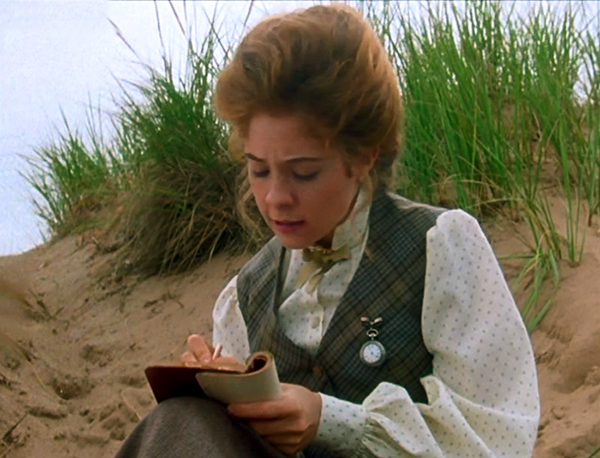
Writing is a birth, of sorts.

When I was pregnant with my first child, I decided I wanted to give birth without medication. I was in love with the idea and informed my husband. He was enamored of the idea as well, and he bought books on the Bradley method of natural childbirth for us both to read. It was in those books that we learned about the emotional signposts of labor.

First, there’s excitement: Today’s the day! I’m having this baby today!

Then, there’s seriousness: Let’s get down to the business of birthing this baby. This is hard. I’m uncomfortable. I need to concentrate. And by the way, DON’T touch me.

Finally, there’s self-doubt: I’m done! I can’t do this anymore! This emotional signpost corresponds to transition. Transition is a nice-sounding word for the most difficult part of labor and signifies that birth is coming soon.

Even though I’d studied these signposts, the books still made birth seem easy, and I was confident I could give birth naturally. I was looking forward to it, in fact. The night my water broke, however, the contractions came hard and fast. I doubted whether I could handle the rest of labor. I did indeed survive my first labor, and I gave birth to a precious baby boy that night. But his birth wasn’t without pain.

Eleven months later, I became pregnant again. This time around, I wasn’t so confident. I’d been blissfully unaware of it during my first pregnancy, but during my second, I knew labor was going to hurt. I knew how bad the labor pains could get, and I wasn’t looking forward to the actual birth process. And I was right — it did hurt. Bad. I knew that I could give birth naturally, but I dreaded the pain.

~~~~~~~~~~~~~~~~~~~~~~~~~~~~~~~~~~~~~~~

Writing is a birth of sorts, complete with all the emotional signposts.

First, there’s excitement: I have an (invariably brilliant) idea!

Then, I pitch the idea to someone, most often, my husband. It’s (usually) met with approval.

I’m still excited. Until I start typing, that is, and the words on the screen begin to look like nonsense. They don’t communicate what I want to communicate AT ALL.

That’s when I decide that my “brilliant idea” is total, complete, and utter trash.

I determine that either

          a) the idea itself is bad or

          b) I have no wordsmithing abilities whatsoever and

          c) I should just quit now.

asw

It’s at this self-doubt signpost that I’ve learned I need to close the laptop and put it away until tomorrow — a luxury not afforded one in active labor. Then I keep returning to it, day after day. This is the serious working phase, and requires concentration. I rearrange words, and rearrange them again, deleting whole sentences and even paragraphs, until I can read them out loud with relative satisfaction. Then, I birth it. I hit Publish and launch it out into the world. My hard work is done.

I used to forget this phenomenon between writing projects. I would forget how annoyingly hard the process is. They say Labor Amnesia is the reason people have second and third and fourth and even fifth babies. The pain of labor dissipates — we forget, and are willing to try again. Well, I had Writer’s Amnesia. Each time I attempted something new, I was surprised and frustrated by the difficulty of the task.

I worked hard each time, yet when I was finished, I still had new ideas I thought I could tackle with ease. (How very naïve.) But this same plotline has unfolded so many times now that I’ve come to accept it as part of the writing process. And I keep coming back to the craft because something inside me tells me there is more to be said, more to be written, more to be done.

Writing — and all art — is messy. It’s hard work, and it sometimes hurts. You might not know this ahead of time. The pain and heartache might take you by surprise, might sideswipe you. That is, until you’ve given birth to enough pieces that you can look back and see the pattern in your labors. Now, you know it will hurt. Now, you know the process is long and drawn-out. Now, you know you might regret your “brilliant” idea, and be tempted to give up. But by now, you’ll also know that you can’t give up, even when faced with the self-doubt signpost. Because something inside you propels you forward.

For the artist, for the creative person, conception of an idea is exciting. The gestation, however, is decidedly not. Your idea often grows much heavier than you expected it would. You reach the same emotional signposts each time you labor over an idea. But the beauty of it? Another day, you can birth another idea. And on a day after that, you can birth another idea. The emotions stay the same, but the ideas change. They are new. They are fresh.

They are invitations to create.

I Need a Silent Night

by Elizabeth

The pace of life in Phnom Penh can, all too often, be hurried and hectic. It’s not your traditional (imaginary) missionary life. It’s crazy, and it’s crazy-making, and I need to call a time-out. I need some space to breathe.

Over the last four months especially, a series of events have left me feeling dry and depleted. And now we’re smack dab in the middle of the holiday season, a season that creates its own frenzy. Lights! Tinsel! Frosted cookies!

Invitations pile up. Attendance feels mandatory at open houses and parties, cookie exchanges and carolings, even church services. These are all worthwhile and enjoyable activities. Even so, the expectations begin to mount. And for me, this time around, it all felt like a mountain I couldn’t scale.

When exactly did having Christmas cheer come to mean doing lots of Christmas activities? I don’t just want the appearance of Christmas cheer; I want Christmas cheer on the inside. But I’m not sure I can get it by doing Christmas the way it’s usually done.

So this year, I’m rebelling. I want a simple Christmas, and I’m taking drastic measures. I’m turning down invitations. I’m aware this might make me appear Scrooge-like and Grinchy. I’m risking it anyway. I’m sitting this season out. (On my couch.) I’m regrouping, retrenching, retreating. Clearing the calendar, saying no, and staying home.

In a culture where our worth is measured by how busy we are, I’m choosing to be countercultural, to go against the flow — or better yet, to drop out of the flow. For the sake of my sanity and for the good of my family’s emotional health.

So this Christmas season, you’ll find me sitting in my living room each evening, main lights dimmed but tree lights twinkling. You’ll find me singing my favorite Christmas carols with my family, resting in the news of the Christ Child and welcoming the peace He brings.

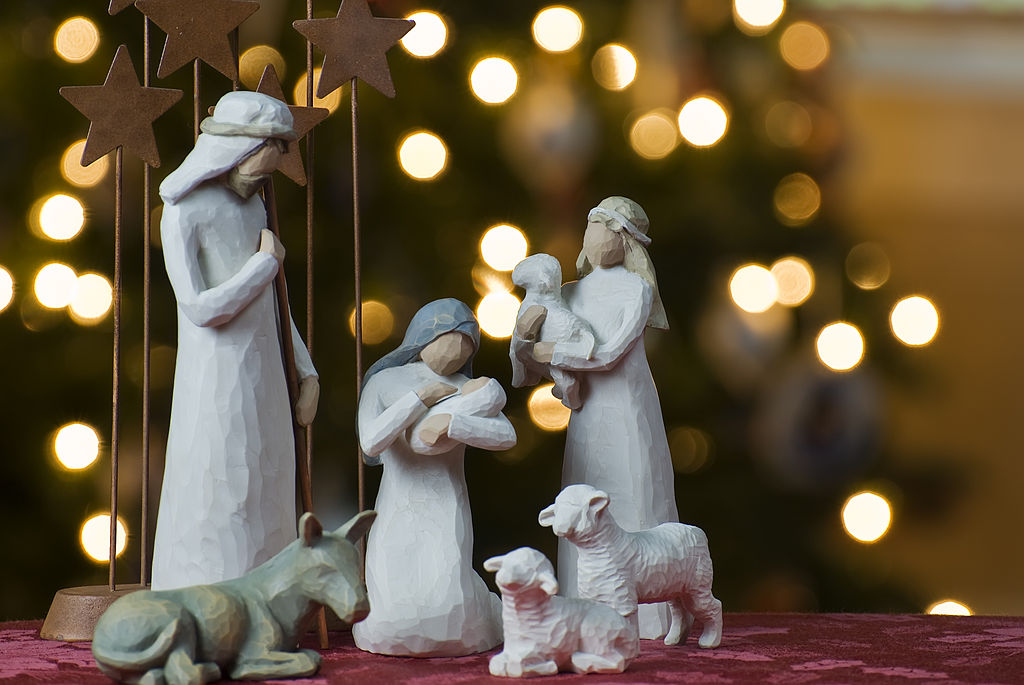
I’m losing myself in the marvel of the Christmas Story, in the wonder of the God-made-flesh, the One who dwelt among men. I’m ignoring the social scene and even the rush to buy presents, and I’m getting swept up in the mystery and majesty of the Nativity. I’m absorbing the Advent, and meeting God in the Messiah. I’m slowing down and savoring the story of our Savior.

 nt

*Title inspired by Amy Grant’s song “I Need a Silent Night”

Photo credit

Here’s my heart, O take and seal it {A Life Overseas}

Elizabeth is over at A Life Overseas today. . .

10807985_10154831883310621_26088305_n

I want to finish the Christian life well. To continue to press in to God, listen to Him, and influence others to do the same. But what if don’t? What if I fizzle out, forsake my First Love, fail to follow Him to my dying breath? I’m not talking about losing my salvation; I know my salvation is secure. What I am talking about is slacking in my obedience, and not consistently seeking Him till the end of my days. (I know I’m not very old, but I still think about these things.)

This dread of mine is echoed in the songs of old. I hear it in James Waddel Alexander’s O Sacred Head: “What language shall I borrow to thank Thee, dearest friend, for this Thy dying sorrow, Thy pity without end? O make me Thine forever, and should I fainting be, Lord let me never, never outlive my love to Thee.

I sense it in Robert Robinson’s Come Thou Fount: “Let Thy goodness, like a fetter, Bind my wandering heart to Thee. Prone to wander, Lord, I feel it, Prone to leave the God I love; Here’s my heart, O take and seal it, Seal it for Thy courts above.” If you know this song, you know the first verse soars with a longing and love for God, but the fear of our own depravity overtakes this later verse.

Finish reading the post here.

The Glory of the Word of God

by Elizabeth

~~~~~ For the word of God is alive and active (Hebrews 4:12) ~~~~~

A peculiar thing happens to me when someone lobs a Bible verse at me and lectures me on how to live my life: I feel trampled upon. I feel controlled and belittled. But when I read Scripture by myself, on my own, and happen upon some life-changing verse — even if it’s something someone else could have pointed out — then that verse is impactful and life changing.

Perhaps this is my stubbornness, my sin nature. But I also believe it’s a testament to the power of the living Word. The Text itself has the power to change us when we encounter it ourselves. I think this is why Scripture readings in church, by themselves and without any commentary at all, can be so very powerful.

When I have an encounter with God Himself, He speaks to my heart and tells me what to do. God’s Word is just so much more effective when God Himself is speaking to me, and not some angry know-it-all. Now, I’m not anti-sermon. I love good preaching and teaching. I love learning information, and I love hearing Bible commentary. What I dislike is having Bible verses thrown at me without love.

The Bible is a living, breathing text, and we were designed to sit under it. To listen, to stay awhile, to be changed. It’s why I have to read it myself. It’s why I feel so much closer to God when I do. Even if I don’t see specific changes happening yet, God’s word is active under the surface of my heart and slowly, sometimes imperceptibly, changing my attitudes over time.

I used to think prayer and Bible reading were separate (yet conjoined) endeavors. But maybe Bible reading is just listening to God talk to us. And if prayer is actually a conversation with God instead of merely my supplications, then listening to Him is one half of prayer. Which means that maybe, reading the Bible is actually . . . praying.

Could that really be prayer? Isn’t prayer when we talk to God? But nothing is separated or segregated in our life with God. I can pray while I sing, and I can worship God without song, when I stand in awe of His creation. So it’s possible that prayer and Bible reading are the same thing sometimes.

Prayer as Bible reading seems so mundane. It’s not fireworks or anything fancy. But it isn’t mundane. It’s God intersecting with the world. It’s God changing my heart – which is actually pretty miraculous if you ask me.

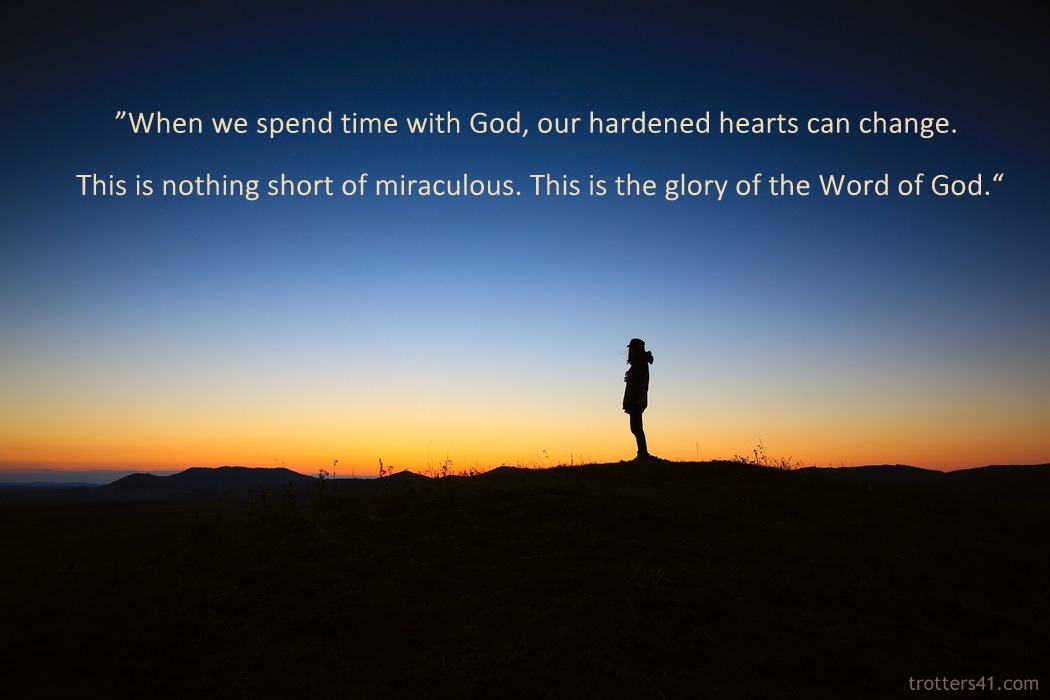
I think sometimes we lose the wonder of a changed heart. But the truth is, when we spend time with God, our hardened hearts can change. This is nothing short of miraculous. This is the glory of the Word of God.

8bc72ed7a