I posted this on Facebook and thought I would share it here too. ~Elizabeth
Are you overwhelmed by the thought of homeschooling overseas?
Are you confused about how to begin homeschooling in those early years?
Or perhaps you’ve been homeschooling for a while and feel pretty comfortable with it, but your student is about to start high school, and you feel nervous all over again?
If so, I’d love to help!
I’ve been homeschooling my four children for 15 years, including eight years in a developing country with regular power and water cuts.
I’ve launched one child to university (engineering school), I’m preparing to launch another (who is currently taking dual credit classes), and I’m still teaching my 13- and 15-year-olds at home.
After a decade and a half, this homeschooling venture feels pretty natural to our family, but I remember how intimidated I felt both in the early years and when my oldest started high school.
I’m offering an introductory rate of $30 per session for homeschool consulting in the months of July and August.
You can fill out the intake form, and I’ll get in contact with you soon!
Topics we can cover include:
homeschooling overseas
the early years
high school and that dreaded transcript
building your homeschool around your strengths while shoring up your weak spots
recognizing when you need outside help
how to approach learning issues, scheduling issues, and discipline/connection issues
answering any curriculum questions you have
evaluating (and celebrating!) your progress
In addition to my 15 years of homeschooling both in the States and in Cambodia, I have experience in:
developing hands-on math and science classes for coops
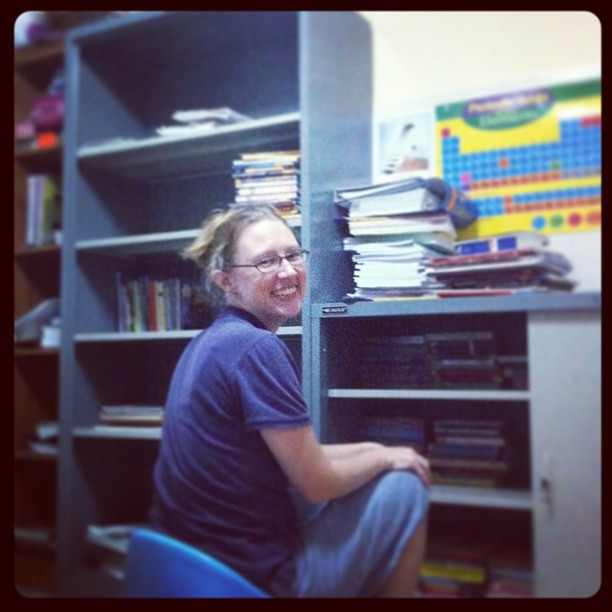
[Photo circa 2013, Phnom Penh, Cambodia. A visitor had just brought us some curriculum, and I was very excited. Note the periodic table in the background.]
You might also be interested in my new book, The Hats We Wear: Reflections on Life as a Woman of Faith, which addresses six different aspects of being a woman of faith, with sections on spirituality, emotions, and embodied living, as well as marriage, motherhood, and homeschooling. ~Elizabeth
“What’s your favorite math curriculum?” This was one of the questions I received when I announced I was tutoring math again. After replying to the question, I realized some of my readers might be interested in my perspective, so I revised and expanded my response and am sharing it here.
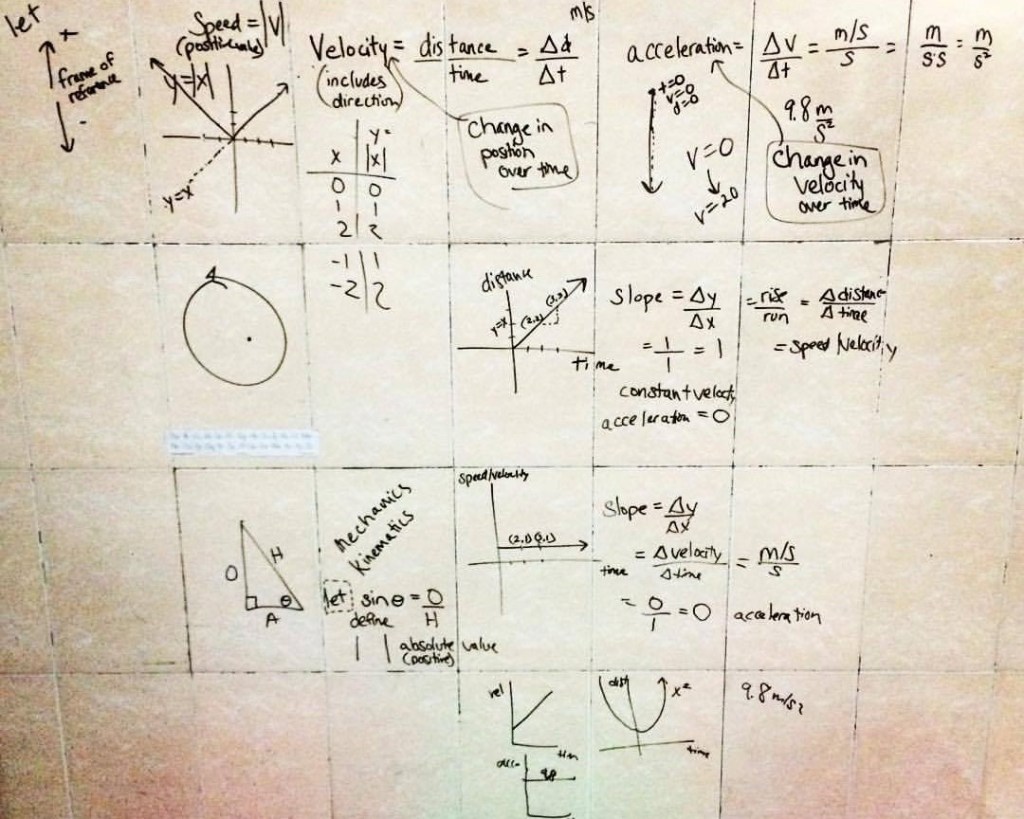
I LOVE math. I got so excited when my oldest started studying the coordinate plane in algebra that I began drawing on the walls and talking about trigonometry and calculus (see photo below). That was way too much, way too soon, and my husband had to pull me back from my adventure in Mathland before my student’s brain melted down. Now I know not to get too ahead of myself.
But anyway, back to the math curriculum. Here are my thoughts on Saxon, Shormann, Teaching Textbooks, Math-U-See, and Singapore, along with a brief mention of Right Start Math, Life of Fred, Math with Confidence, and Understand Math. If you have thoughts on these or other curricula, I’d love to hear from you in the comments! And if you stick around to the end, there’s not just one, but two BONUS sections for you.
But before we get to the reviews, here’s my math background if you’re interested: I have a bachelor’s degree in chemical engineering with a minor in chemistry from the Missouri University of Science and Technology. I’ve been tutoring math (including SAT/ACT prep) and teaching hands-on math classes at homeschool coops for the past 18 years. I’ve also homeschooled my four children in math since the beginning.
SAXON
Saxon is my favorite math curriculum. I love its spiral approach that keeps old material fresh for students. I love how rigorous and straightforward it is. But I wasn’t always such a big fan of Saxon. In my early years of homeschooling, I thought “everybody used Saxon,” and I didn’t want to be like everybody else. I wanted to be different. So I chose Singapore.
Later, when I was looking for something to replace Teaching Textbooks (more on that below), Jonathan encouraged me to try Saxon. He said it worked for him as a teenager. And of course by that time I knew that not everybody was using Saxon and that some people even hated it. This solved my hang-up of not wanting to be like everyone else. I decided to try Saxon, and I haven’t looked back. It’s worked for all four of my children, even though they all learn in different ways.
Something I really like about Saxon is that each problem is linked to the lesson number where that particular skill was taught. This makes it easy to locate the teaching on a particular topic if your student is having trouble with a problem.
I see two main weaknesses in Saxon. As an engineering mom, I feel I’m able to cover those weakness, but that might not work for everyone. The first weakness is that there’s not a video explanation for each problem if the student gets it wrong — but I know I can provide that (plus there’s a solutions manual). Second, Saxon doesn’t provide much of a conceptual framework for students who want to know WHY the math is the way it is. (Saxon uses a “procedural approach” rather than a “conceptual approach.”) But again, I feel I can provide the conceptual framework.
And for busy moms, there’s a third weakness: you have to do all the grading yourself.
The strength of Saxon lies in it skills building, constant review, and preparation for ACT/SAT and college math, and for me, those strengths overcome its weaknesses. My oldest did really well on ACT math with his Saxon work. He’s now taking calc in college and doing well. And as a junior, my second just tested into any college math class he wants to take, including calc if he wanted (though he doesn’t want!).
As I mentioned previously, I use Singapore (more on that below) in elementary school and switch each child over to Saxon at a certain point — usually after Singapore 5 or 6. With my youngest, I noticed the frustration level increasing during Singapore 4, so I switched her over earlier. Once I did that, she really made strides in math. Now our math lessons proceed more smoothly and with much less stress.
SHORMANN MATH
If you like Saxon but need more student support, you might want to look into Shormann Math. Dr. Shormann produced the DIVE CDs that correlate to Saxon lessons (we use these CDs). Later he went on to create his own curriculum that’s similar to Saxon but more updated/modern and does extend all the way through Calculus. I have not used Shormann Math, but I do know he provides video explanation of each problem if the student gets it wrong, and he may even provide grading and student support online.
TEACHING TEXTBOOKS
As with any curriculum, Teaching Textbooks has strengths and weaknesses, but you can get around the weaknesses if you know what to watch out for. The strength of Teaching Textbooks is that it provides a video explanation for each problem if the student gets it wrong. Also, you don’t have to do the grading.
The weakness is that the student gets a second chance to solve each problem (which from one point of view could be considered a strength). However, if the student gets the problem right on the second chance, it still registers as correct in the gradebook. If a parent is not aware of this feature, they may be lulled into a false sense of security regarding their child’s progress. So as a parent you just have to be watching the gradebook.
I began using Teaching Textbooks when my oldest was heading into junior high. I wanted to lighten my workload and transition him from direct instruction from me to more independent learning. At that time Sonlight was still recommending Teaching Textbooks, so I tried it out. After our first year with Teaching Textbooks, I realized it wasn’t as rigorous as I wanted it to be, and that’s when I switched to Saxon. But not everyone wants or needs that sort of rigor, and that’s ok.
Something I love about Teaching Textbooks is that you can see at a glance what your child is struggling with. You can see what they got wrong, when they needed a hint, and when they used their second try. It’s all recorded in the gradebook. And you can usually find patterns in their wrong answers, but you have to be paying attention to the gradebook and lessons. It’s usually sufficient to check on progress once a week to look for patterns. Then you can work to clarify any misunderstandings and strengthen any missing/weak skills. These features are why I love tutoring students who are using Teaching Textbooks: it’s fairly straightforward to figure out whether a student has mastered a certain skill.
Like Saxon, Teaching Textbooks links each problem to the lesson where that skill was taught so that you can go back and review material if you need.
SINGAPORE MATH
I loved using Singapore in elementary school. It was fun in the early years, and I love the way they use paper folding and cutting activities to “prove” geometric principles. I also love the way they model percent problems, which I adopted into my repertoire and still use to solve percent problems — even with Saxon books. I once heard Dr. Jay Wile, whose expertise I respect and whose chemistry program I love, recommend Singapore for the early years.
But there’s not much review in Singapore, so you have to get creative to provide enough review to solidify skills. And the word problems can get really difficult really quickly, which can stress out a young child. I switched each child over to Saxon at some point, some earlier than others (as mentioned above). However, I still recommend Singapore in the early years (K-3)!
MATH-U-SEE
I have only a little experience with Math-U-See, but I like what I’ve seen so far. The video instruction is good. Math-U-See takes a mastery approach (where students stay with one topic until they’ve mastered it) rather than a spiral approach like Saxon or Teaching Textbooks, but from what I’ve seen and heard, Math-U-See is a quality program that can take the frustration out of math for many children.
KATE’S HOMESCHOOL MATH HELP
Kate Snow is brilliant. She’s a Harvard-educated math teacher who specializes in helping homeschool parents. She has a lot of free resources on her website, including several video tutorials, plus she’s published her own elementary math curriculum called Math with Confidence. I use Kate’s arithmetic strategies when tutoring younger children. And although I haven’t purchased her curriculum, I always recommend Kate’s website to parents whose younger children are struggling with math.
LIFE OF FRED
A lot of people ask about Life of Fred and/or claim it’s helped their child either understand math or stop hating math. I don’t have any actual experience with Life of Fred, so I can’t comment on it except to say that my gut reaction is that it doesn’t provide enough practice.
RIGHT START MATH
I haven’t used Right Start Math either, but I’ve heard really good things about it from people I trust. It’s a conceptual program that relies heavily on manipulatives and intensive teacher interaction. Some kids really want those conceptual explanations, and some aren’t that interested. But if you want to lay a good foundation for mathematical thinking, Right Start should be a good option.
UNDERSTAND MATH: REASONS FOR THE RULES
Dr. Andrew Kelley’s new book, Understand Math: Reasons for the Rules, can help homeschool moms explain why math algorithms are the way they are. My children often asked me to explain underlying mathematical principles, and I tried my best to help them. But math had come so easy for me that I hadn’t always thought about some of these deeper questions.
Understand Math is written as a supplement to your regular math curriculum (which you still need for sufficient practice), and it’s written directly to the student, which means you as a parent don’t need to be a math expert in order to help your child(ren) understand math. Once they understand why they’re supposed to follow certain rules, they’ll be set up for more success.
I found a lot of help from Kate Snow for teaching the four basic operations (addition, subtraction, multiplication, and division), but this new resource (published in 2025) will take homeschool moms all the way from fractions in elementary school to algebra, trig, and calculus in high school.
Kelley has also created a series of YouTube videos explaining some of these concepts, including division by zero, exponents of zero and negative one, and logarithms, a topic which is nearly universally challenging for students.
If you know you’re going to want some extra help explaining math but don’t have the finances for an outside tutor or teacher, this hardcover book is a great investment. On his website, Kelley also offers a free 60-page sample of the book, which includes sections from every chapter.
BONUS: MANIPULATIVES TO INVEST IN
In the early ages, manipulatives are so important. Here are my three favorite manipulatives that I still use on a regular basis:
Cuisenaire Rods. This set of color-coded 1-cm through 10-cm rods helps with addition, subtraction, multiplication, division, and the concepts of perimeter and area. Plus they’re super fun to play with.
Base 10 Blocks. Understanding base 10 is an integral part of mathematics, whether we’re talking about borrowing and carrying (renaming/regrouping) in the younger grades or scientific notation and logarithms/exponents in the older grades. Base 10 blocks are a really helpful visual and kinesthetic way to help children understand base 10.
Fraction Circles. If you’re teaching fractions and running up against some frustration, fraction circles can really save the day! Fractions are important not only in upper elementary school when you first learn about common denominators and reciprocals but also in higher level math, where fluency with fractions is essential for Algebra 2 and above. So give your kid a good foundation with fraction circles.
BONUS: OTHER IMPORTANT MATH TOOLS
Flash Cards. Taking the time early on to memorize math facts is so important. It pays dividends later when you get into fractions, long division, and multi-digit multiplication. You want those math facts to be automatic so that your child can focus on the new algorithms they’re learning and practicing.
Skip Counting Songs. Skip counting songs can help your child memorize their math facts, and the songs help with factoring later on.
Hundred Chart. I love a good hundred chart! It’s so useful in teaching prime numbers and the divisibility rules. In the early years I used it almost every day.
Desmos Graphing Calculator. I spent so much money on graphing calculators in high school and college, but you don’t need to do that anymore. The Desmos app is free!
Understanding the connections between algebra and geometry (analytic geometry) is incredibly important starting at the algebra or pre-algebra level (depending on the curriculum). You don’t need a graphing function until Algebra 2, but the foundations are being laid early on, so be sure to make those connections between the algebraic functions and the coordinate plane by doing lots of graphing problems. (A graphing notebook can be helpful here.)
What about you? Any tools, curricula, or supplements you’ve found essential in math instruction?
Note: this post was inspired by this article by David French.
As a homeschooled-in-the-80s kid, I’m well versed in the terrified cry, “The danger is out there! The danger is out there!” I can remember watching The Village and feeling like M. Night Shyamalan had just made a film about my life. (My parents didn’t yell this too loudly, but we were Gothardites.)
But is the primary threat “out there”? No. It is not.
Over the past couple of years, I’ve received a fraction of the pushback that David French has, but still, I resonated deeply with this:
“I get an enormous amount of criticism for not critiquing the secular left more than I do. Yet if I’m concerned for the health of the church, then corruption at the highest levels of the world’s largest Christian university, sexual predation by arguably Christianity’s most influential apologist, widespread conspiracy theories, and disproportionate disregard for the health and well-being of neighbors do more harm than the worst of Joe Biden’s culture war regulations or the most radical developments in the sexual revolution.”
The whole article is excellent, but here are a few more quotes worth pondering:
“If your reaction is that the greatest threat to human souls or to the church itself comes from without—from the external forces attacking Christianity or from the cultural temptations buffeting our children—then that dictates a very different posture to the world and approach to politics than if you believe the true threats lie within.”
A different posture indeed.
I have seen this fear, this alarm:
“If you believe the most dangerous threats come from without, fear can rise in your heart. As you lose political and cultural power, and you see others shape the environment in which you live, then you start to have genuine alarm that other people are destroying the souls of those you love. What a terrifying idea.”
There is hope, of course.
At the end of the day, the Church remains his, and he still loves her. He still calls her to remember her first love. I want to still love her too. I want to build more than I tear down. I want to heed with every fiber of my being Jesus’ call: “Your business is life, not death. Follow me. Pursue life.” (Matthew 8:22)
I want to love more than I fear.
I haven’t always done this, for sure. But I want to. I want to know Jesus more. I’m a few chapters in to Dane Ortlund’s new book, Gentle and Lowly, and it’s helping. It’s not about The Chosen, but it’s explaining, in theological terms, why the Jesus portrayed in The Chosen is so fascinating and healing and loving. He’s helping me understand why I cry every.single.episode.
Turns out, it’s because the stories are real. Ortlund writes, “Jesus is not trigger-happy. Not harsh, reactionary, easily exasperated. He is the most understanding person in the universe. The posture most natural to him is not a pointed finger but open arms.” He goes on to say that Jesus’ “deepest impulse, his most natural instinct, is to move toward” sin and suffering, not away from it.
I can’t believe I haven’t written in 2 and 1/2 years! We’ve been homeschooling!
~~~~~~~~~~~~~~
January 14, 1992
Jonathan was showing Corrie pictures of Laura. Corrie said, “I was sad when Laura died.” Jonathan said, “but you weren’t born when Laura died.” Corrie said, “but I was sad with God in heaven when Laura died.”
~~~~~~~~~~~~~~
February 14, 1992
I’ve been going to Nutri-System for 7 weeks. I have lost 13 pounds and am grappling with all the feelings that go with being fat.
We have been led by God’s Spirit to homeschool, I believe. But such criticism! Today a woman at church told me that she believed I was doing the wrong thing. I tried to say I was doing it because I knew it was what God wanted for us and not something I wanted.
She really didn’t understand. She said I was isolating my kids (ha! Gymnastics, baseball, ballet, soccer, jazz, neighborhood, church, and always extra kids at the house — yesterday, six!)
Anyways, she said Jesus always blended, and I thought, Jesus didn’t leave home and begin his ministry till he was 30!! She said our kids should learn to stand alone — I believe that!! That’s why I’m homeschooling.
I was a little surprised that someone would say I was doing the wrong thing.

 Jonathan & Elizabeth Trotter