Recorded at ICA in Phnom Penh, Cambodia, March 2017.
To listen to the message, Click Here or visit the trotters41 podcast on iTunes.
Paul concluded his message to the Ephesians with the idea of Love mixed with Faith(6:23), and I borrowed his thoughts for a bit. Here are some excerpts…
Love comes to seek and save the lost, while Faith believes they can be.
Faith empowers Jesus to prophetically imagine a new paradigm for the co-crucified: “Today, you will be with me in Paradise.” While Love communicates the fantastical truth: “I want you with me in paradise.”
Faith innervates Jesus’ declaration to the Samaritan woman, “If you only knew the gift God has for you….”
But Love is what got Jesus talking with her in the first place.
“Love joined with faith.”
Faith helps me believe the Gospel. Love helps me share it.
Without Faith, Love lacks vision and imagination, leaving us without mooring and definition.
Without Love, Faith becomes cold and unapproachable, leaving us bitter and mean.
My day job here in Cambodia is serving as a pastoral counselor. In a typical week, I meet with clients from Asia, the Americas, Australia, Europe, and occasionally Africa. And whether these clients are missionaries, NGO workers, or international business people, they’re all trying to figure out how to live well here. In Cambodia.
I was recently asked to share at an international church on the topic of Living Well abroad. I gave it all I had and presented my compiled thoughts and hopes. This article is an extension of that presentation.
It’s not short and it’s not fancy. But it is pretty much all I’ve got.
My hope is that this article might serve as a resource, a touch point, for you and your team/org/ministry/family/whatever. If you’d rather listen to the podcast of this material, you’ll find some links at the very end. All right, here goes!
~~~~~~~~~~~~~~~~~~~~~~~~~~~~~~~~~~~
How long were you in your host country before you cried really hard? You know, one of those famous UGLY cries that no one sees but certainly exists? Was it sometime in your first year? Month? Week?
For me, it took about 27 hours.
Our theme verse for those early days was 2 Corinthians 1:8, “We think you ought to know, dear brothers and sisters, about the trouble we went through in the province of Asia. We were crushed and overwhelmed beyond our ability to endure, and we thought we would never live through it.”
But we did.
For as Paul Hiebert writes in his seminal work, Anthropological Insights for Missionaries, “Culture shock is rarely terminal.”
Theory can only get you so far. At some point, you have to get your feet wet and Nike the thing. That’s what this article’s about. It’s an attempt to give some practical, hands-on, nitty-gritty, [insert random epic language here], rubber-meets-the-road, advice.
Much of this comes from my own experience of transitioning a family of six from the suburbs of mid-west America to the concrete vistas of Phnom Penh. The rest comes from observing lives and stories in that enigmatic place we call “the counseling room.”
The four specific areas we’ll consider include Living Well Abroad…
[September 2025 update. Samples of the newest versions of both The Shapes Diagram and the Pain Worksheet are included below. If you’d like to use these in your practice or ministry, would you consider purchasing the PDF handouts for $4.99 here? Drop your email address in the comments when paying and I’ll email you the files. Thanks!]
Sometimes you stumble across a tool that you didn’t know you needed, but as it turns out, you really do. Like pretty much everything Steve Jobs ever created.
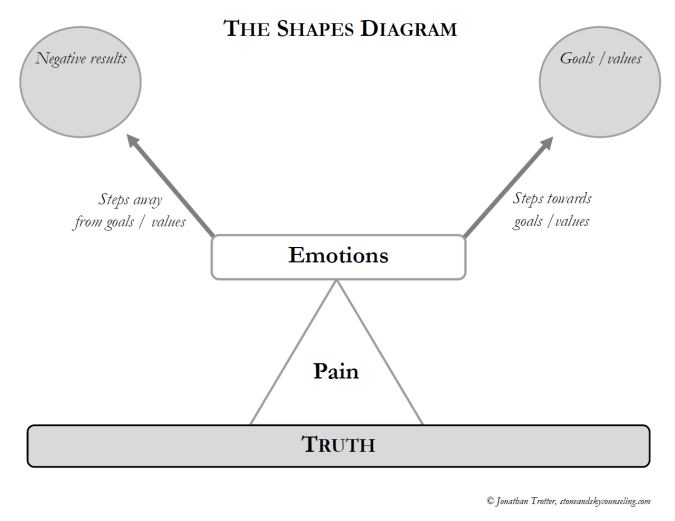
I’ve creatively titled this tool “The Shapes Diagram.” I use it with 90% of my clients because it takes complex ideas (like emotions and inner healing) and makes them a bit more concrete.
This diagram basically designed itself as I was trying to communicate some core emotional health ideas to Cambodians in Khmer. It wasn’t that my clients were dumb, it was that I lacked enough language skill to accurately describe some things.
So I did what any former youth pastor would do, I started scribbling. And this is what I came up with:
I’ll walk you through the thing here in a minute. But if you’d rather watch an 11-minute video of me explaining The Shapes Diagram, click the video below.
[See the second video below for a discussion of the difference between lie-based and fact-based pain.]
OK, so here’s a rough walk-through…
Basically, we all have emotions, and most people end up seeing me because they’re having some emotions they don’t like. In other words, most people don’t come in happy (except the pre-marital clients, they do come in happy, and usually they leave happy too, but that’s not a given).
We start in the middle rectangle. For many, the rectangle (emotion) is anger or sadness or anxiety. Now, many pastors hear the story that led to the unwanted emotion and immediately start looking at what STEPS the person needs to take (or avoid) in order to get to the positive result (and avoid the negative one).
For example, someone might tell the really sad person, “Exercise, read your Bible more, pray!” They might continue, “Don’t drink when you’re sad, don’t do drugs, don’t watch Gilmore Girls. Those would be steps in the wrong direction and would lead to a negative result.”
Here’s the thing: that might all be good advice, and maybe people need to hear it, but pretty much every depressed person I’ve ever talked to already KNOWS those things. What I’ve come to believe (and experience with my clients) is that for the most part, all of that top part (the middle emotion box) and the steps and the results are all future-oriented things. That is, they force the client to ask, “What will I do now?” And that’s certainly a very valid question.
The thing is, that top half of the diagram (Emotions plus Steps plus Results), often balances precariously on the triangle that consists of emotional pain and lies from the past.
Often, past painful events in the client’s life have caused him or her to believe, deep down in their core, lies. Lies like “I’m worthless,” “I’m unlovable,” and “I’m broken beyond repair.”
It takes a lot of energy to keep everything steady on the tip of that triangle, but people try. And they try and they try. And they never deal with the emotional pain and the lies. We do them a tremendous disservice if all we do is give them Steps.
I want to ask the question, “What’s in the triangle? What’s the pain that this is all balancing on?” In practice, about half of my clients see this diagram and immediately say, “Oh, I know what’s in that triangle!” They then go on to list the traumatic event or the emotional trauma and the lies it planted. The other half typically says, “Well, I think this is probably true, but I’m not sure what’s in there.” That’s fine too, and so with their permission, we just continue the conversation.
If we can help a client to see what’s in the triangle and label it and maybe find the lies, then we can encourage them to invite Jesus into that specific place for healing. We can invite the Truth in and he can counter the lies and heal the emotional pain. The triangle can be erased, and it’s not nearly as mystical as it sounds. : )
Then, with the triangle gone, the client’s emotions are simply resting on the Truth (Jesus). The emotions are still there, because the client is still a human, but the whole thing is much more stable.
Now some people try to bypass the triangle and jump straight to the Truth. But that’s not as effective. In fact, it’s just terrible. You can’t skip the triangle and jump straight to Jesus. You want to meet Jesus in the triangle. And he wants to meet you (and your clients) there too.
If you jump over the triangle (the pain/lies) you also jump over the healing.
I ask people to imagine that someone’s drowning in the middle of the Mekong. What if I see them drowning and I ride my boat over to them and I give them five gallons of good, clean water. Do they need that water?
Well, sort of. I mean, people need clean water to drink. And the Mekong is filthy. But is it helpful to them? No. It’s also not very kind. When someone’s drowning, I don’t want to just throw clean water at them, I want to actually help them.
We do that to folks who are depressed or anxious or experiencing a lot of difficult emotions. We give them good clean “water” of Truth and throw a Bible verse at them and stuff. The verses are true and good, but the timing is way off. Help the person NOT drown. That’s what the Church has to get better at doing, not just throwing water bottles to drowning/depressed people and telling ourselves we were helpful.
Caveat: I’m all for medication if it’s necessary, and I would NEVER tell someone who’s depressed to stop their meds or go off their meds. I’m talking about a holistic approach here. So maybe someone’s on meds, fine, they should still be looking at what might be in the triangle. Maybe there’s nothing, but maybe there’s something. Maybe it really is just a chemical imbalance that needs intervention. I believe that happens. But I also think exploring past painful events and asking around for deep-seated lies can expose someone to healing and greater self-awareness.
~~~~~~~~~~~~~~~~~~~~~
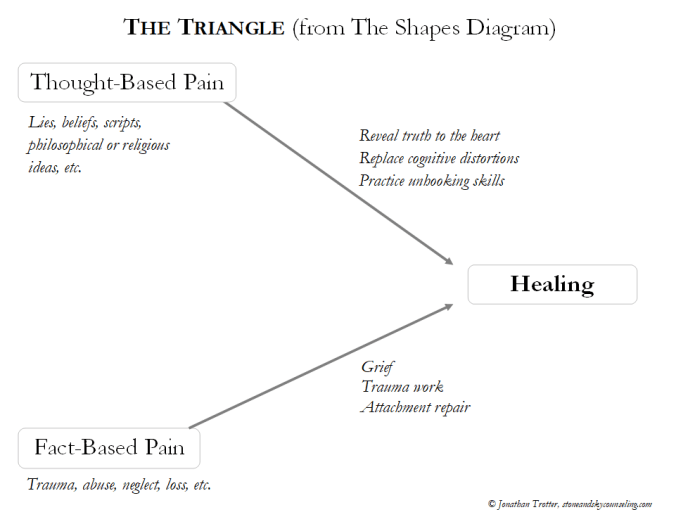
November, 2018 Addendum Let’s talk about the difference between lie-based pain and fact-based pain (the stuff in the triangle), and why the distinction matters.
Here’s the new handout I’m using with clients…
Purchase the PDF handouts for $4.99 here. (Drop your email address in the comments when paying and I’ll email you the files. Thanks!)
“If we honestly face the sadness of life in a fallen world, then only our hope in Christ can preserve us from insanity or suicide.” – Larry Crabb
That’s an intense statement, and I sort of choked when I read it for the first time. But the more I chew on it, and the more I ponder my own life with its episodes of emotional and intellectual crisis, the more I think it’s correct.
I spent three years working as an ER/Trauma nurse in an urban hospital in the States, and that bloody, chaotic trauma room forced me to “honestly face the sadness.” Those were dark days indeed; I was ill-prepared, psychologically and theologically, to deal with the darkness and the depth of the pain I witnessed. I was far outside of the Christian bubble, and reality bit hard.
For many people, moving across cultures, often to developing places, serves as their wake-up call. Missions becomes their trauma room, where they see suffering and poverty and grief up close and personal. People often move to Cambodia bright-eyed and in love, and then after a few months, or perhaps a year, the accumulation of the poverty and the corruption and the darkness forces them to “honestly face the sadness.”
Have you seen that happen?
Of course, the sadness was present in their affluent passport countries too, but money and familiarity have a way of disguising and hiding pain, like gold lacquer on cardboard.
But when the suffering is really seen, honestly, it does what Martin Luther wrote about nearly 500 years ago; it “threatens to undo us.” Of course, it doesn’t have to undo us, but it certainly threatens.
Not because you were brave enough to move overseas “alone.”
Not because you ignored the caring relatives who asked, “How in the world will you find a husband over there?”
You are loved. Adored, even.
Not because you’re an independent thinker, a strong person.
Not because you’ve sacrificed.
You are loved. Anticipated, even.
Because of Him.
You are loved by the eternal God, your Harbor.
You are loved by a Dad who wraps you up in his everlasting arms.
You are loved by the One who knows the true depths of loneliness and the rich intimacy of friendships.
Indeed, you are loved.
You are valuable.
And you are needed. Our churches, our teams, and our families need you.
You probably know that already. You probably feel that already. But just in case you don’t, as a brother, father, husband, team leader, pastor, and friend, let me remind you how much we value you and need you.
We don’t need you to be a wonderful Christian woman. We need you to be a wonderful Christian human, unique because of your personhood, not just because of your womanhood. We need you to love people uniquely, heartily, and with passion.
You see the woman caught in adultery differently. We need your eyes. You are more aware of the emotional needs behind the physical needs. We need your awareness. We need your heart.
We need you to lead. Your perspective is valuable, your needs valid, your abilities real. You see problems and solutions differently. We need your intellect.
We need you to support us. Not like a cook supports the troops, but like a soldier supports a comrade. We serve side by side in this thing.
My kids need you. And not as a babysitter.
My sons need you to show them what a strong woman looks like. Teach them that a woman’s value does not come from the fact that she’s got a body, or a husband, or kids.
My daughters need you. They need to see a woman who’s willing to follow God’s call regardless of who joins her. They need to see a woman who pursues God on her own, enjoying her own relationship with him.
You are not half a unit. Some stray ingredient that I guess we’ll mix in with the “real” ingredients of teams and churches and potlucks.
You are not leftovers.
Without single women serving abroad, there would be a gaping hole in the Church and in the history of modern missions. And in my own life.
Growing up, the names (and books) of Amy Carmichael, Gladys Aylward, Corrie ten Boom, and Elisabeth Elliot taught and inspired and coached me. I read their books, listened to their stories, and learned from their faith.
Single women still teach, inspire and coach me. I am grateful for ladies like Amy, Sara, Yvonne, Tanya, Christina, Rhoda, Ann, Jenny, Sue, Sarah, Mary, Sovannara, Emma, and so many more. I listen to them speak, I read what they write, I watch them love people, I observe their journey through Facebook status updates, and I am grateful.
I need them. The Church needs them.
And Jesus loves them. And he loves you too. Not because you’re awesome or beautiful or perfect. Not because you’re really good with Instagram filters. But because you are part of his Bride, his people. Immensely valuable.
Every day, Elisabeth Elliot began her radio program with this reminder, “You are loved with an everlasting love – that’s what the Bible says – and underneath are the everlasting arms.”
May you remember his everlasting love,
May you rest in his everlasting arms,
Today, tomorrow, and everyday.
With deep appreciation and gratitude, your friend, Jonathan Trotter
~~~~~~~~~~~~~~~~~~~~~~~~~~~~~~~~~~~~~~~~~~
*This article originally appeared on Velvet Ashes. Used with permission