Seven ideas for teaching your teen to drive (things I wish I’d known)

Our fourth kiddo just passed her driver’s test this week, and honestly, I’m pretty happy to hang up my hat as the resident driving instructor. It has not been my favorite part of fathering (and that’s on me, not my kids).

Here are some things that helped along the way, and I wish I had known them when I started…

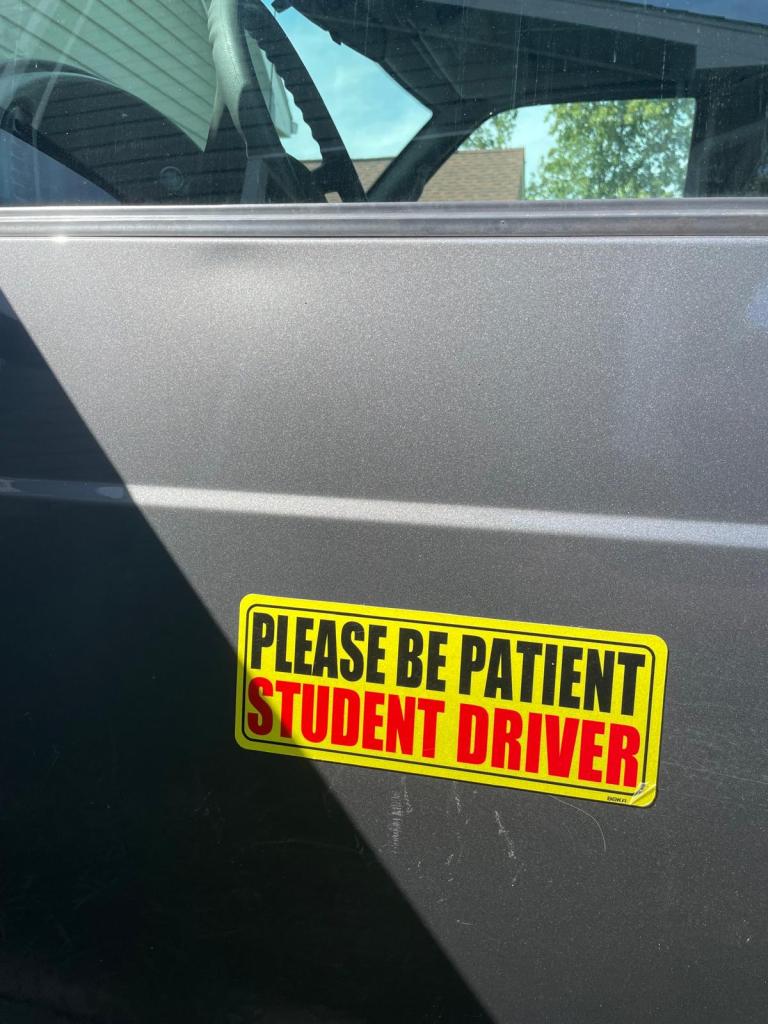
1. Buy these magnets. We put them on both front doors and the rear of the car. I’m positive it reduced the anger and frustration of other drivers, which increases safety for everyone. You don’t want a stressed out student driver getting honked at if you can avoid it. It also caused other drivers to give us a wide berth, which is great, all things considered. We went through two sets of these (they’re pretty cheap on Amazon).

2. Read The Inner Game of Tennis by Timothy Gallway. I know I how to drive, but I didn’t know how to TEACH driving. This book has nothing to do with driving, but everything to do with teaching someone a skill. I changed my teaching style dramatically after reading this book.

3. Drill the simple. We spent ample time drilling in order to reduce cognitive load:
– Red light right? Stop, yield, go.
– Red light left? Stop.
– Green light left? Yield, go.
– Green light right? Go.
– Etc.

4. Use CLEAR communication about stopping, and practice it. We trained in a parking lot that if I say STOP, it always means STOP NOW. If I needed them to stop up ahead somewhere, or slow down to a stop, I would say, SLOW TO STOP. It was helpful for me to know that if something came up and I said STOP, they would react immediately and without thinking.

5. Remember that driving is a very complex skill that doesn’t feel like it to you anymore. But it is, and the cognitive load for the newbie is very high.

6. It’s about more than driving. It’s about a kid learning resilience and processing and how to not freak out even when lots of data is coming at them.

7. Your kid doesn’t know what they’re doing, and neither do you. Breathe. Hug. And look forward to a future day when you celebrate with your daughter because she just passed with a 100% in a Chevy ASTRO…

Traffic | Postcards from Re-entry

by Elizabeth

We drove through the city recently. We didn’t even drive into the city; we just drove through it on the interstate. I was shocked by how quickly the traffic changed. It became so much faster, so much more crowded, and so much more stressful – and I wasn’t even the one driving.

When I lived in Kansas City, I thought this kind of traffic was normal. It didn’t stress me out. I knew the city like the back of my hand, and I could drive most places on autopilot. But now that I’ve lived away from it for over a year, the city feels very overwhelming. I’ve definitely become accustomed to the slower pace of driving in Joplin. And I have no desire to return to city driving.

I have, in fact, successfully contracted my life. The grocery store is five minutes away, as is the doctor. Our church is ten minutes away, and the airport is close by. I don’t mind at all. On the days when I have to drive across town – say, for instance, to the dentist — it feels like I’m making a long journey. And it’s only 20 minutes. This stands in contrast to Kansas City driving, where no one bats an eye over a 20-minute drive, and many trips are 40 minutes or more.

Traffic is light here, most of the time. And when traffic is heavy, it’s nothing like the painfully slow, packed streets of Phnom Penh. I didn’t even drive in Phnom Penh. Traffic was so stressful that the very first week we lived there, I decided never to drive in it. And the traffic only worsened over the years. That means I experienced Phnom Penh traffic only as a passenger, either in a vehicle with Jonathan driving (and probably getting stressed out) or in a tuk tuk.

So whether I compare Joplin traffic to Kansas City traffic or to Phnom Penh traffic, I will choose Joplin every time. It is relaxed and unrushed, and I love it. Initially it was stressful learning the art of the traffic circle, but now I love its simplicity. And at first it was disorienting to try to find my way around a new town, but these days I’m more familiar with the layout. Now that I’ve lived here awhile, I’m not sure I could ever go back to city driving, and I’m perfectly content with that.