A Letter for the One Who’s Waiting {Velvet Ashes}

by Elizabeth

waiting-shortcuts-detour-726x484

You in the waiting,
Yes, you
And yes, me too —
For we are all waiting for something —
Dear sister,
Beloved one,
You in the waiting,
This much I know:
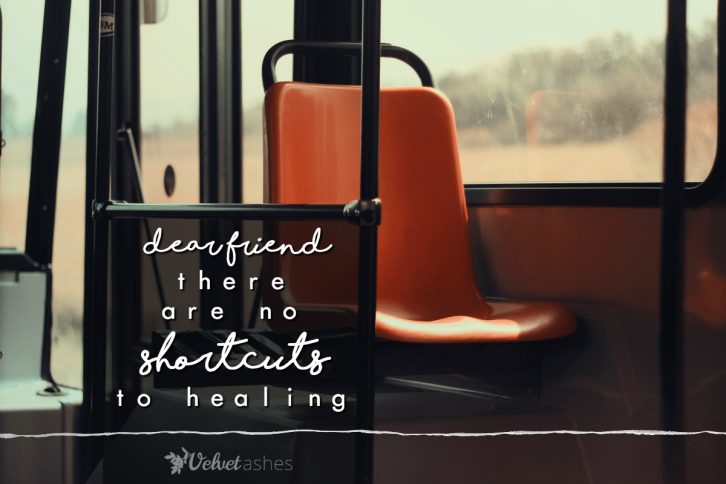
There are no shortcuts to healing.
There are no shortcuts to wholeness.
For we can’t know God as Healer without first being wounded.
And we can’t know God as guide without first being lost.
We can’t know Him as counselor without first being confused.
And we can’t know Him as comforter without first sustaining pain.
We can’t know Him as intimate companion without first feeling abandoned.
And we can’t find our identity in Christ alone without first losing it elsewhere.

You in the waiting,
Dear One,
This much I know:
There is no way around the ache of the human soul.
There is no detour through the pain.
When we walk through the valley —
And we will all walk through the valley —
None of us gets to skirt around the edges.
We are completely baptized in sorrow,
Fully immersed in its grief.
For there are no shortcuts to healing,
No shortcuts to joy.
There is only Jesus.
If anything, He is the short cut:
He is, after all, our Way home
Even if that way be long and broken.

So you in the waiting,
Keep waiting.
Keep seeking,
And keep asking,
Even in the silence —
For there may be silence —
And even in the darkness —
For there may be darkness —
But don’t you give up Hope.
Hold on to Hope.
Hold on to the name of our Jesus.
This waiting, it takes time.
It takes space.
And, I wish I didn’t have to say this, but —
It takes hard work too:
The hard work of shedding the lies we believe about God,
The hard work of shedding the lies we believe about ourselves,
The hard work of being honest with Him about the injuries,
And the hard, Spirit-assisted work of letting go of our entangling sins.

So you in the waiting,
Yes you —
And yes, me too —
For we are all waiting for something —
Dearest sister,
Beloved One,
You in the waiting,
This much I know:
There are no shortcuts to healing,
But in Jesus there is healing.
And there are no shortcuts to wholeness,
But in Jesus there is wholeness.
So we hold on to Him,
We hold on to Hope,
And together, we wait.

Originally published here, reprinted with permission.

The Two Things I Believe About Youth Ministry

by Elizabeth

bonfire-698917_960_720

I was 19 years old when youth ministry bored its way into my bones and penetrated my marrow. I’m 34 now, and youth ministry still pours into my blood and circulates through my veins. I believe in youth ministry, in all that is good and holy about loving and caring for young people in the context of the local church. And these are two of the things I believe about youth ministry:

1. Effective youth ministry isn’t in opposition to involved parenting. It doesn’t have to be “youth ministers are bad and war against the parents.” And it doesn’t have to be no ministry at all. Youth ministry can be respectful of parents and their influence and authority. It can bridge the gaps between parents, teenagers, and the local and global Church.

2. But effective youth ministry needs more workers: more Bible teachers and youth leaders, more Christ followers and relationship builders. Group ministry is great — and I believe in it — but one-on-one discipleship is even greater, and I believe in it even more. One minister or even a ministry team can’t possibly disciple all the youth in the church. So we need more people who care. More people who aren’t afraid of teenagers. More people who think youth ministry means something, something really important. Because youth ministry does mean something. It means the world to every teenager you invest in. So let’s do a little investing. A little guiding. A little caring and a little paying attention. And we just might witness the restoration of lives and the rescue of souls.

~~~~~~~~~~~~~~~~~~~~~~~~~~~~~

With many thanks to the youth workers who poured into me as a young person, the youth workers who now pour into my own children, the parents who have trusted me to minister to their children, and the teenagers who have allowed me into their hearts and lives over the years. I love you all.

Facebook lies and other truths {A Life Overseas}

Jonathan is over at A Life Overseas today . . .

fbl1-700x439

Have you ever created a fake boyfriend? Yeah, me neither.

One woman did, though, and while she’s no Chewbacca Lady, I still think she’s pretty awesome. You can read Ms. Smothers’ story here. Apparently, It only took one week and five easily stageable posts for Smothers to convince her followers that she had found love.”

Facebook, er, Instagram, lies. [And for the purists, Facebook owns Instagram, so the title of this post still fits.]

Ms. Smothers succeeded in convincing her followers that something amazing had happened: she had found love!

But it was all a ruse.

You can finish reading the article here.

The Home School Manifesto

by Elizabeth

homeschoolmanifesto1

We will remember why we started homeschooling in the first place, and we will write those reasons on the door frames of our houses and tie them as symbols on our hands so that on the hard days – for there will be hard days — we will not forget the bigger picture and higher purpose.

We will remember that homeschooling is only part of parenting, and that even when we feel like quitting, we will remember that quitting home schooling will not solve all our parenting woes.

We will find our safe people. We will confide in other parents who understand both our daily struggles and our big picture struggles. And we will politely ignore those who disdain our family and educational choices.

We will commit to seeing our children as whole, integrated beings and not as students only, and we acknowledge that their scholarship — whether high, low, or somewhere in between — is only one aspect of their personhood.

We will remember that we are not trying to produce perfection; we are trying to honor humanity. We are trying to explore the big ideas in Scripture and literature together. We are trying to build loving relationships and make good memories.

We will accept our own limitations. And we will accept our children’s limitations. We will embrace who our children are and not try to squeeze them into any one particular educational mold.

We will laugh often, and we will refuse to take ourselves too seriously. We will release the pressure on ourselves to perform and to produce kids who perform. Performance is not the point of education; neither is it the point of life.

We will remember that kindness and character are more important than test scores, and we will refuse to devolve into check-listing. Or competition.

We will cultivate our own sense of wonder, and we will share that wonder with our children. We will delight in the world God made, we will delight in the children He has given us, and we will delight in learning new things alongside them.

And when we miss the mark and forget these things – because we will miss the mark sometimes – we will return to the notes on our door frames, turn our hearts toward our children, and ask the Holy Spirit to guide us anew.

—————–
Download a printable PDF version of this Manifesto here.

This is what I know about spiritual formation (so far)

by Elizabeth

potters-410290_960_720

An Anglican priest ruined it for me. He ruined the phrase “enter the presence of God.”

I was at a Lenten prayer service last year when he said, “Let us become present to the Lord, for He is always present to us.” I knew what he was saying was true, for I’d learned it in other areas of my life (Psalm 139 anyone?). So what he said was more a vocabulary lesson than a course correction.

God is always present and available to us, and I can no longer say with integrity that we “enter the Lord’s presence” during a worship service. In fact, now when I hear that phrase from others, I start to tune out. What I can say with integrity is that we can choose to become present to the Lord.

So with that in mind, here’s everything I know about becoming present to the Lord. In other words, here’s everything I know about spiritual formation (so far).


1. Regular, private devotional times with God.

I’ve talked about this a lot before and how it’s changed my life, so I won’t rehash it here. I’ll just summarize my low-pressure method for cultivating intimacy with God:

  • Don’t feel guilty for short times with God
  • Don’t feel guilty if you can’t keep up with a fast-paced Bible-reading plan
  • Don’t feel guilty for deviating from your plans
  • Don’t feel guilty about skipping times.


2. Meeting with other believers for corporate worship.

The Church has been key to my spiritual growth. I go into a worship service expecting God to speak to me through songs, sermons, and prayers. And He does.

I’d like to quote Misty Edwards here on the mystery of corporate worship: “Musical worship involves a physical voice, physical sound waves that actually move through the air and strike your ear, go into your mind, into your emotions and spirit.” She also noted that “Musical worship is how the Body becomes One.”

I cannot downplay the importance of the Church in my spiritual life; neither can I downplay the importance of my private devotional life. I need both.


3. Small group Bible studies and other intimate forms of community.

I’ve talked about this before, but for years in the States I was part of a small ladies’ Bible study. I learned so much about life and faith from those (mostly older) women. They empathized with my struggles and prayed me through some of my darkest days. Most of what I know about Grace, I learned with them.

These days my teammates function as my small group. We share sorrows and joys together and pray for and support each other. I’m so thankful for people who listen to, accept, pray for, and advise the “real me.”


4. Getting counseling.

Sometimes personal devotionals, corporate worship, and talking with trusted people are enough to work through my issues; sometimes they are not. I’ve had several key breakthroughs in my life because of counselors (both licensed professional counselors and pastoral counselors), and I cannot overstate the importance of sometimes getting outside help. I would not be where I am today in my relationship with God and my relationship with others without the help and intervention of those counselors.


Well there you have it, everything I know about spiritual formation (so far). What would you add to my list?