Open letter to trailing spouses {A Life Overseas}

Elizabeth is over at A Life Overseas today, offering words of encouragement for marriages struggling through a trailing spouse issue.

ts4

“Feeling so fearful and alone since moving as a trailing spouse”

Last month someone found my blog because they did an internet search for that phrase. It reminded me how much pain a trailing spouse endures. I remember the struggle; I remember the suffering. And while whoever typed those search terms is actually not alone, I can attest to the fact that it very much feels that way. I remember how dark it felt, how black the future seemed. I remember how much pressure I was placing on myself not to ruin my husband’s dreams. I remember being afraid that nothing would ever be OK again and that it would all be my fault.

Telling my trailing spouse story has opened up conversations with women all over the world, both before and after they reach the field. (A trailing spouse doesn’t have to be a woman, but women are the ones who have reached out to me.) So with that in mind, I’m going to share parts of emails I’ve sent to women who have asked for more of my story. I’ve deleted identifying details to protect their privacy. These are the things I would say to any marriage dealing with a trailing spouse issue.

Finish reading the post here.

Underwhelmed by God’s Love

l2h

by Elizabeth

As a family we recently read the story of Jacob fleeing Esau and sleeping on a stone and having that ladder dream. I’ll be honest, the ladder story has never done very much for me. Who cares about some dumb stairway in a dream? (Apparently, I didn’t.) But that night the story moved me like never before. In it, we learn that God interacts with us, relates to us, speaks to us, not because of what we’re doing or how well we’re following Him (because at that point Jacob wasn’t), but because He loves us.

He loves us? Yes, He loves us — loves us because we exist, because He made us, because He is Love. He loves us because He has chosen us, and our relationship with Him isn’t dependent upon our good behavior, our good standing, our proper obedience. It wasn’t until years later that Jacob was really following God with his heart, but here God gave Jacob an experience of Him that was so intense that he named the place Bethel, or “house of God.”

Jacob met God in that place, and it wasn’t because of anything Jacob had done. To think that God wants to interact with me no matter the state of my soul! How wondrous not to deserve this interaction with God, but to get it anyway. How incredible that He gives us His fellowship even though we are unworthy. His love is that big. And this kind of unconditional love is not just in the New Testament as we sometimes tell ourselves (or as I sometimes gathered growing up in church). No, God’s unconditional love is all over the Old Testament too. We don’t deserve this relationship, yet God gives it to us anyway — even before He sent His son.

Hearing my husband read this story out loud spoke to deep places inside me. Afterwards I tried to share my amazement. What I said may not yet make sense to such childlike faiths — young hearts that don’t yet doubt God’s love for us human beings. But I hope that planting these kinds of revelations in their little hearts and minds will help them later in life. I hope they will look back on what we taught them and be able to see His love written all across Scripture in a way that is sometimes hidden from the more legalistic among us.

So thank you, God. Thank you for including the story of Jacob’s ladder in your Word. Thank you that a passage I know so well and am usually so underwhelmed by could still touch me so deeply. To borrow a phrase from Connie Harrington, “Your grace still amazes me. Your love is still a mystery.”


Faith That Won’t Fracture

by Elizabeth

fract3

By now you probably know I’m a romantic about the Cosmos. So when I heard that Krista Tippett had interviewed Margaret Wertheim for her podcast On Being on April 23rd of this year, I knew right away I had to listen to it. Several years ago Wertheim gave a TED talk on coral reefs as physical representations of hyperbolic (or non-Euclidean) geometry, and I’ve been enraptured by — nay almost addicted to —  those ideas ever since. (But hyperbolic coral geometry is a blog post for another day.)

Anyway, at one point during the interview Krista Tippett says, “So, I always like this fact that light can be a particle or a wave depending on what question you ask of it as kind of a way of demonstrating, I think — something we all also experience, that contradictory explanations of reality can simultaneously be true.” Oh yes – there is paradox in physics as well as life. I’ve talked about that before.

Krista goes on to read something beautiful that Margaret Wertheim wrote in one of her books:

“Wave particle duality is a core feature of our world. Or rather, we should say, it is a core feature of our mathematical descriptions of our world. But what is critical to note here is that, however ambiguous our images, the universe itself remains whole and is manifestly not fracturing into schizophrenic shards. It is this tantalizing wholeness and the thing itself that drives physicists onward like an eternally beckoning light that seems so teasingly near. It is always out of reach.”

In the interview Margaret expounds on her own quote:

“Physics, for the past century, had this dualistic way of describing the world. One in terms of waves, which is usually conceived of as a continuous phenomena. And one in terms of particles, which is usually conceived of as a discrete or sort of digitized phenomena. And so quantum mechanics gives us the particle, as it were, discrete description. And general relativity gives us the wavelike, continuous description. And general relativity operates at the cosmological scale. And quantum mechanics operates so brilliantly at the subatomic scale. And these two theories don’t currently mathematically mesh. So the great hope of physics for the last 80 or so years has been, ‘Can we find a unifying framework that will combine general relativity and quantum mechanics into one mathematical synthesis?’ And some people believe that that’s what string theory can be. And it’s often — when contemporary physicists write about the world, they talk about this as being a fundamental problem for reality. But it’s not a fundamental problem for reality. It’s a fundamental problem for human beings. The universe is just getting on with it.

And so I think the universe isn’t schizophrenic. It’s not having a problem. We’re having a problem. And I don’t think it means that there’s anything wrong with what physicists are doing. Quantum mechanics and general relativity have both been demonstrated to be true in their demands of expertise to 20 decimal places of experimentation. That’s a degree of success which is mind-blowing and awe-inspiring. But the fact that these two great, fabulously functional descriptions don’t fit together means we haven’t, by any means, learned all we’ve got to know about the world.”

I love how Wertheim says the Cosmos isn’t fracturing with our inability to reconcile relativity (on the large scale of planets, stars, and galaxies) with quantum mechanics (on the small scale of subatomic particles). The Universe isn’t freaking out about this problem. We humans are the ones freaking out, because we can’t get the math to work.

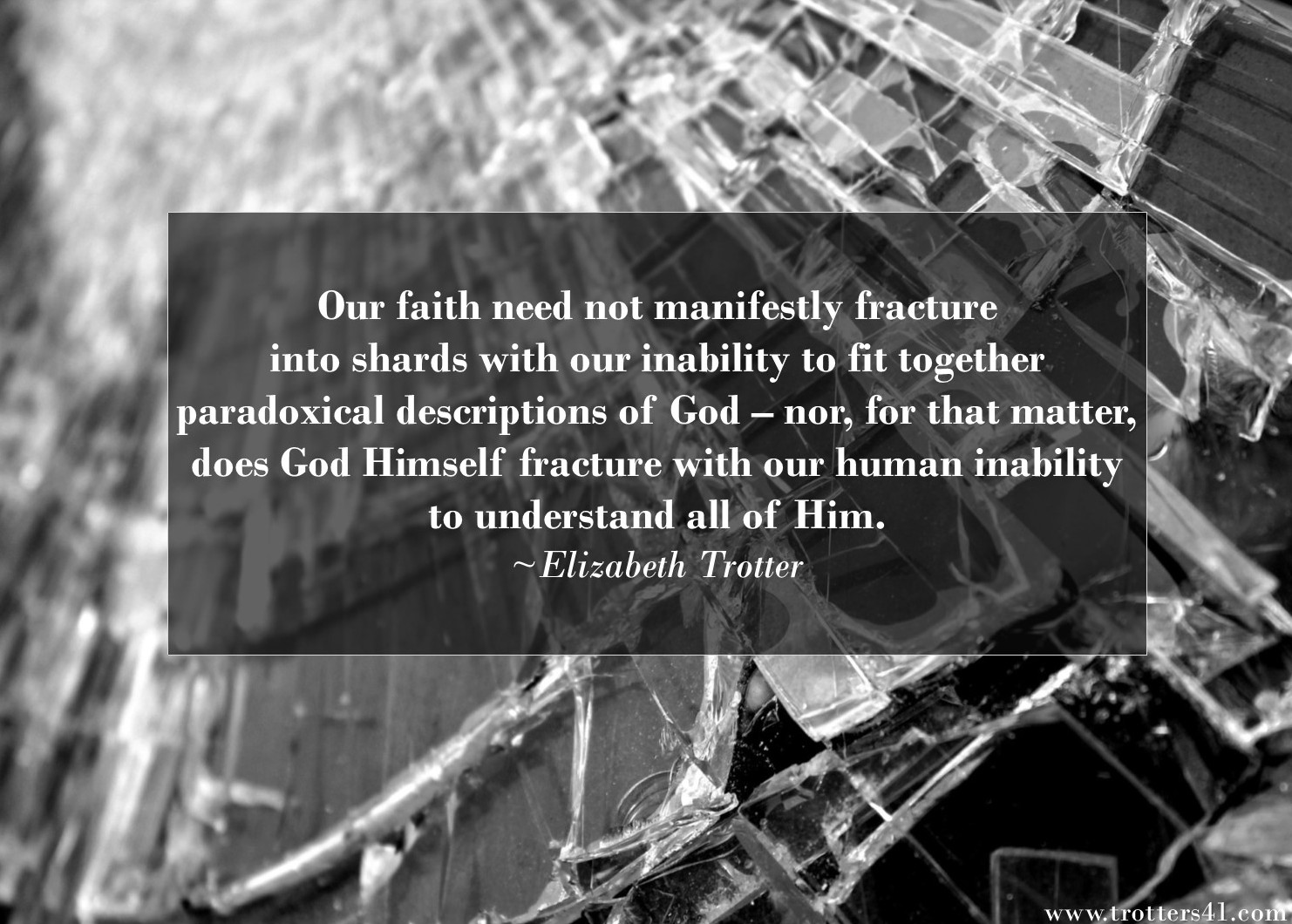
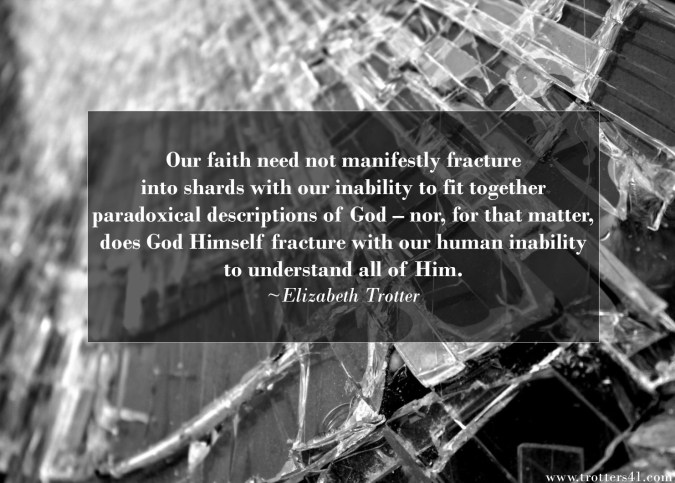
In the same way, our faith need not manifestly fracture into shards with our inability to fit together paradoxical descriptions of God – nor, for that matter, does God Himself fracture with our human inability to understand all of Him. I love the idea that the Cosmos and its Creator are higher than our capacity to comprehend them. I love the sense of awe and wonder that induces. And I love the fact that there’s always more for us to learn and discover.

In the 6th chapter of John’s gospel, Jesus says some really strange cannibalistic-sounding things. The disciples respond by saying, “This is a hard teaching. Who can accept it?” The Greek word that is translated “accept” means to “comprehend by listening.” I find there is a difference between accepting something as paradox or mystery, and actually comprehending it. So perhaps the disciples were really saying, “Who can understand this teaching?”

I do not need to fully understand the way the universe works in order to accept that it does work. I do not have to fully understand Jesus’ words in order to accept them as Truth. This is the enigma of loving a limitless God.  This is the mystery of life with Christ, God-made-flesh. This is the joy of a faith that won’t fracture.


photo credit

margin: the wasted space we desperately need {A Life Overseas}

Jonathan is over at A Life Overseas today, talking about margin. . .

margin1

“Staying alive is not about how fast or how slow you go; it’s about how much margin you have.”

That’s what a friend of mine here in Cambodia says when asked about how to not die while riding motorcycles in our little corner of Asia. And since he’s been riding and racing motorcycles since before I was born, I listen.

Going slow with no margin can be more dangerous than going fast with tons of margin. It’s true with motorcycles and it’s true with missions.

Your speed is not necessarily what determines your safety; your margin does. Margin takes into account all sorts of variables: How far can you see? How much space is between you and the next vehicle (or cow)? What are the road conditions? Is this even a road? How likely is it that the large pig strapped to the back of that bus in front of you will stay strapped to the back of that bus in front of you?

Read the entire post here.

A Few of My Favorite Things

by Elizabeth

I’m excited to start a new series! From time to time, I’ll be sharing links to my favorite blog posts, books, songs, videos, etc. I wanted to put all my favorite resources in one place, rather than scattering them around Facebook the way I’ve done in the past. I’m super excited to share things that have been an encouragement to me, and I hope they will be to you, too. This launch post might be longer than usual because it has some of my “old” favorites along with the newer ones.

som2

BOOKS

The Prodigal God by Tim Keller. I read this book this spring and cried on nearly every page. I cannot do the book justice here without quoting entire chapters. It’s a short read anyway, so you should just read it yourself!

Grace for the Good Girl by Emily Freeman. I’m just starting this book and really enjoying it so far. I so relate to the way she describes herself in the first couple chapters! I wish I had read this book in college and saved myself a lot of spiritual pain and effort. I’ve learned a lot of truth about grace through trial and error, but it’s always good to take a refresher course, if you know what I mean! You can get a taste of her material for free by watching her book club videos.

Reflections for Ragamuffins by Brennan Manning. Still loving this book and reading it almost daily. Occasionally I post exceptionally good quotes on Facebook.

VIDEOS & PODCASTS

IF:Equip on Matthew 5:4. I love subscribing to IF:Equip! The 2-minute video discussions each day are very interesting and insightful. This one is closely related to what I learned about repentance earlier this year, and so it was very dear to my heart.

More IF:Equip on Matthew 5:4. More video discussion on the same ideas. Such richness.

Who Do You Think You Are? Short video at Self Talk the Gospel. I love Self Talk the Gospel’s tagline! “We must embed the Gospel so deep within our conscience that it transforms the way we think, which, in turn, will transform the way we live.” Don’t you just love that?

How Christians Find Hope for Anxiety by Meghan Alanis. This 15-minute interview at Self Talk the Gospel mirrors my own experience with anxiety: that it can be helped and healed. I’ve gone back to the interview a few times because it simply overflows with grace and hope for those struggling with anxiety. I truly believe that with God’s help (which sometimes includes medication and almost always includes counseling), we don’t have to be bound by anxiety. God can set us free. If you struggle with anxiety, you don’t want to miss this video!

Finding Permission to Rest. This is a one-hour interview with Bonnie Gray, author of Finding Spiritual Whitespace, at Kat Lee’s Inspired to Action podcast. I first found Inspired to Action through Kat Lee’s other blog Hello Mornings, which I also love. Oh man, was this podcast good! So rich with biblical insight and ideas for approaching God like a child and finding space for your soul to breathe. I haven’t read the book yet, but it’s on my list.

How To Do a Greek Study Using BibleHub.com by Katie Orr. This short tutorial taught me how to look up Greek words on BibleHub.com, something I didn’t know how to do before — and something that has been very useful because I left my Hebrew/Greek Study Bible in the States when we moved here. (I found Katie Orr through Hello Mornings as well.)

BLOG POSTS

God Can Heal Our Broken Potatoes by Chris Bowman. A blog post I’ve returned to again and again ever since Chris first published this post on his own blog a couple years ago. I was honored to repost it at A Life Overseas this year.

Airplanes are Time Machines by Angie Washington. Encouraged me to lift the timeline off my expectations of others and introduced me to The Message version of Matthew 11: “Learn the unforced rhythms of grace.” I think this was the first post I ever read at A Life Overseas, and it hooked me. I so needed its message.

When You Have to Wash Seven Times by Erin Duplechin. A gorgeous story of the restoration that comes slowly but surely. We all need the healing of Jesus every day of our lives. Erin’s words are life and hope for the soul.

I Broke Up With My Therapist by Megan Gahan. Hmm . . . breaking up with your therapist? Except it’s not what you think! So good. Reminded me of a book I got free on Kindle a few years ago. I have definitely had this problem in my life.

Ask Me in 10 Years by Kathy Escobar. Super-encouraging post about personal change being S-L-O-W.

Slowly, Then All At Once by Tanya Marlow. Another encouraging piece about perseverance, slow change, and waiting on God.

Dwell by Chris Lautsbaugh. God wants to dwell with us. Best news ever!

TELEVISION

When Calls the Heart from Hallmark Channel. My husband found this on Netflix, and I fell in love with it (though I’m a little upset the second season ended in such a cliffhanger!). It’s based on Janette Oke’s Canadian West novels, and the show inspired me to read the book on Kindle. I’m into the second book now, which is basically the story of a woman crossing cultural lines, so I have a lot of fun with that. The TV show deviates pretty far from the books, but I love how clean and family friendly both of them are.

North and South by the BBC. I just found this 2004 adaptation of Elizabeth Gaskell’s novel on Netflix. Will someone please tell me how the internet has been keeping this jewel from me all this time??! It’s one of the most achingly romantic stories I’ve ever seen — and you know I have high expectations in that area (think Anne of Avonlea, Pride and Prejudice, and Emma). North and South is like a Dickensian version of Pride and Prejudice, except it doesn’t focus solely on the marital aspirations of British young ladies. It also has a wider social commentary on poverty in Industrial England, making it acceptable for viewing even by husbands — and it just so happens to be a story of crossing cultures as well.


What about you? What are your favorites lately??