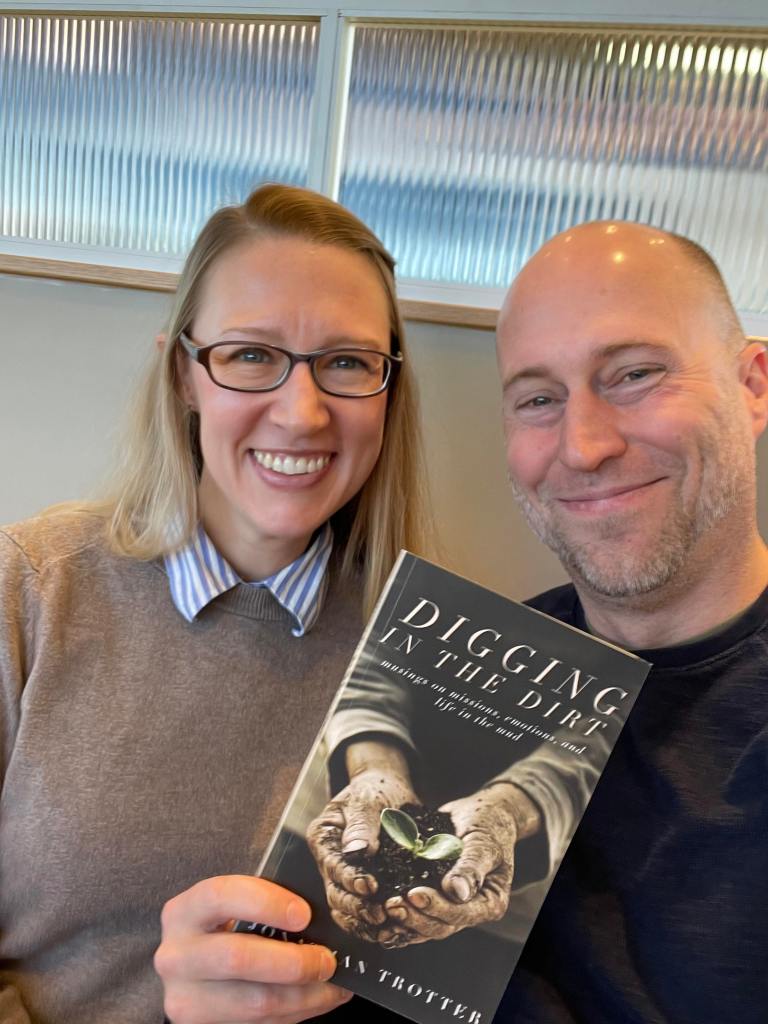
BOOK LAUNCH! Digging in the Dirt is here!

Buy it here!

From the back cover:

Welcome to ground level, to the dirt and the mess.

We like the mountain tops and the sunshine. We like green grass under a clear blue sky. We like victory and breakthrough and answered prayers. But sometimes it rains, the shadows deepen, and life turns muddy. Sometimes God seems quiet. What then? What happens when depression descends, or anxiety hangs like a sword overhead? What happens when loneliness suffocates, the thief steals more than stuff, and you get blood on your shoes?

In Digging in the Dirt, Jonathan Trotter delves into the disasters, the darkness, and the deluge, and he offers comfort, presence, and a gentle invitation to hope.

With humor and prose, with poetry and Top Ten lists, Jonathan welcomes us to the dirt, to the places where we actually live. He invites us to boldly see life as it is, with eyes wide open, and reminds us that even when the digging is scary, we are never alone.

To the ones who are dealing with devastation and distress, welcome. To the ones who need to uproot, to pull out, to clear ground, welcome. To the ones who seek desperately to plant seeds of grace and hope in once barren soil, welcome. To the missionary abroad and the believer at home, welcome. Receive the invitation, and join with Jonathan here at ground level, together.

Come, dig in the dirt.

From the preface:

Hello and Welcome!

I’m Jonathan, and it’s such a pleasure to meet you. I look forward to journeying with you through these pages. Together, we’ll delve into the dirt of life and relationships, of sorrows, pain, and loss. And maybe we’ll plant some things too.

Perhaps, along the way, we’ll see small, green stalks of life and hope begin to poke through, watered with the tears of the journey. Digging like this can be messy, but it can be good too.

These musings will meander from the hot dirt of Cambodia to the sticky mud of American politics. Some of these musings are inspired by international missionary life; some of them are firmly rooted in an American context. But whether you’re American or not, whether you’re a missionary or not, I hope that you find them all a blessing, an encouragement, and perhaps sometimes a challenge. I wrote them for you, and I share them with you with my whole heart.

Start reading Digging in the Dirt wherever you’d like, and feel free to skip ahead or go backwards. Are you a cross-cultural missionary? Start there if you want. Are you interested in developing emotional intelligence, or are you exploring whether or not Christians are allowed to have feelings? Consider starting in the Emotions section. Are you reeling from recent life events that have left you feeling like you’re choking on the mud and muck? First of all, I’m so sorry. Second, breathe a slow, deep breath, look over the Table of Contents, and start wherever you need to start.

Wherever you are, and whatever your story, welcome to ground level, to the dirt. It is here that the real work happens; the good, hard, sweet, healing work. It is my deepest hope that here, among these musings, you may find grace, peace, and a hope that just might be strong enough to crack through the crust.

All for ONE,

Jonathan Trotter
What people are saying about Digging in the Dirt:

A genuine book where no topic is off limits, Digging in the Dirt hits you right where you are regardless of location or vocation. This book is a must-read for anyone who is or is thinking about serving in missions and ministry! – DeAnna Anderson, former Director of the Launch Team for Wycliffe Bible Translators and missionary

Digging in the Dirt is a breath of fresh air for Christians. – Kim H.

Jonathan has such an authentic insight into life on the field, and he addresses the hard things in such a real and tangible way that helps you to know you are not alone. I would totally recommend this book for anyone who is serving overseas, sending someone overseas, or remotely interested in mission life. – Sydney, PI Leader for Southeast Asia

Rarely does an author bring the perspective of a missionary, nurse, theologian, pilot, counselor, parent, and gardener to cross-cultural ministry, family dynamics, depression, grief, politics, and the church, all in one book. Even rarer is a book that combines all of those things in a way that rings authentic and meaningful. Digging in the Dirt manages to do both, bringing thought-provoking and heartfelt lessons out of an incredible range of real-life experiences. – Reuben James

Digging in the Dirt is a must-read for anyone in missions or ministry. It’s refreshingly humble and vulnerable, and no matter what stage of life and ministry you’re in, you’ll walk away with some wisdom and new insight. – B.W., Stateside missions support worker

__________________________________________

Check it out on Amazon here!

*Amazon affiliate links

The Day We Didn’t Go Home {A Life Overseas}

by Jonathan

We were supposed to go home on August 6th. We had tickets and plans, we had dreams and ideas. But when we left Cambodia back in March, we did not have an awareness of how COVID-19 would turn the world upside down.

So we’re not flying home on August 6th. As a result of passport issues, visa issues, entry requirements, finances, and a whole host of reasons (everyone has them), we’re staying.

For our family, August 6th is now Stay Day.

Does your story include a Stay Day? Perhaps for you it wasn’t a Stay Day as much as a Leave Day. Do you have a day that marks when life quaked and plans tumbled? Do you memorialize a Stay Day or a Leave Day? Should you?

We hope to remember our eight years in Cambodia on this August 6th, and every August 6th afterwards. It will be a sort of anniversary; a blend of stories and laughter and tears.

Like so many memorials, it will be a funky mix of mirth and merry.

On Stay Day, we’ll remember the day we didn’t go home.

Sure, America is home too. Or at least it was. And it will be again. I’m speaking for myself here, of course, because my children will have their own stories, and they’ll need to tell them. Their relationship with America (and Cambodia) always was and always will be unique. Different than mine.

But some things we shared.

Like the eight years around a thick, Khmer-style round table. Well, more like seven. The first year we had a cheaper wooden rectangular table that got eaten up by termites so big you could hear them feasting: lightning-bug-size table chompers.

We’re shipping the Khmer-style table to America, so every Stay Day we’ll gather around it and remember.

We’ll remember the scent of frangipanis, and we’ll probably try to buy some. We’ll feel the feel of traditional kramas, the checkered scarves Cambodians (and my daughters) use for everything.

We’ll probably order Indian food and remember Mount Everest, the local restaurant in Phnom Penh that taught us to absolutely adore Nepalese and Indian food.

We’ll look at old photos of a younger family riding tuk tuks, playing on the street, trying to figure out cross-cultural living.

We might search YouTube for Khmer dance music, and we will probably laugh about the incessant, LOUD, and DRUNK karaoke that permeated our house during wedding season.

We’ll watch old videos of moto rides through our neighborhood, and we’ll remember the kind old man who laughed at the four white foreigners driving a moto through flooded streets and belly laughing. I wonder if he knew how much it reminded me of riding a jet ski.

Maybe we’ll check Google street view and meander past friends’ houses.

On Stay Day, we will remember. And we will pray.

We’ll pray for Cambodia, for our friends there, and for the Church that’s blossoming into its identity.

And Lord willing, we’ll do this every August 6th: the day we didn’t pack up, weigh all suitcases to 49.9 pounds, quadruple check passports, and jet across the Pacific.

August 7th won’t find us staggering out into the scents and smells of Phnom Penh. We won’t un-mothball our house and turn it back into a home. We won’t schedule reunions with local friends. We won’t visit favorite haunts and coffee shops.

Instead, we’ll mourn what was, and we’ll be grateful for it too.

Mourning is a wetter way of expressing gratitude, after all. 

And we’ll move on, whatever that means.

God remains the God of the past. He will always be the God of the past, and he will always care enough to ask the same question he asked Hagar, “Where have you come from?”

He is the God of Stay Day, August 6th, but he is also the God of August 7th and 8th. And if he’s true, if he’s real, he’s got us, and he holds us in his strong right hand.

And he will hold us on every Stay Day, and every day after that too.


~~~~~~~~~~

Do you have a day like this? A Stay Day, or something like it?

Do you need one?

Here are some more thoughts about creating shared meaning and the importance of family rituals. As folks who regularly celebrate “shared meaning” through Sacraments, I hope these ideas will resonate and inspire.

May our families be places where we remember our stories, together.

Furlough is Coming

‘Twas the day before furlough and all through the house,
Everybody was crazy, even the mouse.

With kilograms counted and carry-ons packed,
The dad will get asked, “Can I fit this last sack?”

With Ma on her IG and Pa on his Twitter,
They’ll update their close friends through one last newsletter.

Frazzled and frayed, the start of a furlough,
The family boards early with one last cold Milo.

Onboard entertainment will probably help
Pass the time and the sadness, and the little one’s yelp.

The children will sleep, if they’re any the wiser;
Jet lag comes for all, the great equalizer.

Arrival with greetings and baggage galore!
“Now pick up the kid sleeping on the floor.”

A welcome is waiting at somebody’s house,
Along with green grass and a bed without louse.

Selah

Awakened and rested, two weeks have now passed.
It seems like a dream the term that was last.

No VPNs needed! No guards at the gate!
And Grandma and Grandpa let parents go date.

“Another world that.” They’ll say to each other,
Debriefing and telling it all to the Mother.

Then shopping will start, making up for lost time,
Enjoying the produce and actual lines.

“The stores are so huge!” They’ll gasp and they’ll stammer,
With carts made for tonnage like fridges and jammers.
“All the things in one place?” A small child’s amused;
A TCK so he’s often confused.

The church is so clean, inviting and nice!
It’s also, turns out, surprisingly white.

The parks are amazing and so well maintained;
The trash is discarded and canines restrained.

Folks think that they’re on an extended vacation,
Relaxing and soaking up big adulations.

“Please Father forgive them, they just do not see,
The pressures and burdens of this ministry.”

The family will travel in borrowed van and,
They’ll tell all their stories and hope that you can,
Listen and care some, then get on your knees,
And join them in this work, their Life Overseas.

— Jonathan Trotter

page01

From A Life Overseas

Gandalf’s Scream, Love, and Why We Need More Anger {A Life Overseas}

by Jonathan

Anger is a wonderful, powerful, amazing, informative, life-giving, protective resource. Or at least it can be. Anger can be a redemptive sword, when it’s wielded by love.

 “Anger is a surgical weapon, designed to destroy ugliness and restore beauty. In the hands of one who is trained in love and who can envision beauty, the knife of righteous anger is a weapon for restoration.” – Allender & Longman

We’ve too often seen anger as the enemy, while all along it was begging to be our teacher. We’ve loved to pray and sing emotional ballads like, “Break my heart for what breaks yours,” but have we dared to sing, “Enrage my heart for what enrages yours”?

That sounds crazy, right? And scary.

As Christians, as cross-cultural workers, we’re way more comfortable with holy sadness than holy anger. And that’s not without cause; sadness is safer. More tame. Anger can destroy. Anger can harm deeply. Anger is like electricity — or fire. Both have tremendous potential to destroy, and even kill. But they also reveal, energize (literally), and make magic.

Have you flown on the fire of a jet engine, propelled through the night sky like a populated comet? Have you ever activated a dozen tiny suns with the flip of a switch? These miracles are astounding, and possible due to the power of white-hot fire and lightning fast electrons flowing on demand.

To be sure, arsons exist, but so do steel magnates. They both harness fire for their own purposes; one to destroy, the other to build. I’ve seen the burns and tissue damage wreaked by a lightning strike, but I don’t scream and run away every time I see an outlet.

Again, anger is just energy. It’s an emotion, neither good nor bad, neither healthy nor dysfunctional.

“Feelings are information, not conclusions.” – Greenberg

“Feeling angry or annoyed is as human as feeling sad or afraid.” – Greenberg

We have to be careful, at the start, that we don’t moralize some emotions as good, others as bad, some as holy, others as sinful. That’s not accurate, spiritually or scientifically. [See The Gaping Hole in Modern Missions.]

It’s also important to distinguish between the feeling of anger and the actions of aggression. The two are not the same thing. Greenberg offers this helpful reminder:

“Anger should not be confused with aggression, which comprises attacking or assaultive behavior. Feeling angry does not mean behaving aggressively, and people can be aggressive without feeling any anger at all.” – Greenberg

Chances are you’ve been hurt by someone who acted aggressively. Perhaps their anger/aggression left wounds you’re still recovering from. Chances are you’ve hurt someone in similar ways. So I understand if all this talk about the goodness of anger feels like bile in the brain.

Read the full post here

page01 (3)

So Much NOISE! (and a Book Giveaway)

Here’s my latest over at A Life Overseas

I grew up in rural America. We had neighbors, but you couldn’t see them. In fact, get this, you couldn’t even hear them. And I know this stretches the bounds of believability, but you couldn’t even smell the neighbors’ food. They were acres away.

We were closer to cows than people.

Now I live in a place where you can most definitely see your neighbors (because the kitchen and bedroom windows are less than 10 feet from their kitchen and bedroom windows.) Now I can hear the neighbors coughing (or fighting or playing marbles with bowling balls).

I can feel the neighbor’s music, and I can certainly smell the neighbors’ food.

Is this stressful for anyone else?

In the whole scheme of cross-cultural work, in the whole Story we’re excited to live out, noise and hyper-proximity is not a very big deal. You could even spiritualize it and call it incarnational. But you know, I’m a human, and the constant LOUDNESS is actually a thing. It’s actually a pretty stressful thing. So I thought I’d use the first part of this article to see if it’s stressful for anyone else?

You too? Really?

How do you deal with it?

I believe in a multi-disciplinary approach, ergo, I’ve tried pharmaceuticals (Benadryl), technology (apps), multiple physical barriers (mattresses and headphones), and of course, prayer (“please make hearing ears deaf”).

Of course, there’s nothing inherently wrong with our living arrangements in Cambodia (or our neighbors, for that matter), and I’m in no way claiming any sort of moral superiority because I like quiet. It’s just that this is part of the cross-cultural thing that’s hard: it’s a lot louder here than where I came from, and eight years hasn’t changed that.

So here’s how I manage…

Diphenhydramine sort of helps with getting to sleep and staying that way. Consult with your doctor first, and word to the wise: don’t try parenting while on this stuff, ’cause that’s not good for no one.

Noise cancelling headphones = magic. My over usage, combined with the tropical climate, destroyed multiple sets of the earpieces on these things. But still, one of the best purchases of my cross-cultural life.

Nope. It’s not gum. You’re looking at my earplugs container. I’ve got one of these in my office, one in my backpack, and one on the nightstand. You NEVER want to be without earplugs. Just remember it’s not gum.

The Sleep Pillow app. (see below)

I heart white noise. So if you take the white noise that’s possible from Sleep Pillow, add in earplugs, then cover the whole thing with noise cancelling headphones, _______________________ is all you can hear.

Extreme circumstances call for extreme measures. When our neighbors decided that karaoke was the best way to spend evenings, we called in the Queens — two queen-size foam mattresses propped up outside of our bedroom windows. This might be confusing if you’re not sure how Cambodian row houses work, but if you get it, you totally get it. Basically, our bedroom windows open up into this room, which is the first level. I was standing in our front door when I took this photo.


If none of these measures are effective, then you should probably just go ahead and buy our book.

A Book Giveaway!
Elizabeth and I would love to gift a couple of folks with a free Kindle version of our new book, Serving Well: Help for the Wannabe, Newbie, or Weary Cross-cultural Christian Worker.* If you live in the US, the UK, or Australia, we could send you a hard copy instead, if you’d like.

Ruth Van Reken (co-author of Third Culture Kids) had this to say about Serving Well:

“Recently I read a lovely book called Serving Well by Jonathan Trotter and Elizabeth Trotter. While it contains many great practical tips and strategies for success in cross-cultural living and working, it is not simply one more ‘how-to’ manual. Particularly for those in the faith-based communities, the authors continually emphasize the why of service, not simply the how. This is a soul-encouraging book. I highly recommend it.

Serving Well has over 100 chapters that cover everything from how to prepare for the field all the way to how to return well. It includes reflections and discussions on transitioning overseas, taking care of your heart, marriage, and children once you’re there, communicating with senders, common pitfalls, grief and loss, and what to do when things don’t go as planned.

To be entered into the drawing, think of someone who might like a copy of Serving Well and then tag them in the comments section of A Life Overseas’ Facebook share of this post. If you tag someone, we’ll enter your name and their name into a drawing that will happen on September 10th. You can tag up to three people and they will all be entered into the drawing.

If you are reading this via e-mail and you have limited access to Facebook, just reply to the message and put “book giveaway” in the subject line. That’ll get you entered.

Thanks so much for understanding that this cross-cultural gig is amazing, and LOUD, and rewarding, and hard, and wonderful, and so much more.

And may the Father’s grace and peace be with you and yours today.

All for ONE,
Jonathan


*affiliate link