by Elizabeth
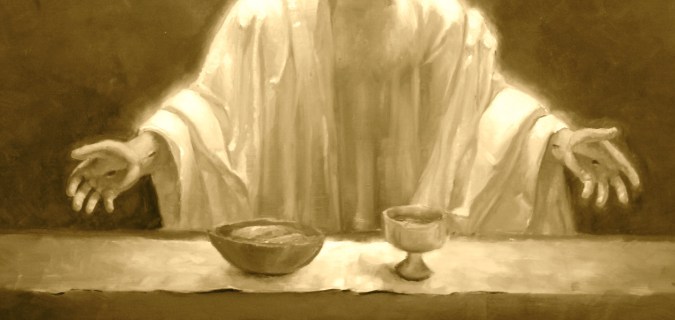
I didn’t grow up with the Sacraments. Sacraments were for liturgical traditions, while I was a proud and happy member of Restoration Movement churches. I did, however, grow up with physical commemorations of spiritual truths — for that is what sacrament means. Of course, I didn’t know that back then.
I like to talk about these things when I get together with my friend Heidi, whose husband is an Anglican priest. When I asked her what sacrament means, this is what she told me:
“The Anglican Book of Common Prayer uses this definition of sacrament: a sacrament is an outward and visible sign of an inward and spiritual grace given to us. There’s also the pithy phrase ‘Matter matters.’ It relates to the way God comes to us through matter (water, the bread and wine, etc) and to His value of matter (our physical bodies themselves and all of creation are precious to him – not evil or something to be escaped as in Gnosticism).”
“Matter matters.” As someone who has been running away from her physical body since early adolescence, this was novel concept to me. But as I reflected on my spiritual history, I realized that my church tradition did observe two sacramental practices: baptism and the Lord’s Supper.
Baptism celebrates our union with Christ through death, burial, and resurrection and is intended to occur once in a lifetime. The Lord’s Supper, on the other hand, is a regular occurrence and a reminder of how much we are loved. We are loved enough for Christ to pour out his very blood and allow his very body to be broken for us and for our eternal home.
(I like to designate corporate singing as a sacramental practice due to the fact that in singing we join the physical sound waves of our voices together to worship our Triune God and to declare spiritual truths over ourselves, but that’s another conversation entirely.)
Some people call it the Eucharist. I usually call it communion. Whatever its name, this meal of bread and wine is our feast of love. It is where we learn and remember our belovedness. It is where God speaks to us. It is where He calls us: every particle of every person in every place.
God communicates His call in every conceivable human language, for in His wisdom He created communion as the intersection of all things.
It is the intersection of the physical – bread and wine – with the spiritual – the forgiveness of sins and the promise of eternal life.
It is the intersection of the deeply personal – what Christ did for ME – and the incredibly communal – what Christ did for ALL of us.
It is the intersection of the Old Testament sacrifices and the new covenant where no more sacrifices are needed.
It is the intersection of the ancient and the far future as we look back to the Exodus and the Passover – the central story of the Old Testament – and eagerly await the wedding feast of the Lamb.
It is the intersection of the ordinary — a regularly repeated act — and the ceremonial — a special event.
It is the intersection of celebration – our God is victorious and we are free — and mourning – our God suffered and our sins caused it.
The Lord’s Supper is the intersection of the marriage invitation and the acceptance of His offer. It is the intersection of being chosen and the act of choosing back.
The Table brings together all human experiences. At the Table He speaks to each person’s particular history and particular language and particular longings. At the Table He places us in a community that will never end.
So come to the Table where there’s always room for more.
Take, eat: the Body of Christ, broken for you.
Take, drink: the Blood of Christ, shed for you.
Come to the Table and remember. Come to the Table and celebrate. Come to the Table where there’s always room for more.
photo source

 Jonathan & Elizabeth Trotter