Don’t Call Your Kids “World Changers” {A Life Overseas}

Jonathan is at A Life Overseas today . . . 

thomas-scott-515840-unsplash

It’s tempting. I get it. It sounds motivating and inspirational. I get that too. But I’ve come to believe that the good-intentioned, hopefully inspiring practice of talking about children as “world-changers” is, in most cases, damaging.

You can cover it with a spiritual veneer, you can call it “speaking truth over them,” you can call it a “parental blessing,” you can even call it “stirring them up to greatness.” But from where I sit, and after what I’ve seen, I’ll just call it probably harmful.

Let me explain.

I grew up among world-changers.

My family was part of an exciting, global ministry which had as its motto, Giving the world a New approach to life!Wow! What a vision! What a large, God-sized dream!

What hubris.

I sang in a choir of 5,000 teenagers, “It will be worth it all, when we see Jesus!” We were going to do it. Our parents had found the hidden truths, the secret. And with derision for rock music, an affinity for character qualities, and a navy and white uniform, we were in fact going to give the WHOLE WORLD a BRAND NEW approach to life.

And then we didn’t.

In fact, one of the most painful parts of my adult life has been watching peers wilt under the pressure of a world-changing paradigm. Families just aren’t designed to raise world-changers. They’re designed to raise children.

I watched friend after friend crumble under the pressure. Who were they? What were they worth when life just felt…normal? When the mission trips stopped and the typical bills came, a sense of dread and failure often settled in.

When the call of God, legitimately and accurately interpreted, looks nothing like the world-domination and global impact you were primed to experience, what then?

Finish reading here.

Why Cross-Cultural Workers Need Tent Pegs {A Life Overseas}

Elizabeth is at A Life Overseas today. . . . 

tent pegs post

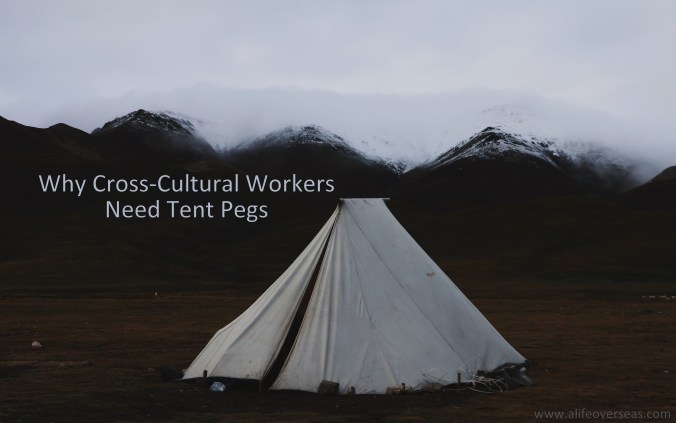
Home is a complicated word. A complicated idea. What is it? Where is it? As global nomads, we’re not entirely sure how we feel about home. We’re not sure we have it, and we’re not sure how to get it. We know the correct spiritual answer – that Christ is our home. That He is busy preparing an eternal home for us. And that even now, He makes His home in our hearts, wherever we go. Still, we search for a more earthly home. A physical place to set up camp for a while.

As an adult Third Culture Kid, I’ve spent a lot of time seeking out roots. But lately I’ve been wondering if I should stop my search. I’m far too easily disappointed; permanence of people or place is not something we’re promised in this life. Even so, we need a support system for lives as portable as ours. This summer I started describing those supports as tent pegs.

A tent is a temporary shelter, and the tent pegs that fasten it to the ground also provide only temporary security. Tents and tent pegs are mobile, going with us wherever we go. They allow us to make a home right here, right now. And when the time comes, they allow us to make a home somewhere else too. Every time we pull our tent pegs up out of the ground, pack them in our bags, and move on, we can take the time to hold each tent peg in our hand and remember.

Finish reading here.

Coming Home: a story in 3 parts

by Elizabeth

31958915_10160218261265621_8409725615460057088_n

1. We landed in L.A. for an 18-hour layover after what was perhaps the Most Turbulent Flight Ever. Then we headed to an airport hotel to sleep off some jet lag (courtesy of my husband, the Expert Trip Planner).

The next morning after breakfast, we walked around to get some sun so we could keep fighting off the dreaded jet lag. And lo and behold, what did I see? Only my very favorite plant: the magnificent palm tree.

(There were also succulents, which may just need to be added to my list of favorite plants.)

And I thought to myself, maybe the part of my soul that longs for palm trees really can be satisfied on this soil. I think on some level I knew America had palm trees, but I’d never been in a place to see them before. It was a welcoming sight.


2. That next day as we settled in to our last flight, we ran into an old family friend. (Actually, it was the minister who performed my husband’s grandfather’s funeral, and his wife.)

As we chatted, the husband said, “Heading home?” And I nodded and said, “yes” — because we are, and that’s the way most people talk about these trips anyway.

But then he paused, for maybe only half a second, and said: “Heading home, on your way from home.”

Yes. We’re heading home, on our way from home. And I THANKED him for that statement, because it’s the truest way of describing this strange mobile life, and not everyone takes the time to acknowledge that truth.

We are, ever and always, heading home on our way from home.


3. Friends and family greeted us at the airport and helped us load our luggage into their vehicles. In the car I talked with my parents some and listened to my parents talk to my kids some. I was tired.

We passed plenty of places that looked just the same, and we passed plenty of places where new homes and businesses had sprung up. The highway doesn’t look quite the same as it did when I was growing up.

But the moment we turned onto the street that heads to my parents’ house, I knew I was home. It may have been 2 1/2 years since I’ve seen it, but it seemed like I had driven that road only yesterday.

And so I am Home. It’s a good feeling.

Worlds Apart: A Third Culture Kid’s Journey {book review}

I am so excited to review and promote Marilyn Gardner’s new book Worlds Apart: A Third Culture Kid’s Journey. This book is a chronological journey through Marilyn’s childhood as a Missionary Kid and Third Culture Kid in Pakistan and includes a brand new foreword from author and fellow A Life Overseas blogger Rachel Pieh Jones.

On the surface my TCK experience seems quite different from Marilyn’s, so I had initially wondered how much of her story I would relate to. Where hers involves missions and boarding school, mine involves military service and public schools. But my concerns were completely unfounded. There was so much to relate to, on so many levels. Truly, this is a story for everyone.

As I’ve said in other places, for me the mark of a good book is that I laugh all the way through and then cry at the end. Worlds Apart certainly measured up in that regard as well.

One of the funnier parts came when reading about her family’s visits to the ruins of the ancient Indus River valley. Somehow the ancient Indus civilization managed to install covered drains in their city, while during Marilyn’s childhood, Pakistan had not yet done so. I could relate — the lack of covered sewers in Cambodia is something I continually lament.

I also laughed over her comparisons of popular (but fleeting) camp songs to the steady and stalwart hymns of our faith. But by the time I finished the book, I have to tell you I was wrecked. Wrecked.

In the end, Worlds Apart is simply the story of a child’s faith in God. Marilyn holds her story loosely and tells it humbly, so it’s worth a read even if you’ve never lived overseas.

Here are Jonathan’s and my “official” reviews.

~~~~~~~~~~~~~~~~~~~~~~~~~~~~~~~~~~~~~~~~~~~~~

From Elizabeth:

For anyone who has wrestled with heavy bouts of homesickness or lived through long stretches of loneliness, Marilyn Gardner’s new book, Worlds Apart, is a gift.

For anyone who has walked through the valley of the shadow of death or of betrayal while simultaneously trying to hold onto faith in a good and loving God, this book is a light in your darkness.

For anyone who longs for the people and places of your past or has ever had to pack up a life and say goodbye, this book is a trustworthy traveling companion.

For anyone who has ever grappled seriously with their privilege or come face to face with their own shortcomings, this book is a safe place to land.

And for anyone who’s ever wondered if it’s even possible to raise a happy family in difficult or unusual circumstances, Worlds Apart offers hope and, what’s better, guidance.

But these stories are also a sober reminder to parents that no matter how much love and security we lavish upon our children, we cannot protect them from the sorrows and difficulties of this life — nor is it our job.

Marilyn’s book is a gem for all these reasons, and it is also a joy to read. The language is beautiful, and each story is seasoned with profound truths about life and faith. Somehow as we read, we are able to swallow the bitter along with the sweet. That is what grace is all about, and that is what this book is all about.

~~~~~~~~~~~~~~~~~~~~~~~~~~~~~~~~~~~~~~~~~~~

From Jonathan:

It’s been said that if you dig down into your story deep enough, you find the common things. I didn’t grow up in Pakistan, and I didn’t experience boarding school or life as a missionary kid. But that doesn’t matter, because in this book Marilyn digs down deep enough into her own journey that I found myself resonating throughout. And crying.

The cross-cultural connections and the cross-cultural stretching, the faith struggles, the reverence of older missionaries, the questions about God’s sovereignty in the midst of catastrophe, and the confusion surrounding the loaded word, Calling. It’s all here.

We need this story. The missions community needs this story. Yes, it’s one person’s history, but this is a book that missionaries and TCKs of all stripes need to read, because Worlds Apart ties us to our shared history. It links us with the bigger Story, and it reminds young cross-cultural workers that they’re not the first. Not the first to travel. Not the first to care about social justice. Not the first to raise children abroad. It shows us that we are part of a larger plot arc that both preceded us and will in fact follow us. These reminders are much needed and deeply enriching.

I am sure that Marilyn’s gentle storytelling and textured memories will encourage and inspire and heal many.

Embracing a Healthy Body Image Overseas {Taking Route podcast}

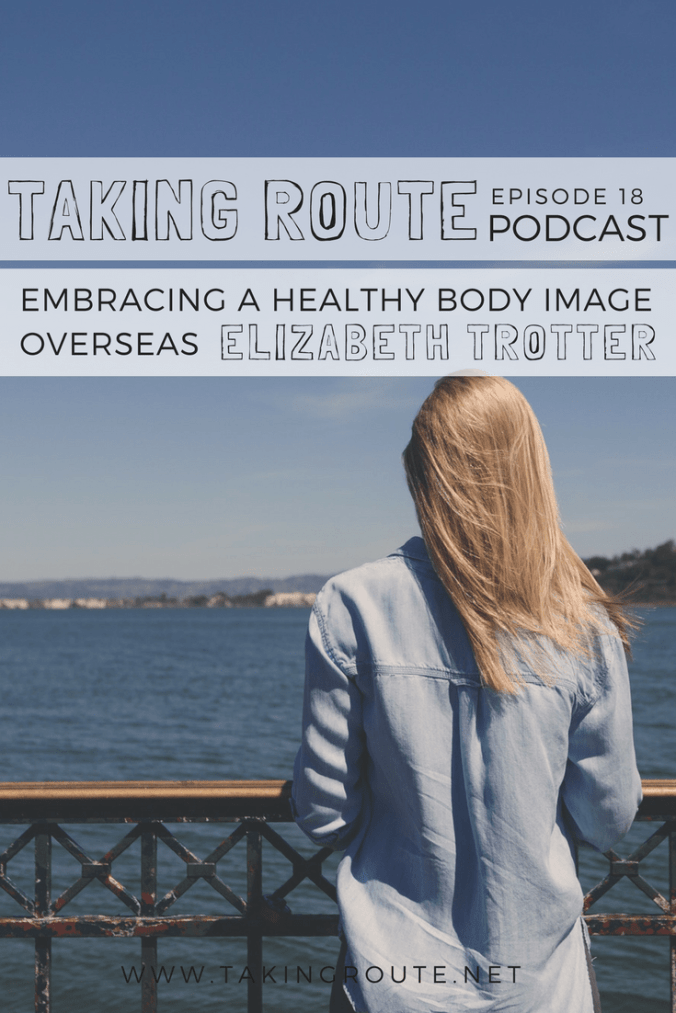
Elizabeth recently chatted with Denise James, host of the new Taking Route Podcast. They discussed some of the issues surrounding eating and body image that many women deal with, regardless of where they live.  You can listen to that conversation here. And when you’re done, be sure to check out the other conversations on the podcast!

Embracing-a-Healthy-Body-Image-Overseas-with-Elizabeth-Trotter-TRP-18-2