The Church: Hungry for Community

church series1

by Elizabeth

Last week I posted this on my Facebook wall:

This morning at church we sang “We welcome You with praise” (from Chris Tomlin’s song “Here For You”). Sometimes it’s easy to welcome Him with praise. Other times, not so much.

I remember in early 2006 when we learned that Jonathan’s dad had brain cancer. A dear friend dropped everything to come sit with me. I couldn’t pray; she prayed for me. She told God that we bring a sacrifice of praise to Him, for today, it is exactly that, a SACRIFICE. She welcomed God with praise when I couldn’t do it myself.

I love the story in Exodus where Moses holds up his staff, and the Israelites gain the advantage over the Amalekites. Soon Moses’ arms are so tired he can’t hold them up, and Aaron and Hur find a stone for him to sit on. Then they stand on either side of him, holding up his hands. And his hands hold steady.

I remember when Jonathan’s mom was dying of cancer. It was Jonathan’s turn to lead singing, and his mom was in the congregation. As he was leading “God Moves in a Mysterious Way,” he got to a point where he couldn’t continue. An elder took over the song leading, and two men came and stood on either side of him and literally held his arms up as we sang.

May we be people who band together, holding each other’s arms up in the battle. May we be people who join with the tired, the weary, and the hurting, and welcome God with praise even when some in our midst cannot.

He is still with us.

The next day I wondered why I’d felt so compelled to share that. Then I realized that it was because I was writing about the Church, and I love the Church. In fact, I get irrationally happy talking about the Church. I’m captivated by God’s great idea. His magnificent idea.

I didn’t expect my Facebook post to resonate with so many people, but it did. That tells me that we are hungry for the kind of community God designed, even as we sustain damage from His people through unhealthy or abusive church environments.

A couple years ago I wrote about all the reasons I love the Church. But it felt incomplete. There’s so much more to say, so much more to flesh out. My thoughts on the Church have been percolating for a while now. So this is my launching point for a series on the Church. It won’t be in any particular order or on any particular schedule. I’ll add to the series whenever I get the chance, and I’ll unashamedly share how I feel about Christ’s Bride, the Church.

*photo credit

~~~~~~~~~~~~~~~~~~~~~~~~~~~~

Other posts in the Church series:
“Me too” Moments

On Not Being the Casserole Lady

Dear American Church

I am a Worshipper

Authenticity is Not New

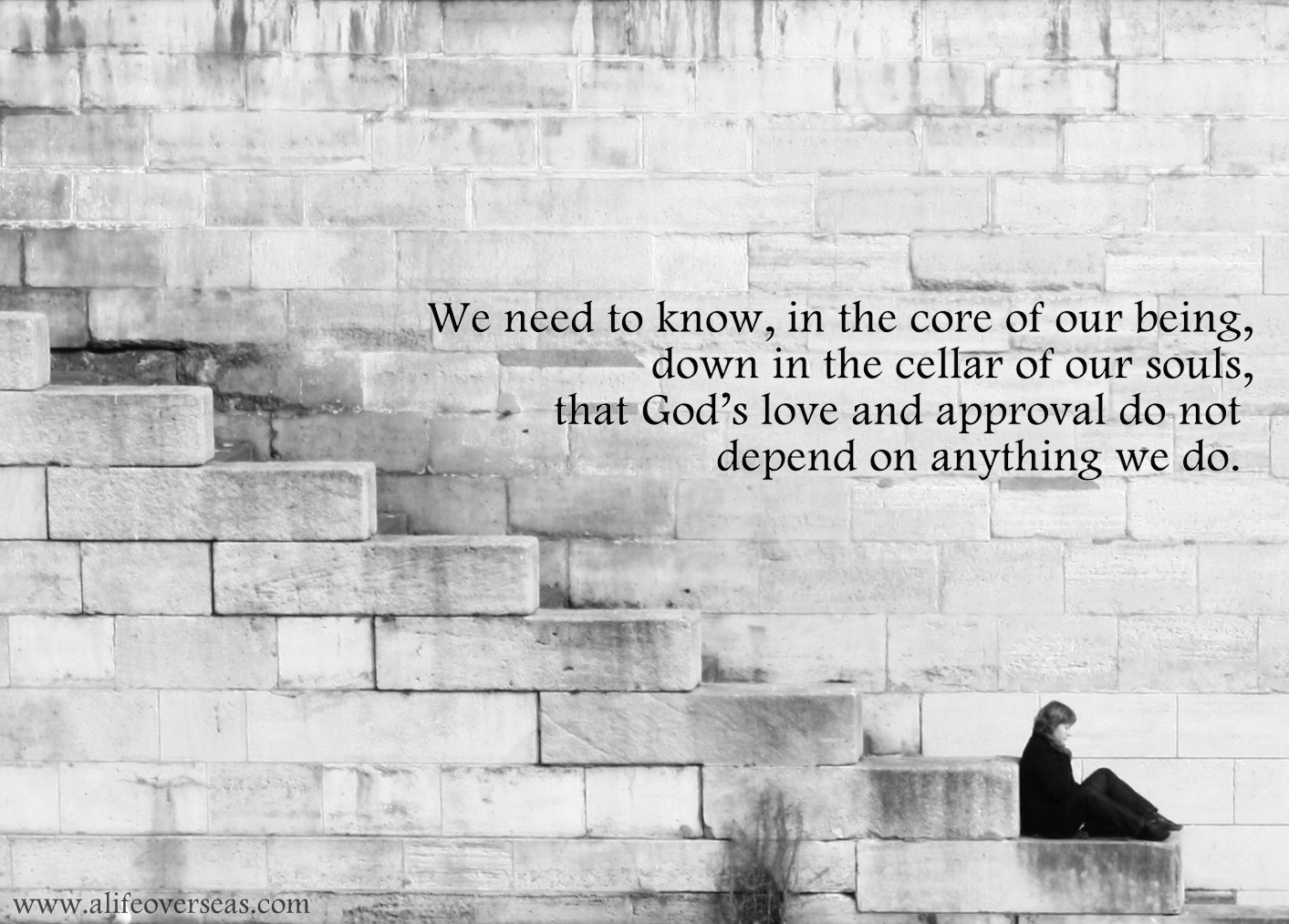
“I’m Not Supposed to Have Needs” {A Life Overseas}

Elizabeth is over at A Life Overseas today, continuing her series on life in ministry families. Here’s a snippet:

The idea that “other people’s needs are more important than my own” sounds very spiritual. It sounds very sacrificial and giving. But we are all of us humans, created and finite beings with limited resources. Our lives are powered by the Holy Spirit, true, but none of us can survive if we think we are only here for others, or if other’s needs are always more important than our own.

There’s a deeper, more insidious lie at work here, too. When we believe the lie that the only purpose of our life is to serve other people, we buy into the falsehood that we earn our worth. That our performance justifies our existence. That what we do, the service we yield for others, is what makes us valuable in both God’s eyes and other people’s eyes.

 You can read the entire article here.

cel2

When Baby Snuggles Make Me Grateful for Modern Medicine

1469978_10153576585285621_256299125_n

by Elizabeth

Warning: This is a frank discussion of childbirth complications. Men in particular (and perhaps pregnant women) may not wish to continue reading any further. You will not find statistics here; rather, you will find my story. It is a story of immeasurable thankfulness.

My kids were extra snuggly today. (The weather is still cool enough to want to snuggle.) As I wrapped my arms around the Baby and sang to her, I remembered afresh how miraculous it is that I’m even alive and able to hold her.

When she was three weeks old, I was so weak I could barely get out of bed to go to the bathroom. The narcotics I had on hand were barely touching the abdominal pain. I didn’t know what was wrong with me, but I wondered if I was going to die. Not the seizure coma death type of fear I talk about so much, but a foreboding that I might not live to see my baby grow up. I wanted her to know how fiercely she was loved, and I wrote her a note to tell her so.

Later that day, emergency room doctors diagnosed me with endometritis — a uterine infection which can, they told me, spread to the bloodstream if left unchecked. I received intravenous antibiotics, spent the night in the hospital, and took heavy-duty oral antibiotics for the next week. I needed another full week of people bringing us meals and watching my older kids for my strength to return.

I wouldn’t have lived long enough to require those life-saving antibiotics if it hadn’t been for other modern obstetric interventions. I’d hemorrhaged at 10 days postpartum and required a semi-emergent D&C (dilation and curettage, my first, and so far only, surgery). Even before that, I’d hemorrhaged in the hospital an hour after her birth. It took, for all you medical people out there, two bags of Pitocin, one shot of Methergine, and another of Hemabate, alongside an already-nursing baby and that delightful practice of fundal massage, to stem the bleeding. Just as we began discussing blood transfusions, the hemorrhage finally abated.

I’m not sure I would even have been alive to have a fourth baby without those same hemorrhage-halting drugs for my second baby, whose nearly 10-pound weight stretched my uterus so far it had trouble contracting again, and whose large head tore my cervix, requiring a clamp to stop the bleeding. (I think it’s fairly obvious why my propensity to postpartum hemorrhage was a reason I didn’t want to move overseas in the first place.)

When I think about the fact that before oxytocic drugs, hemorrhage was a huge maternal killer (and still is in some parts of the world), I am thankful I didn’t die during my fourth birth or in the ensuing weeks of infection and illness. I am thankful I didn’t die during my second birth, either. Without modern medicine, I might not have lived to watch my second born walk at 11 months, or enjoy him as the laughingest baby I’d ever known. I might not have been around to watch him over and over again as he earned his “Danger Baby” nickname.

I might not have been around to watch him refuse to talk till he was three, communicating only through gestures and nods, simply because he didn’t want to talk. I wouldn’t have been around to watch his two-year old self lay on his floor every night, looking at board books with his stuffed Tigger till he was so tired he fell asleep there.

Without modern medicine, I wouldn’t be able to snuggle my Baby and sing “Twinkle Twinkle Little Star,” or her favorite Steve Green’s Hide ‘Em in Your Heart song “When I am Afraid I Will Trust in You.” I wouldn’t be able to belly-laugh at her dinnertime jokes.  I wouldn’t be around to watch her dance like a ballerina or to receive her sweet kisses.

I am profoundly grateful to the doctors, nurses, and midwife who treated my postpartum hemorrhages and infection. Because of you and the scientists who created those life-saving drugs, I can enjoy my four precious children. Because of you, I can cuddle with them on a couch in Cambodia. From my house to your hospital, I thank you.

The Little Word that Frees Us {A Life Overseas}

Elizabeth is over at A Life Overseas today, beginning a discussion on the pressures of ministry life for both adults and children.

_freedom__by_candymax-d1c7acla

I believe, along with William Paul Young, that “since most of our hurts come through relationships, so will our healing.” Sometimes the Church gets stuck in damaging behavior patterns, and we, as a collective people, perpetuate beliefs in the lives of ministry families that simply aren’t true. Lies seep into our souls, and as a community we need to acknowledge them, wrestle with them, and ultimately, reject them – for there is a religious culture at work here that needs destroying.

I love the Church, and I believe one of the glorious reasons God places us in a local Body is so that we can “love each other deeply, from the heart,” and by so doing, participate in the healing of each other’s hearts. That is what these posts are about. Sharing our stories, and finding healing and wholeness together.

It is not about blaming parents or making anyone feel guilty. Rather, it is about mobilizing the Church to dismantle some of our harmful systems. It is about calling on Christians to change the way we do life together. Ministers, missionaries, and their families are the most notable casualties here, but the Body as a whole suffers when any member suffers. I believe we can be part of the healing.

But we need to do something first: we need to give ourselves permission to be honest.

You can read the rest of the post here.

For the times when you hold back the tears

cas1

by Elizabeth

I’ve spent most of my life locked in my head. Keeping my emotions at bay, and not even realizing I was doing so.

I still do this, even though I know by now what’s going on inside of me. I can feel tears rising up inside me, begging to be poured out. But I shove them down and don’t engage.

I swallow the lump in my throat. I blink back the tears. I’m so good at this that I don’t even have to blink sometimes.

I can literally watch myself do this. It’s like an out-of-body experience. I can say to myself,“She’s locked in her head right now, refusing to deal with those pesky emotions. Why is she so stubborn??”

Why? Because emotions take time. They take energy. And after I engage my emotions, I seriously need a nap. So it’s easier for me to detach from them. It’s easier to ignore them.

It might not be easier in the long run. But in the short run, it’s certainly faster. Because I’ve got things to do. People are depending on me. I can’t take the time to deal with this. Crying won’t help my situation.

No, crying might not help my situation. But it might help me. When I’m done crying, my problem might not be better, but I am be better. My problem might not be solved, but I no longer feel like it’s insurmountable.

I don’t always let myself do that. I’m afraid that if I start crying, I won’t stop. I’m afraid it won’t fix my problem. And I’m all about solutions, people.

But. What if the tears are the solution? What if the tears allow my soul to say something that words can’t?

I need to feel.

I don’t always feel like feeling.

But I need to feel.

So today, if you’re like me, and you have a hard time accepting the fact that you’re human and that you have feelings in the midst of all the goals and tasks of life, I give you permission to feel.

And if it’s easier to shove the tears down your throat than to let them flow freely, I give you permission to cry. Cry as hard as you need, for as long as you need. Use all the tissues you need.

And if too much is going on in your life, and you don’t think you have the time to stop and cry, I still give you permission. After you’ve cried a little, or even a lot, you just might find you have the strength to carry on.

And when you’re finished, you can look up and remember that if I were with you today, I’d be sitting right beside you, with a tearful smile and a warm hug.

I promise.


 photo credit