I’m not even sure how to write about this. Four months ago we bought a cat for our children. He was a beautiful stray who had been rescued by the Humane Society, and we fell in love with him. He was our little Lion King. He filled our yard with life and light. And we thought he’d be a part of our family for a long time.
But it wasn’t to be.
Gryff was a wanderer. He was constantly trying to get into other people’s houses. Sometimes he succeeded. He left us often, and most of the time he came back on his own. But nearly as frequently, we received calls from people as far as 3 streets away to come pick him up at their house.
Still, we were ridiculously in love with this cat. The kids liked to study outside with him. They liked to draw pictures of him. They liked to snuggle him. People often commented on how sweet of a cat he was.
He had started staying out at night and not coming back till the next morning. We were expecting this; he was supposed to be an outside cat. But then he didn’t come back, and we also didn’t receive a call from anyone. Eventually a neighbor stopped by to tell us what had happened — another neighbor had seen the accident and told her.
A car hit him on the road near our house. We weren’t at home when it happened. But when we found out, Jonathan went looking for the body and helped us bury him. We cried and even wailed over Gryff’s death. It was a deep pain and a deep loss. He was our first pet. We didn’t know how sad it would be to lose a pet.
Now we know.
A mom doesn’t want her kids to suffer, but she can’t stop the suffering. I wish my kids didn’t have to lose Cambodia. I wish they didn’t have to lose their cat. But as much as I wish to prevent them from experiencing pain, I have no power to do so. It’s one of the most difficult parts of being a parent. All I can do is walk through the pain with them.
So we held a funeral for him. We talked about the silly things he did. We talked about the annoying things he did. We talked about how much we loved him. We honored his place in our lives for just a short time. He helped us settle our hearts in America, and for that I will be forever grateful.
It’s been a week since we buried him, and there’s still an empty spot in our hearts. In the beginning we couldn’t bring ourselves to spend time in the yard without him. It was too sad and lonely. The first few days without him were especially rough. We watched with our own eyes as my husband shoveled dirt onto his body. Still, we kept expecting him to show up at the back door, begging for food. Other times we thought we could hear him meowing.
For days we couldn’t bring ourselves to clean up his water bowl and food bowl. I still haven’t put away the blanket he slept on. And at first I didn’t think I could ever buy my family another cat. I could not give my heart to another creature, only to lose it again so soon after. But after visiting some friends whose cats are just as loveable as ours was and learning how many cats they’ve lost over the years, I’m beginning to think I could possibly welcome another cat some day. But not yet.
So we are slowly adjusting to life without our beloved kitty. After all, there are still birds to feed and plants to water. God’s good, green earth still grows even in the midst of death. Through the pain — and maybe because of the pain — our hearts and souls grow along with it.
It takes nine months to birth a baby. Nine months, a lot of frustration and discomfort, too many emotional ups and downs, far more waiting than we’d prefer, and a lastly, a good birth attendant. This is not unlike our nine-month-long search for Home last year.
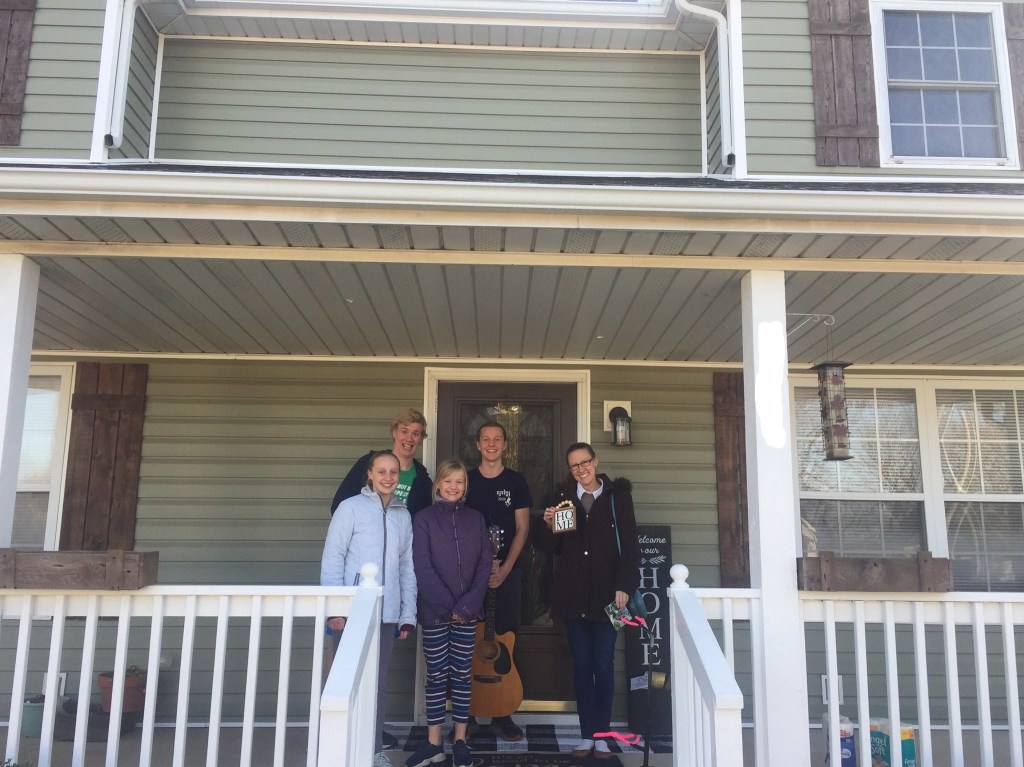
The two photos above were taken on Closing Day, the day we signed on the (many) dotted lines and became homeowners for the first time. We love this house. Love it. After four months, I still wake up most mornings and think to myself, “How did I end up with the coolest house?!” Many evenings I think some iteration of the same.
We knew this house was a good fit for our family when we moved in; we just didn’t know how good of a fit it would be. There’s something special for all six of us at this house. The kids have an in-ground trampoline and a basketball court. There’s a campfire pit, a bunch of trees, and plenty of outdoor space to read and relax. And it’s all enclosed in a privacy fence so that I never worry about the kids while they’re playing outside.
There’s enough room for all four kids to study quietly and privately. I have my own office – something I never thought I’d have. Jonathan set up his office in a detached building that has heating and cooling, which means he’ll be able to meet with people in person while also preserving their privacy. We have a space for exercise. And I can’t believe it’s ours. Often as I’m making dinner, I think to myself, “This is my kitchen! I don’t have to leave here and start cooking somewhere else.”
I didn’t expect to feel so settled after moving into a house of our own. After living as a global nomad for so long, I wrongly assumed that permanent dwelling places were superficial, unnecessary things. I didn’t know a long-term home could make such a difference in how I feel. I know I promised earlier that I’d tell the story of how we got this incredible house, so here’s the long version. . . .
Nine months passed from the time we landed in the U.S. to the time we moved into this house. And it was somewhat like a surprise pregnancy: when we first arrived, we didn’t know we would be staying. We lived a few ignorant weeks between conception and that positive pregnancy test. Then the realization hit, and as I’ve explained before, I woke up miserable every morning. Perhaps it was repatriation’s version of morning sickness.
But then we had to get to work figuring out what to do and where to go. We made many plans; most of them fell through. We thought we would live in one city but instead landed in another. We were grateful to be given temporary housing on a college campus. Shortly after moving in, we contacted a local realtor.
Jonathan told her how he dreamed of land. After living in a concrete jungle for eight years, he wanted his kids to experience some of what he had experienced growing up in rural Missouri. (His Kansas City suburb truly had a rural feel at that time.) I didn’t care about land, but I did care about his happiness, so we started out by looking for land.
There weren’t a lot of houses with land in our price range, but we found something we thought might work. The house was super cute and had some really great land. It was older and needed a few repairs, and honestly it was too small for us, but we were confident we could restore the house’s former beauty and somehow adjust to its small size. Looking back, I see that it really was too small for our large family, but we were somewhat in denial because of our desire for open spaces.
Then we received the septic system inspection, which basically indicated a system in need of total replacement — an upgrade we could not afford. I’m thankful now that the first house didn’t work out, but at the time it was pretty disappointing.
Next, we looked for smaller lots. There still wasn’t much to be found, but we saw four or five houses on Zillow that might work. By the time our realtor called to arrange tours, all but one already had contracts on them. That’s how fast the housing market was moving last fall, even in the small town of Joplin.
We walked into the one available house and fell in love. It had enough room for all of us to work and study, it was a split level just like I’d always dreamed of, and it had both a covered porch and an expansive deck for entertaining. It had a spacious yard with older trees. The color of paint on the walls even fit our family’s style.
We made an offer based on our realtor’s estimation of its value. The owners would not lower the price, but they were still willing to sell it to us for the original listing price. Seeing as how there weren’t many houses on the market — and none at all that fit our large family — we decided to accept their terms. We’d read that throughout the country, home prices had soared during the pandemic, so we figured we had no choice. We needed a house by the end of December, we adored this one, and though it was priced higher than we preferred, it was still in our price range.
The inspection went well, and we were excited. Then the appraisal came in, and it wasn’t good news. This house didn’t appraise anywhere near its listing price. (Apparently our realtor knew what she was talking about – the house independently appraised right at her prediction.) This new information suddenly made the financing untenable. With the requirement of a greater down payment and/or PMI, this fantastic house wasn’t in our price range anymore.
We tried to re-negotiate, but negotiations fell through. I was heartbroken. I had been in love with this house. (I had not been in love with the first house.) What were we going to tell our children?? They had been through so much loss already last year. And more importantly, how were we going to find a house in time? We only had a couple weeks to secure a contract if we were going to have a place to live when we had to move out of our temporary housing (which was a hard deadline).
Time was running out, and I was nervous. There were a few houses on the market that could fit our family; our realtor hastily set up a couple tours. Jonathan was out of town, so I had to go alone. It felt strange because we always do big things together — but time dictated otherwise. The first house didn’t look like it would work for us, but the second house did. It had enough inside space to homeschool, the yard was big, and there was a separate building where Jonathan could work.
And two other potential buyers had looked at it that day.
I sent Jonathan photos and a description, and he replied, “Let’s go for it.” He hadn’t even seen it in person, but we knew we had to move fast. Our realtor advocated for us, and these owners worked with us on both pricing and repairs. They were all a true delight to work with. We were excited but still nervous – would anything interrupt the buying process on our third attempt?
But nothing did. It proceeded smoothly, and in December we moved into a house we knew we would love. We’ve grown to love it even more now than we did then. And I now understand why my husband wanted land — having a large yard has been such a joy for all six of us.
I remember when I was giving birth to my babies, I had certain feelings for my birth attendants. I felt like they had truly made the birth experience special. I felt like they had tried to honor my birth plan to the best of their ability. It’s not that birth isn’t painful – it is. But a good birth attendant will make it as comfortable and safe as he or she possibly can. And when the birth is over, you feel a sense of indebtedness to them.
I don’t know if birth attendants feel a special connection to you – they deliver so many babies after all. But I know a birthing parent feels a special connection to their attendant. And it’s the same way with a realtor. Helping people buy and sell houses is their day job – they do it all the time. But a family doesn’t buy a house just every day. It’s a momentous occasion. You remember the person who helped you through it. Both giving birth and buying a house are things you do only a finite number of times in life. If your helpers were good, you remember them with fondness.
So nine months after accidentally leaving Cambodia forever, we settled into a house that seems like it was built just for us and our family’s needs — and hopes and dreams. For we dream of this home becoming a launching pad for ministry. That’s already true in the sense that Jonathan does his ministry from this place, but in the coming years we also hope to host lots of people in our home and in our yard.
Based on the interest expressed in the comments of my last post, today I’m sharing three of my favorite “healthier” chocolate desserts. They’re all pretty easy to make but have slightly different personalities.
—
Tahini Date Fudge I borrowed this recipe from Aviva Romm’s Instagram post.
3/4 cup dates, pitted, soaked, and chopped 1/4 cup cocoa powder 1/4 cup – 1/3 cup tahini 1/2 tsp vanilla
All you’re going to do is drop the ingredients in the food processor and process till smooth, but I have a few tips first. Choose Deglet Noor dates over Medjool dates. Everyone says Medjool dates are the sweetest and softest, but this has not been my experience in America. The Medjool dates at the store have been pitted and have dried out already. Even soaking them in hot water does not solve this problem.
The Deglet Noor dates I’ve found here are still soft, even if they’ve already been pitted. I don’t mind pitting them myself if I have to, although pre-pitted is convenient. (I had to pit them myself in Cambodia, where I was thrilled to find any dates at all.) The thing I love about using dates as a sweetener is that they are not only composed of sugar; they are full of vitamins, minerals, and fiber. I still soften my Deglet Noors in hot water and slice them into small pieces, just to make them easier to puree.
Depending on the thickness of the tahini, sometimes you need more, sometimes you need less. Sometimes I add a splash of water if the fudge isn’t coming together. I love tahini. I can eat it plain. But it’s pricy, so I don’t do that very often, only when I’m really craving it.
I don’t like my fudge to be super sweet. I’m going for the flavor of dark chocolate, not traditional fudge. I’ll play around with the amounts of the ingredients until it tastes just right. Sometimes that means adding more dates, other times that means adding more cocoa. The thing I love about this recipe is that it’s very fudgy and rich. Sometimes I make it too thin, and it’s more like cookie dough, but that’s delicious too.
I generally make this for myself only; I don’t share with my children. Store in the fridge.
—
Chocolate Silk Mousse I found this recipe in an old vegetarian cookbook somewhere along the lines.
2 packages silken soft tofu 1/3 cup cocoa scant 1/3 cup honey 2 tsp vanilla
Open the soft tofu and drop into the food processor; then add the other ingredients. Process till smooth. It takes a little while, but all the cocoa and honey does eventually get distributed in the tofu. And it does have to be soft silken tofu. (Obviously this recipe is only for those who eat tofu!)
This is a very fresh-tasting mousse. It has more protein and calcium than some dessert recipes. You can refrigerate or freeze it. I like it refrigerated, which makes it feel like a mousse or soft pudding. Just kind of dissolves in your mouth. My family prefers frozen, which makes it taste like a chocolate popsicle. Not exactly a fudge-cicle as it’s not quite rich enough for that. This recipe feels satisfying while not overly indulgent.
—
Coconut Milk Mousse I adapted this recipe from Mary Vance’s site.
2 cans full fat coconut milk, chilled in fridge 1/3 cup coconut sugar 1/2 cup cocoa powder 1 tsp vanilla extract
You’ll need an electric stand mixer for this one. Chill the coconut milk in the fridge for at least 30 minutes (you can also chill the mixing bowl). Open the coconut cans, and carefully spoon out the cream into the mixing bowl. You don’t want any of the water underneath. Start mixing for a minute or so until fluffy (it might not get fluffy; that’s ok too).
Add the cocoa, coconut sugar, and vanilla, and mix again until fully incorporated. Chill in fridge. This one is so delicious and rich. I love coconut cream by itself (when making curry, I often swipe bits of leftover coconut cream from the can). The flavor of coconut and chocolate here is a big hit in our family. It’s very rich, though, so even though you want to eat a lot at once, you really have to limit yourself to small amounts unless you’re willing to risk a stomachache! Pair it with berries to cut the richness.
A note on chocolate avocado mousse: I’ve tried it, and it doesn’t taste right. After it’s chilled, it tastes almost right, but the avocado just comes through too much. I want to like avocado mousse; avocados are so good for you, and I was looking for a way to get healthy avocado fats in me. But I just can’t do avocado mousse at this time. After this short detour through RecipeLand, my next blog post will return to my more “normal” blogging topics.
Remember how I said I wasn’t going to have a specific blog focus moving forward? That I was just going to write updates on my life, whether large or small, whether meaningful or mundane? Well, today is a recipe day! The kids and I are still on a much-needed spring break, so I have extra time to share some fun stuff.
The two recipes below are our family’s favorite vegan cheese sauces. Now, I don’t have anything against dairy in principle. I love cheese and yogurt, and half and half goes in my half-caf or decaf coffee every morning. But two of us (including me) have tummy troubles if we eat too much cheese, one of us gets eczema flares from dairy, and another tries to eat mostly plant-based for other reasons.
I have therefore attempted to fill the gap with various vegan cheese recipes. Some recipes require a lot of advance planning because cooked vegetables (like potatoes, sweet potatoes, cauliflower, carrots) form the base of the sauce. Others don’t taste quite right, like cashew-based sauces which are often too sweet and not savory enough. These two recipes are different. They are satisfying and delicious, and if you have all the ingredients on hand, they do not require advance planning (a plus for any cook!).
—
Cannellini Cheese Sauce I can’t remember where I found this cheese sauce recipe, so unfortunately I can’t give any credit. But it’s been our family’s absolute favorite until recently, when I discovered a new recipe that has divided us on which sauce is best. So I currently make both (and one family member combines the two).
This sauce has more protein and fiber than most cheese sauces and is an excellent addition to a baked potato bar. It calls for more ingredients than your typical cashew sauce might call for, but they give a depth of flavor to the sauce, so don’t skimp on any ingredients.
1 can cannellini (great northern) beans, drained 3/4 cup unsweetened plant milk 1/2 cup nutritional yeast 1 Tbsp olive oil 3/4 tsp salt 3/4 tsp vinegar 1/4 tsp garlic powder pinch turmeric
Blend all ingredients in a blender, then heat on medium till hot and bubbly. You’ll have to scrape down the sides regularly.
—
The Best (but more complicated) Vegan Cheese Sauce I found this sauce at Hungry Vegan Mama and thought I’d give it a whirl, even though it called for several ingredients I didn’t normally keep on hand. This is cashew-based, which I mentioned I don’t normally like, but it has so many unusual ingredients that, when combined, create the savory flavor you have been looking for. Yum! This one is especially good on broccoli.
I tend to blend up this sauce and then heat it in the microwave while I blend up the cannellini sauce to heat on the stove. That way I can make two cheese sauces at once without cleaning the blender in between. If you have a high-power blender, you don’t have to soak the cashews a full hour, which is good for my frequent lack of advance planning. I usually start soaking them when I start preparing dinner, and that seems to be enough.
1/2 cup raw cashews, soaked 1 hour 1/2 cup vegetable broth 1/2 cup water 3 Tbsp nutritional yeast 4 Tbsp plain instant mashed potatoes 2 Tbsp lemon juice 1.5 Tbsp white miso paste 1 tsp smoked paprika 1 tsp maple syrup 1/4 tsp turmeric 1 tsp garlic powder 1 tsp onion powder
Blend all ingredients on high in the blender, then heat in the microwave (or on the stove). Happy cooking!
Over the last few years of learning to eat and cook in healthier ways, I’ve collected some delicious better-for-you chocolate dessert options. Let me know in the comments if you’d like me to share those recipes sometime.
I wanted to pass this song on to you during Easter Vigil (the night before Easter Sunday). Perhaps you need it as much as I do.
The Paschal Troparion is an Orthodox hymn dating back to the 5th century. Originally written in Greek, one of its English translations proclaims: “Christ is risen from the dead, trampling down death by death, and upon those in the tombs bestowing life.”
It is a sort of bridge between a mournful Holy Saturday and a joyous Resurrection Sunday (though Orthodox believers usually celebrate Easter on a different date than Protestants and Roman Catholics).
The music and lyrics of the Paschal Troparion were reimagined by the husband/wife musical duo eine blume, and I first heard it during a Velvet Ashes retreat several years ago. Its simplicity lends it an easy memorability, and it joins the best of ancient words with a beautiful modern melody.
I love the comfort and solidarity of singing something that believers have prayed in faith for hundreds of years. This hymn has become one of the songs that our family sings to end our morning devotions. Originally we closed only with the Doxology, but now we close with either the Doxology or the Paschal Troparion (or occasionally both).
In case you haven’t heard this song, or in case you had and just needed reminding, I wanted you to have it before the dawn of Easter morn. Confluence Worship covered it here (or you can purchase it on iTunes like we did). I’ve also pasted the song below.



 Jonathan & Elizabeth Trotter