What George Orwell and C.S. Lewis can teach us about chaos, creation, and a world living in fear

by Elizabeth

21121793_10159142924775621_990278575_n

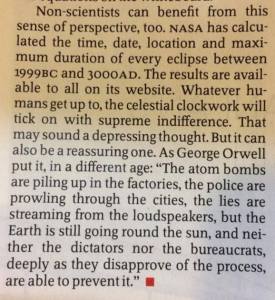
“The atomic bombs are piling up in the factories, the police are prowling through the cities, the lies are streaming from the loudspeakers, but the earth is still going round the sun, and neither the dictators nor the bureaucrats, deeply as they disapprove of the process, are able to prevent it.”

I burst into tears over this George Orwell quote in the bookstore the other day. Let me explain why.

If you know me at all, you know I was crushed over the lack of eclipse viewing on this side of the planet. Crushed. I first started reading about the eclipse in science magazines about a year and a half ago, when I realized with sadness that I would not be able to see it, even though totality was passing very close by my hometown.

As we edged ever closer to the eclipse date, and people became more and more excited, I became sadder and sadder. I would wake up every morning thinking about what I was missing and imagining in my mind’s eye what it would be like to experience that kind of natural reversal. I hear you receive spiritual and philosophical insights during a total eclipse that you rarely get in life apart from extreme grief and loss. I hear that you feel at one with humanity and at one with the solar system. Whether you believe in God or not.

But here’s the thing: I already feel at one with the solar system on a regular basis. Every time I look up at the moon, no matter where it is in its waxing or waning, I imagine where I am in relation to it and to the sun and to the rest of the planets, and I get this enormous sense of awe and wonder. I experience more awe and wonder when I catch a glimpse of a planet with the naked eye. I even get a thrill from ordinary everyday sunsets and ordinary everyday cloud-dotted skies. Understanding the science behind each of these sights does not in the least diminish their wonder for me.

So to miss out on an event that causes people who don’t normally care all that much about the sky to shudder with shock and awe, felt like a devastating loss. I collect those moments of wonder and awe in my life and, like Mary, ponder them in my heart. I store them in the long-term memory of my soul. I am a glory-chaser, and this month I felt I was missing out on something glorious that all my countrymen were going to witness (though I know the descriptor “all” is not entirely accurate here). I have really had to grieve this loss as one of many losses on both sides of the Pacific over the last 6 years.

Then today I found myself at the local bookstore with my kids, perusing the magazine rack. It’s a sort of Saturday morning tradition for us. Magazines are too expensive to buy here, so we just stand around reading articles about space and geography. I was reading an article about that infamous eclipse when I came across these words by George Orwell. They brought to mind parallel (and prescient) thoughts from C.S. Lewis, in his 1948 essay entitled “On Living in an Atomic Age”:

In one way we think a great deal too much of the atomic bomb. ‘How are we to live in an atomic age?’ I am tempted to reply: ‘Why, as you would have lived in the sixteenth century when the plague visited London almost every year, or as you would have lived in a Viking age when raiders from Scandinavia might land and cut your throat any night; or indeed, as you are already living in an age of cancer, an age of syphilis, an age of paralysis, an age of air raids, an age of railway accidents, an age of motor accidents.’

In other words, do not let us begin by exaggerating the novelty of our situation. Believe me, dear sir or madam, you and all whom you love were already sentenced to death before the atomic bomb was invented: and quite a high percentage of us were going to die in unpleasant ways. We had, indeed, one very great advantage over our ancestors – anaesthetics; but we have that still. It is perfectly ridiculous to go about whimpering and drawing long faces because the scientists have added one more chance of painful and premature death to a world which already bristled with such chances and in which death itself was not a chance at all, but a certainty.

This is the first point to be made: and the first action to be taken is to pull ourselves together. If we are all going to be destroyed by an atomic bomb, let that bomb when it comes find us doing sensible and human things – praying, working, teaching, reading, listening to music, bathing the children, playing tennis, chatting to our friends over a pint and a game of darts – not huddled together like frightened sheep and thinking about bombs. They may break our bodies (a microbe can do that) but they need not dominate our minds.

I had read Lewis’s words earlier this month and been sobered, my mind plumbed back into alignment. Orwell’s words were likewise so true that they brought tears to my eyes. Our world is in chaos. We all know this. Globally and locally, everyone you and I meet can see the chaos in both their own country and the countries of others. There’s so much fear, fear from all sides and of far too many things.

But. There is awe and wonder that can outweigh the fear. There is truth that can outweigh the lies. And there are things we can be sure of, the chief of which is that we do not control the heavens. We do not direct their footsteps. We can predict them, and we can describe them — though they lose none of their awe-inspiring power when we do — but we cannot direct them. That is a task only God can manage. We can merely watch — or not.

So let us rest in God, in His creative power and in His unfathomable goodness. Let us take comfort in His nearness and in His grandeur, in His wisdom and in His foolishness. Let us walk with Him, through our tears and through our joys, through our fears and through our distracted and distractible daily lives. And let us remember that, regardless of how we live and regardless of how we die, God is God and we are not, and neither is any world leader who appears to be wresting power from Him — for no one can rob Him of His glory.

~~~~~~~~~~~~~~~~~~

I originally published this on Facebook. On one of the FB shares a friend of a friend (someone I don’t know) commented: “When asked what he would like to be found doing by Jesus on Jesus’s return, Luther said, ‘Planting a tree.’ I think the reason is the same as your quote.” That story was just too good not to pass on to you here.

The One Question We Must Ask {A Life Overseas}

by Jonathan

It’s a simple question, carrying with it the power to clarify purpose and extend longevity. It’s a question that buttresses against the nasty cousins of burnout and bitterness. It’s a question we need to ask more often.

It’s simply this: “What is it that I really need?”

We’ve got to start asking our cross-culturally-working-selves, “In an ideal world, what is it that I really need to make it? To thrive? To be ok? To survive where God’s called me? What is it that I really need?”

Before you crucify me for turning the Gospel inside out and hamstringing it with a message about me and my needs, hear me out.

I’m not at all advocating a life without obedient sacrifice; I am expressly advocating a life of eyes-open sacrifice. You might not get what you need. In fact, I’m pretty sure you won’t. There are a lot of things you need that a life of cross-cultural service just won’t be able to provide. I’m talking about the full spectrum here, from a Starbucks latte all the way to the absence of gunfire.

And that’s where this gets real.

When you realize that some legitimate needs won’t get met, when you realize that safety and functioning utilities and access to public libraries and date night just aren’t as much a thing where you live, you can do two things. You can seek to mitigate, or you can choose to sacrifice. In reality, I actually recommend both.

Mitigate it: Consider whether there are any creative workarounds that might meet the need, in whole or in part.

Sacrifice it: Obediently, with a full heart and open eyes, sacrifice the thing as a holy act of worship.

Continue reading over at A Life Overseas…

When God Won’t Give Me What I Want {A Life Overseas}

by Jonathan

Is he really a “good, good Father”? We sing it often enough, and truth be told, I really like singing and talking about the good character that our Abba Father indeed has.

But sometimes it sounds like we’re desperately trying to convince ourselves. Because sometimes we doubt. And no wonder.

Because sometimes we ask for things that we don’t get it. We ask for more support and we’re still blank. We ask for healing for ourselves or someone we love, and they stay sick. Or they die.

We brush up against storms and trauma and we see horrific things and we question him. Where are you? Why this? Why him or her?

Keep reading over at A Life Overseas…

photo-1474739331020-a715a6719403a

When fear strikes at night, here’s something you can do

by Elizabeth

photo-1470406385593-bb0110c681a9

I was talking with a friend recently when the subject of fear came up – specifically, nighttime fears. And all of a sudden I remembered the nameless, faceless fears of my early twenties. These were the fears that were irrational and nonspecific, feelings more than words. I didn’t always know what I was afraid of, I just knew I was afraid and couldn’t sleep.

Back then, all I knew to do was to sing the name of Jesus, over and over again, until I fell asleep. I had a few songs on repeat in my head. Later I would sing those same songs over my babies as I rocked them. This practice became so much a part of who I was that I didn’t consciously think about it as a weapon for fighting fear until I was in the middle of this recent conversation.

As we were talking, my friend said, “It’s like singing yourself a lullaby. We sing lullabies over our children, why wouldn’t we sing them over ourselves?” That was such a great description of the practice. So I’m going to share with you my lullabies. They’re calming to me but may not do anything for you. However, I think it’ll give you a starting point to find (or remember) your own evening songs.

The first and main song is one we used to sing in college with our friends. This version sounds fairly close to the way we used to sing together. I used to sing the “Jesus” chorus over and over to myself till I calmed down and fell asleep. There’s something so powerful about lifting your eyes up, away from your problems and even away from petitions for help, and focusing on the name of JESUS.

Here’s another one that helped me, though I can’t find any music for it anywhere. It was written by a lady in our Church of Christ circles who sang in a group called Free Indeed:

“Lord give me peace,
I’m feeling all alone,
calm my spirit,
still my mind,
fill my heart with peace.”

It had a really simple melody that I learned one Saturday morning from my youth minister’s wife. She used it when she needed peace and patience as a mama of young children; I used it at night when I couldn’t sleep.

And this last one might seem kind of strange, so bear with me. In middle school choir we sang a song set to words that had been scrawled on a cellar wall during WWII’s Holocaust:

“I believe in the sun even when it is not shining
And I believe in love even when there’s no one there
And I believe in God, even when He is silent
I believe through any trial, there is always a way

But sometimes in this suffering and hopeless despair
My heart cries for shelter, to know someone’s there
But a voice rises within me, saying ‘Hold on my child,
I’ll give you strength, I’ll give you hope. Just stay a little while.'”

The melody and the lyrics are both haunting, and the song has stayed with me all these years. It gives me comfort – though I’m not entirely sure why. Maybe it’s when I’m in the dark, alone and afraid, that I need its message most. And it represents the undaunted faith I want to pass on to my children.

I was only 12 when I first learned the song, so I couldn’t understand the full soul-depth of its cries, but I remember watching people in the audience weep as we performed it. Now I know why they were crying. They were living in – or had lived in – a world where the sun wasn’t shining, a world where God was silent, a world where it seemed no one was there. Yet they still wanted to believe.

The version below is the closest I could find to the song I learned:

These days, I rely more on the “Doxology” and the “Gloria Patri” for peace and calm. Many years ago in a ladies’ Bible class I listened to one woman talk about how her mentor had taught her to center herself with the “Doxology” when she felt anxious. (Did you catch that? That was a long stream of women passing on wisdom that I’m now passing on to you.) So now in times of stress, I tend to fall back on:

“Praise God from Whom all blessings flow
Praise Him all creatures here below
Praise Him above ye heavenly hosts
Praise Father, Son, and Holy Ghost”

And this:

“Glory be to the Father
And to the Son
And to the Holy Ghost.
As it was in the beginning
Is now and ever shall be
World without end
Amen, amen.”

If you’ve never sung to yourself at night, I hope this post gives you a new weapon for fighting fear and anxiety. The songs that speak to you in the middle of the night may be different from the ones that speak to me, but I pray you can find your own nighttime lullabies and start singing yourself to sleep.

If you already sing away your nighttime fears, consider blessing someone else by sharing your own songs in the comments.

The Answer to All the Questions {Velvet Ashes}

Elizabeth is over at Velvet Ashes today. . .

you-1170x780

I’ve always been a question asker, a seeker of knowledge. I hunger and thirst for answers, for insight, for understanding. And this question-asking has often served me well, for questions can lead to a greater awareness of God or of His cosmos or of the human creatures He so lovingly tends. Questions can lead to worship and wonder, to praise and appreciation, to connection and intimacy.

My journals are evidence of this incessant question asking; they’re littered with questions. They’re filled with their fair amount of lament too, and plenty of Scriptures-turned-prayer, but always and ever, questions.

You can finish reading here.