It was just a sparrow. A tiny little bird hopping up and down on the sidewalk outside the coffee shop that day. Why couldn’t I pull my eyes away from it? Why do I love the way it hops so much? (Truth be told, I get distracted by cute little hopping birds a lot now that I’m in my 40s.)
Later it was someone using sign language during a worship service. I couldn’t tear my attention away from that either — how beautiful to use your entire body to worship God.
It’s not lost on me that Jesus cares for us even more tenderly than He cares for these sparrows. Or that the whole point of life is to become living sacrifices, worshiping God with our bodies.
Sometimes I’ll be walking the neighborhood and find myself mesmerized by the broad-winged hawk that nests near our home. The way it soars, the way it rises on the wind, the way it doesn’t have to flap too hard to ride the skies. I can’t stop looking at it either. It’s not lost on me that God renews our strength like eagles — birds of prey like that hawk that soars above my house.
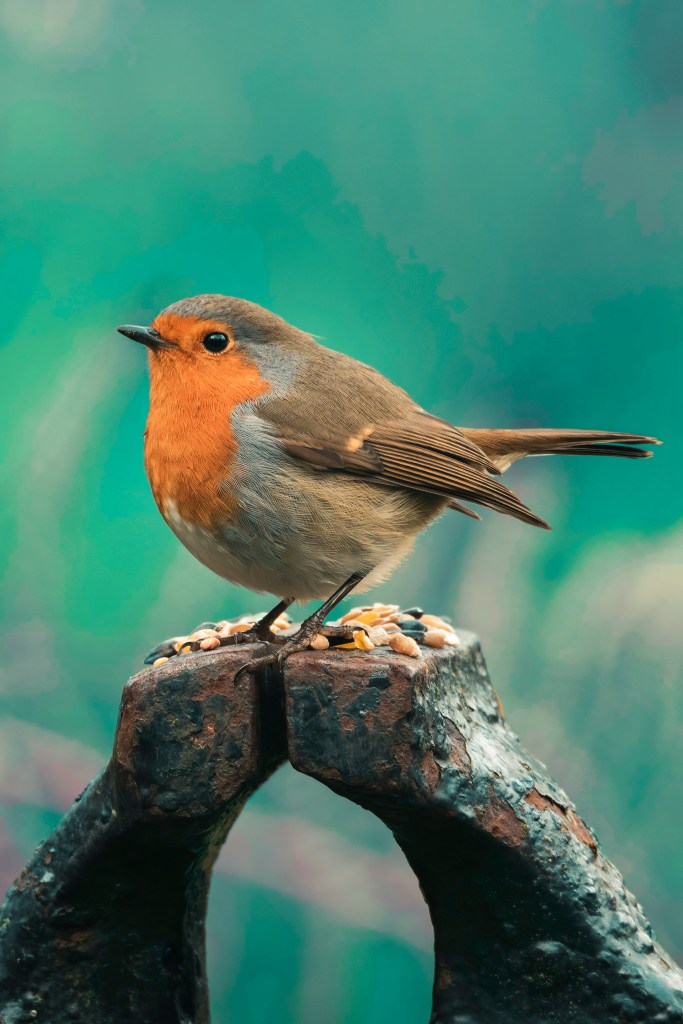
And then there’s the way robins run. They always make me smile.
It wasn’t always like this. It wasn’t always birds. Historically speaking, I’ve always been enthralled by the sight of the moon. I’ve even been known to lose my focus to a particularly striking moon while driving. And I’m delighted by young babies, those soft squishy little people. It’s hard to engage with an adult if a baby is in the room.
Several years ago it was fractals that beckoned me. I couldn’t stop studying them, thinking about them, talking about them, drawing and redrawing them. Fractals are shapes that repeat themselves on both the large scale and small scale.
In math they’re things like the Sierpinski triangle and the Mandelbroit set, Koch snowflakes and Pythagoras trees. In nature they’re things like clouds, trees, snowflakes, and shorelines that have the same repeating structure from far away and up close. (Fun fact: Humans didn’t begin exploring the mathematics of fractals until at least the late 1800s.)
Interestingly, we now know that the human mind is calmed by fractals. It’s part of why nature walks are so healing, so soothing. Our modern lives are so Euclidean, so basic, all these clean lines and corners.
But God’s good creation is fractal in nature — or even hyperbolic, another form of non-Euclidean geometry that shows up in undersea creatures like corals and sea slugs and that also used to captivate me (but whose math humans didn’t discover until the mid 1800s).
What am I really saying here, in obsessing over the math and science of nature? In the end the point isn’t the math and science — fascinating and fun as it is. The point is that beauty is out there. In the good world God made. So gaze upon it. Smile upon it. Let it calm your spirit and your heart and your breath.
God may have made your brain to delight in different things than me. If so, the question to ask is what things? And once you know what God made you to love, delight in it. Don’t ignore it or pass it by. Perhaps you will pause over the simple beauty of a sunset or the painted majesty of pink and grey clouds. Perhaps you will consider the birds and let them charm your heart, enrapture your soul.
Whatever loveliness draws you in, remember that God made you to be distracted by beauty. Let yourself be.
For more reflections on the walk of faith,
read The Hats We Wear.

