To be fair, I’m probably closer to the end than the beginning. And if the CDC’s stats are correct, being 45 years old places me well beyond the halfway point for the average American male (it’s 76.5 years). I don’t feel old, and my goal is not to be too macabre, but if you’ll allow it, I’d just like to share some reflections from this side of things.
Perhaps they’ll remind you, or help you, or clarify some things. In whatever case, and for whatever they’re worth, here are some musings from the middle…
1. You will need the Psalms more than you know.
2. Seasons of doubt will come and may keep coming – this is normal and need not be terrifying.
3. Education is never wasted.
4. Beauty matters a lot.
5. Work hard and build something wonderful, then be prepared to realize that that was only the 1st Mountain (Brooks), the 1st Half (Rohr). There is so much more.
6. Read widely, both chronologically and geographically.
7. Be where your feet are.
8. Remember the orienting reality of eternity.
9. Realize that much additional suffering results from our unwillingness to accept the regular pain and suffering of normal life.
10. Seasons are not the same thing as ages.
11. Look for the people you want to be like and then spend more time with them.
12. Grow with your children.
13. Say yes to lots of things when you are young, but know that the better you get at anything, the more you will need to say no. If you don’t learn the goodness of a no, all the wisdom and expertise you gained from saying yes will be diluted.
14. Not everyone who speaks with confidence knows what they’re talking about.
15. Accept book recommendations and music recommendations from your children.
16. Don’t ever stop playing.
17. Read Chesterton.
18. Adore God.
19. Love people.
20. Walk boldly. All will be well.
“Expect the end of the world. Laugh. Laughter is immeasurable. Be joyful though you have considered all the facts.” ~ Wendell Berry
No one else sees the hidden work he does. I do. The way he fixes tech problems at church events, at weddings and funerals. The way he guides people through the process of healing. I may never know the personal stories of his clients, but I get to hear the prayers, theology, practical tools, and existential philosophy behind his counseling approach.
He’s the one who remains calm when the house is in chaos and somehow brings that calm to everyone else. The one who serves in the background when nobody knows. But I know. I see the sacrifice, the secret labor, the invisible support.
He’s the one with the crazy ideas, and for twenty-six years I’ve been happy to be the armor bearer of the Trotter family (in the mold of 1 Samuel 14). The truth about us is that he has leadership skills I don’t have. He’s farsighted, farseeing, blessed with long vision. I might miss the forest for the trees sometimes, but once I catch that vision, I have implementation skills. And let’s face it, a leader isn’t a leader unless someone else is following.
I’ve said yes to a lot of crazy ideas not everyone would say yes to, and we’ve made it work. Together. Because he’s never once done something without me or my full support — and because he believes I’m his equal partner, à la 1 Peter 3:7.
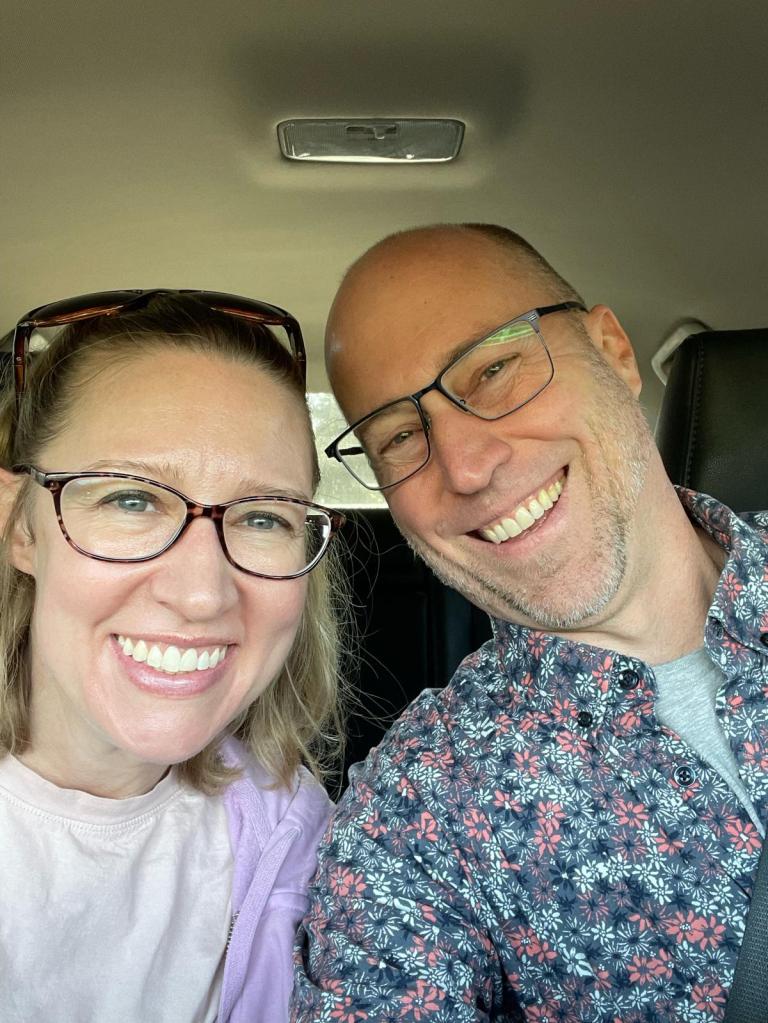
We’re getting closer to the empty nest years, close enough that we can almost taste what it’s going to be like. This picture is of a recent road trip without kids. It reminded me of weekends with him when we were younger. We would literally spend the entire weekend together, walking, talking, eating pizza (back when I could eat gluten — oh the days), watching movies. Sharing our hearts. There’s something about spending long periods of time together that unlocks something in both of us, and we can go to the deeper levels of our souls with each other.
These days we try to spend as much time together as possible, but it wasn’t always easy the past few years. In the middle of launching our kids my brain and nervous system was so confused. I couldn’t see it at the time; I can only see it looking back. At the time all I could see was my former life—a life I had loved and poured my whole self into—disappearing. I couldn’t grasp what was next, and what had been was slipping away.
That middle period was incredibly discombobulating, and sadly I wasn’t the best partner to the oldest friend I have. I’d been so singularly focused while our children were growing up that I couldn’t see past that stage. I didn’t want to “grow old together” because that meant losing this precious part of family life, this defining part of myself.
But this guy. He waited.
He waited for my brain to settle and my hormones to normalize. He waited till the girl he fell in love with came back to him. This most recent road trip didn’t feel like we were entering a new phase. It felt more like returning to the early days of our marriage, to the way this family got started. In a curious mirror of our early years, this life still holds the hope of future babies — though this time they won’t be ours.
So, my dear Jonathan, I want to grow old with you. Who knows? In the end it might be more like growing young with you, just with more aches and pains. But wherever you go, I’m going too.
For more reflections on marriage and motherhood, read my book, The Hats We Wear.
I finally got started on Substack! I’m still in the process of figuring out how to share my writing both on this blog, which has been our online home for over fifteen years, and on Substack, but if you’re someone who prefers that platform, I’d love it if you would head over there and subscribe and follow!
As time goes on, I’ll be sharing my thoughts on motherhood and homeschooling, launching kids, creativity and AI, and the spiritual life. For now, I wanted to give you a feel for what kinds of thoughts I’ll be sharing over there, so I’m including my first Note down below.
//
I’m a late adopter of most new technologies (case in point: I only joined IG this year). But my daughters tell me Substack is the place where writers and readers gather, so until I can figure out what else I need to know to keep up with this platform, I thought I’d begin by sharing about books that have shaped me and are continuing to shape me. Books are friends, after all.
Today’s books are both from authors I was initially dubious of. Authors whose first books I encountered did not connect with me. But I gave them another chance anyway, and I’m so glad I did—because they are remaking me.
First up, Tish Harrison Warren’s What Grows in Weary Lands: On Christian Resilience. Years ago I tried Liturgy of the Ordinary and couldn’t finish it. It felt too surface level and just didn’t draw me in. But when a dear friend told me she was reading Harrison’s newest book and told me a bit about it, I was intrigued and thought it might be just what I needed.
It was. I was in tears in the first chapter and underlined most of it, so accurate was her description of life these last several years. Our 40s can be a desolate time. And Tish’s “cure” for what ails is now posted all over my house: “Stay in your cell.” You’ll have to read the book to find out what she means by that.
Next up, John Mark Comer’s Practicing the Way: Be with Jesus. Become like him. Do as he did. I didn’t like the first Comer book I read. The Ruthless Elimination of Hurry didn’t teach anything I disagreed with, but it was written in a style that pained my creative and editorial heart. I didn’t think I’d be reading any more Comer.
But then our church started going through his Practicing the Way course on Wednesday nights, and I thought I’d give it a try. I’m always looking for transformation, after all. That first video session was contemplative and careful, not pithy and punchy—enough of a shift to convince me to buy the book based on the course.
And oh how glad I am. The book digs much deeper into the course concepts, has shed the breathlessness of that 2017 book, and speaks my innate spiritual language—giving words to truths I somehow already knew in my heart yet just didn’t know how to apply.
Books, and their authors, are friends and guides. They form us and change us and can illuminate the path before us. And just as with real-life friends, first impressions are not always correct. Sometimes you have to give someone a second chance. And when you do, your life just might be changed for the better.
Just ask Elizabeth Bennett.
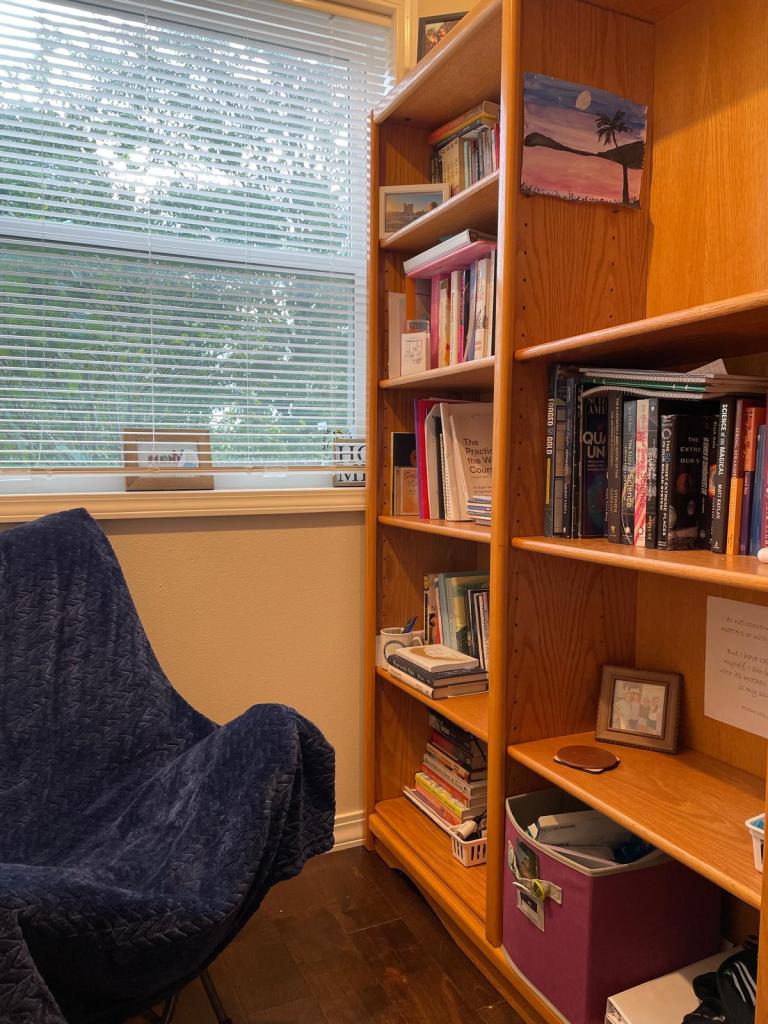
My morning time spot, one of the main spaces where transformation takes place in my life.
Nine years ago this August my family slept in tubes. Huge culvert pipes, to be precise. We drove two hours from our row house in Phnom Penh to the top of Kirirom Mountain for a mini vacation before school started. A resort there had created separate sections with tent camping, the tube “cabins” we stayed in, and actual hotel rooms.
We only stayed one night, but it was a delight. There was a playground and a zipline/low ropes course for little ones. That night I read Ballet Shoes to the girls in our pipe. The pipe rooms were just large enough to hold a single 1.8-meter (king) mattress, so the guys slept in another pipe (which probably had less culture than ours).
The next morning we ate a combination Asian/Western breakfast under a canopy with plenty of breeze flowing, and I had the distinct realization that this was the good stuff. We were in the sweet spot of parenting. Everyone was potty trained, and they still lived at home, still liked us, and still liked each other.
After breakfast I sat drinking tea under the canopy while Jonathan played American football with our kids on a Cambodian mountain and soaked in the moment. I knew the moment wouldn’t last forever. I knew I needed to treasure it. My oldest was about to start 8th grade, and he wouldn’t be around forever.
Sure enough, fast forward to four Augusts ago, and I was taking our firstborn to college. Jonathan couldn’t come with us because he’d just tested positive for COVID-19. Thankfully both boys and I tested negative, because I don’t know what I would have done on that drive home without my other son nearby to contain the edges of my grief.
But family life moves relentlessly forward. Two years later, we took our second to college, and this August we took our third, our first girl — four years to the day after we took our oldest. Many of my friends were taking their oldest to college. I remember the grief well. Four years ago the farewell felt like a death.
I sobbed outside the dorm before we parted. I sobbed in the car before driving away. And when we had to stop for gas, the act of walking into a restroom and seeing my reflection in the mirror was enough of a pause to get me started sobbing all over again. We had to wait in the car for another round of tears to pass before I could safely pull back onto the highway. Just keep talking to me, I remember saying to my younger son. I couldn’t risk any stray thoughts, or I’d burst into uncontrollable tears again.
After we got home, I cried for weeks. Where was he? He was supposed to be here in the school room, studying calculus and physics. He was supposed to be here in the living room, playing Billy Joel’s “Piano Man” and Aeon’s “River Flows in You” on our upright. He was supposed to be here in the kitchen, washing the dishes. He was supposed to be outside on the trampoline, practicing flips. He was supposed to be near, and he wasn’t.
I knew the transition was going to be hard, and I didn’t plan on doing any work or school the first week after he was gone. I walked around the house in a daze, organizing things here and there but not fully present.
I couldn’t bring myself to throw away his old math and science notebooks, so I tossed them onto the top shelf of the closet instead. He would never look at those notebooks again, but in that moment I just couldn’t part with the reminders of him. I couldn’t pitch the evidence that he really had gone through my homeschool.
The truth is, it feels like a death the first time you launch a kid. And it is the end of something — it’s the end of family life as you’ve always known it. It’s the end of all of you being together automatically. It’s a real loss, and you should honor it and grieve it.
But death isn’t the end. Because somehow, there’s a rebirth. Family gets reborn, it’s just different from before. And it can still be good. It can still be precious. Family togetherness doesn’t have to disappear, but it does have to change.
They come back for the weekend, and you have a campfire or a movie night. They come back for Thanksgiving, and you reminisce about all those Thanksgivings together growing up. They come back for Christmas, and you still do all your old traditions.
Then another kid goes to college, and the schedule gets more complicated. But they still come back together sometimes, and of course there are the summers. But then one day your oldest graduates and won’t be coming back as frequently. Or someone brings home a significant other, and you start sharing your house with more people — and sharing your people with other families.
But by this time you’ve learned to roll with the changing schedules. You’ve learned to adapt to fewer people in the house, most of the time anyway. You’re watching all of your kids grow up and make big decisions. And you miss them, and you’re so proud of them for navigating these waters, and you still try to support their process.
You know that family will never look like it did when you had a bunch of littles underfoot and were stepping on Legos all the time and picking up sippy cups. But it doesn’t have to, because those memories are safe inside your heart, ready to be visited whenever the need arises.
And here’s another truth: Those years were good. Those years were worth it. But young motherhood always came with an expiration date, even if we didn’t know it at the time. Babies are supposed to grow. Children are supposed to grow. And teenagers are supposed to fly away in the end.
So first-time college mom, take heart. Remember the wisdom of Cindy Rollins, mother of nine grown children, who taught us that home isn’t a place to stay; it’s a place to leave. Our job as parents is to build a home that is safe enough and strong enough for them to launch from. And then to believe in them as they fly away (and sometimes come back to visit).
That picture of us outside the tubes hangs on the wall next to my prayer chair. Every day I can look over and see a family frozen in time — a family old enough to enjoy each other and young enough to still live together, a family old enough to sit still for read alouds and young enough to still appreciate them.
While those particular details of family life might not be true any longer, the family is still going. We’re still holding onto each other, still spending time together when life allows. More photos will be added to walls and phones and albums as the six of us keep tackling new adventures, but that one at the top of a tropical mountain will stay in my heart forever.
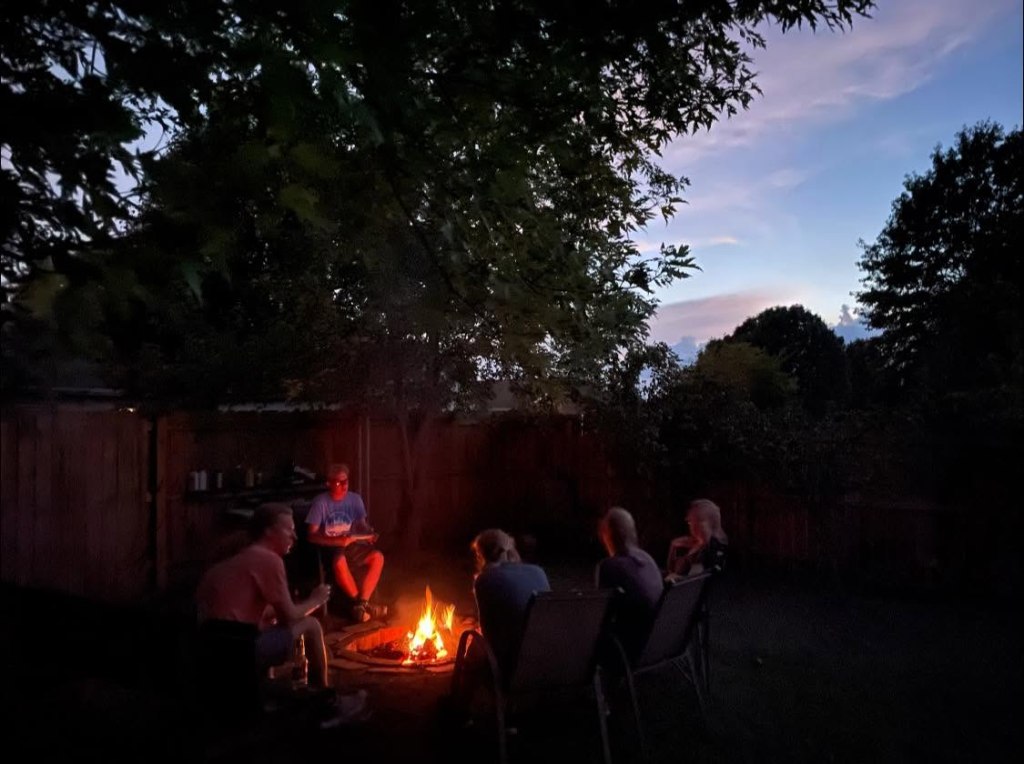
All of us around a campfire two years ago, after having launched half our kids.
For more of my reflections on marriage, motherhood, and all things Christian womanhood, read my book,The Hats We Wear.
My mom was an Army wife. She told me that things always go wrong when a dad is out of town — whether deployed or out for field exercises or summer training. All the Army wives knew it was true.
A kid would get seriously sick, or the car would break down, or something would go wrong with the house when a dad was gone. It was a fact of life they had no choice but to accept. One time a toddler ended up in the hospital while my dad was gone. Another time Mom had a baby. (Thank God for supportive church people, right?!)
But this truism ended up applying to more than military life. Ministry life felt much the same.
I remember being six months pregnant with my fourth child when Kansas City received torrential downpours. Jonathan was at Bible camp with the youth group, and the parsonage basement flooded over fifteen inches. It short-circuited both the air conditioning system and the (newly replaced) hot water heater, which now both needed replacing, and ruined most of what we’d stored down there — books and family photo albums in cardboard boxes which we had carefully placed on top of stone blocks.
But the water level rose above those stones, and capillary action on the cardboard ensured total damage. I needed an entire team of people to help empty the basement of its boxes and furniture, now ruined, try to salvage anything we could, and toss the rest. Later that week a nearby water main broke, and we didn’t have water at all for a while, which was even worse than trying to shower in cold water a few days before.
After that, we stored our belongings in plastic boxes on even higher blocks.
I remember another time when we lived in Cambodia and Jonathan was on an international trip and I got sick. He wasn’t planning to come straight home though. He was going to meet me and the kids in Thailand, where we were scheduled to be the keynote speakers at a home education conference.
I had to figure out how to get better and still make it to the conference with four kids in tow. Asian airlines and airports have been checking for fevers long before COVID-19 hit the world, so I didn’t actually know if I would make it to the conference. That week involved a lot of praying, phone calling, and Tylenol swallowing.
Something similar happened again recently. Jonathan was just about to leave for an international ministry trip when I became seriously ill. I couldn’t concentrate, I was in constant pain, and I could barely get out of bed, but I somehow dragged myself to the doctor for testing. What I was diagnosed with (thyroiditis) was going to require a long recovery, but there were some medications that could help manage symptoms in the meantime.
Then it was time to decide whether he should leave on the ministry trip or not. I was in bad shape, and he offered to stay home and care for me. But I really felt he still needed to go. People were depending on him — some people were attending the event specifically to meet with him. Plus, I had all these older teen and adult children who could help, in addition to an amazing local church family. One thing I know for sure: the prayers of the saints have held me these past couple weeks.
This illness isn’t fun. I actually got worse for a little while after he left. But the experience reminded me of my mama’s wisdom. Things always seem to go wrong just when the person who is supposed to help you navigate the trials of life is also gone. Is it chance, happenstance, spiritual warfare? I don’t know. I do know that my husband and I have often fought just before a big ministry event — so much so that he began to expect it.
This time around we didn’t fight. I got sick instead.
I’ve never been one to accuse the devil of much. I’ve seen the practice misused. But sometimes it’s hard not to draw spiritual conclusions. This illness was so unexpected. I’ve never had thyroid problems, and they don’t run in my family. I’m generally healthy. Yet right before Jonathan was supposed to leave for an eleven-day trip to do some really important ministry, I was diagnosed with a temporarily debilitating illness.
The truth is, maybe we’ll never know the reasons these things happen. But as every military, ministry, and missionary wife knows, they do tend to happen. The question then becomes: What are we going to do when they happen?