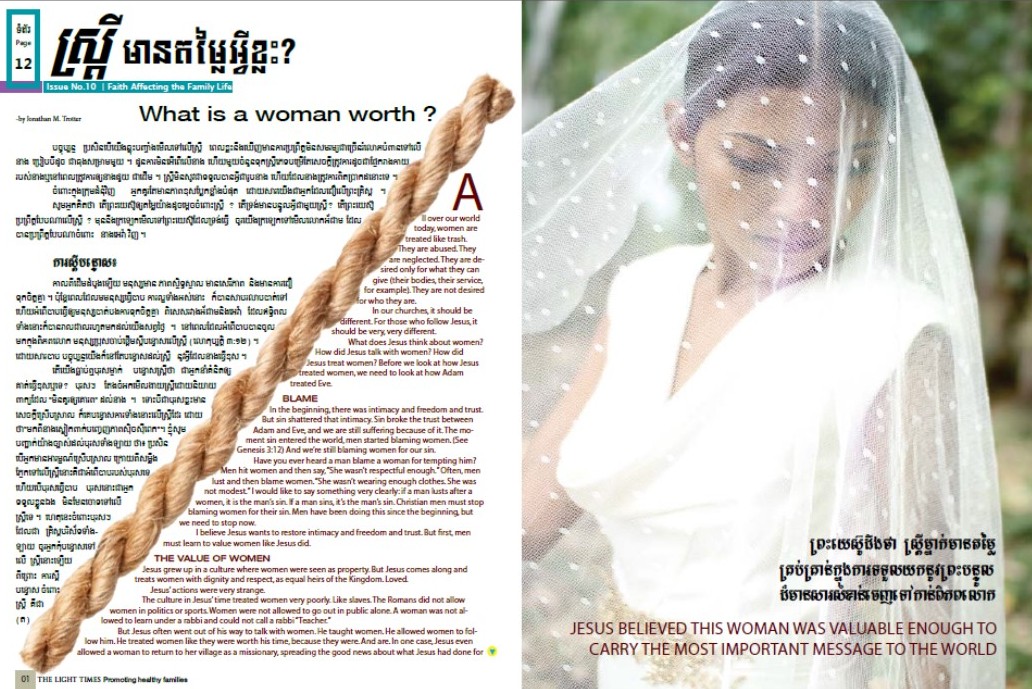
What is a Woman Worth?

This post was originally written for and published in The Light Times Magazine, with Khmer translation done by the magazine editors. Download a PDF of the article (in English and Khmer) here. — Jonathan

wiaww3

All over our world today, women are treated like trash. They are abused. They are neglected. They are desired only for what they can give (their bodies, their service, for example). They are not desired for who they are.

In our churches, it should be different. For those who follow Jesus, it should be very, very different.

What does Jesus think about women? How did Jesus talk with women? How did Jesus treat women? Before we look at how Jesus treated women, we need to look at how Adam treated Eve.


Blame
In the beginning, there was intimacy and freedom and trust. But sin shattered that intimacy. Sin broke the trust between Adam and Eve, and we are still suffering because of it. The moment sin entered the world, men started blaming women. (See Genesis 3:12) And we’re still blaming women for our sin.

Have you ever heard a man blame a woman for tempting him? Men hit women and then say, “She wasn’t respectful enough.” Often, men lust and then blame women. “She wasn’t wearing enough clothes. She was not modest.” I would like to say something very clearly: if a man lusts after a women, it is the man’s sin. If a man sins, it’s the man’s sin. Christian men must stop blaming women for their sin. Men have been doing this since the beginning, but we need to stop now.

I believe Jesus wants to restore intimacy and freedom and trust. But first, men must learn to value women like Jesus did.


The Value of Women
Jesus grew up in a culture where women were seen as property. But Jesus comes along and treats women with dignity and respect, as equal heirs of the Kingdom. Loved.

Jesus’ actions were very strange.

The culture in Jesus’ time treated women very poorly. Like slaves. The Romans did not allow women in politics or sports. Women were not allowed to go out in public alone. A woman was not allowed to learn under a rabbi and could not call a rabbi “Teacher.”

But Jesus often went out of his way to talk with women. He taught women. He allowed women to follow him. He treated women like they were worth his time, because they were. And are. In one case, Jesus even allowed a woman to return to her village as a missionary, spreading the good news about what Jesus had done for her. Jesus believed this woman was valuable enough to carry the most important Message the world has ever seen. (See John 4)

And when it was time for people to find out that he was alive again, the first people to know were women. Women were the very first people to announce the resurrection of Jesus. This was very strange. In that culture, women could not be legal witnesses in a court of law, but now, they are witnesses of the greatest event in history. And they’re telling men all about it. (See John 20)

There is one more story that we must talk about. In John 8, a very vulnerable woman is in front of very powerful men. And Jesus stands in between. Because that’s where he always stands. Jesus always positions himself between religious men and hurting women. When the men want to throw stones, Jesus stands there, protecting, wanting to heal hearts.

We must follow his example.

Ladies, hear what Jesus says to you,

You are loved,
You are valuable,
You are precious to me. 

I made you on purpose, and I love you.
If you have been hurt or abused, I am so sorry.
If you feel shame, remember that I came to erase shame.
When I see you, I do not see shame.
I see the girl I Iove, the girl I died for. 

My daughters are shameless and blameless.
Perfect in my sight.

It is my hope and prayer that the Church in Cambodia would be a place where all people are respected and loved and cherished. Old and young. Rich and poor. Men and women.

Amen. Come, Lord Jesus.

~~~~~~~~~~~~~~~~~~~~~~~~~~~
[page 1 of 2]

Failing at Fatherhood {A Life Overseas}

Jonathan is over at A Life Overseas today, talking about how moving abroad ruined his parenting.

faf2-700x501

I sat on the floor, weeping.

I was two whole days into living abroad, and I was already losing it.

Those tears portended more, and in our first year overseas, the thing that knocked me down the most, the thing that discouraged and distracted and depressed me the most, was the sense that I was failing at fatherhood.

I loved being a dad. It was a very core part of my identity, and something I really cherished. Moving to Cambodia, I had expected cross-cultural stress. I had expected transition tension and unmet expectations. I had even expected conflict with other missionaries and nationals. But I never thought I’d feel like my identity as a father was being shredded up and burned in the furnace of a cross-cultural move. That was a surprise.

We moved overseas when our boys were six and seven and our girls were one and three.

I suppose my fathering style could have been characterized as, um, B I G. I loved playing with our kids in wide open spaces, throwing things, kicking things, climbing things. We played loud and we took up a lot of space, and that’s how we liked it.

And then we moved to a concrete box with bars on the windows in an urban capital of a developing country. No grass. No yard. No large spaces.

For me, the shift from wide open spaces to urban jungle was rough. I had to adjust, but first I got depressed. Often, it’d happen on a Saturday; I’d wake up just wanting to go outside and throw a football with my kids.

And with the clarity of thought that overwhelms at times like this, I felt like I had moved from a garden to a prison. A prison that was 95 degrees and thick with humidity!

I had traded acres of green for walls of grey. En Gedi for Sheol.

I watched my kids hang from metal bars on windows when they used to hang from giant limbs on oaks. They were happy, but I was dying.

I missed being able to step outside and kick a soccer ball. I missed our fire pit on cold autumn nights. I missed our porch swing. I missed our yard. I missed the way I used to father.

But thank God the story doesn’t end there, with a depressed dad missing what once was. No, the story definitely doesn’t end there…

To read the rest of the story, click here.

Women Are Scary (and other lessons modesty culture teaches men)

by Jonathan

I am sad.

I live in Southeast Asia, and there’s a “massage parlor” a few blocks down the street. In fact, there are several. “$2.50” is what the sign reads. And then there are the KTVs (“karaoke bars”) with rows of plastic chairs holding property: young women in skimpy cocktail dresses waiting for clients. Several of them within a mile of my house. One’s called Dubai, one’s called Las Vegas, and one’s simply called J. I know the names because they’re on the main streets. They’re not hidden.

I see it everywhere: men trampling women.

And then I get on my computer and read about Ashley Madison and Josh Duggar, and my worlds collide. I grew up under the same teachings as Josh. Same home school group. Same emphasis on modesty and purity and playing the violin.

But my parents weren’t “all in.” I was much more into it than they were, actually. As a young teenager, I was upset because my dad wouldn’t sell his dental practice so we could move into the country to be more holy. I stopped listening to “rock music” and even left a Christian concert once out of my strong conviction. My parents stayed.

My parents still took us to the (agh!) public pool, but when I decided that was too dangerous for me, I recused myself from that den of iniquity.

So yes, I did grow up under the same teachings. Sort of. But because we had friends outside of the movement, and because my parents were very loving and “too compromising,” I was spared much of the devastation.

It’s from this vantage point that I’d like to speak about modesty culture.

I lot of people talk about modesty. A lot of people talk about purity. I never have. But I can’t take it any more; I must talk about it, and so I will. I will talk about the lessons I believe modesty culture teaches men. This is not about Josh Duggar specifically, although the current news cycle certainly has made me think a bit more deeply about this topic.

Also, I have daughters. And sons.
I have a bunch of younger sisters. And brothers.
I have a wife.
That makes this all very, very personal.

photo-1434210330765-8a00109fc773a

What modesty culture teaches men: Lesson 1 — Women Are Scary

All of them. All the time. Yes, you should “treat them like sisters,” but really, you should be terrified of them. They could “reduce your life to a loaf of bread.” It’s really best to domesticate them. We don’t want any wild and free women roaming the countryside, luring unsuspecting holy men.

Women are powerful, a force to be reckoned with, and if you’re not careful, they will ruin you. That’s why women need to dress modestly, cover their power.

So be cautious. Keep them at a distance, lest you be snared.

The result? Men who are scared to interact with half of the human population. Men who must look at the dirt when a woman walks by instead of looking her in the eye. That cannot be right. These men grow up so scared of women they never develop healthy relationships with any of them; they don’t actually get to know a girl as a co-equal member of the human race.


What modesty culture teaches men: Lesson 2 — Men have a responsibility to not look, but women have MORE responsibility to not be looked at.

I grew up learning of the guy’s responsibility to not look, and that’s great, but what I really heard A LOT about was the girl’s responsibility to not be looked at. Practically speaking, this is just really stupid. And it’s offensive, because it’s basically saying that guys can’t help themselves and we need women to save us from our own animalistic urges. “Please, ladies, put this blanket on.”

Seriously, men? Give it up and guard your own heart. Not.Her.Job. You cannot blame your lust on a woman. Ever. Period. If you walk down the street by her house late at night and “fall into temptation,” that’s on you, man. I don’t care what she was wearing or if she came after you buck naked. Man up and run away.

Furthermore, let’s assume for a second that EVERY.CHRISTIAN.WOMAN on the planet agrees to dress modestly (however you define it) in order to help you stay pure, what are you going to do about the rest of them? The ones who don’t know Jesus and don’t care about “protecting your heart”? The ones Jesus still calls you to love and serve?

Modesty culture shifts blame; I’d like to shift it back.

Because I can’t really imagine Jesus saying, “Don’t lust, but if she’s really hot and she’s not wearing much, then I totally get it. And really, if she’s pretty at all and is walking in front of you, it’s not really all your fault. She doesn’t follow me or care about you, but she should know better than to dress like that. I’ll assign her some of your guilt. Carry on.”


Women Are People Too

So much of modesty culture dehumanizes women. It reduces their complexity and unique personhood to their sexuality. In an effort to guard sexuality, it actually makes it ALL ABOUT SEXUALITY. In our strong reaction to the “sexualization of our culture,” we’ve done a pretty good job of turning women into sex objects. And our men have lost the ability to have healthy, close relationships with real women.

But women are people too. Image bearers. They have their own voices, their own relationships with the Father, their own hopes and dreams.

And actual prostitutes? Turns out, they’re people too. In fact, as he often does, Jesus comes along and ups the ante by HANGING OUT WITH THEM. Oh my! How could he do that and stay pure? Wasn’t he afraid his disciples would follow his example, hang out with “bad people,” and fall miserably into the abyss of sexual sin? I don’t think so.

In fact, I believe Jesus wasn’t afraid of the “bad people” because he saw their humanity. And he knew that their humanity desperately needed his divinity. To love people is to be with people. And people don’t always follow the rules or dress appropriately.

If we can’t figure out how to deal with that, we’re going to have a heck of a hard time sharing Jesus with folks who don’t know him and act like it.

And that just might be the saddest thing of all.

That Lane is Your Lane, This Lane is My Lane

To the tune of This Land is My Land, sort of.

Lyrics:
That lane is your lane
This lane is my lane
Does it really matter
You have the right of way

You have a big car
I’m so much less than
You flashed your lights first
Please go ahead

You drive a Lexus
I drive a Honda
You have rank
So dasvedanya

You’re more important
Jesus still loves you
So I’ll just move now
And let you through

That lane is your lane
This lane is my lane
Does it really matter
I might just go insane

You have a big car
I need my therapist
You flashed your lights first
I feel so miffed

You drive a Lexus
I drive a Honda
You have rank
So dasvedanya

You’re more important
Jesus still loves you
So I’ll just move now
And let you through

How to Communicate So People Will Care {A Life Overseas}

Jonathan is over at A Life Overseas today, sharing his perspective on what creates effective communication back to senders and supporters.

hse

Newsletters. Prayer updates. Itinerations. Reports. Furloughs. Presentations.

Are you stressed out yet?

For most of us, living and serving abroad means communicating back to senders. A lot. But this isn’t what we went to school for, and besides that, communicating in person or in print is scary. It’s exposing. It’s like learning a new culture and language; sometimes when we mess up it’s funny, sometimes not so much.

We’re all too familiar with the dangers:

Communicate too much and we’ll annoy people or people will say we’re not protecting the privacy of the nationals.

Don’t communicate enough and we’ll get dropped; people or churches will stop supporting us, because “out of sight, out of mind.”

Talk about the right stuff in the right way. One missionary recently told me that you have to appear miserable enough that people will still support you while not appearing so miserable they want you to come home.

To be sure, communicating with senders (via newsletter or a live missions report) is a unique form of communication, blending a bit of travelogue with a side of sales pitch, and then adding a large spoonful of sermon. It’s like a Christmas Letter got married to a Church Bulletin and had an Amway.

Finish reading the post here.