I love my job so much that…

I love my job so much that I’m trying to get better at it. Want to help?

Thanks to the generous support of so many churches and individuals, I’ve served as a pastoral counselor and coach to missionaries for about nine years now. Last week alone I met online with missionaries serving in or returned from Kyrgyzstan, Kenya, west Africa, Japan, Cambodia (six clients), Bulgaria, Dominican Republic, and Tanzania.

Shortly after our return to the States, Elizabeth and I decided that I should go back to school. I’ve been in grad school studying clinical mental health counseling for one year now, and I have a year and a half to go. I hope to use this education to continue serving missionaries around the world for many years to come. So…

Here’s the request

Like many companies and churches, our missions agency provides an educational reimbursement benefit up to $5,000 per year. This is fantastic and could be extremely helpful! However, because Team Expansion is a missions agency, and because we serve in a support-based position, we have to raise our own benefits.

In other words, we won’t get the benefit if we don’t raise it. Maybe that sounds weird to you, but we’re super grateful for even the chance of this benefit, and that’s just sort of how things are done in the missions world.

So, we’d like to invite you to consider giving especially for this educational need. (It’s tax-deductible for folks in the US.) Some have already given, so we’re only $3,700 away from our goal!

Many of you gave towards this last year, and we are soooo grateful! It was immensely helpful in deferring some of the school fees!

If you’ve been blessed over the years by our writings or pastoral counseling ministry, or if you’d like to support this preparation for future ministry, would you consider giving through PayPal (preferred) or Team Expansion’s giving portal here? Note: if you donate through Team Expansion’s website, please add “education” to the notes section.

Team Expansion has taught us to invite boldly, so here we are. We’re not using regular donations to fund this education benefit — only money raised specifically for it.

As I’ve said over and over, we couldn’t have gotten this far without y’all, and we can’t get a whole lot farther without y’all. If you have any questions, please let me know.

In the meantime, we’re going to keep trying to “follow close” behind Him, serving missionaries and cross-cultural workers around the world, equipping them to see the hearts of the hurting people around them, for his glory and for the growth and health of the global Kingdom.

All for ONE,

Jonathan T.

One of the counseling rooms at Mt. Hope Christian Counseling Center here in Joplin. I started my part-time internship here last week!
Living Well, Cambodia
Counseling room at our international church in Phnom Penh, Cambodia.

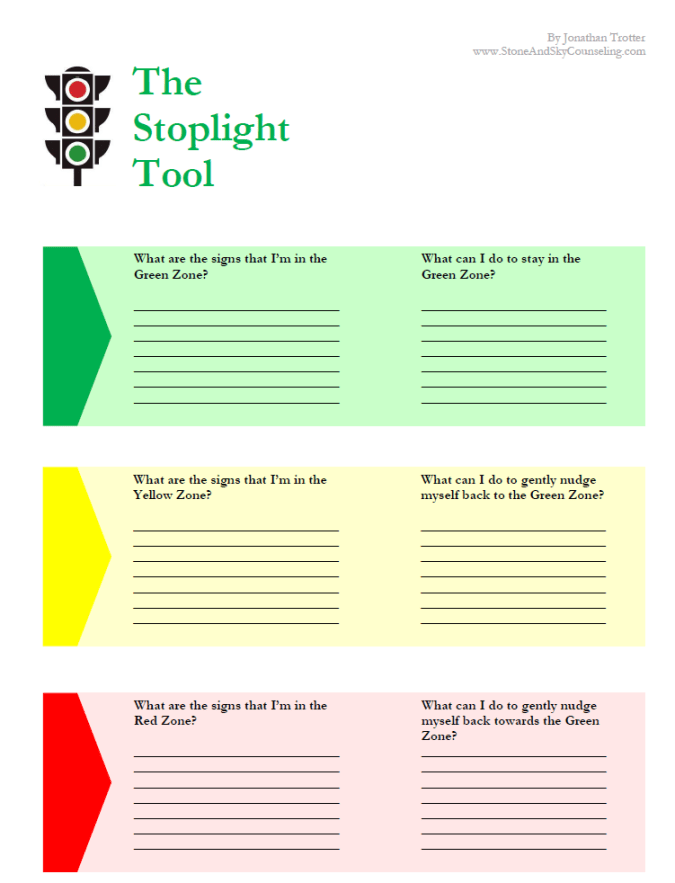
The Stoplight Tool

The idea is pretty simple. First, think about the signs that show that you are doing well in that area. How do you know you’re in the green? What does your friend or partner see when you’re in this color? And then, what are the things that help you to STAY in that color? Keep doing those things.

What are signs that you’re in yellow? What starts to happen when you’re trending in a direction you don’t want to go? The idea is to notice these things earlier than maybe you have in the past. And then, what are some things you might want to think about doing (or stop doing) that would help nudge you back to green?

And then the last one. What are the signs that things are really running hot? That you’re really struggling or not doing well? What are some things that maybe you don’t normally do, but that you might really want to do (or stop doing) that would get you moving back toward the healthy green?

It’s not rocket science, but when we’re really struggling with something, we don’t need rocket science. We need simple. We need straightforward. We need pre-planned.

Filling this out gives you a cheat sheet when you need it. When you’re trending towards red, you’re probably also forgetting all the helpful things. But if you’ve written them down, if you’ve shared them with a friend, partner, or ally, then you can look back, remember, and then maybe implement.

Hope that’s helpful out there, y’all! Take care, and happy Thursday!

Jonathan T.

__________________________________________

I’ve been using these concepts for a few years now, but I finally got around to creating a handout/worksheet for The Stoplight Tool. I’ve used this with folks dealing with OCD, depression, anxiety, and even adult ADHD. If you’d like to use this in your practice or ministry, would you consider purchasing the PDF for $2.99 here? Drop your email address in the comments when paying and I’ll send you the file. Thanks!

I’m Going to Grad School!

So here’s an announcement and a request…

ANNOUNCEMENT

I’m very happy to announce that I’ve been accepted into the MA in Clinical Mental Health Counseling program at Colorado Christian University. It’s a two-and-a-half-year program that’ll start in July. It’s mostly online and is designed for folks with full-time jobs, which is handy.

This feels like the next step in responding to God’s call on my life to “see the hearts of the hurting.” In fact, during our first year in Cambodia I attended a leadership conference and felt like God clearly pressed upon me the image of a bridge built on two pillars. The top of the bridge, the overarching call on my life, was the growth and health of the global church. The two pillars upon which that calling would rest? Discipling young people and heart-focused pastoral counseling. Those core ideas have been on my office wall for nearly ten years now.

Since this grad program is designed for adult learners with full-time jobs, I plan to continue serving with Team Expansion in exactly the same capacity, providing pastoral care and empathetic coaching to missionaries all over the world.

Starting years ago at Living Well in Cambodia, both of my counseling supervisors repeatedly encouraged me to look into a step like this. They both told me: “Your forties are the perfect time to get a masters in counseling. You should go for it.” They both had. 😊

I’ve spent thousands of hours over the last eight years sitting with hundreds of clients from around the world, and my deep hope is that this program will equip me to serve them with more skill, more resources, and more knowledge.

An MA degree will also open the door for possible teaching at the college level at some point in the future (missions and/or counseling). I hope to write more in the future too, exploring the blessings the church can bring when we walk alongside of those who are hurting, and contrasting that with the tremendous damage that can be done when we fail to understand trauma, abuse, grief, and deep emotional pain.

REQUEST

Like many companies and churches, our missions agency provides an educational reimbursement fringe benefit up to $5,000 per year. This is fantastic and could be extremely helpful! However, because Team Expansion is a missions agency, and because we serve in a support-based position, we have to raise our own benefits.

This isn’t a new concept, but it is a bit unique: we won’t get the benefit if we don’t raise it.

We don’t know exactly how we’re going to pay for grad school. We do know that we’re not going to use funds that our regular supporters have given to the general ministry fund. What we can do, however, is invite you to consider giving especially for this educational need.

If you’ve been blessed over the years by our writings or pastoral counseling ministry, or if you’d like to support this preparation for future ministry, would you consider giving? Team Expansion has taught us to invite boldly, so here we are. Just put “education” in the notes section of our giving page.

We couldn’t have gotten this far without y’all, and we can’t get a whole lot farther without y’all. If you have any questions, please let me know.

In the meantime, we’re going to keep trying to “follow close” behind Him, serving missionaries and cross-cultural workers around the world, equipping them to see the hearts of the hurting people around them, for his glory and for the growth and health of the global Kingdom.

All for ONE,

Jonathan T.

Politics, Plumeria, and the Kingdom of Heaven

“I miss Ima,” my daughter tells me. “I miss her singing, and I miss her flowers.”

Ima was one of the best worship leaders I’ve ever known, and I’m so glad our paths crossed at an international church in Phnom Penh, Cambodia.

Originally from the islands of Fiji, Ima always led worship with a tropical flower in her hair. Usually, she chose a frangipani (plumeria), the bright yellow satiny flower that smells like the most luscious citrus dessert and is the mainstay of Hawaiian leis.

Cambodia has a tropical climate and wonderful people, but even so, the country has suffered much as a result of war, genocide, and corruption. Cambodia is not a tropical paradise, but the church is growing, and Ima is helping.

With her global team she led our global church. Typically, she shared the stage with a Filipino on keys, a Pakistani on percussion, an Australian on guitar, and a Malaysian on drums. Together, they helped lead a rag tag group of Jesus followers from over 30 nations in worship. They helped us declare, week after week, the hope of the cross and the certainty of God.

Our church was full of missionaries and businesspeople, those involved in anti-human trafficking work, and those serving in the relief and development sector. Many of us came to church on Sundays tired, exhausted, and poured out. We traveled by motos and tuk tuks, buses and cars, to be reminded of our Hope. We came to drink of Life, and we came to declare the death and resurrection of our Lord, until he comes again.

I hadn’t grown up in a church like this. I hadn’t grown up in a church with pastors from China, New Zealand, the Philippines, India, Canada, Cambodia, and the United States.

I thought the church was primarily American.

I mean, I didn’t really think that; it’s just that growing up in the Midwest in a standard evangelical church, the church just was pretty American. And Caucasian too. Our authors were American, our musicians were American, everyone was American.

Typically, the only non-American folks I ever came across were the ones we were sending missionaries to. We were the ones sending the gospel, and they were the ones receiving it.

As believers in America we’re taught, often accidentally, that to be a Christian is to be American, or at least to look like it. Even if not purposeful or intentionally racist, the trickle-down effect of this theology is dangerous and thieving, denying us connection to the breadth and depth of the global church.

But here was Ima, a Fijian woman, singing the gospel with power. She was pouring her heart out in prayer, and she was ushering a global community into the throne room of God. The Kenyan sister was dancing, the Samoan brother was singing, and the Australian guy was jumping up and down with a huge smile.

The global church was so much more beautiful and diverse than I had ever known. Christ’s people had come from all over the place, they were going all over the place, and they were worshiping.

I love the American church. But I’m afraid that somewhere in our history, we began to believe that we Americans held the keys to the Kingdom. We would never say it like that, but we sometimes act like that.

So long ago, our spiritual forefathers rightly declared that Rome was not the central hub of global Christianity. But I’m afraid we’ve drifted into our own hubris and begun to believe that the American church is the hub, the main gospel force in the world. It is not.

That vision is too small. That church is too claustrophobic.

I want to be brothers with the Swiss guy who runs a climbing gym in Cambodia. I want to serve alongside a Chinese businessman who converted himself (as far as that is possible) by picking up a Bible someone left behind in a hotel room in Nepal.

I want to rejoice with the Pakistani couple who opened their hearts and kitchen to us, telling stories of the faithfulness of God and how they escaped to safety. The unique flavor of homecooked samosas will always remind us of our friends’ faith and our Father’s faithfulness.

I want to honor the Japanese man providing care and education to disabled Cambodians. I want to join in with Cambodian pastors who continue to teach God’s word to God’s people in difficult times and challenging places.

Christ is the King, and his church is global.

We must remember: the church existed before America.

We must remember: the church will endure long after America.

We must remember: the church is older than Western civilization.

The church is global, and she is not dying.

And while the church is global, the gospel always gets worked out locally. That’s the beauty of it. The church can be local precisely because it’s so stunningly global. The church is big enough to be local everywhere.

As citizens of America, we should celebrate and honor and cherish the church in the United States. She remains beloved and part of the Bride. But as citizens of the Kingdom, we should celebrate and cherish and love the global Church too, wherever she may be found.

A Fijian worship leader with a flower in her hair helped me learn that.

When I finally get home and meet Jesus face to face, I will not be surprised at all if he bellows out the Fijian greeting: “BULA!” which means, “Life to you!” I hope to hear him say on that day, “Welcome home, my son. Here is the life you’ve been searching for! Well done.”

And then I will wander.

I will find a frangipani tree. I will inhale its cheerful citrus fragrance, I will smile, and I will look out on the nations that God has brought together, and I will declare, “This looks familiar; look at what the Lord has done!”

And then I will find Ima, and I will thank her for what she gave our church and what she gave my daughter. I will thank her for what she gave me. With her uniquely Fijian flair and a frangipani flower in her hair, week after week, she led God’s people to paradise.

When Depression Descends

Author’s note: This article should not be used to diagnose or treat clinical depression. If you are having thoughts of hurting yourself or attempting suicide, please seek out a medical and/or mental health professional immediately, visit the Lifeline online, or call 1-800-273-8255 (U.S.). A list of international suicide prevention hotlines can be viewed here and here. — Jonathan

It feels like a leaden mantle descending over everything, blotting out the sun, joy, and the belief that there is anything good in the world. It leaves your feet bolted to the floor and your heart frozen in the empty void of black space.

It feels like liquid cement pouring into your body, heavy and thick, slowly solidifying, hardening, restricting movement. It feels like your chest is being crushed. Like a polio victim without an iron lung, desperately searching for the energy to overcome diaphragmatic paralysis. It feels like a suffocation.

It doesn’t always feel like sadness. It might look like incessant weeping, sure, but it just might look like staring at a blank wall for fifteen minutes. Unmoving.

Even if you’re a missionary. Even if you love your wife and kids. Even if you have enough money and love your job. Even if you have a fulfilling ministry, both on and offline. Even if you work with therapists and help pastor a church. Even if you love the Psalms and know about lament and have written extensively about emotional health. Even if you’ve studied depression and sat with suicidal clients (in a counseling center) and patients (in an ER). Even if.

Sometimes, it’s just there, and it is so terribly heavy.

I have been there. And still, after our unplanned transition back to America, our dislocation and eventual resettling, COVID-19, a dark winter, and political chaos, it still threatens. Occasionally I get a whiff of the darkness, and it turns my stomach sour.

If you’ve been there, if you’ve felt these things, please know this: you are not alone.

For me, at the scariest point, I started thinking about ending my life. I never developed a plan (which is a blaring warning sign, especially if the person has the means to carry out the plan), but I was ruminating more and more about death and dying, and it scared me tremendously.

I had started taking an occasional non-narcotic pain medication to help me sleep. In Cambodia, so many prescription medications do not require a prescription and are available in blister packs at the cash register. This can be handy, but it’s also very dangerous and should probably be the topic of a later essay. Anyways, we had neighbors on both sides of our row house that kept very late hours. On one side, it was drunk karaoke followed by the smashing and screaming of domestic violence. On the other side, it was a bit of a house-turned-warehouse where they repackaged boxes for local distribution – think screeching packing tape – until 1 or 2 am nightly. The packaging center was about three feet away from the head of our bed. The drunken abuse was about five feet from the foot of our bed. Bricks and a little plaster and tile were not enough. I wasn’t sleeping well, and I was getting more and more anxious and agitated.

So I started taking this medication.

Looking back, I think the spiritual, environmental, and psychological stresses brought me to the tipping point, and the medication nudged me over the edge.

Incentive to Hide

In any sort of Christian ministry, there can be an immense incentive to hide things like this. If the person who’s asking how you’re doing also has the power to fire you, relocate your family, or detach you, your spouse, and your kids from your church, school, and social support, well, honestly, that’s a ridiculous ask. (I’m not saying that’s a healthy dynamic, by the way, I’m just saying that it’s pretty typical in the missions world. Again, another essay for another time.)

But when it comes to depression, silence could be deadly. And while I certainly understand the reasons for hiding, hiding depression can lengthen your misery, shielding you from help and resources. Depression is very treatable once it’s identified.

Don’t hide, and please oh please don’t feel like you’re a failed Christian or a failed missionary just because you’re depressed. You’re not less than or anything of the sort; you just may need a little bit of extra support for a time.

I did.

I still do from time to time.

How to Respond: Tell Someone

I talked with a doctor. I’ll never forget the day he said, “You know, it’s a rare side effect, but it is a documented side effect of that particular medication.” I went home and threw those blister packs in the trash like they were filled with gecko poop and crawling with giant cockroaches.

I increased the frequency of meetings with two good friends, one of whom was a therapist and one of whom was a pastor. I broadened my support base. I changed my diet, reducing processed foods and sugar, increasing fruits and vegetables. I started exercising more.

If you’re not sure, but you think you might be depressed, please consult with your doctor and/or a mental health professional. Check out our resources page for mental health professionals in your area. You do not have to do this alone.

There are so many resources available, and there are so many treatment modalities that are proven to help (talk therapy, medications, lifestyle changes, etc.). You do not have to do this alone.

NOTE: If someone hears your story and tells you that you just need to try harder or read your Bible more or root out the sin in your life or be more disciplined or some such nonsense, please smile and nod, turn around, and run the other direction towards someone who will give you good advice. Because that person’s not.

How to Respond: Educate Yourself

Sometimes, the depression’s so thick that you don’t have it in you to do any sort of online research or reading. That’s ok. If that’s where you’re at, reach out to someone and skip this part.

But if you can and if you want to, remember that you have access to a whole host of online resources. I typically turn to the Mayo Clinic or the Cleveland Clinic for medically accurate information that’s written for non-medical folks. Read their information on depression here and here and chronic depression (over two years) here and here.

The NHS has a short depression self-assessment tool that might also be a helpful place to start.

And now, please don’t laugh, but I REALLY appreciated the material in the book Cognitive Behavioural Therapy for Dummies, by Rhena Branch and Rob Willson. Their section on depression has been immensely helpful for me and several friends. Check it out.

Additional Resources

This is the first time I’ve written so explicitly about depression. Here are some musings (and a sermon/podcast) about related things, like Grief, C.S. Lewis and the Deeper Magic, and Hope.

Remember, you are not alone. The promises are true.

You are not alone.

~~~~~~~~~~~~~~~~~~~~~~~~

From the Mayo Clinic: When to get emergency help

If you think you may hurt yourself or attempt suicide, call 911 or your local emergency number immediately.

Also consider these options if you’re having suicidal thoughts:

  • Call your doctor or mental health professional.
  • Call a suicide hotline number — in the U.S., call the National Suicide Prevention Lifeline at 1-800-273-TALK (1-800-273-8255). Use that same number and press “1” to reach the Veterans Crisis Line. [Visit their website here.]
  • Reach out to a close friend or loved one.
  • Contact a minister, spiritual leader or someone else in your faith community.

If you have a loved one who is in danger of suicide or has made a suicide attempt, make sure someone stays with that person. Call 911 or your local emergency number immediately. Or, if you think you can do so safely, take the person to the nearest hospital emergency room.