Misogyny in Missions {A Life Overseas}

Jonathan is over at A Life Overseas today. . .

photo-1466357955653-f8a10d011dcb1-480x300

Ladies Who Lunch – With Men

That’s the name of an article I shared on Facebook recently, not knowing it would unleash a torrent of opinion. How should men and women interact? If they work together, what sort of rules should we put around their interaction? How do we safeguard marriages while treating women with respect?

Do our rules surrounding male-female interaction demean women?

It was an interesting discussion, and one that I think our community needs to have.

Click over to A Life Overseas for the discussion.

The Top 6 Things I’m Learning and Living this Year

A couple weeks ago I shared the “Top 5 Things I’m Learning and Living This Year (because I have neither the time nor inclination to blog)” on Facebook. Since that time I’ve been learning a 6th really key lesson; and since my Facebook readers and blog readers aren’t always the same, I’m taking the time to share this here too. I’d love to hear in the comments what you’re learning and living this year!

road-sign-799141_960_720a

1. ON MARRIAGE: I neglect Date Night only at my peril. Sometimes after a busy month I look at my husband and think to myself, “We don’t even know each other.” I don’t want to get to the end of 20 years and think those thoughts; 20 days is long enough. All my work is at the house: mom, teacher, writer, housekeeper. So I have to get out of the house with my man Jonathan Trotter. To breathe, to think. To connect, to focus. To relax, to commune. I literally can’t live without Date Night.

2. ON HOME SCHOOL: I’m loving read-aloud time (part of the reason I have neither time nor inclination to write). I’m finding that children’s literature is sometimes the best thing I can read by myself too. And I’m starting to think that one of the hardest parts about this home education gig is teaching basic phonics & decoding (reading) and base ten arithmetic. Those two hurdles are hard to jump for a 5 or 6 year old. And they’re so intuitive to this 34-year-old former engineer that they can be hard to teach, too.

3. ON FORGIVENESS AND HEALING: Sometimes healing from a fractured relationship means letting the other person go and being completely at peace with the loss of relationship. I never thought I would get there, but I am. Slowly.

4. ON SOUL CARE AND THE RHYTHMS OF WORK AND REST: I tend to work too hard and too long. I tend not to carve out enough time to rest. I have to take enough time to feed my soul and rest my body. I have to take time to feed my hunger for awe and wonder. It doesn’t get fed enough when I overcommit myself or work too much. I’m slowly coming back to a better rhythm of work and rest (also part of the reason I have neither the time nor the inclination to blog).

5. ON SYMBOL AND METAPHOR: I am all about the symbols and metaphors lately. Symbol: a word or phrase that encompasses a world of meaning. Like Genesis 1:1 or Prodigal God or Passover or Kassiah Jones. Just one word and everything I know about something comes flooding back to my mind. The symbol is paramount, as is the metaphor. I can’t get enough metaphors for God: Shepherd, Father, Rock, Bread, Wisdom. We can only see facets of His character — and we need them all — but He isn’t in any one of them. Still, I love the metaphor.

6. ON NEGLECTING REAL-LIFE COMMUNITY: Community is something I’ve neglected in my overwork and overwhelm. But I neglect it at the expense of my mental health. I was beginning to lose the mental game in several areas of my life — that is, I was beginning to lose the mental game until I started reaching out to real-life friends and confiding my struggles to them. Presto! Mental game, ON. We really must do as James says and confess our faults to one another and pray for one another, that we may be healed. So thankful for real-life friends who support and encourage me.

What about you? I’d love to learn what you’re learning, too.

3 Ways to Care for the Heart of Your Wife {A Life Overseas}

by Jonathan

Marriage can really be a drain on missions. Marriage on the field can be a constant source of distraction, discouragement, and pain.

But I hope it’s not.

photo-1428189923803-e9801d464d76a (Large)

I’ve written before about marriage and its purpose, but today I’d like to take a step back and speak directly to husbands: my brothers.

This advice is carefully given, and with no slight hesitation. After all, if you want people to argue with you (and I don’t particularly enjoy it), then write about marriage. Even so, I will write. Because it matters. And because I hope the men who marry my sisters will do these things. I hope the men who pursue my daughters (in the very far distant future) will do these things. I hope my sons will do these things. Because marriage is important. It’s also really complicated.

Marriage is a complex thing (2 into 1) entered into by complex people (humans) who have to do complex stuff (live).

And you all know this already, but missions is a hard gig for marriages. You’ve got sky-high stress levels, extreme temperatures, lots of broken things, financial tightness, the fishbowl of fundraising, and a rewarding but very hard job. Sounds like fun, right? Well, if you add all of that to an unhappy marriage, I can tell you the one thing you certainly won’t be having is fun.

So, onward! What are three things you can do to care for the heart of your wife?

Continue reading over at A Life Overseas…

Intensity and Intentionality {a note about marriage and motherhood on the field}

A while back our organization asked me to write a little something about marriage and motherhood on the field. At the time I wasn’t sure whether I wanted the article to be anonymous or not, as I obliquely discuss both my children and my marriage in it. So I waited awhile before deciding (with both Jonathan’s and my children’s approval) that this is something that I could share publicly. ~Elizabeth

~~~~~~~~~~~~~~~~~~~~~~~~~~~~~~~~~~~~~~~~~~~

Two words come to mind when I think about marriage and motherhood on the field: Intensity and Intention. After living internationally for over four years, my experience has been that everything about living overseas is more intense than living in your passport country.

It’s more physically intense. It’s wildly hot where I am, with no central air conditioning. Housework takes longer as there are fewer automated devices. Electricity and water are sometimes unreliable, and food and water supplies aren’t as clean. That meant that in the beginning especially, we were ill more often – and more severely – than we were back “home.” Life in another country is also more mentally and emotionally intense. Learning a strange, new culture and doing everything in a new language is hard work. You make mistakes and misunderstand things every day.

Anyone crossing cultures must deal with these changes and stressors, but as a parent, I also bear witness to the strain of crossing cultures on my children. They get annoyed by aspects of life here: it’s loud, it’s crowded, and we have no yard or playgrounds nearby. They don’t like the way local people touch them or stare at them, and they don’t particularly like the local cuisine (or at least, not all of it). Life here is transitory, and the friends they make often move in and out of their lives with little advance warning. On top of all that, they miss friends and family back home – especially grandparents.

In light of the intensity of missionary life, I have to be more intentional about marriage and motherhood. I need to care for my children’s hearts in a way I wouldn’t if we lived in America. Of course we have the same pre-school and pre-adolescent emotional turmoil that children and parents have in their home culture, but we also have more potential issues. I have to keep my own heart soft towards my kids, and I need to take the time to validate their feelings. This is difficult to do as I am already emotionally, physically, and spiritually stretched to the max myself. Practically speaking, it means I also need to carve time out of our schedule so they can communicate with friends and family back home (usually that’s through Skype).

Marriage is the same way: I have to be intentional about taking care of it. Simply surviving here takes more time and energy, so it’s tempting not to spend enough time on my marriage. But of course when I don’t spend time on it, my marriage suffers. The less time I spend on my marriage, the farther I drift away from my husband, and the harder it is to bring us back to together again. Likewise, the more time and effort I pour into my marriage, the easier and more fulfilling it is. It becomes life-giving instead of life-draining, as it does when I’m not nurturing it enough.

In order to pour so much time and energy into my husband and my children, I have to be intentional about filling myself up. I have to be vigilant about taking care of my spirit by getting up early to spend time with God. I have to be diligent about taking care of my mind and body by eating at regular intervals throughout the day, exercising four or five days a week, and going to bed on time. If I don’t do these things, I don’t have enough emotional energy to pour into my husband and children, who need me so much.

In many ways marriage and parenting on the field is the same as it is in my home culture, but its intensity level is higher. Missionary life simply requires more of me, and in order to match its intensity, I have to be intentional about taking care of both myself and my family. I have to daily turn my heart toward them and toward God. When I don’t, the consequences are great. But when I do, the reward is greater still.

This article originally appeared here.

a practically perfect porch

by Elizabeth

I’ve been getting back to my roots with a stroll through Lucy Maud Montgomery’s Jane of Lantern Hill. It’s as good as — or better than — I remember it. At age 11, it was my very first Lucy Maud book. I stayed up late reading it, hunched over the night-light in the bedroom on Forsyth Avenue.

download

Forsyth Avenue, Fort Riley, Kansas

I also read it during daylight hours, swinging back and forth on the porch swing in the screened-in wrap-around porch (complete with ceiling fan if I remember correctly — quite the dream porch if you ask me). We were guests in that house, and its pantry gave me my first introduction to V8 juice, which I would drink while reading on the swing.

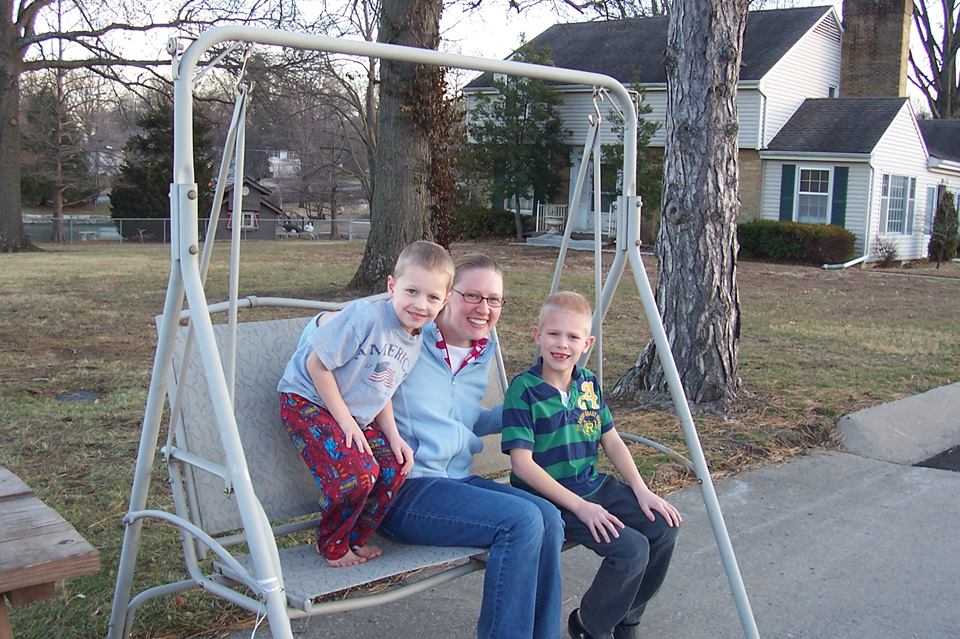
Years later, and just before his own father died, my husband gave me a covered porch swing as a surprise birthday present. He knew I’d always wanted one. And I cherished that gift. I would sit on it and watch my kids play in the yard. I would sit on it and read science magazines and natural childbirth books and home school catalogs. I would sit on it and talk to my husband during the at-home dates we would manage to steal after tucking our kids into bed — winter, spring, summer, or fall.

12804458_10156576007680621_63830042_n

Saying one last goodbye to the porch swing.

It was with great difficulty that I parted from that swing the year we moved to Cambodia. And to this day, when my man wants to show me he loves me, he buys me a can of V8 — the search for which can sometimes be quite the treasure hunt in Phnom Penh.

These are the legacies of Lucy Maud and of the innocent joys of a childhood well-spent.

~~~~~~~~~~~~~~~~~~~~~~~~~~~~~~

photo credit: Library of Congress

My blogging friend and fellow Third Culture Kid Marilyn Gardner encouraged me to take this TCK story, which was originally a Facebook status, and turn it into a blog post.