I had the chance to talk about a bunch of ideas from Digging in the Dirt on a couple of different podcasts recently. Read about what we discussed, and check ‘em out!
The Clarity Podcast with Dr. Aaron Santmyire: We talked about married sexuality, the danger of centering America in the story of global Christianity, why not to call our kids “world changers,” the uniqueness of having a work spouse, Shiny Happy People, and more.
Missionary Life with Sarita Hartz: We talked about the fun stuff like depression, anxiety, the “missionary life cycle,” and the important distinction between anger and aggression. It’s a vital conversation for those in missions and pretty much everyone else too.
Welcome to ground level, to the dirt and the mess.
We like the mountain tops and the sunshine. We like green grass under a clear blue sky. We like victory and breakthrough and answered prayers. But sometimes it rains, the shadows deepen, and life turns muddy. Sometimes God seems quiet. What then? What happens when depression descends, or anxiety hangs like a sword overhead? What happens when loneliness suffocates, the thief steals more than stuff, and you get blood on your shoes?
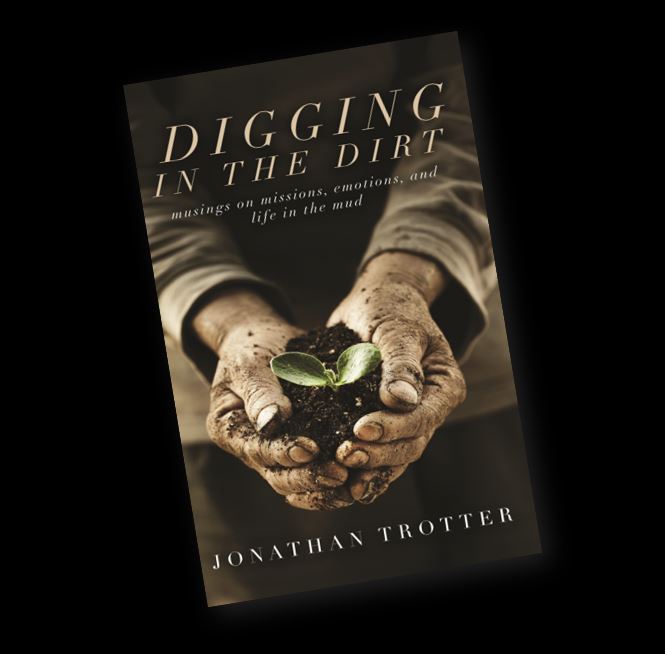
In Digging in the Dirt, Jonathan Trotter delves into the disasters, the darkness, and the deluge, and he offers comfort, presence, and a gentle invitation to hope.
With humor and prose, with poetry and Top Ten lists, Jonathan welcomes us to the dirt, to the places where we actually live. He invites us to boldly see life as it is, with eyes wide open, and reminds us that even when the digging is scary, we are never alone.
To the ones who are dealing with devastation and distress, welcome. To the ones who need to uproot, to pull out, to clear ground, welcome. To the ones who seek desperately to plant seeds of grace and hope in once barren soil, welcome. To the missionary abroad and the believer at home, welcome. Receive the invitation, and join with Jonathan here at ground level, together.
Come, dig in the dirt.
From the preface:
Hello and Welcome!
I’m Jonathan, and it’s such a pleasure to meet you. I look forward to journeying with you through these pages. Together, we’ll delve into the dirt of life and relationships, of sorrows, pain, and loss. And maybe we’ll plant some things too.
Perhaps, along the way, we’ll see small, green stalks of life and hope begin to poke through, watered with the tears of the journey. Digging like this can be messy, but it can be good too.
These musings will meander from the hot dirt of Cambodia to the sticky mud of American politics. Some of these musings are inspired by international missionary life; some of them are firmly rooted in an American context. But whether you’re American or not, whether you’re a missionary or not, I hope that you find them all a blessing, an encouragement, and perhaps sometimes a challenge. I wrote them for you, and I share them with you with my whole heart.
Start reading Digging in the Dirt wherever you’d like, and feel free to skip ahead or go backwards. Are you a cross-cultural missionary? Start there if you want. Are you interested in developing emotional intelligence, or are you exploring whether or not Christians are allowed to have feelings? Consider starting in the Emotions section. Are you reeling from recent life events that have left you feeling like you’re choking on the mud and muck? First of all, I’m so sorry. Second, breathe a slow, deep breath, look over the Table of Contents, and start wherever you need to start.
Wherever you are, and whatever your story, welcome to ground level, to the dirt. It is here that the real work happens; the good, hard, sweet, healing work. It is my deepest hope that here, among these musings, you may find grace, peace, and a hope that just might be strong enough to crack through the crust.
All for ONE, Jonathan Trotter
What people are saying about Digging in the Dirt:
A genuine book where no topic is off limits, Digging in the Dirt hits you right where you are regardless of location or vocation. This book is a must-read for anyone who is or is thinking about serving in missions and ministry! – DeAnna Anderson, former Director of the Launch Team for Wycliffe Bible Translators and missionary
Digging in the Dirt is a breath of fresh air for Christians. – Kim H.
Jonathan has such an authentic insight into life on the field, and he addresses the hard things in such a real and tangible way that helps you to know you are not alone. I would totally recommend this book for anyone who is serving overseas, sending someone overseas, or remotely interested in mission life. – Sydney, PI Leader for Southeast Asia
Rarely does an author bring the perspective of a missionary, nurse, theologian, pilot, counselor, parent, and gardener to cross-cultural ministry, family dynamics, depression, grief, politics, and the church, all in one book. Even rarer is a book that combines all of those things in a way that rings authentic and meaningful. Digging in the Dirt manages to do both, bringing thought-provoking and heartfelt lessons out of an incredible range of real-life experiences. – Reuben James
Digging in the Dirt is a must-read for anyone in missions or ministry. It’s refreshingly humble and vulnerable, and no matter what stage of life and ministry you’re in, you’ll walk away with some wisdom and new insight. – B.W., Stateside missions support worker
The idea is pretty simple. First, think about the signs that show that you are doing well in that area. How do you know you’re in the green? What does your friend or partner see when you’re in this color? And then, what are the things that help you to STAY in that color? Keep doing those things.
What are signs that you’re in yellow? What starts to happen when you’re trending in a direction you don’t want to go? The idea is to notice these things earlier than maybe you have in the past. And then, what are some things you might want to think about doing (or stop doing) that would help nudge you back to green?
And then the last one. What are the signs that things are really running hot? That you’re really struggling or not doing well? What are some things that maybe you don’t normally do, but that you might really want to do (or stop doing) that would get you moving back toward the healthy green?
It’s not rocket science, but when we’re really struggling with something, we don’t need rocket science. We need simple. We need straightforward. We need pre-planned.
Filling this out gives you a cheat sheet when you need it. When you’re trending towards red, you’re probably also forgetting all the helpful things. But if you’ve written them down, if you’ve shared them with a friend, partner, or ally, then you can look back, remember, and then maybe implement.
Hope that’s helpful out there, y’all! Take care, and happy Thursday!
Jonathan T.
__________________________________________
I’ve been using these concepts for a few years now, but I finally got around to creating a handout/worksheet for The Stoplight Tool. I’ve used this with folks dealing with OCD, depression, anxiety, and even adult ADHD. If you’d like to use this in your practice or ministry, would you consider purchasing the PDF for $2.99 here? Drop your email address in the comments when paying and I’ll send you the file. Thanks!
I’m very happy to announce that I’ve been accepted into the MA in Clinical Mental Health Counseling program at Colorado Christian University. It’s a two-and-a-half-year program that’ll start in July. It’s mostly online and is designed for folks with full-time jobs, which is handy.
This feels like the next step in responding to God’s call on my life to “see the hearts of the hurting.” In fact, during our first year in Cambodia I attended a leadership conference and felt like God clearly pressed upon me the image of a bridge built on two pillars. The top of the bridge, the overarching call on my life, was the growth and health of the global church. The two pillars upon which that calling would rest? Discipling young people and heart-focused pastoral counseling. Those core ideas have been on my office wall for nearly ten years now.
Since this grad program is designed for adult learners with full-time jobs, I plan to continue serving with Team Expansion in exactly the same capacity, providing pastoral care and empathetic coaching to missionaries all over the world.
Starting years ago at Living Well in Cambodia, both of my counseling supervisors repeatedly encouraged me to look into a step like this. They both told me: “Your forties are the perfect time to get a masters in counseling. You should go for it.” They both had.
I’ve spent thousands of hours over the last eight years sitting with hundreds of clients from around the world, and my deep hope is that this program will equip me to serve them with more skill, more resources, and more knowledge.
An MA degree will also open the door for possible teaching at the college level at some point in the future (missions and/or counseling). I hope to write more in the future too, exploring the blessings the church can bring when we walk alongside of those who are hurting, and contrasting that with the tremendous damage that can be done when we fail to understand trauma, abuse, grief, and deep emotional pain.
REQUEST
Like many companies and churches, our missions agency provides an educational reimbursement fringe benefit up to $5,000 per year. This is fantastic and could be extremely helpful! However, because Team Expansion is a missions agency, and because we serve in a support-based position, we have to raise our own benefits.
This isn’t a new concept, but it is a bit unique: we won’t get the benefit if we don’t raise it.
We don’t know exactly how we’re going to pay for grad school. We do know that we’re not going to use funds that our regular supporters have given to the general ministry fund. What we can do, however, is invite you to consider giving especially for this educational need.
If you’ve been blessed over the years by our writings or pastoral counseling ministry, or if you’d like to support this preparation for future ministry, would you consider giving? Team Expansion has taught us to invite boldly, so here we are. Just put “education” in the notes section of our giving page.
We couldn’t have gotten this far without y’all, and we can’t get a whole lot farther without y’all. If you have any questions, please let me know.
In the meantime, we’re going to keep trying to “follow close” behind Him, serving missionaries and cross-cultural workers around the world, equipping them to see the hearts of the hurting people around them, for his glory and for the growth and health of the global Kingdom.
When you think of COVID-19, where do you start? What’s your initial gut reaction to discussions of pandemic response, vaccines, etc.?
Obviously, these are treacherous waters, and our society has fractured along some new and some old fault lines. But why? I’ve been pondering this hard, trying to figure out, as an American, as a Christian, what motivates (or scares?) people in these discussions. It seems to me that the primary difference in these discussions hinges on whether you believe that the pandemic threatens either liberty or life.
For some, the pandemic is an overblown risk that governments around the world are seizing upon as an opportunity to strip away liberties and long-held freedoms: freedom of movement, bodily autonomy, even the freedom to worship.
For others, the pandemic involves a deadly disease that has killed 800,000 people in our country alone, and governments (and people) have a responsibility to mitigate the loss of life as much as possible.
Where we start often determines where we end up, so this matters.
If the issues circle around freedom, you’re likely to claim government overreach, saying things like “Don’t tread on me” or “Give me liberty or give me death.” Vaccine requirements, social distancing, and even mask mandates, present an existential threat to your freedoms. Fair enough.
If the issues circle around public health and the threat to life (yours and others’), you’re more likely to embrace masks and vaccines and be ok with government regulations that aim to prevent the spread of a deadly pathogen. You’re willing to give up some liberty and some opportunities. Also, fair enough.
If you’ve read much of what I’ve written, you know which side I generally reside in. As an ER nurse and pastor/missionary for twenty years, one of the hardest things for me to reconcile has been the fact that so many Christians seem to reside — almost exclusively — on the liberty side. Sean Feucht’s “Let Us Worship” gatherings represent what I’m talking about. White evangelical Christians have seemed so very LOUD when it comes to defending religious liberty and bodily autonomy. I have not heard so much about masking and vaccines as a form of loving your neighbor. Those things are ploys of the devil (or democrats) to steal my liberties.
But 800,000 souls have been lost in our country alone, and the tidal waves of grief and loss emanating from those losses impact millions. So many people (including several friends) are dealing with long-haul COVID, and that is no joke. Again, we’re just talking about the US here. Hospitals and healthcare staff around the country are being stretched to the margins, and we may only be at the beginning of a winter surge.
I guess what I’m saying is, let’s look at our starting points and honestly assess them. Hey, I love freedom, and I’m glad I live in America. I am grateful for the parts of our heritage that value liberty and freedom. Those are worth caring about and defending. But as a Christian, if my biggest concern and motivating factor is personal freedom (even of religion), I’ve lost the plot. We are called to so much more.
I’ve heard pastors say that we shouldn’t worry because 99% of people who get COVID will be fine. That gives you personally a pretty good chance, sure, but across a population, that would mean over three million dead Americans. Can someone care about those deaths without being a communist?
Is there a middle ground? Is it possible to care about liberty and life? Is it possible to recognize that some mitigation measures have been too onerous and caused way too many negative outcomes, while also having empathy for the sick and vulnerable and acting in their best interests? Is it possible to care about life and not support draconian lockdowns? Is it possible to worship God without exposing everyone around you to a potentially lethal pathogen?
Is it possible to behave with mercy and gentleness and the love of Christ in this day and age?



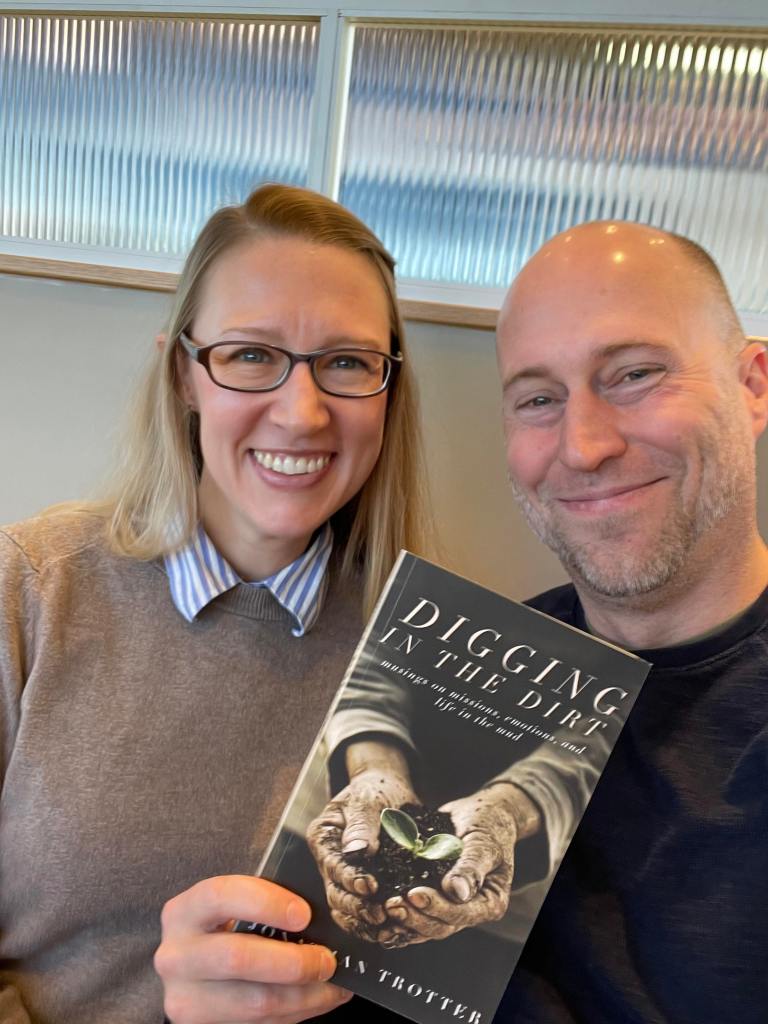

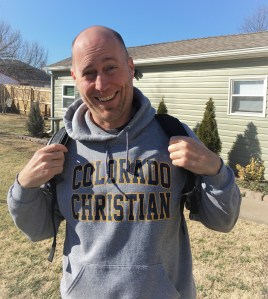

 Jonathan & Elizabeth Trotter