Darkness and grief, shadow and death
The Hope that had been
Sags low without breath
Weak and alone, absorbing the pain
The one who was Love
Endures for my gain
“Forgive them,” he prays,
“Jews, Romans, all!”
Redeeming us from our sins and the fall
“It’s finished!” he yells
For his sons and his daughters
His life and his mission now lead to his slaughter
Giving it all, keeping naught in reserve
The Lamb takes my place
Taking all I deserve
The darkened sun hiding, the women are weeping
The earth loudly cracking, the curtain now ripping
Blood and water are dripping
The death of the Lamb is obscene, but predicted
The fog of great evil begins to be lifted
But first, the end of all things
The son of God dies.
“He left us!” they cry, confused and alone
“Our friend and our brother, terminated by Rome!”
“Our hopes have been broken, our dreams have been pierced.”
Disciples sit trembling, ashamed of their fears
Three quiet days come and go without Word
The King is nowhere and faith seems absurd
But behind the scenes now, the deep magic stirs
The plan before time finds its time and occurs
The broken world groans, the stone starts to move
Rome’s power now fractures, the Light’s breaking through
The splinters that pierced, pierced more than just flesh
They tore holes in despair, pushed back the darkness
Ascended!
Enthroned!
The King wore his crown
Taking authority, striking Death down
Conquering sin, the grave, and all hist’ry
He gave up his life so all souls could see
The dawn of new life and eternity
The Kingdom has come!
The Lamb has been slain
Our sins have been wiped
Along with the stains
The Kingdom has come!
Christ is risen indeed!
Right here and right now, the
Beginning of all things
‘Twas the day before furlough and all through the house,
Everybody was crazy, even the mouse.
With kilograms counted and carry-ons packed,
The dad will get asked, “Can I fit this last sack?”
With Ma on her IG and Pa on his Twitter,
They’ll update their close friends through one last newsletter.
Frazzled and frayed, the start of a furlough,
The family boards early with one last cold Milo.
Onboard entertainment will probably help
Pass the time and the sadness, and the little one’s yelp.
The children will sleep, if they’re any the wiser;
Jet lag comes for all, the great equalizer.
Arrival with greetings and baggage galore!
“Now pick up the kid sleeping on the floor.”
A welcome is waiting at somebody’s house,
Along with green grass and a bed without louse.
Selah
Awakened and rested, two weeks have now passed.
It seems like a dream the term that was last.
No VPNs needed! No guards at the gate!
And Grandma and Grandpa let parents go date.
“Another world that.” They’ll say to each other,
Debriefing and telling it all to the Mother.
Then shopping will start, making up for lost time,
Enjoying the produce and actual lines.
“The stores are so huge!” They’ll gasp and they’ll stammer,
With carts made for tonnage like fridges and jammers.
“All the things in one place?” A small child’s amused;
A TCK so he’s often confused.
The church is so clean, inviting and nice!
It’s also, turns out, surprisingly white.
The parks are amazing and so well maintained;
The trash is discarded and canines restrained.
Folks think that they’re on an extended vacation,
Relaxing and soaking up big adulations.
“Please Father forgive them, they just do not see,
The pressures and burdens of this ministry.”
The family will travel in borrowed van and,
They’ll tell all their stories and hope that you can,
Listen and care some, then get on your knees,
And join them in this work, their Life Overseas.
He’s just a carpenter. A blue-collared day laborer. And he’s the one who builds mountains and stars.
He’s just a carpenter. A townie, a long long ways from cosmopolitan. And he’s the King of kings.
But he’s just a carpenter, uneducated, the son of nobodies. And he’s the dearly loved son of the Father.
The crowds are blind, eyes filled to the brim with scoffing, incredulous. They can’t see beyond their own limiting words.
It is true. He is a carpenter. But he is not just a carpenter. He is so much more.
And by his grace, we are too.
We are not just sinners.
We are not just failures.
We are not just inadequate.
We are loved.
We are saved.
We are sought after and enjoyed by our God.
So when people see us and laugh, saying we’re “just a” whatever, we smile and nod and run to Jesus.
And there we sit among the wood chips, remnants of a Roman cross, and we belly laugh with the Carpenter who saved the world.
~~~~~~~~~~~~~~~~~~~~~~
Jesus left that part of the country and returned with his disciples to Nazareth, his hometown. The next Sabbath he began teaching in the synagogue, and many who heard him were amazed. They asked, “Where did he get all this wisdom and the power to perform such miracles?” Then they scoffed, “He’s just a carpenter, the son of Mary and the brother of James, Joseph, Judas, and Simon. And his sisters live right here among us.” They were deeply offended and refused to believe in him. Mark 6:1-3
Only two songs have ever won all three major awards (Oscar, Golden Globe, Grammy) while being composed, written, and performed by a single artist. Carly Simon’s “Let the River Run,” the theme from the 1988 film “Working Girl,” was the first to do so.
Now, a few others have received all three awards but were co-written. One of those songs was Howard Shore’s, Fran Walsh’s, and Annie Lennox’s “Into the West,” the final song of the Lord of the Rings Trilogy and an absolute family favorite. “Into the West” speaks to something so deep and true, so simultaneously melancholic and hopeful, that it’s no wonder it won all three awards.
But anyway, back to “Let the River Run.” I first heard the song not from the movie, but from my junior high choir director Mrs. Chaney (whom you may remember from last week’s musical contemplations). Simon described her song as an “anthem with a jungle beat.” And indeed it was the sound that first drew me in, not the density of the lyrics — lyrics I could not possibly have comprehended fully at the time.
Even so, something in those words was stretching out and reaching for me. And I think it’s safe to say that, having won all those awards, the song spoke to deep, cracking places inside a lot of people. Of course there are layers of meaning here — some more material, some more spiritual.
And I’m still not sure I understand the song in its entirety, but I understand bits of it. I know it’s about dreams and desires. I know it’s about longing and risk. I know it’s about waking up and about waking up others. I don’t think you have to understand every part of the song anyway. It’s not necessarily for understanding but — like all art — for feeling.
Speaking of art, you all know I am no artist; I cannot even draw stick figures. But this semester I found myself teaching an art class in our home school coop. (In actuality, I’m substituting for the real art teacher until she gets back into town.) I love numbers, patterns, and designs, so I figured we could explore the intersection of math and art together.
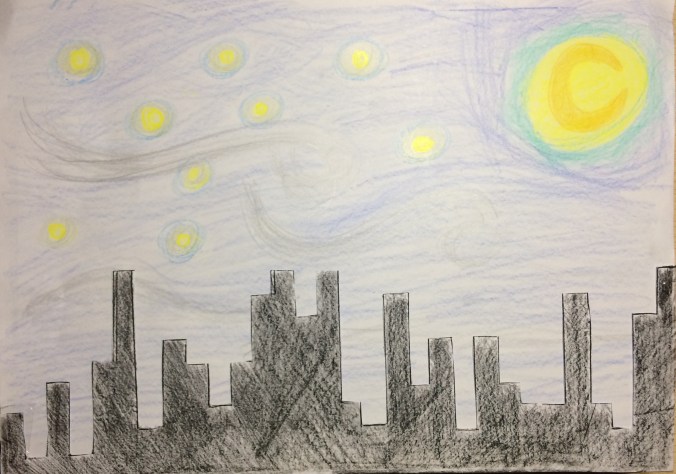
In preparing for this class I used some old material but also sought out new material. One of the new art projects I stumbled upon was the Pi Sky Line. While the New York City skyline (complete with Twin Towers) is the setting for the song “Let the River Run,” the Pi Sky Line is a city skyline whose building heights are based on the first 30 digits of pi.
Pi is the ratio of a circle’s circumference to its diameter. And it’s an irrational number, which means its decimals go on and on forever, never terminating and never repeating. There are no patterns to its digits, and there is no end either: it is infinity captured in a single number.
After you create your sky line, you paint or draw a background for it. And bringing this conversation full circle here, I knew I could not draw any background but Van Gogh’s night sky: “The Starry Night.” It was a painting I first encountered in Mrs. Chaney’s class. And this photo is the finished product. For me it is the intersection of art, music, math, literature and, most importantly, my soul in motion.
Educational thinker Charlotte Mason said, “Education is the science of relations,” and each week Mrs. Chaney assigned us a “Connection” paper. We had to connect something in her class to something in the rest of our lives. Every week we did this. She may not have known of Charlotte Mason’s century-old philosophy, but she knew that brain science supported the idea of interdisciplinary studies. Maybe that’s why, all these years later, the soundtrack of her class is still playing in my life.
Let the river run, Let all the dreamers Wake the nation. Come, the New Jerusalem.
Silver cities rise, The morning lights The streets that meet them, And sirens call them on With a song.
It’s asking for the taking. Trembling, shaking. Oh, my heart is aching.
We’re coming to the edge, Running on the water, Coming through the fog, Your sons and daughters.
We the great and small Stand on a star And blaze a trail of desire Through the dark’ning dawn.
It’s asking for the taking. Come run with me now, The sky is the color of blue You’ve never even seen In the eyes of your lover.

 Jonathan & Elizabeth Trotter