Team Christmas | Postcards from Re-entry

by Elizabeth

One of my favorite parts about Christmas in Cambodia was the lack of commercialism. I particularly remember our first Christmas there. We took our children to the Russian Market (Tuol Tom Poung) and gave them each $5 to pick out presents for their siblings. Then we went home and took turns wrapping each other’s presents.

On Christmas morning the children opened their presents. They were thrilled with the simple gifts they’d been given. And watching their collective joy was a gift to me. With no cultural cues that they needed a multitude of expensive presents, they were satisfied with small things.

My other favorite part about Christmas in Cambodia was celebrating it with our team. With no extended family nearby, expats must forge their own on-field family. Early on, I had realized that my children would never experience the type of large extended family I had grown up with — dozens of cousins, aunts, and uncles who gather at Grandma and Grandpa’s house on holidays. And I grieved over that.

But every Christmas we celebrated with teammates. I watched as our children interacted with teammates like they were cousins, aunts, and uncles — and my heart healed a little. My children were going to experience something similar to my childhood; they just weren’t related to these people.

Truly, teammates are like family. They take care of you when you are in need, you spend holidays with them, and sometimes you even fight with them. Our first Thanksgiving in Cambodia involved both sickness and caretaking: our children had contracted hand, foot, and mouth disease, and we were all quarantining at home. Teammates brought us holiday-themed food to cheer us up; at least we could celebrate in isolation.

The experience of Team Christmas was a cornerstone of life on the field, and it was something I particularly missed during Christmas 2020.

Christmas 2021 was different. Some of our old teammates have also repatriated, and they were traveling through our hometown the week before Christmas. They stopped and spent the weekend with us. We used to have regular game nights with them. I went out with the wife every few months in Cambodia, and she and I have done nearly all the Velvet Ashes retreats together (although we’ve had to switch to retreating virtually since moving back to the States).

It had been over two years since we’d seen them in person, since we had farewelled them at the Phnom Penh International Airport. And it was good. We played games. We talked about all the things. And we began a new tradition: gingerbread house competition. We enjoyed it so much we’ve decided to do it again next year.

We hit a cold snap that weekend, and I froze. This was a major departure from Christmas in Cambodia, where it was always hot and sweaty. Thankfully Joplin weather warmed up nicely for Christmas Day.

Today is the twelfth day of Christmas, and I guess I didn’t want to say goodbye to Christmastide without honoring my relationships with teammates, both on and off the field. The years were good, and the years were hard, but the holidays were made sweeter by the presence of good friends. I’m grateful I could experience that sweetness once again in 2021.
Eight Hundred Thousand

When you think of COVID-19, where do you start? What’s your initial gut reaction to discussions of pandemic response, vaccines, etc.?

Obviously, these are treacherous waters, and our society has fractured along some new and some old fault lines. But why? I’ve been pondering this hard, trying to figure out, as an American, as a Christian, what motivates (or scares?) people in these discussions. It seems to me that the primary difference in these discussions hinges on whether you believe that the pandemic threatens either liberty or life.

For some, the pandemic is an overblown risk that governments around the world are seizing upon as an opportunity to strip away liberties and long-held freedoms: freedom of movement, bodily autonomy, even the freedom to worship.

For others, the pandemic involves a deadly disease that has killed 800,000 people in our country alone, and governments (and people) have a responsibility to mitigate the loss of life as much as possible.

Where we start often determines where we end up, so this matters.

If the issues circle around freedom, you’re likely to claim government overreach, saying things like “Don’t tread on me” or “Give me liberty or give me death.” Vaccine requirements, social distancing, and even mask mandates, present an existential threat to your freedoms. Fair enough.

If the issues circle around public health and the threat to life (yours and others’), you’re more likely to embrace masks and vaccines and be ok with government regulations that aim to prevent the spread of a deadly pathogen. You’re willing to give up some liberty and some opportunities. Also, fair enough.

If you’ve read much of what I’ve written, you know which side I generally reside in. As an ER nurse and pastor/missionary for twenty years, one of the hardest things for me to reconcile has been the fact that so many Christians seem to reside — almost exclusively — on the liberty side. Sean Feucht’s “Let Us Worship” gatherings represent what I’m talking about. White evangelical Christians have seemed so very LOUD when it comes to defending religious liberty and bodily autonomy. I have not heard so much about masking and vaccines as a form of loving your neighbor. Those things are ploys of the devil (or democrats) to steal my liberties.

But 800,000 souls have been lost in our country alone, and the tidal waves of grief and loss emanating from those losses impact millions. So many people (including several friends) are dealing with long-haul COVID, and that is no joke. Again, we’re just talking about the US here. Hospitals and healthcare staff around the country are being stretched to the margins, and we may only be at the beginning of a winter surge.

I guess what I’m saying is, let’s look at our starting points and honestly assess them. Hey, I love freedom, and I’m glad I live in America. I am grateful for the parts of our heritage that value liberty and freedom. Those are worth caring about and defending. But as a Christian, if my biggest concern and motivating factor is personal freedom (even of religion), I’ve lost the plot. We are called to so much more.

I’ve heard pastors say that we shouldn’t worry because 99% of people who get COVID will be fine. That gives you personally a pretty good chance, sure, but across a population, that would mean over three million dead Americans. Can someone care about those deaths without being a communist?

Is there a middle ground? Is it possible to care about liberty and life? Is it possible to recognize that some mitigation measures have been too onerous and caused way too many negative outcomes, while also having empathy for the sick and vulnerable and acting in their best interests? Is it possible to care about life and not support draconian lockdowns? Is it possible to worship God without exposing everyone around you to a potentially lethal pathogen?

Is it possible to behave with mercy and gentleness and the love of Christ in this day and age?

I hope so.

Jet Lag | Postcards from Re-entry

by Elizabeth

I used to be an expert jet-lagger. For eight years we traveled the globe, making multiple 24-hour trips. We would arrive to a world exactly one-half day behind or ahead of the world we’d just left. It usually took my body about two weeks to fully adjust.

Sometimes I would hear travelers to Europe complaining about the long flights and the trans-Atlantic jet lag, and I would laugh. Because I knew they could arrive at their destination in less time than it took to fly my longest leg, start to finish. Their time difference was several hours shorter than mine, so I flattered myself either that I was “better” at jet lag — or that I merely suffered more.

Other times in those eight years overseas, I would hear people complaining about the shift between Daylight Savings Time and Standard Time. And I would think to myself, what can one measly hour do? How can it wreck an entire week? I had been told that it generally takes about one day per time zone difference to recover from jet lag. So I figured people should be able to recover from Fall Back and Spring Forward in just one day.

I mean, I remembered time changes from before Cambodia. Spring Forward was annoying, as I lost an hour of sleep. But I loved Fall Back. I loved the idea that I could get the same amount of sleep and still stay awake an hour extra. A night owl’s dream, right?

But now that I live here again, I don’t find Fall Back to be such a dream come true. We turned our clocks back a week ago, and all last week I woke up an hour early, effectively losing more hours of sleep than I supposedly gained last Saturday. What had happened to me? What happened to the globe-trotting girl who could hack time changes and days-long airplane trips? I don’t know if she grew old, or if she merely lost her traveling skills.

But from now on I understand why Americans complain about the biannual time change. Because it’s no joke.

Traffic | Postcards from Re-entry

by Elizabeth

We drove through the city recently. We didn’t even drive into the city; we just drove through it on the interstate. I was shocked by how quickly the traffic changed. It became so much faster, so much more crowded, and so much more stressful – and I wasn’t even the one driving.

When I lived in Kansas City, I thought this kind of traffic was normal. It didn’t stress me out. I knew the city like the back of my hand, and I could drive most places on autopilot. But now that I’ve lived away from it for over a year, the city feels very overwhelming. I’ve definitely become accustomed to the slower pace of driving in Joplin. And I have no desire to return to city driving.

I have, in fact, successfully contracted my life. The grocery store is five minutes away, as is the doctor. Our church is ten minutes away, and the airport is close by. I don’t mind at all. On the days when I have to drive across town – say, for instance, to the dentist — it feels like I’m making a long journey. And it’s only 20 minutes. This stands in contrast to Kansas City driving, where no one bats an eye over a 20-minute drive, and many trips are 40 minutes or more.

Traffic is light here, most of the time. And when traffic is heavy, it’s nothing like the painfully slow, packed streets of Phnom Penh. I didn’t even drive in Phnom Penh. Traffic was so stressful that the very first week we lived there, I decided never to drive in it. And the traffic only worsened over the years. That means I experienced Phnom Penh traffic only as a passenger, either in a vehicle with Jonathan driving (and probably getting stressed out) or in a tuk tuk.

So whether I compare Joplin traffic to Kansas City traffic or to Phnom Penh traffic, I will choose Joplin every time. It is relaxed and unrushed, and I love it. Initially it was stressful learning the art of the traffic circle, but now I love its simplicity. And at first it was disorienting to try to find my way around a new town, but these days I’m more familiar with the layout. Now that I’ve lived here awhile, I’m not sure I could ever go back to city driving, and I’m perfectly content with that.

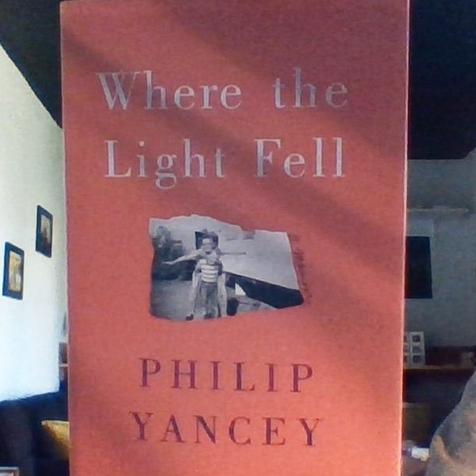
Book Review: Where the Light Fell

by Jonathan

I thought I’d like this memoir from Philip Yancey, but I had no idea it would be such a page turner, lurching from fundamentalism to racism to grace to dysfunction to mercy to LSD to classical piano to faith and on and on and on.

“An upbringing under a wrathful God does not easily fade away.”

For someone who’s written so much (and so gently) about suffering and grace, I should not have been surprised at the terror, trauma, and healing present in Yancey’s story.

“Like every secret, it gained power as it lay hidden.”

If you’ve wrestled with religious burn out, or if you’ve had a hard time reconciling the church with Christ, you might resonate with this book.

“As a boy wandering in the woods, a teenager constructing a psychic survival shell, a lovesick college student running from the Hound of Heaven — in all those places I found what T.S. Eliot called ‘a tremour of bliss, a wink of heaven, a whisper.’ I came to love God out of gratitude, not fear.”

This book will endure for quite some time, I think.

Find it on Amazon here.*

*Amazon affiliate link