About the God who restores, gushes, and calls us friends. Recorded at Second Mile Church, Phnom Penh Cambodia, November 2017.
Click here to listen to the mp3, or find it on the trotters41 podcast here.

Elizabeth is over at Velvet Ashes today . . .
The word myth often conjures up the idea of epic fantasy tales or of commonly held beliefs that need debunking. In fact, the Oxford Dictionary defines myth as both “a fictitious or imaginary person or thing” and “a widely held but false belief or idea.”
The dictionary also defines myth as “a traditional story, especially one concerning the early history of a people or explaining a natural or social phenomenon, and typically involving supernatural beings or events.” The word derives from the Greek mythos which simply means “story.”
And that is what I think of when I think of myth: I think of story. I think of narrative. So when I use the word myth to describe the Bible, I’m not saying it’s not true – because I most certainly believe it is true. Rather, when I say the Bible is myth, I’m saying that it’s full of stories that infuse meaning into our lives and that it is, in actuality, one overarching Story.
The God of the Bible audaciously makes a world, joyfully populates it with creatures, and then willingly redeems those creatures from sin and death. This story is unlike any story humans have ever told. Indeed, the Bible’s uniqueness among world myths is one reason I believe it, love it, and base my life on it.
Finish reading here.
by Elizabeth
At eighteen years old I really wanted to write my own wedding vows. I was hopelessly in love, and I didn’t want to say the same old words everyone else had been saying for years. That was stale, passé. I wanted to be original, unique, special. (Perhaps there was a bit of pride there too?) So my fiancé and I wrote our own vows. Ten years and four children later, we renewed them — with the same minister and in front of the same congregation.
Lately I have been thinking about those seventeen-year-old vows. How they were somehow incomplete. Not that they were insincere — they were so very sincere. But they were incomplete. And they were very, very young.
In the last couple months circumstances have conspired to distress us on many levels. (Jesus wasn’t joking when He told us we would have trouble in this world.) But in the midst of these recent difficulties, I’ve been drawn to the beauty and majesty of traditional vows. Vows in which we acknowledge the sacredness of the marriage covenant. Vows in which we promise the same things married couples have been promising for centuries.
When a bride and a groom promise “to have and to hold, from this day forward, for better, for worse, for richer, for poorer, in sickness and in health, to love and to cherish, until we are parted by death,” it’s beautiful and romantic. But when we are young, we do not imagine we will ever be sick or old or poor. We imagine we will be young, healthy, happy, and wealthy — for always. We imagine that loving and cherishing will be easy. We say these vows, and we mean them, but we do not know the fullness of what we say. We do not imagine we will need to live them out sacrificially.
Young couples promise each other, before God and before the congregation, to “live together in holy marriage, to love, comfort, honor, and keep, in sickness and in health, and forsaking all others, be faithful as long as we both shall live.” In that breathtaking moment we can’t imagine that any better “other” may ever come around, but nonetheless we vow to forsake the others. These are grand promises that we make. And they are promises I intend to keep, even if I didn’t make them in so many words.
My own personalized vows skirted around these issues. I promised to respect and support my husband in a generalized “in everything I do, in every season God gives us” rather than specifying any potential struggles with “for better, for worse, for richer, for poorer, in sickness and in health.” One sounds gentle and all-encompassing. The other is harsher, more abrasive. But I wonder now if the second one is more exactingly truthful when troubles start to rain down on a married couple: we committed for just such a time as this.
Instead of vowing to forsake all others, I told my new husband, “I pledge my faithfulness to you, my best friend and one true love.” My youthful version almost assumes that because my 18-year old self considered Jonathan my best friend and one true love, that I always would. That faithfulness was a mere matter of friendship and finding one’s soul-mate.
Now, I still consider my husband my best friend and one true love, but what if that changed? What if we grew apart? What if our relationship were strained? Would I still owe him my faithfulness and my fidelity? I believe I still would — especially in a situation like that. But I’m not sure my personalized vows were specific enough. “Pledging my faithfulness” sounds pretty, but “forsaking all others” much more accurately describes the turning away from temptation that all married people must do.
Seventeen years after I said “I do” (metaphorically speaking of course, because we didn’t actually say those words), I understand more fully the weight of these lifelong vows. And I also know what it means to live in holy matrimony with one person through the various seasons of life. It’s a big deal to commit to a single person, regardless of what happens from that point on. And a lot can happen in a life. A lot of tragedy. A lot of heartbreak. A lot of things that can threaten to swamp a young marriage (or even an older one). A lot of reasons to remember and fulfill the specific promises that we made to each other.
I want to renew our vows again on our 20th wedding anniversary. But I’m not sure whether I want to repeat my initial vows or say the traditional ones. I think about these traditional vows often, and I’ve come to consider them my own. I didn’t say them on my wedding day, but I’ve said them to my husband since then. And I’ve come to understand that there’s a reason traditional vows have held up over time. They distill the essential aspects of a holy institution down into just a few sentences. They are guidance and they are wisdom. And they are a picture of what true love looks like.
The traditional vows are hardy. They can apply universally to Christian couples. At the same time I love listening to people’s personal vows; they are lovely and heartfelt and meaningful. But they necessarily apply to only one couple. Perhaps, though, we need both universality and specificity in our marriages. Perhaps we need both unity with other married couples throughout time and a sense of uniqueness in our own love story. It makes me think that if one my children ever came to me and asked me for wedding advice, I might suggest saying both traditional vows and personalized vows. Because maybe a marriage can use a bit of both.
~~~~~~~~~~~~~~~~~~~~~~~~~~
For any concerned readers, infidelity is not something our marriage has dealt with. I’m only reflecting here on the magnitude of the promises we make at the altar.
Sources for traditional vows and their history.
A list of the other marriage articles we’ve written.
by Elizabeth
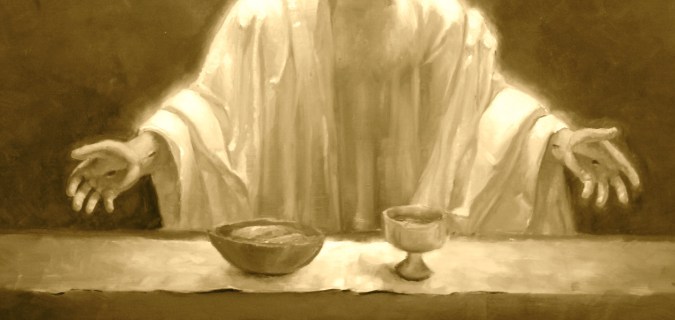
I didn’t grow up with the Sacraments. Sacraments were for liturgical traditions, while I was a proud and happy member of Restoration Movement churches. I did, however, grow up with physical commemorations of spiritual truths — for that is what sacrament means. Of course, I didn’t know that back then.
I like to talk about these things when I get together with my friend Heidi, whose husband is an Anglican priest. When I asked her what sacrament means, this is what she told me:
“The Anglican Book of Common Prayer uses this definition of sacrament: a sacrament is an outward and visible sign of an inward and spiritual grace given to us. There’s also the pithy phrase ‘Matter matters.’ It relates to the way God comes to us through matter (water, the bread and wine, etc) and to His value of matter (our physical bodies themselves and all of creation are precious to him – not evil or something to be escaped as in Gnosticism).”
“Matter matters.” As someone who has been running away from her physical body since early adolescence, this was novel concept to me. But as I reflected on my spiritual history, I realized that my church tradition did observe two sacramental practices: baptism and the Lord’s Supper.
Baptism celebrates our union with Christ through death, burial, and resurrection and is intended to occur once in a lifetime. The Lord’s Supper, on the other hand, is a regular occurrence and a reminder of how much we are loved. We are loved enough for Christ to pour out his very blood and allow his very body to be broken for us and for our eternal home.
(I like to designate corporate singing as a sacramental practice due to the fact that in singing we join the physical sound waves of our voices together to worship our Triune God and to declare spiritual truths over ourselves, but that’s another conversation entirely.)
Some people call it the Eucharist. I usually call it communion. Whatever its name, this meal of bread and wine is our feast of love. It is where we learn and remember our belovedness. It is where God speaks to us. It is where He calls us: every particle of every person in every place.
God communicates His call in every conceivable human language, for in His wisdom He created communion as the intersection of all things.
It is the intersection of the physical – bread and wine – with the spiritual – the forgiveness of sins and the promise of eternal life.
It is the intersection of the deeply personal – what Christ did for ME – and the incredibly communal – what Christ did for ALL of us.
It is the intersection of the Old Testament sacrifices and the new covenant where no more sacrifices are needed.
It is the intersection of the ancient and the far future as we look back to the Exodus and the Passover – the central story of the Old Testament – and eagerly await the wedding feast of the Lamb.
It is the intersection of the ordinary — a regularly repeated act — and the ceremonial — a special event.
It is the intersection of celebration – our God is victorious and we are free — and mourning – our God suffered and our sins caused it.
The Lord’s Supper is the intersection of the marriage invitation and the acceptance of His offer. It is the intersection of being chosen and the act of choosing back.
The Table brings together all human experiences. At the Table He speaks to each person’s particular history and particular language and particular longings. At the Table He places us in a community that will never end.
So come to the Table where there’s always room for more.
Take, eat: the Body of Christ, broken for you.
Take, drink: the Blood of Christ, shed for you.
Come to the Table and remember. Come to the Table and celebrate. Come to the Table where there’s always room for more.
photo source
by Elizabeth

You have walked with God in this place a long time, and He has walked with you. He has been beside you and inside you this whole time. The same Spirit remains in you and with you in your new place.
This place has changed you, and you have changed this place. Do not be distressed if you don’t understand everything that has happened and that is happening. Remember that the stories God writes are always long. They unfold over generations, not days or weeks or even months.
You have been here long enough to understand some of what God is writing, for both yourself and the people you’ve served, but some things may not make sense yet. Do not fret, and do not fear. The Father will show it all to you One Day. Until That Day, remember that you leave with our love, even as you live within God’s love.
Many years ago you came to this place as a foreigner, and the place you’re going now may also seem foreign to you. Everyone and everything has changed, including you.
So in the days and months and years to come, when you feel misunderstood, remember that no one understands your foreignness like Jesus, the One who came to the most foreign land to show his beloved creatures Truth and Light. He will understand your sorrows like no other.
You have seen so much change in your years here. Change in the people around you, change in yourself, change in the people you’re returning to. And you are tired. So tired. No one can work and live as long as you have and not be tired. Remember that Christ is your rest. (And on your journey, also remember to sleep.)
Circumstances change, and communities change, and in the end, He is all we have to hold onto. So don’t lose hope: He IS our hope. Hold onto Him, and remember that His love never fails. It will never fail you.
Though organizations may fail you, though supporters may fail you, though cultural acquisition may fail you, though years of experience may fail you, though people you love and invested in may fail you, though you may even feel you’ve failed yourself, still one thing will not fail you: the love of the Great Three in One will never fail.
And One Day, this squeezing in your heart and this aching in your bones from all these years and all these travels and all the years and travels to come, it will all be undone. Everything will be made new. Remember this.
Originally appeared at A Life Overseas.
 Jonathan & Elizabeth Trotter