A Far Away Funeral — Memories of My Grandma

This past weekend my extended family celebrated my Grandma’s life and mourned her death. I couldn’t be there in person, so I sent my love through this letter, and my mom read it at the funeral. I’m sharing it now for any of my family who wants to read it. I love you all and am missing you desperately at this time. ~Elizabeth

ggpicnic

I remember polka music. I remember dancing. I remember ancient family photos on the staircase, and current family photos on the book case. How I would stare at those pictures, as though I could absorb the family history by osmosis. I remember seeing pictures of Grandma as a young woman and thinking she had the most beautiful face I had ever seen. She was prettier than the prettiest model in my eyes (and probably in Grandpa’s eyes too!).

I remember kolaches and rolickies and hoska. How I would gorge myself on the delicious Bohemian dough that Grandma always baked to perfection. I remember her Duck and Dumpling. How I adored those potato dumplings. And I remember the apples — apples every year, and oh how I balked at eating their skins.

I remember their house being such a hot place on Christmas Eve, stuffed as it was with all those people, the kitchen heated to the boiling point with noodle soup. (The stairs to the basement, however, were still cold.) I remember waiting, just waiting, to graduate from kid tables in the dining room to adult tables in the kitchen. And I remember how long the dishes took after dinner, with all the aunts washing and drying and talking together.

The Musels were this big, loud, happy Catholic family, and I loved it. Grandma and Grandpa’s home felt like my home too, while my parents and sisters and I wove our way around the States and around the world. At Grandma’s, cousins were like brothers and sisters, and being at her house meant playmates never being far away. I remember loving her front porch, the most amazing porch in the world. It was covered and large enough to play house on, large enough to play Red Light Green Light from. And it was large enough to host scads of stair step cousin photographs.

I remember Grandma and Grandpa’s 45th wedding anniversary. I remember the hall and the candles and that beautiful surprise slide show and the music that accompanied it. To this day I can’t hear “What a Wonderful World” without thinking of Grandma and Grandpa. And it was always Grandma and Grandpa together in my mind, not separated as they’ve been these last 15 years. How these 15 years must have hurt. How she must have ached.

It’s been hard to be away these last 3 ½ years. I’ve missed weddings and holidays. I’ve watched photographs of the family appear on Facebook. I’ve rejoiced that I’m part of a family who still loves each other enough to get together. I’ve also mourned the loss of nearness and togetherness for myself. When I went away, I didn’t know if I would see Grandma again. I knew she was getting older and that my last goodbye to her might be my very last. But still, I hoped it wouldn’t be; I hoped to see her again.

None of us knew this past 4th of July would be Grandma’s last time to gather her family around her and love them. She looked good. She looked happy and healthy and as beautiful as ever. Those pictures make it hard to accept that this really happened, that I really have to say goodbye. I wish I didn’t have to say goodbye from far away. I wish I could say goodbye in person. This goodbye won’t be forever; I know that. We will meet again. And I’m sure when we do, it’ll be over fresh poppy seed kolaches and the music of the Christmas Polka.


gghug

Open letter to trailing spouses {A Life Overseas}

Elizabeth is over at A Life Overseas today, offering words of encouragement for marriages struggling through a trailing spouse issue.

ts4

“Feeling so fearful and alone since moving as a trailing spouse”

Last month someone found my blog because they did an internet search for that phrase. It reminded me how much pain a trailing spouse endures. I remember the struggle; I remember the suffering. And while whoever typed those search terms is actually not alone, I can attest to the fact that it very much feels that way. I remember how dark it felt, how black the future seemed. I remember how much pressure I was placing on myself not to ruin my husband’s dreams. I remember being afraid that nothing would ever be OK again and that it would all be my fault.

Telling my trailing spouse story has opened up conversations with women all over the world, both before and after they reach the field. (A trailing spouse doesn’t have to be a woman, but women are the ones who have reached out to me.) So with that in mind, I’m going to share parts of emails I’ve sent to women who have asked for more of my story. I’ve deleted identifying details to protect their privacy. These are the things I would say to any marriage dealing with a trailing spouse issue.

Finish reading the post here.

Underwhelmed by God’s Love

l2h

by Elizabeth

As a family we recently read the story of Jacob fleeing Esau and sleeping on a stone and having that ladder dream. I’ll be honest, the ladder story has never done very much for me. Who cares about some dumb stairway in a dream? (Apparently, I didn’t.) But that night the story moved me like never before. In it, we learn that God interacts with us, relates to us, speaks to us, not because of what we’re doing or how well we’re following Him (because at that point Jacob wasn’t), but because He loves us.

He loves us? Yes, He loves us — loves us because we exist, because He made us, because He is Love. He loves us because He has chosen us, and our relationship with Him isn’t dependent upon our good behavior, our good standing, our proper obedience. It wasn’t until years later that Jacob was really following God with his heart, but here God gave Jacob an experience of Him that was so intense that he named the place Bethel, or “house of God.”

Jacob met God in that place, and it wasn’t because of anything Jacob had done. To think that God wants to interact with me no matter the state of my soul! How wondrous not to deserve this interaction with God, but to get it anyway. How incredible that He gives us His fellowship even though we are unworthy. His love is that big. And this kind of unconditional love is not just in the New Testament as we sometimes tell ourselves (or as I sometimes gathered growing up in church). No, God’s unconditional love is all over the Old Testament too. We don’t deserve this relationship, yet God gives it to us anyway — even before He sent His son.

Hearing my husband read this story out loud spoke to deep places inside me. Afterwards I tried to share my amazement. What I said may not yet make sense to such childlike faiths — young hearts that don’t yet doubt God’s love for us human beings. But I hope that planting these kinds of revelations in their little hearts and minds will help them later in life. I hope they will look back on what we taught them and be able to see His love written all across Scripture in a way that is sometimes hidden from the more legalistic among us.

So thank you, God. Thank you for including the story of Jacob’s ladder in your Word. Thank you that a passage I know so well and am usually so underwhelmed by could still touch me so deeply. To borrow a phrase from Connie Harrington, “Your grace still amazes me. Your love is still a mystery.”


Faith That Won’t Fracture

by Elizabeth

fract3

By now you probably know I’m a romantic about the Cosmos. So when I heard that Krista Tippett had interviewed Margaret Wertheim for her podcast On Being on April 23rd of this year, I knew right away I had to listen to it. Several years ago Wertheim gave a TED talk on coral reefs as physical representations of hyperbolic (or non-Euclidean) geometry, and I’ve been enraptured by — nay almost addicted to —  those ideas ever since. (But hyperbolic coral geometry is a blog post for another day.)

Anyway, at one point during the interview Krista Tippett says, “So, I always like this fact that light can be a particle or a wave depending on what question you ask of it as kind of a way of demonstrating, I think — something we all also experience, that contradictory explanations of reality can simultaneously be true.” Oh yes – there is paradox in physics as well as life. I’ve talked about that before.

Krista goes on to read something beautiful that Margaret Wertheim wrote in one of her books:

“Wave particle duality is a core feature of our world. Or rather, we should say, it is a core feature of our mathematical descriptions of our world. But what is critical to note here is that, however ambiguous our images, the universe itself remains whole and is manifestly not fracturing into schizophrenic shards. It is this tantalizing wholeness and the thing itself that drives physicists onward like an eternally beckoning light that seems so teasingly near. It is always out of reach.”

In the interview Margaret expounds on her own quote:

“Physics, for the past century, had this dualistic way of describing the world. One in terms of waves, which is usually conceived of as a continuous phenomena. And one in terms of particles, which is usually conceived of as a discrete or sort of digitized phenomena. And so quantum mechanics gives us the particle, as it were, discrete description. And general relativity gives us the wavelike, continuous description. And general relativity operates at the cosmological scale. And quantum mechanics operates so brilliantly at the subatomic scale. And these two theories don’t currently mathematically mesh. So the great hope of physics for the last 80 or so years has been, ‘Can we find a unifying framework that will combine general relativity and quantum mechanics into one mathematical synthesis?’ And some people believe that that’s what string theory can be. And it’s often — when contemporary physicists write about the world, they talk about this as being a fundamental problem for reality. But it’s not a fundamental problem for reality. It’s a fundamental problem for human beings. The universe is just getting on with it.

And so I think the universe isn’t schizophrenic. It’s not having a problem. We’re having a problem. And I don’t think it means that there’s anything wrong with what physicists are doing. Quantum mechanics and general relativity have both been demonstrated to be true in their demands of expertise to 20 decimal places of experimentation. That’s a degree of success which is mind-blowing and awe-inspiring. But the fact that these two great, fabulously functional descriptions don’t fit together means we haven’t, by any means, learned all we’ve got to know about the world.”

I love how Wertheim says the Cosmos isn’t fracturing with our inability to reconcile relativity (on the large scale of planets, stars, and galaxies) with quantum mechanics (on the small scale of subatomic particles). The Universe isn’t freaking out about this problem. We humans are the ones freaking out, because we can’t get the math to work.

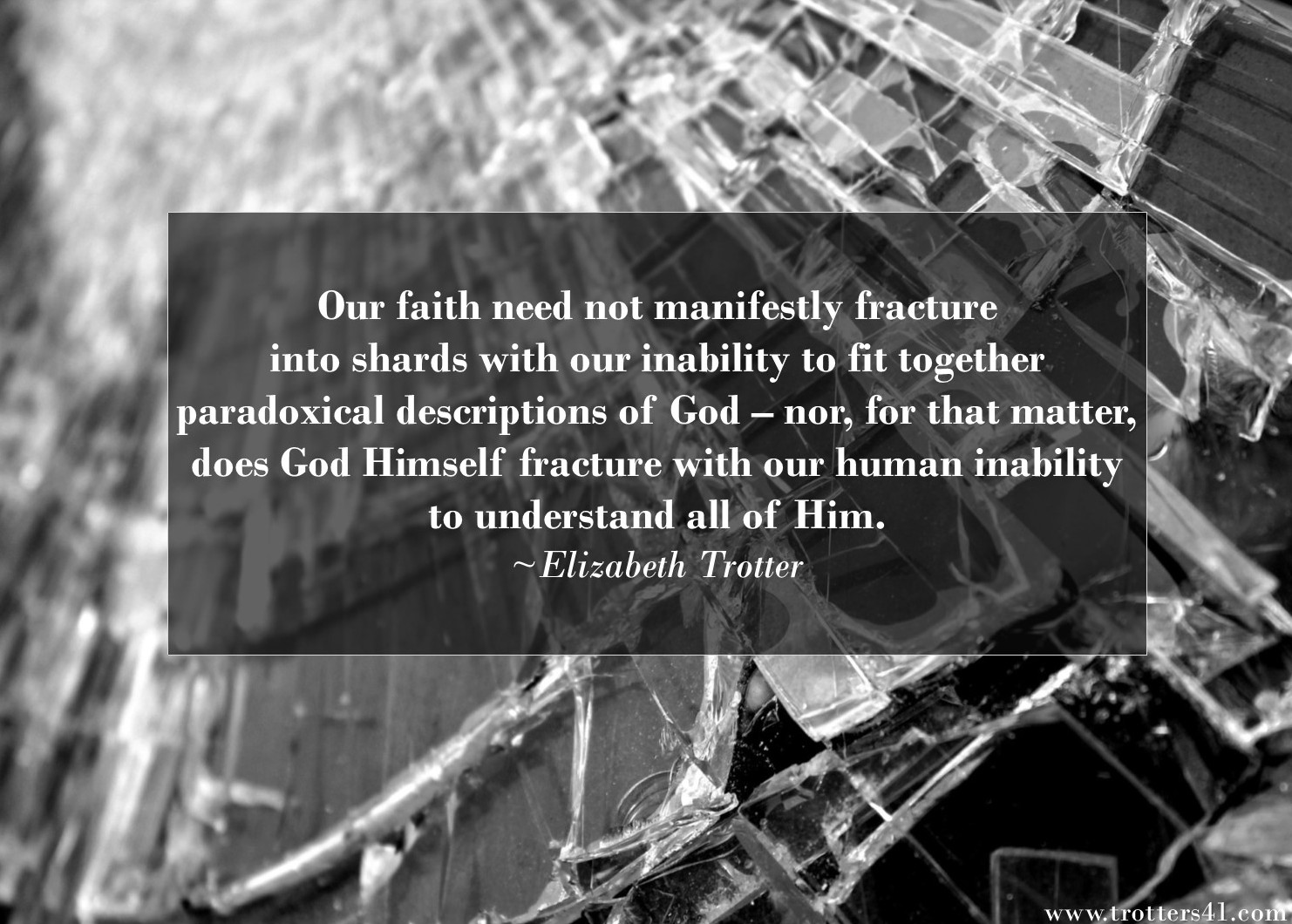
In the same way, our faith need not manifestly fracture into shards with our inability to fit together paradoxical descriptions of God – nor, for that matter, does God Himself fracture with our human inability to understand all of Him. I love the idea that the Cosmos and its Creator are higher than our capacity to comprehend them. I love the sense of awe and wonder that induces. And I love the fact that there’s always more for us to learn and discover.

In the 6th chapter of John’s gospel, Jesus says some really strange cannibalistic-sounding things. The disciples respond by saying, “This is a hard teaching. Who can accept it?” The Greek word that is translated “accept” means to “comprehend by listening.” I find there is a difference between accepting something as paradox or mystery, and actually comprehending it. So perhaps the disciples were really saying, “Who can understand this teaching?”

I do not need to fully understand the way the universe works in order to accept that it does work. I do not have to fully understand Jesus’ words in order to accept them as Truth. This is the enigma of loving a limitless God.  This is the mystery of life with Christ, God-made-flesh. This is the joy of a faith that won’t fracture.


photo credit

margin: the wasted space we desperately need {A Life Overseas}

Jonathan is over at A Life Overseas today, talking about margin. . .

margin1

“Staying alive is not about how fast or how slow you go; it’s about how much margin you have.”

That’s what a friend of mine here in Cambodia says when asked about how to not die while riding motorcycles in our little corner of Asia. And since he’s been riding and racing motorcycles since before I was born, I listen.

Going slow with no margin can be more dangerous than going fast with tons of margin. It’s true with motorcycles and it’s true with missions.

Your speed is not necessarily what determines your safety; your margin does. Margin takes into account all sorts of variables: How far can you see? How much space is between you and the next vehicle (or cow)? What are the road conditions? Is this even a road? How likely is it that the large pig strapped to the back of that bus in front of you will stay strapped to the back of that bus in front of you?

Read the entire post here.