I love my job so much that I’m trying to get better at it. Want to help?
Thanks to the generous support of so many churches and individuals, I’ve served as a pastoral counselor and coach to missionaries for about nine years now. Last week alone I met online with missionaries serving in or returned from Kyrgyzstan, Kenya, west Africa, Japan, Cambodia (six clients), Bulgaria, Dominican Republic, and Tanzania.
Shortly after our return to the States, Elizabeth and I decided that I should go back to school. I’ve been in grad school studying clinical mental health counseling for one year now, and I have a year and a half to go. I hope to use this education to continue serving missionaries around the world for many years to come. So…
Here’s the request
Like many companies and churches, our missions agency provides an educational reimbursement benefit up to $5,000 per year. This is fantastic and could be extremely helpful! However, because Team Expansion is a missions agency, and because we serve in a support-based position, we have to raise our own benefits.
In other words, we won’t get the benefit if we don’t raise it. Maybe that sounds weird to you, but we’re super grateful for even the chance of this benefit, and that’s just sort of how things are done in the missions world.
So, we’d like to invite you to consider giving especially for this educational need. (It’s tax-deductible for folks in the US.) Some have already given, so we’re only $3,700 away from our goal!
Many of you gave towards this last year, and we are soooo grateful! It was immensely helpful in deferring some of the school fees!
If you’ve been blessed over the years by our writings or pastoral counseling ministry, or if you’d like to support this preparation for future ministry, would you consider giving through PayPal (preferred) or Team Expansion’s giving portal here? Note: if you donate through Team Expansion’s website, please add “education” to the notes section.
Team Expansion has taught us to invite boldly, so here we are. We’re not using regular donations to fund this education benefit — only money raised specifically for it.
As I’ve said over and over, we couldn’t have gotten this far without y’all, and we can’t get a whole lot farther without y’all. If you have any questions, please let me know.
In the meantime, we’re going to keep trying to “follow close” behind Him, serving missionaries and cross-cultural workers around the world, equipping them to see the hearts of the hurting people around them, for his glory and for the growth and health of the global Kingdom.
All for ONE,
Jonathan T.
One of the counseling rooms at Mt. Hope Christian Counseling Center here in Joplin. I started my part-time internship here last week!
Living Well, Cambodia
Counseling room at our international church in Phnom Penh, Cambodia.
Over the years our family has developed a morning ritual. We call it “devo,” and we model it after the daily devotionals my husband grew up with. Every morning his family gathered in the living room before breakfast to read the Proverb and Psalms for the day.
We started doing morning devos in Cambodia when everyone was young and still learning how to read out loud, and we’ve changed up our routine several times. We started with the Proverbs only but at one point got bored of them and switched to the Psalms instead. Then we went through a phase where we were reading through the Gospels. We tried Shane Claiborne’s Common Prayer for a while, and now we’re back to the Proverbs again – we all missed the simplicity of those early days in Cambodia.
Several years ago we decided to sing on Friday mornings instead of read. Hymns had been instrumental in building my faith and keeping me moored in times of doubt and fear, but my children didn’t know the hymns, as we didn’t sing them at church on Sunday mornings. We owned a few Church of Christ hymnals, so we got to work teaching our family how to sing.
I don’t know if you do a “morning time” in your homeschool or if you have evening devotionals with your family. But I do know a few liturgies that have been helpful to our family, and I wanted to share in case you want to add any of them to your worship times.
The Apostles’ Creed. With a world in such flux and so many arguments over what is important or true, we wanted to draw our children to the foundations of our faith. In the Creeds we proclaim the most important beliefs of the Christian faith. They are the ones we need to agree on, the ones we should never waver from. We worked together to memorize the Apostles’ Creed and say it together most (not all) days. It has been an anchor for me the past several years. There are a couple modern songs based on the creeds, but nothing beats reciting the complete Apostles’ Creed, whether by yourself or in community.
I believe in God, the Father almighty, creator of heaven and earth.
I believe in Jesus Christ, his only Son, our Lord, who was conceived by the Holy Spirit, born of the virgin Mary. He suffered under Pontius Pilate, was crucified, died, and was buried; he descended to hell. The third day he rose again from the dead. He ascended to heaven and is seated at the right hand of God the Father almighty. From there he will come to judge the living and the dead.
I believe in the Holy Spirit, the holy catholic church, the communion of saints, the forgiveness of sins, the resurrection of the body, and the life everlasting. Amen.
The Doxology. This was one of the first songs we taught our children. It’s simple and easy to sing and is really a prayer. We often end our morning devo by singing the Doxology (although we sometimes end on another song, which I’ll explain below). We also sing it before meals, especially when we have guests over. We love it when old Church of Christ friends come over because they can SING. Four-part acapella harmony, delicious and delightful and a little taste of heaven. (As it turns out, you can take the girl out of acapella churches, but you can’t take the acapella out of the girl.)
Praise God, from whom all blessings flow; Praise Him, all creatures here below; Praise Him above, ye heavenly host; Praise Father, Son, and Holy Ghost. Amen.
The Serenity Prayer. Reinhold Niebuhr’s words are a newer addition to our morning times, but I think they have staying power. Like most people, I’ve known the first stanza for years (and it is the only part of the prayer attributed to Niebuhr with certainty). The second part is used in many 12-step programs and has been particularly helpful to me as a compulsive worrier. We are memorizing the entire prayer as a family.
Lord grant me the serenity to accept the things I cannot change, the courage to change the things I can, and the wisdom to know the difference, Living one day at a time, Enjoying one moment at a time, Accepting hardship as a pathway to peace, Taking, as He did, This sinful world as it is, Not as I would have it, Trusting that He will make all things right, If I surrender to His will, That I may be reasonably happy in this life, And supremely happy with Him forever in the next. Amen.
Paschal Troparion (Resurrection Hymn). We’ve been singing this song ever since I learned it from eine blume during a Velvet Ashes retreat. The lyrics are a modern English translation of a 5th century Orthodox hymn. We sometimes end our morning times with the Paschal Troparion instead of the Doxology.
Christ is risen from the dead, Trampling down death by death. And to those in the grave He’s given life, He’s given life.
The Lord Bless You and Keep You. My mom prayed Numbers 6:24-26 over us each day before we headed off to school, and I started praying it over my oldest as soon as we got home from the hospital. At some point I stopped saying it over my bigs before bed, but my youngest still regularly requests this prayer – a reminder of the power of repeated prayers. The version below is closest to the New American Standard.
The Lord bless you and keep you; The Lord make His face to shine upon you, The Lord be gracious to you; The Lord lift up His countenance upon you, And give you peace.
And finally, the 23rd Psalm and the Lord’s Prayer. We don’t pray these as a family, but I pray them regularly by myself. I depend especially on “The Lord is my shepherd; I shall not want”; “Yea though I walk through the valley of the shadow of death, I will fear no evil, for you are with me, Your rod and your staff, they comfort me”;“Our Father in heaven, hallowed be your name”; and “Give us this day our daily bread.” They speak to my tendency to worry, especially over money and death and danger. I need something beautiful and poetic and true to ground me in those times.
Prayer rituals have the power to form us as Christ followers. Perhaps you already have prayer rituals of your own; perhaps you are looking to develop some. If so, I hope these ideas can enrich your spiritual life and build a deeper, sturdier faith in our triune God.
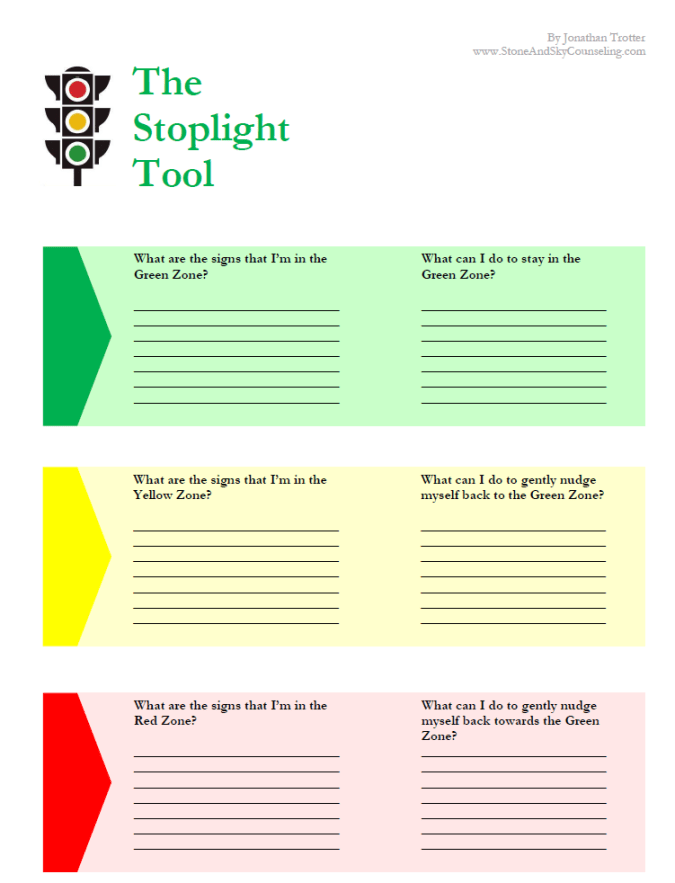
The idea is pretty simple. First, think about the signs that show that you are doing well in that area. How do you know you’re in the green? What does your friend or partner see when you’re in this color? And then, what are the things that help you to STAY in that color? Keep doing those things.
What are signs that you’re in yellow? What starts to happen when you’re trending in a direction you don’t want to go? The idea is to notice these things earlier than maybe you have in the past. And then, what are some things you might want to think about doing (or stop doing) that would help nudge you back to green?
And then the last one. What are the signs that things are really running hot? That you’re really struggling or not doing well? What are some things that maybe you don’t normally do, but that you might really want to do (or stop doing) that would get you moving back toward the healthy green?
It’s not rocket science, but when we’re really struggling with something, we don’t need rocket science. We need simple. We need straightforward. We need pre-planned.
Filling this out gives you a cheat sheet when you need it. When you’re trending towards red, you’re probably also forgetting all the helpful things. But if you’ve written them down, if you’ve shared them with a friend, partner, or ally, then you can look back, remember, and then maybe implement.
Hope that’s helpful out there, y’all! Take care, and happy Thursday!
Jonathan T.
__________________________________________
I’ve been using these concepts for a few years now, but I finally got around to creating a handout/worksheet for The Stoplight Tool. I’ve used this with folks dealing with OCD, depression, anxiety, and even adult ADHD. If you’d like to use this in your practice or ministry, would you consider purchasing the PDF for $2.99 here? Drop your email address in the comments when paying and I’ll send you the file. Thanks!
Starting in a couple of weeks, I’ll be seeing clients at Mt. Hope Christian Counseling Center on Wednesday and Thursday afternoons. And since I’m an intern, Mt. Hope offers clients a sliding scale payment option that makes sessions pretty inexpensive.
Please help spread the word, and let me know if you have any questions.
Here’s the announcement from Mt. Hope’s Facebook page:
Meet Jonathan Trotter, our newest counseling intern!
We are excited to announce that Jonathan is currently accepting new clients for individual and couples counseling.
~~~~~~~~~~
Read Jonathan’s bio:
As an intern with Mt. Hope, Jonathan is excited to offer marriage counseling, pre-marital counseling, and individual counseling to clients thirteen and over. Since 2014, Jonathan has walked alongside hundreds of couples and individuals in dozens of countries. He has experience journeying with people through issues such as grief and loss, life transitions, anxiety, depression, trauma, OCD, abuse (spiritual, sexual, physical, emotional), debriefing, ministry burnout, and addictions.
With couples, Jonathan utilizes an attachment-based, emotion-focused approach. He also greatly appreciates the evidence-based tools and resources from Dr. John Gottman. With all clients, Jonathan takes a person-centered, trauma-informed, experiential approach.
From 2012 to 2020, he and his family served as cross-cultural missionaries in Phnom Penh Cambodia. Prior to that, he worked bi-vocationally as an ER/trauma nurse (RN) and youth and worship pastor. He is a licensed attorney in California (inactive) and is currently completing his master’s in clinical mental health counseling at Colorado Christian University.
For questions, or to schedule an initial consult, contact the office at (417) 624-9659 or contact Jonathan directly at JonathanTrotterCounseling@gmail.com.
I love to write, and I love to edit, but I was still lost when it came to teaching my own children the craft of writing.
I remember something Susan Wise Bauer said once. It was something to the effect of, “Good writers intuitively know how to construct sentences, paragraphs, and papers that are beautiful and logical, but they’re not sure exactly how they do it.”
That means that if writing comes easy for you, you might not know how to explain the process to someone else. But students who struggle with writing need explicit guidance. And so do their teachers.
That’s where writing curriculum comes in. But which one should we use?? There are so many to choose from! So today I’ll share some principles for writing instruction, along with practical resource ideas. I’d also love to hear about the resources you have used and loved (or loathed).
First, a little primer on the writing process. Susan Wise Bauer, whom I consider to be an expert on the subject, has explained in many places that there are two distinct steps to the writing process. The writer must first put an idea into words; they must have something to say. Then, they must put those words down on paper. These two steps aren’t necessarily related — at least not in the beginning.
The first step is really a thinking step. In fact, Bauer has said that bad writing isn’t a writing problem; it’s a thinking problem. The second step involves our physical bodies: we must hold the pencil or pen properly, we must know how to construct each letter legibly, we must know how to spell words (mostly) correctly, and we must put the words in the correct order on the page. Eventually we must know how to type quickly and accurately.
This is all quite complex work, which is why Bauer recommends developing the skills separately. For the thinking piece, she recommends oral narration, or a re-telling, of the selection. The student isn’t required to write anything down yet; they are just practicing coming up with something to say. The parent can either listen to the narration and write it down or just listen.
For the pencil-and-paper part, she recommends dictation and copywork. Copywork is exactly what it sounds like: copying sentences from another source. In general we try to choose beautiful sentences for copywork so that the child develops an appreciation of what good writing looks like and sounds like. (This is also why we read them living books and develop a read-aloud culture in the home, but that’s a topic for another article.)
Dictation is harder and involves more memory work. The teacher reads a sentence aloud (usually only once, but sometimes twice), and the student listens and records the sentence as they see it in their mind. Here they are remembering and recording at the same time, but they are not formulating original thought.
In the early years these can be combined if a parent writes down the child’s narration and then assigns copywork or dictation from that narration, but the two activities are not yet happening simultaneously.
Eventually the student will connect both parts of the writing process. They consider the thoughts they want to communicate while recording those thoughts on paper (or a screen) and also remembering to implement spelling and grammar rules as they write or type.
Bauer’s elementary writing program, Writing with Ease, is based on these two principles of narrating (thinking) and recording. I used this program in the early years and enjoyed it.
Later on, Bauer teaches that the student will need to come up with their own thoughts rather than retelling ideas through narration. This is a higher-level process and involves learning how to outline nonfiction works and beginning to create their own outlines and compositions. That program, entitled Writing with Skill, took a lot more time and energy from both me and my oldest child, so eventually I gave up on it and simply used the Sonlight writing assignments.
Now, I love Sonlight, but there are some weaknesses in their writing curriculum. The main issue is that it tends to focus too much on creative writing and not enough on expository writing. This weakness seems to work itself out around level 200 or so, when more of the assignments become expository in nature and fewer are creative. This is important because, as Susan Wise Bauer has explained in several places, not everyone needs to know how to do creative writing, but everyone needs to know how to do expository writing.
As I was transitioning my oldest to the Sonlight writing program, I continued requiring copywork from my younger students. Their copywork was usually in the form of poems and hymns. I also assigned daily written narrations based on their science and/or history reading. They would begin with just a sentence or so in 4th grade and move on to short paragraphs from there, gradually lengthening over time to longer and longer paragraphs.
In these years I used the following articles from Mystie Winckler as my “handbooks” for teaching writing. I printed them out and referred to them regularly:
The more I read about Charlotte Mason education, however, the more I realized I wasn’t doing narration right. True Charlotte Mason instruction requires narration after a single reading, which focuses the child’s attention and requires more of the mind. And the more I read about Charlotte Mason, the more I became convinced that her style of education is one of the best for children. Which means I could have taught writing better in the middle years.
So if you, like me, are convinced of the efficacy of Charlotte Mason principles but don’t know where to begin with writing, here are a few resources:
Karen Glass has written Know and Tell, an entire book about narration.
Cindy Rollins (one of my favorites!) writes about the magic of narration in her magnificent memoir Mere Motherhood.
If you’re short on time, you could read this article about narration to help you figure out if the approach is right for you.
And if you tend toward more a more classical style of education, you may want to check out the Progym. This particular program looks to be an excellent resource from some trusted voices in the homeschool world. (I love Schole Sisters and have learned a lot from them.)
Here are some practical recommendations in case you skipped narration or paragraph writing with a child who had difficulty with spelling or handwriting or some other skill involved in writing. As a homeschool teacher, I appreciated the step-by-step instructions, because I didn’t feel competent to develop them on my own.
Paragraph Writing for Kidsby Ann Roeder is designed for students in 4th through 6th grade and teaches them how to write descriptive, narrative, persuasive, expository, and comparative paragraphs. It breaks down the writing process into very small steps – it takes a couple weeks to learn how to write each type of paragraph! But after the student has truly grasped the process for each type of paragraph, they can write another sample paragraph in one sitting. This workbook is especially good for students who are nervous about the writing process and lack the confidence that they can do it. By the end of this book, my student could confidently write paragraphs and was ready to move on to a more robust composition program.
Jump In: Middle School Composition by Sharon Watson is the next step in that process. In this program, students learn how to write entire compositions. Everything in Jump In is also broken down into small steps, which both my student and I needed. I recommend getting the teacher’s guide along with the student book.
At the same time, I know literary analysis is coming in high school, and I want my students to be prepared. One way to prepare them is to start having them think about story structure for some of their assigned reading in upper elementary or middle school. You can have a conversation about the ideas with your younger students, or if your student is a little older and thus more proficient in writing or typing, you can assign a short paper that covers just one or two of the ideas. Here’s my template for beginning literary conversations.
A discussion of writing instruction wouldn’t be complete without a mention of spelling and grammar.All About Spelling is, hands down, the best and easiest way to learn spelling.
Grammar is much harder to teach. I’ve tried so many programs, trying to fit the program to each child’s needs. What I’ve learned is that there are a lot of not-great ones out there. Two of the better ones are Shurley English and Rod and Staff English. Shurley is more fun, but Rod and Staff is extremely thorough (though at times too thorough – who really needs that many practice problems?!).
In case you didn’t know. . . .
In addition to my editing services, I also provide homeschool consulting. Whether you’re in the early years of home education or are wondering how to approach high school, I’d love to help you with your questions! I’m especially passionate about helping moms who are overseas. You can find the intake form here. I’m offering a discount until August 31, 2023.



 Jonathan & Elizabeth Trotter