Politics, Plumeria, and the Kingdom of Heaven

“I miss Ima,” my daughter tells me. “I miss her singing, and I miss her flowers.”

Ima was one of the best worship leaders I’ve ever known, and I’m so glad our paths crossed at an international church in Phnom Penh, Cambodia.

Originally from the islands of Fiji, Ima always led worship with a tropical flower in her hair. Usually, she chose a frangipani (plumeria), the bright yellow satiny flower that smells like the most luscious citrus dessert and is the mainstay of Hawaiian leis.

Cambodia has a tropical climate and wonderful people, but even so, the country has suffered much as a result of war, genocide, and corruption. Cambodia is not a tropical paradise, but the church is growing, and Ima is helping.

With her global team she led our global church. Typically, she shared the stage with a Filipino on keys, a Pakistani on percussion, an Australian on guitar, and a Malaysian on drums. Together, they helped lead a rag tag group of Jesus followers from over 30 nations in worship. They helped us declare, week after week, the hope of the cross and the certainty of God.

Our church was full of missionaries and businesspeople, those involved in anti-human trafficking work, and those serving in the relief and development sector. Many of us came to church on Sundays tired, exhausted, and poured out. We traveled by motos and tuk tuks, buses and cars, to be reminded of our Hope. We came to drink of Life, and we came to declare the death and resurrection of our Lord, until he comes again.

I hadn’t grown up in a church like this. I hadn’t grown up in a church with pastors from China, New Zealand, the Philippines, India, Canada, Cambodia, and the United States.

I thought the church was primarily American.

I mean, I didn’t really think that; it’s just that growing up in the Midwest in a standard evangelical church, the church just was pretty American. And Caucasian too. Our authors were American, our musicians were American, everyone was American.

Typically, the only non-American folks I ever came across were the ones we were sending missionaries to. We were the ones sending the gospel, and they were the ones receiving it.

As believers in America we’re taught, often accidentally, that to be a Christian is to be American, or at least to look like it. Even if not purposeful or intentionally racist, the trickle-down effect of this theology is dangerous and thieving, denying us connection to the breadth and depth of the global church.

But here was Ima, a Fijian woman, singing the gospel with power. She was pouring her heart out in prayer, and she was ushering a global community into the throne room of God. The Kenyan sister was dancing, the Samoan brother was singing, and the Australian guy was jumping up and down with a huge smile.

The global church was so much more beautiful and diverse than I had ever known. Christ’s people had come from all over the place, they were going all over the place, and they were worshiping.

I love the American church. But I’m afraid that somewhere in our history, we began to believe that we Americans held the keys to the Kingdom. We would never say it like that, but we sometimes act like that.

So long ago, our spiritual forefathers rightly declared that Rome was not the central hub of global Christianity. But I’m afraid we’ve drifted into our own hubris and begun to believe that the American church is the hub, the main gospel force in the world. It is not.

That vision is too small. That church is too claustrophobic.

I want to be brothers with the Swiss guy who runs a climbing gym in Cambodia. I want to serve alongside a Chinese businessman who converted himself (as far as that is possible) by picking up a Bible someone left behind in a hotel room in Nepal.

I want to rejoice with the Pakistani couple who opened their hearts and kitchen to us, telling stories of the faithfulness of God and how they escaped to safety. The unique flavor of homecooked samosas will always remind us of our friends’ faith and our Father’s faithfulness.

I want to honor the Japanese man providing care and education to disabled Cambodians. I want to join in with Cambodian pastors who continue to teach God’s word to God’s people in difficult times and challenging places.

Christ is the King, and his church is global.

We must remember: the church existed before America.

We must remember: the church will endure long after America.

We must remember: the church is older than Western civilization.

The church is global, and she is not dying.

And while the church is global, the gospel always gets worked out locally. That’s the beauty of it. The church can be local precisely because it’s so stunningly global. The church is big enough to be local everywhere.

As citizens of America, we should celebrate and honor and cherish the church in the United States. She remains beloved and part of the Bride. But as citizens of the Kingdom, we should celebrate and cherish and love the global Church too, wherever she may be found.

A Fijian worship leader with a flower in her hair helped me learn that.

When I finally get home and meet Jesus face to face, I will not be surprised at all if he bellows out the Fijian greeting: “BULA!” which means, “Life to you!” I hope to hear him say on that day, “Welcome home, my son. Here is the life you’ve been searching for! Well done.”

And then I will wander.

I will find a frangipani tree. I will inhale its cheerful citrus fragrance, I will smile, and I will look out on the nations that God has brought together, and I will declare, “This looks familiar; look at what the Lord has done!”

And then I will find Ima, and I will thank her for what she gave our church and what she gave my daughter. I will thank her for what she gave me. With her uniquely Fijian flair and a frangipani flower in her hair, week after week, she led God’s people to paradise.

Book Review: Where the Light Fell

by Jonathan

I thought I’d like this memoir from Philip Yancey, but I had no idea it would be such a page turner, lurching from fundamentalism to racism to grace to dysfunction to mercy to LSD to classical piano to faith and on and on and on.

“An upbringing under a wrathful God does not easily fade away.”

For someone who’s written so much (and so gently) about suffering and grace, I should not have been surprised at the terror, trauma, and healing present in Yancey’s story.

“Like every secret, it gained power as it lay hidden.”

If you’ve wrestled with religious burn out, or if you’ve had a hard time reconciling the church with Christ, you might resonate with this book.

“As a boy wandering in the woods, a teenager constructing a psychic survival shell, a lovesick college student running from the Hound of Heaven — in all those places I found what T.S. Eliot called ‘a tremour of bliss, a wink of heaven, a whisper.’ I came to love God out of gratitude, not fear.”

This book will endure for quite some time, I think.

Find it on Amazon here.*

*Amazon affiliate link

A Lament for the American Church (or how I’m processing my codependent relationship with the church)

by Jonathan

I love the church, and I have loved the church for a long time.

I’ve led worship 600+ times in local congregations. I’ve preached dozens of times across several countries. I served as an overseas missionary in Southeast Asia for 8 years. I’ve been in “church work” in one capacity or another for over 20 years.

In fact, I still serve with a church planting mission organization, providing pastoral care and coaching to missionaries around the world. My day job is walking alongside of hurting people who also love (and are serving) the global church.

I still love the church, but I’ve got a problem.

Watching the American evangelical church for the last several years has been devastatingly hard. Initially, I watched as a sort of outsider, living and ministering in a developing country that had a proud and boisterous autocrat as a leader. And now since COVID led to an early repatriation in March of 2020, I’ve watched from a more comfortable spot in the rural Midwest.

Has it been devastating for you too? Have you grieved at how some elements of the American church have responded to racial issues, to politics, to the Capitol siege, to the ongoing global pandemic that’s killed over 660,000 people in our country alone? Have you lost friends and maybe even family?

During all of this, I’ve desperately wanted to change the church. I’ve shared articles and written Facebook posts trying to convince people to behave differently, to care differently, to love differently.

I’ve needed the church to behave differently so that I would be ok, so that I wouldn’t be embarrassed, or ashamed, or angry. As it turns out, that’s not very loving or healthy.

I’m beginning to realize that there’s a difference between loving the church and being enmeshed with it. There’s a difference between being grieved at her sins and being so emotionally devastated by her sins that I want to scream at people. One is healthy and vital, while the other is evidence of codependency.

Definitions & Caveats

Codependency is “excessive emotional or psychological reliance on a partner, typically one who requires support on account of an illness or addiction.”[1]

In unhealthy systems like this, talking about things openly and honestly can get complicated; silence is of paramount importance, and silence helps to maintain the status quo. One writer described it this way:

“One fairly common denominator seemed to be the unwritten, silent rules that usually develop in the immediate family and set the pace for relationships. These rules prohibit discussion about problems.”[2]

I have felt this. I have felt the urge to sit down, to shut up, to stay silent. But I can’t anymore.

The real-world impact of codependency is complex, but at least in part, a codependent person will seek to control the ill person (or addict) so that the codependent will remain psychologically intact.

This was me. And it’s made me bone-weary.

My identity was so wrapped up in the church that a threat to the church (even if it was from inside the church) felt like a direct threat to my core self. I don’t want to live that way anymore.

Is the American church a functioning alcoholic, drunk on power and patriarchy? Yes, some of it is. But “the church” is a pretty large entity to lump together in an accusation like that. So please hear me when I say this: there are parts of the American evangelical church that really are sick. Those parts need to be honestly assessed and truthfully addressed. But that doesn’t mean it all needs to be burned to the ground.

Eugene Peterson spoke plainly about the tensions of living in (and serving) a community of believers. It was not all rosy. But even while admitting the challenges, he wrote, “I have little time for the anti-church crowd who seem snobbish and who have little sense of the lived way of soul and Christ.”[3]

C.S. Lewis would have agreed, I think. A generation before Peterson, Lewis wrote this in a letter to a friend: “The New Testament does not envisage solitary religion. Some (like you – and me) find it more natural to approach God in solitude; but we must go to Church as well.”[4]

I can’t “do faith” on my own. I’ve gained so much from my involvement in local churches. It has been good for me, spiritually, emotionally, and even psychologically. My family has found a local body of believers in our new town in the Midwest, and we are jumping in to community and fellowship.

I am not anti-church, but I am anti-pretend, and I can’t act like things are OK in the American church.

I resonate deeply with Beattie when she writes, “[C]odependency is called a disease because it is progressive. As the people around us become sicker, we may begin to react more intensely.”[5]

Is that what’s happening to me? To us? Have we been in a codependent relationship with the church? Is this why now, as her behavior appears to become sicker and sicker, so many of us are reacting more and more intensely, getting either angrier or else just running away? I think so.

Churches Love Codependents

Codependents make great church members. They’re sacrificial. They’ll do anything. They’ll go anywhere. And they’ll defend the leaders and the system if they have to. They care a LOT about the church.

Many church-growth strategies look like a playbook for making people codependent. Encourage strong identification with a specific church/leader/group. Call it branding. Teach a lot about the uniqueness of this church and church culture. Create a very strong “us vs. them” motif. Emphasize teachings on authority and respecting spiritual leadership/headship. And if our “family” is ever in crisis, circle the wagons. And God forbid, but if anyone from without or within criticizes the church, take it personally, react vehemently, and DEFEND.

As it does in the world of codependency and addiction, these strategies quickly lead to a persecution complex, and American evangelicals thrive on a persecution complex.

Local Church, Hope of the World?

The now-disgraced pastor and author Bill Hybels used to say regularly, “The local church is the hope of the world.” I used to quote that statement regularly. But you know what? I’ve learned it’s not true. In fact, that message causes a slow but steady trend towards deep dysfunction: Hide flaws. Silence survivors. Conceal abusers (or transfer them somewhere else). Don’t let those on the outside see reality.

Codependents always protect the addict.

But protecting the reputation of the church is a fool’s errand, and it typically ends up meaning, “We need to protect the reputation of our leaders.” If the leader is leading the church that is the hope of the world, or at least the city, then we must protect him, along with the system he leads.

And if a narcissistic politician promises to protect our churches and our “Christian rights,” then we must protect him, too, and hold him above reproach. This is so wrong and harmful for our nation, but we learned it in our churches first.

To put it more bluntly, if the local church is the hope of the world, then the leader of the local church is the hope of the world too. Chuck DeGroat, clinician and pastor, writes about narcissistic church leaders. These leaders are more than happy to be seen as the hope of the world. He writes, “The grandiosity, entitlement, and absence of empathy characteristic of narcissistic personality disorder was translated into the profile of a good leader.” In these systems, “Loyalty to the narcissistic leader and the system’s perpetuation is demanded.”[6]

This is not healthy.

Next Steps

The last few years have revealed some of the addictions and illnesses of the evangelical church: patriarchy, white nationalism, a fervent and enduring embrace of narcissistic, abusive leaders, and a disregard for the truth.

During all of that, we were also taught to love the church. And we did.

I did.

What many of us learned, though, was that we needed to love the church as the prime thing. Nobody said it, but I think we gained more identity from our churches than we did from our Christ.

We desperately need to work on de-centering the church (and politics) and re-centering the Christ, the hope of the world. Karen Swallow Prior recently wrote about this in her article titled, “With this much rot, there’s no choice but to deconstruct.” She says,

“We must make Jesus the head of his bride again. We can no longer put the church — its name, its reputation, its money, its salaries, its staff, its programs, its numbers — before Christ himself.”[7]

Enmeshing ourselves with charismatic Christian (or political) leaders is tempting. It helps us feel like we belong and like we’re on the inside. But if our core identities hinge on our churches or our political parties, we have erred terribly.

The Church Called TOV

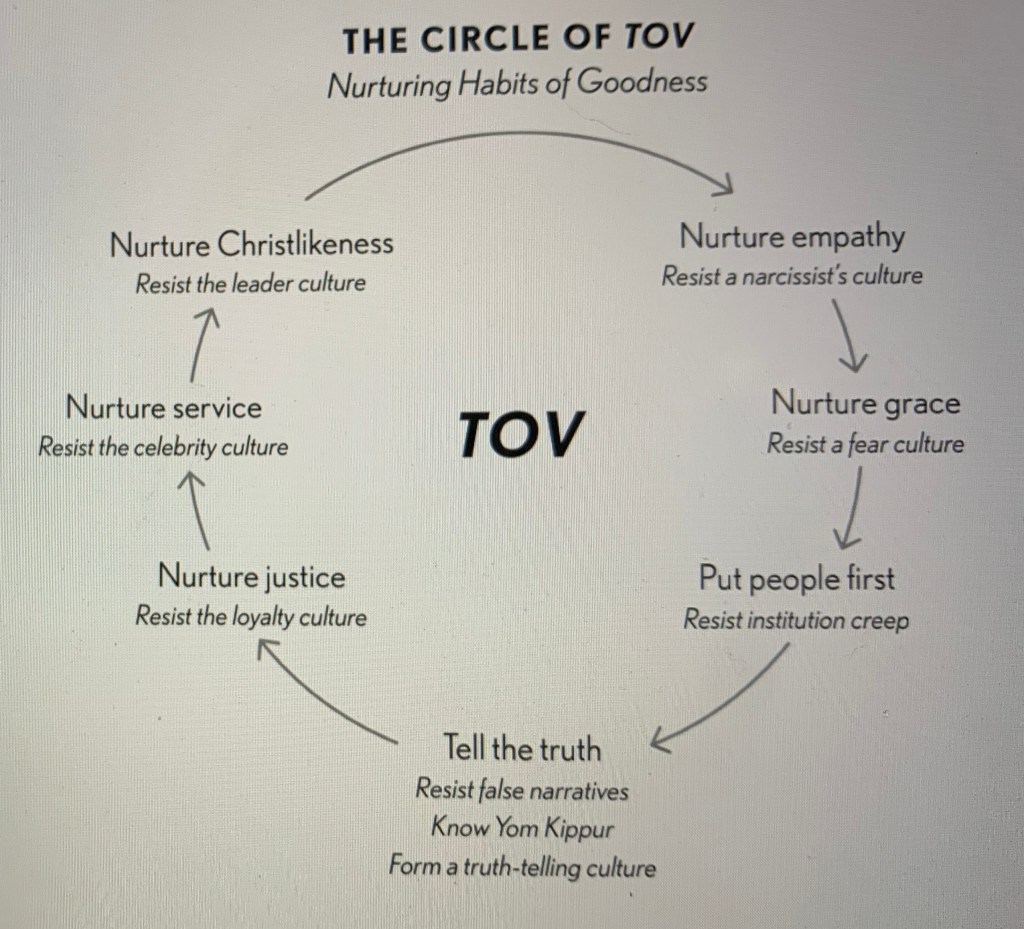
This article is not a book review. However, I believe a truthful review of Scot McKnight and Laura Barringer’s book, A Church Called TOV, would be this simple: A Church Called TOV is a textbook for walking out of religious codependency.

It’s that good.

The authors compare unhealthy, dysfunctional dynamics, with gentle, Christ-honoring pathways forward. Here are the main ideas:

Conclusion

I don’t want to love the church in a codependent way anymore. I will still love her, but I don’t want to be enmeshed with her, where her good (or bad) behavior alters my own sense of self.

I want to nurture empathy and grace. I want to put people first and tell the truth. I want to pursue justice and honor humble service. I want to grow into Christlikeness.

I will continue to be a part of my local church, but I don’t want my core identity to come from her. It can’t. I can’t be enmeshed any longer with the American evangelical complex.

The local church (even a great one) is not the hope of the world.

Jesus Christ is the hope of the world.

Amen.

Come, Lord Jesus.

A Lament for the Church: a prayer of letting go

The path to healing from codependency often involves an emotional detaching. That does not mean you care less for the person from whom you’re detaching. It just means you are detaching from “the agony of involvement.”[8]

This lament, patterned after the material in Mark Vroegops’ book, Dark Clouds, Deep Mercy, is my attempt not to care less, but to care healthier.

God of the Church, the one who sees the end from the beginning, hear my cry to you today. You established the heavens above and the Church below, and one day you will invite your Bride, your people, to feast with you in the New City, the golden city of God.

But here and now, O God, your Bride seems sullied. More to the point, your Bride seems to be chasing after the wind, pining away for other lovers who promise power and a seat at the table. Your people are damaging people. They have turned on the least of these, preferring instead to join in with mockers, to stand with sinners.

You will not be mocked, and you will not endure their sins forever. So do something! Stop this madness! Bring light back to our eyes. Make compassion great again! Do not stop your ear to the cry of your people. No! Listen to their fawning over false prophets, see their bowing before every lying hashtag and would-be tyrant. Open their eyes and break their hearts!

You alone know, O God, the depths of the deceit, and the depths of your love. I yield the floor, trusting that this is your case to make, and believing that you will. Your ways are too complex and masterful for me to comprehend, so I yield.

I trust you to figure this out and respond appropriately.

And I rest in your promises to forgive me too.

Amen.


[1] Oxford English Dictionary

[2] Codependent No More, by Melody Beattie

[3] As quoted in the book, A Burning in My Bones, by Winn Collier

[4] The Quotable Lewis, by Martindale and Root

[5] Codependent No More

[6] When Narcissism Comes to Church, by Chuck DeGroat

[7] https://religionnews.com/2021/08/04/with-this-much-rot-theres-no-choice-but-to-deconstruct/

[8] Codependent No More

Is the primary danger “out there”?

by Jonathan Trotter

Note: this post was inspired by this article by David French.

As a homeschooled-in-the-80s kid, I’m well versed in the terrified cry, “The danger is out there! The danger is out there!” I can remember watching The Village and feeling like M. Night Shyamalan had just made a film about my life. (My parents didn’t yell this too loudly, but we were Gothardites.)

But is the primary threat “out there”? No. It is not.

Over the past couple of years, I’ve received a fraction of the pushback that David French has, but still, I resonated deeply with this:

“I get an enormous amount of criticism for not critiquing the secular left more than I do. Yet if I’m concerned for the health of the church, then corruption at the highest levels of the world’s largest Christian university, sexual predation by arguably Christianity’s most influential apologist, widespread conspiracy theories, and disproportionate disregard for the health and well-being of neighbors do more harm than the worst of Joe Biden’s culture war regulations or the most radical developments in the sexual revolution.”

The whole article is excellent, but here are a few more quotes worth pondering:

“If your reaction is that the greatest threat to human souls or to the church itself comes from without—from the external forces attacking Christianity or from the cultural temptations buffeting our children—then that dictates a very different posture to the world and approach to politics than if you believe the true threats lie within.”

A different posture indeed.

I have seen this fear, this alarm:

“If you believe the most dangerous threats come from without, fear can rise in your heart. As you lose political and cultural power, and you see others shape the environment in which you live, then you start to have genuine alarm that other people are destroying the souls of those you love. What a terrifying idea.”

There is hope, of course.

At the end of the day, the Church remains his, and he still loves her. He still calls her to remember her first love. I want to still love her too. I want to build more than I tear down. I want to heed with every fiber of my being Jesus’ call: “Your business is life, not death. Follow me. Pursue life.” (Matthew 8:22)

I want to love more than I fear.

I haven’t always done this, for sure. But I want to. I want to know Jesus more. I’m a few chapters in to Dane Ortlund’s new book, Gentle and Lowly, and it’s helping. It’s not about The Chosen, but it’s explaining, in theological terms, why the Jesus portrayed in The Chosen is so fascinating and healing and loving. He’s helping me understand why I cry every.single.episode.

Turns out, it’s because the stories are real. Ortlund writes, “Jesus is not trigger-happy. Not harsh, reactionary, easily exasperated. He is the most understanding person in the universe. The posture most natural to him is not a pointed finger but open arms.” He goes on to say that Jesus’ “deepest impulse, his most natural instinct, is to move toward” sin and suffering, not away from it.

Jesus is really like that.

And that is Good News indeed.

*Contains Amazon affiliate link.

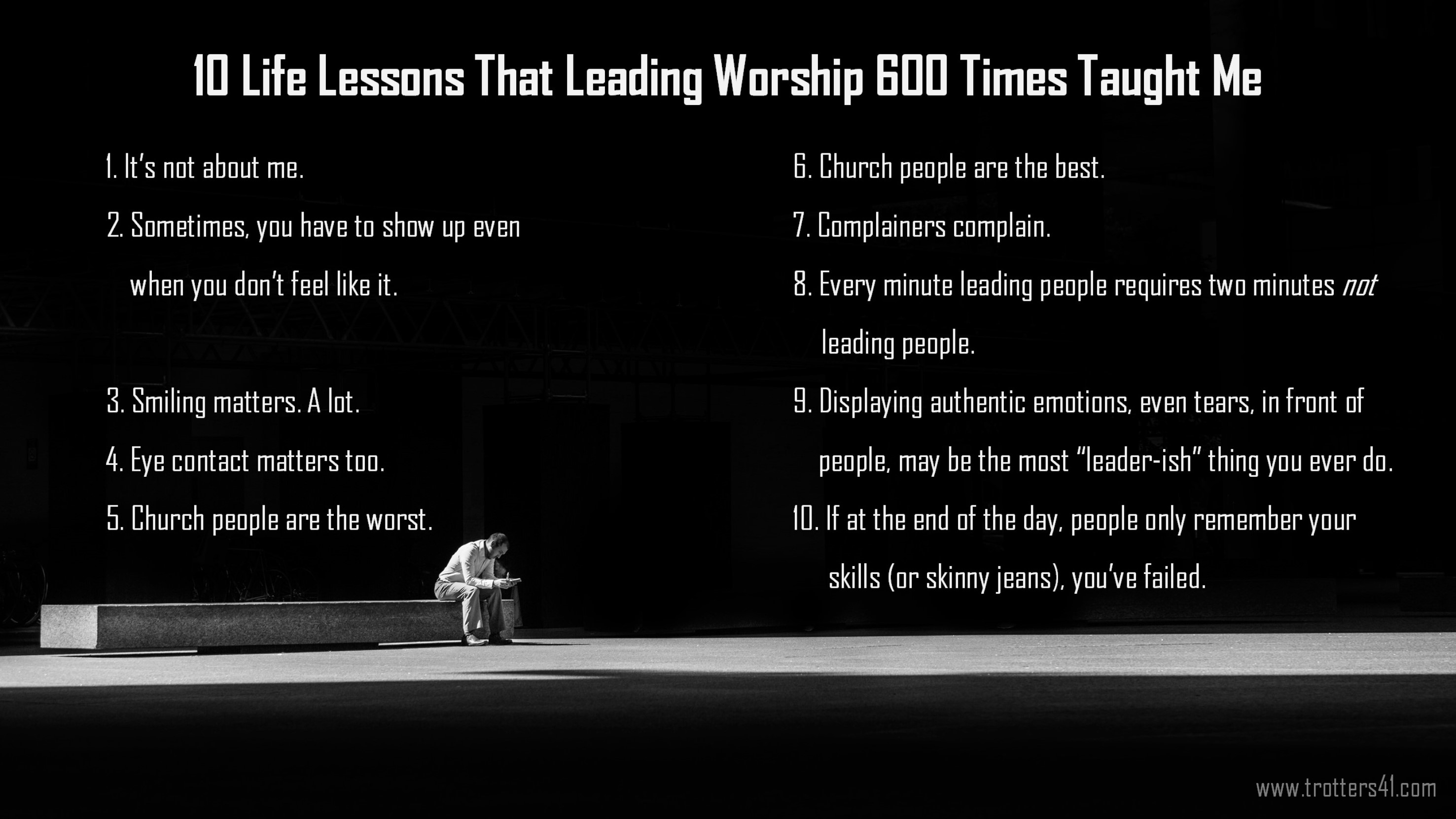
10 Life Lessons That Leading Worship 600 Times Taught Me

It just sort of happened.

As a teenager growing up in an a cappella church with an a cappella youth group, I sang a lot. In a non-instrumental church, any guy who can loosely carry a tune will be asked to carry that tune. A lot. And so I was. Over and over. And over. No guitar skills necessary.

In college, our inter-denominational student ministry needed a band leader. I still lacked all guitar skills, but no matter, they tagged me and I became the de facto leader for our Thursday night gatherings.

And then I actually started working for a church, leading the youth and worship ministries. I led worship nearly every Sunday for about six years. And that’s how we get to 600 plus.

I recently sat down to ponder what life lessons those experiences taught me.

matthew-henry-130381-unsplash

1. It’s not about me.
Whether I’m standing before a group of 15 or 500, it’s not about me. It’s about the struggling mom of littles, the financially-strapped couple wondering how to make ends meet. It’s about the widower who feels his loneliness deep in his bones. It’s about the teen who’s trying to figure out who she is — and who God is.

Of course, it’s not about me.

And of course, it’s not primarily about them either. It’s about the Father who is longing to connect with his beloved people through moments of communion and community. It’s about the presence of the only One who is worthy; it’s about what the Spirit is saying to his Church.


2. Sometimes, you just have to show up, even when you don’t feel like it.
When you do anything over and over and over again, even if it’s a good thing, there will come a time when you don’t feel like doing it. Well, what’s a worship leader (or human) supposed to do? Is it inauthentic to stand before people when you’ve had a crappy night’s sleep, or when you’re in the middle of a big fight with your wife, and pretend that things are OK?

I really had to wrestle with this. Every Sunday is not a glorious day, and there were many Sundays the last thing I wanted to do was go to church, much less lead people in worship.

Showing up and doing your job, even when you don’t feel like it, isn’t inauthenticity. It’s actually maturity.

One question that continues to help me with this is, “Who is benefiting from my NOT revealing everything?” Am I hiding my true self from people in order to protect myself? In order to avoid intimacy? Or am I not revealing EVERY THING IN EVERY SINGLE MOMENT to get myself out of the way and help people meet with God? Is it for me or for them? If it’s for them, then it’s probably OK. (Of course, this assumes that at some point, and with some people, the leader will be authentic and vulnerable.)

God is worthy of worship whether I feel like it or not, and sometimes I need to stand before him and worship not because of my feelings, but in spite of my feelings. This is true about leading worship, and it’s true about leading life.


3. Smiling matters. A lot.
Effie Harnden was a kind old lady who became The Great Encourager of my 16-year-old self. When I was just starting out, someone told me, “Locate the few people who are smiling; look at them often.” I looked at Effie a lot.

It’s pretty good life advice too, “Locate the few people who are smiling; look at them often.”


4. Eye contact matters.
I’ve seen worship leaders who never look at a single person in the audience. That M.O. can look super-spiritual, and maybe it is. Maybe they’re lost in total adoration, caught up in the moment. Or maybe they’re just super disconnected from the people their leading.

In life too, I’ve seen people who never notice the people in front of them. So look at people, look at their eyes, wonder about their stories, ask about their stories. If you do, you will impact people very deeply; for when it comes down to it, we are all longing to be seen, even if we’re desperately afraid of it.


5. Church people are the worst.
Some people at some churches hated me. They disliked my style, my music, and maybe even my face. It’s just the way it is. Some people will not like you no matter what you do. That does not necessarily mean you’re doing something wrong or bad, but it does mean that you (and they) are humans.


6. Church people are the best.
It was church guys who painted our house when my mom was sick with terminal cancer.

It was the “casserole ladies” who fed us.

It was inter-generational trips and Bible studies that showed me how to be a Christian adult, not just a Christian teen.

It was a man, a leader in the church, who came to my side when I couldn’t finish leading God Moves In a Mysterious Way. The cancer-induced tears were drowning me. He stood with me, shoulder to shoulder. We were two men at the front of a church, one young and crying, unable to voice anything. The other, older, an elder, choking tears and singing through empathy.

I will never forget that moment, because in that moment, standing vulnerable before God and his people, I was not alone. I was joined by a man thirty years my senior, and I was saved.


7. Complainers complain.
It’s what they do. But it is possible, sometimes, to maintain a positive relationship with complainers. And when it’s possible, it’s also extremely valuable.

But sometimes complainers are just toxic and keeping relationship with them is inadvisable. One key difference? If the complainers really want what’s best for you and for the church, they just really disagree with you, it’s probably best to try to maintain a friendship. If they’re out to control and dominate, manipulating through pressure and threats, to meet their own twisted needs, yeah, run away.


8. Every minute leading people requires two minutes NOT leading people.
At least.

The times that you’re NOT leading are more important than the times when you are leading. It may not look related, but sabbath has a direct impact on Sunday.


9. Displaying authentic emotions, even tears, in front of people, may be the most “leaderish” thing you ever do.
We live in hard times, and my current job as a pastoral counselor has convinced me (again) that most people do not feel free to really feel their feelings. They feel societal, religious, familial pressure to “keep it all together,” whatever that means. By showing emotions, leaders can help change this. We must change this.


10. If at the end of the day, people only remember your skills (or skinny jeans), you’ve failed.
When it really matters, people won’t care about your vocal ability. People won’t care about your flashy .pptx or Prezi or Keynote. People won’t care about your hair style or flannel shirt. At the end of the day, people will ask, “Did he care about us? Did he care about the Church?”

Basically, what matters when the sun sets are these three things:

  • Was I a person of faith, even in my doubts?
  • Did I demonstrate hope, even through my despair?
  • And in a world gone mad, did I love like Christ?

May God help us all to live towards that.

~~~~~~~~~~~~~~~~~~~

As I drafted this article, I wept.

I remembered my church, the Red Bridge church of Christ, and my breath caught.

You see, as I pondered, I realized something: I needed them way more than they needed me. That’s just the truth. I was in front of them, but they were leading me. I taught them new songs, but they taught me what Jesus looked like with skin on. I cried in front of them, and they joined their hearts with mine and embodied those beautiful people who mourn with. I got frustrated with them and I’m sure they got frustrated with me, and yet, we stayed friends. I’m so very glad we did, for those dear saints showed me what a “long obedience” could look like.

I’ll forever be grateful for the group of God’s people who invited a scrawny teenager with a pitch pipe to stand, to cry, to lead. They taught me so much, and I will never forget them.


*Photo by Matthew Henry on Unsplash


10 Life Lessons that leading worship 600 times taught me