by Elizabeth
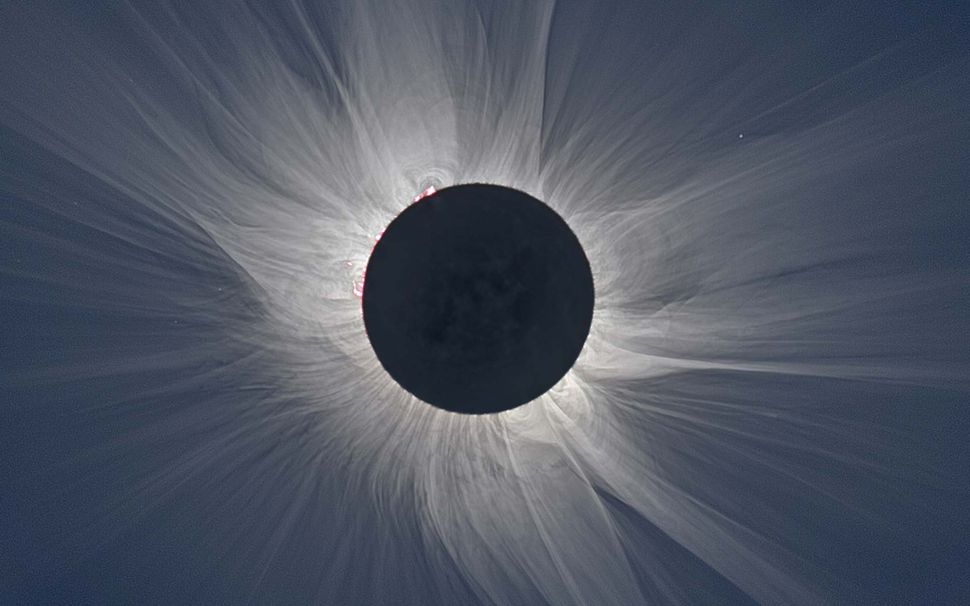
It was so wildly beautiful it couldn’t possibly be real. A brilliant ring of light in the sky should fill in, not fan out. My mortal mind simply couldn’t comprehend it. I had longed for this day for years. I grieved hard in 2017 when I missed the total solar eclipse so many other Americans witnessed. And it was then that I planned to watch the one on April 8, 2024.
We drove past the midline of the eclipse clear to the other side, where we were just barely inside the path of totality and where dear relatives welcomed us into their home. I do not claim to understand how prayer works, but I am not ashamed to admit I prayed for clear skies. No matter how far our technology progresses, we humans are still beholden to the weather for the most spectacular sight on earth.
The week before the eclipse, the weather looked to be cloudy that day. I didn’t hold too tightly to my dream of seeing and experiencing totality. I didn’t want to be disappointed. Even in 2017 when I started making plans for the 2024 eclipse, I knew that Arkansas skies have about a 50% chance of clouds in April.
But as the days went on, forecasts changed from cloudy to partly cloudy and then, the day before the eclipse, to sunny. The morning of the eclipse, a bright yellow orb hung in a clear blue sky with only a few cirrus clouds floating by. I cried all morning, unable to believe that God might actually give me a chance to see this fantastic event.
Seriously, I cried all morning.
After lunch I walked onto the deck and searched the sky for first contact. We put on music and sunscreen and played in the backyard, intermittently observing the sun through our eclipse glasses. I wore sunglasses at first because it was so bright outside, but at one point someone pointed out how much darker it was getting. We probably only had about 70% coverage, but the light was already changing. Everything was greener, more muted, a little bit eerie. I no longer needed those sunglasses.
As the moon moved farther across the disk of the sun, the temperature started to drop, and I actually put my sweater back on. After eight years in Southeast Asia, I’m particularly sensitive to cold, and I didn’t want to risk being distracted by the chill during totality. I watched through eclipse glasses as a sliver of orange light got thinner and thinner and shorter and shorter until it disappeared.
Suddenly everything went black, and I took off my glasses. The corona wasn’t anything like I had expected from photos. It was feathery and delicate, but also crystalline, not as diffuse as in the pictures. It was much whiter, much brighter, and much purer than I had expected.
It spread out unevenly and much farther than I had imagined, and I didn’t know what to do with those little pinpricks of starlight I saw at the bottom and on the sides of the crown. At first I thought they might be Bailey’s beads, but they were on the wrong side of the sun for that, and they remained for the entire duration of totality. Later I learned they were prominences, courtesy of the sun’s 11-year maximum for solar activity.
Totality wasn’t as dark as night, which surprised me. Though the sky near the corona was a deep shade of purple blue I’d never seen before, all around me was only as dark as dusk. Not your normal everyday lopsided dusk where one side of the sky darkens first, leaving coral pink and terra cotta on the other side, but a dimness all around. We swam in twilight as the shadow of the moon raced across the surface of the earth.
I looked for Jupiter and Venus, in line with the sun in the middle of the day. Venus was to the right (west), closer and bigger, while Jupiter lay to the left (east), a bit smaller and farther from the sun. I looked around the horizon, expecting the 360-degree sunset I’d read about, but to the east I saw a small patch of light blue, where the other side of the city wasn’t in totality.
I went back to gazing at the corona for the rest of the eclipse, but all too soon it was over. As soon as it ended, I was sad. I wanted to whisper, “Come back,” wanted to hold onto it like a perfect dream you’re not ready to quit when the sun rises in the morning. My daughter told me she could see the disappointment on my face.
In the immediate aftermath, it was like the eclipse had never happened. The sun came back out, and it was soon warm again. And even though I had stared at the moon’s obscuration of the sun for most of the two minutes and 20 seconds of totality we had, I couldn’t remember what it looked like. I remembered Venus and Jupiter; I’d seen them before. They looked the same. I remembered the nearly 360-degree sunset. But I’ve seen sunsets before. My brain knows what to do with an orange glow along the horizon. The white fingers spreading out from a dark hole in the sky – that’s what my brain couldn’t understand.
It was whiter than the full moon, much whiter than the sun should be, and yet it was the sun, not the moon. It stretched out so far, much farther than I’d expected. And all those sparkling pearls on the surface – what were they?! I saw at least five. Only later did I understand those bright drops of light, some larger than others. I wish I’d known at the time what I was seeing. I might have been able to catalog it better.
At first I felt like I had somehow done the eclipse wrong. But when I talked with my kids, they felt the same way. It was hard to remember the actual event. Two minutes is not very long to take in something that you’ve never seen before. Even if you’ve read a lot of eclipse material like me.
I love the moon. I’ve been watching her all my life. We are intimate friends, she and I. But even as an obsessive moon watcher, I still can’t wait to catch another glimpse each time the moon turns full. Watching me, you might think I’d never seen it before, though I have – a thousand times. So of course I would find it difficult to remember two minutes of moon shadow.
We waited for the moon’s last kiss of the sun and piled back into our car. The memories kept slipping through my mind as we drove. I couldn’t catch or hold them. I had wanted this for so long, and it was disappearing right in front of me. I had looked at the planets once or twice, I had looked at the horizon once or twice, but mostly I had stared at that glowing orb in the sky. Why was that bright wreath going dark in my mind? Why couldn’t I touch the glory?
I wanted to hold it in my hand. I wanted something sure and steady. I’d dreamed about this day for so long, I needed more than what I’d been given. Like Philip in John 14, my heart told the Lord, “Show me the eclipse, and that will be enough for me.”
But it wasn’t enough. It didn’t satisfy. It only made me homesick for heaven. I caught a glimpse of God’s glory, yet the moment soon passed. The sun returned and life went on. The glory had moved on, and though I saw it from a distance, I couldn’t touch it, couldn’t keep it. God’s glory is slippery, totality is brief, and just like that the corona evaporated before my eyes.
The eclipse transported me to another dimension, but like so many experiences of awe, it was fleeting. Every sunset, though beautiful, though common, is fleeting. Once the sun slips below the horizon, the sunset is gone, and you’ll never see another one like it. God’s glory is ephemeral, and we can never quite touch it.
So is this chasing, this longing, this remembrance of His glory, the closest we get to God? Can we catch an infinite God with our finite hands? Would we even want a Lord like that? Is it better to worship a God who only gives us glimpses, who asks us to be satisfied with almost, who allows us just a sideways glance?
Am I content with a God who only shows me His back? Can I embrace this mysterious distant presence? Can I love a God I’m always on the verge of losing? Each time I hear from Him, there’s a certain not-knowingness, a small amount of doubt that I actually heard from God – just as I doubted that I saw the sun’s outer atmosphere that day.
My frantic search for internet photos later that night was really just a desire to confirm what I saw. I wanted photographic evidence that April 8th was real. But I couldn’t find a photo that truly captured what I saw that day. An eclipsed star is more sparkly and twinkly than the photos, more delicate and threadlike. Brighter and bigger. There was something wrong with every photo I found, something not quite like what I saw.
And so my solution was to see another eclipse. That way I would know what I experienced was real, that it actually happened. But even if I watch another solar eclipse some day (and I’m already planning for 2045), it won’t look the same. The sun won’t be at solar maximum. Earth’s weather won’t be the same. Every eclipse is different, just like every sunset is different.
I would have to accept the mystery of the eclipse, the way I have to accept the mystery of a sunrise, mundane as it is. Every celestial event is fleeting in its own way. I remember how quickly the Christmas conjunction of Jupiter and Saturn sank below the horizon.
The next morning I woke up and had a difficult time getting started on work. All I wanted to do was ponder the eclipse. All I wanted to do was relive it in my mind over and over and over again. What’s the point of achieving things when we could just sit around all day and watch eclipses?
But that’s exactly the point. We can’t sit around all day watching eclipses. They’re too rare. God doesn’t show us His glory like that all the time. Most days are filled with a lot of menial tasks. We have to work. We have to clean. We have to care for others.
But can the memory of glorious moments keep us company our whole lives long? Can they be a down payment for heaven, a reminder that we did indeed experience the Creator God?
In the days since the eclipse I’ve searched the sky for the colors of that day. I watch the dark part of the sky in the east as the sun sets in the west and think of that day. I gaze at the whiteness of the moon as it soars overhead at bedtime and think of that day.
I wake up in the morning and look at the sky and thank God. If it’s cloudy, I thank God that He parted the clouds for me on April 8th. If it’s sunny, I thank God that he gave us clear, blue skies. Day or night, clear or cloudy, I look toward the heavens and thank God for granting me a glimpse of His glory.
The eclipse reminded me what a beautiful sky we have been given. It reminded me how miraculous each day and night truly are. We turn to the light, and then we turn away, and God paints the sky with every degree we turn.
Now, two weeks later, my brain has finally started to settle down. I can keep myself from inserting eclipse awe into every conversation. I still watch stray YouTube videos of the eclipse now and then, but I can focus on work and school and family life. I look at the photos and videos we have of that day and am thankful for the evidence that the experience was real.
But mostly I’m thankful that God answered the long-held prayer of an astronomy-obsessed girl to see His glory. And for now, that is enough.
 Jonathan & Elizabeth Trotter