I Wrote Letters and Never Sent Them

I wrote letters and never sent them. I’d heard it would heal me. But no matter how many letters I wrote and didn’t send, I never felt healed.

Maybe it’s because I have an obsessive personality. Maybe it’s because in my waking life, I already ruminate and rehearse. All I know is that this classic mental health tool did nothing for me. What I really needed was Paul’s instruction in Philippians 3:12-14 to press on, forgetting what is behind and reaching for what is ahead.

In the very next chapter, Paul shows us how to press on:

“And now, dear brothers and sisters, one final thing. Fix your thoughts on what is true, and honorable, and right, and pure, and lovely, and admirable. Think about things that are excellent and worthy of praise. Keep putting into practice all you learned and received from me—everything you heard from me and saw me doing. Then the God of peace will be with you.” (Phil. 4:8-9)

As a person whose brain tends to get stuck on loops, I need to make sure my loops are positive ones, not negative ones. Otherwise I will just spiral downward and fall into the black hole of despair. If I get stuck on sad, angry, or fearful thoughts, I may never find my way back out again. [Cue spaghettification.]

Our thoughts influence our emotions, which influence our spirits, which feed back into our thoughts. This cycle occurs regardless of the quality of our inputs, but the Holy Spirit through Paul directs us to fix our thoughts on true and beautiful things, not frightening or resentful things. 

I must put this principle into practice every single day from the moment I wake up. Some days I wake up in a dark cloud. I have to set my eyes on lovely things, or they will sink into a storm. Other days my brain wakes up blank, but as soon as my thoughts kick into gear, they swirl into a dark, depressed, and anxious cloud. My natural thoughts are not always happy ones.

Just a few verses earlier Paul says something else, something I never noticed before this year. I had of course tried to abide by Philippians 4:6: “Don’t worry about anything; instead, pray about everything.” 

But this verse is only part of a multi-step command, which continues with: “Tell God what you need, and thank him for all he has done” (v. 6).

And the promise of peace comes after both parts: “Then you will experience God’s peace, which exceeds anything we can understand. His peace will guard your hearts and minds as you live in Christ Jesus” (Phil. 4:7).

How exceedingly abundantly has God blessed me? And yet how often do I — like one of the nine lepers — forget to turn around and thank God for a gift? If I so repeatedly forget the source of our peace, is it any wonder when I don’t experience it?

For me, healing comes from putting into practice the words of Paul, not the remembrance of hurtful scenes or conversations. Not the rehashing of all my dark, depressed, angry, or fearful thoughts every morning. I still write those things out, of course, but it’s no longer the only thing I do. 

Because simply vomiting the rotten stuff onto the paper isn’t enough to cleanse us. We must also look to the past for reminders of God’s faithfulness. We must smile and thank Him for the good things in our lives, no matter how small. The way to reset the brain is to focus on the good, not the bad — even as we make our requests known to a Father who longs to hear from us.

There’s a reason the author of Hebrews tells us to fix our eyes on Jesus Christ (12:2). Gazing on Jesus is the only way to endure the difficulties of this life. It is the only way to find our way out of the dark maze of our minds. 

So my task each morning is to write myself back to the truth. I present my requests to God. I thank Him for the things He has done. And I declare my trust in Him. I speak honestly to the Lord, but I also allow His truths, hidden in my heart, to speak honestly to me. 

Then I put the blue pen down. I set the journal on the shelf for tomorrow, when the peace of God will come to me again through words scribbled on a page. Not words of hurt and pain but words of hope and healing. For His faithfulness never ends — and His mercies are new every morning.

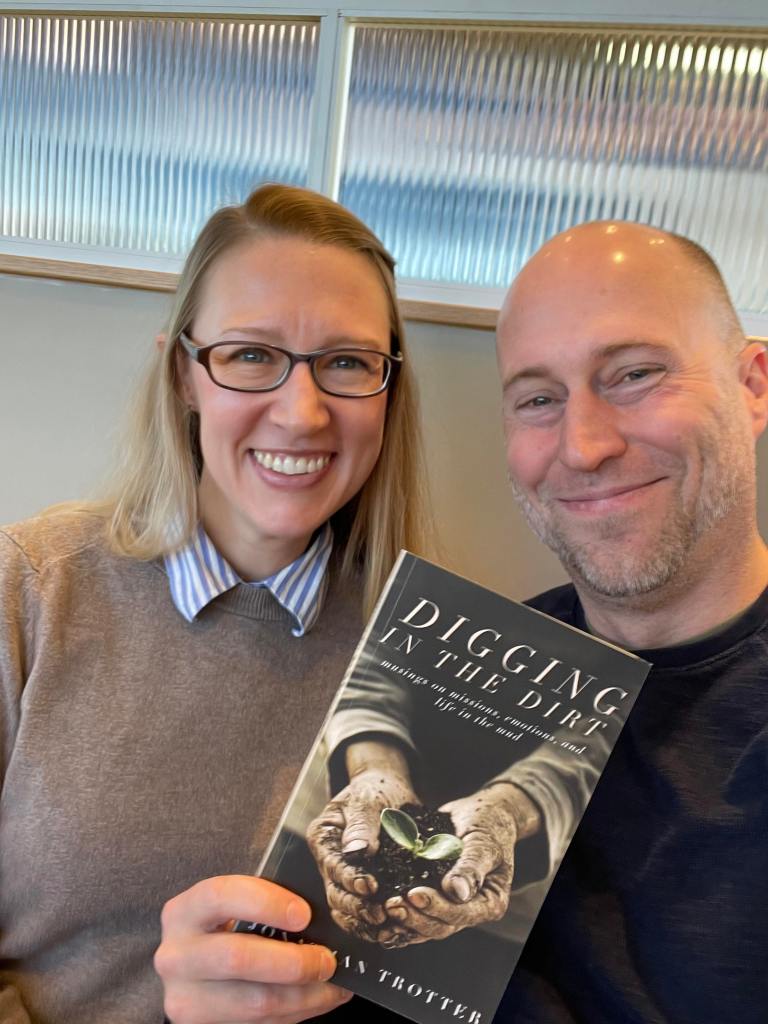
BOOK LAUNCH! Digging in the Dirt is here!

Buy it here!

From the back cover:

Welcome to ground level, to the dirt and the mess.

We like the mountain tops and the sunshine. We like green grass under a clear blue sky. We like victory and breakthrough and answered prayers. But sometimes it rains, the shadows deepen, and life turns muddy. Sometimes God seems quiet. What then? What happens when depression descends, or anxiety hangs like a sword overhead? What happens when loneliness suffocates, the thief steals more than stuff, and you get blood on your shoes?

In Digging in the Dirt, Jonathan Trotter delves into the disasters, the darkness, and the deluge, and he offers comfort, presence, and a gentle invitation to hope.

With humor and prose, with poetry and Top Ten lists, Jonathan welcomes us to the dirt, to the places where we actually live. He invites us to boldly see life as it is, with eyes wide open, and reminds us that even when the digging is scary, we are never alone.

To the ones who are dealing with devastation and distress, welcome. To the ones who need to uproot, to pull out, to clear ground, welcome. To the ones who seek desperately to plant seeds of grace and hope in once barren soil, welcome. To the missionary abroad and the believer at home, welcome. Receive the invitation, and join with Jonathan here at ground level, together.

Come, dig in the dirt.

From the preface:

Hello and Welcome!

I’m Jonathan, and it’s such a pleasure to meet you. I look forward to journeying with you through these pages. Together, we’ll delve into the dirt of life and relationships, of sorrows, pain, and loss. And maybe we’ll plant some things too.

Perhaps, along the way, we’ll see small, green stalks of life and hope begin to poke through, watered with the tears of the journey. Digging like this can be messy, but it can be good too.

These musings will meander from the hot dirt of Cambodia to the sticky mud of American politics. Some of these musings are inspired by international missionary life; some of them are firmly rooted in an American context. But whether you’re American or not, whether you’re a missionary or not, I hope that you find them all a blessing, an encouragement, and perhaps sometimes a challenge. I wrote them for you, and I share them with you with my whole heart.

Start reading Digging in the Dirt wherever you’d like, and feel free to skip ahead or go backwards. Are you a cross-cultural missionary? Start there if you want. Are you interested in developing emotional intelligence, or are you exploring whether or not Christians are allowed to have feelings? Consider starting in the Emotions section. Are you reeling from recent life events that have left you feeling like you’re choking on the mud and muck? First of all, I’m so sorry. Second, breathe a slow, deep breath, look over the Table of Contents, and start wherever you need to start.

Wherever you are, and whatever your story, welcome to ground level, to the dirt. It is here that the real work happens; the good, hard, sweet, healing work. It is my deepest hope that here, among these musings, you may find grace, peace, and a hope that just might be strong enough to crack through the crust.

All for ONE,

Jonathan Trotter

What people are saying about Digging in the Dirt:

A genuine book where no topic is off limits, Digging in the Dirt hits you right where you are regardless of location or vocation. This book is a must-read for anyone who is or is thinking about serving in missions and ministry! – DeAnna Anderson, former Director of the Launch Team for Wycliffe Bible Translators and missionary

Digging in the Dirt is a breath of fresh air for Christians. – Kim H.

Jonathan has such an authentic insight into life on the field, and he addresses the hard things in such a real and tangible way that helps you to know you are not alone. I would totally recommend this book for anyone who is serving overseas, sending someone overseas, or remotely interested in mission life. – Sydney, PI Leader for Southeast Asia

Rarely does an author bring the perspective of a missionary, nurse, theologian, pilot, counselor, parent, and gardener to cross-cultural ministry, family dynamics, depression, grief, politics, and the church, all in one book. Even rarer is a book that combines all of those things in a way that rings authentic and meaningful. Digging in the Dirt manages to do both, bringing thought-provoking and heartfelt lessons out of an incredible range of real-life experiences. – Reuben James

Digging in the Dirt is a must-read for anyone in missions or ministry. It’s refreshingly humble and vulnerable, and no matter what stage of life and ministry you’re in, you’ll walk away with some wisdom and new insight. – B.W., Stateside missions support worker

__________________________________________

Check it out on Amazon here!

*Amazon affiliate links

Politics, Plumeria, and the Kingdom of Heaven

“I miss Ima,” my daughter tells me. “I miss her singing, and I miss her flowers.”

Ima was one of the best worship leaders I’ve ever known, and I’m so glad our paths crossed at an international church in Phnom Penh, Cambodia.

Originally from the islands of Fiji, Ima always led worship with a tropical flower in her hair. Usually, she chose a frangipani (plumeria), the bright yellow satiny flower that smells like the most luscious citrus dessert and is the mainstay of Hawaiian leis.

Cambodia has a tropical climate and wonderful people, but even so, the country has suffered much as a result of war, genocide, and corruption. Cambodia is not a tropical paradise, but the church is growing, and Ima is helping.

With her global team she led our global church. Typically, she shared the stage with a Filipino on keys, a Pakistani on percussion, an Australian on guitar, and a Malaysian on drums. Together, they helped lead a rag tag group of Jesus followers from over 30 nations in worship. They helped us declare, week after week, the hope of the cross and the certainty of God.

Our church was full of missionaries and businesspeople, those involved in anti-human trafficking work, and those serving in the relief and development sector. Many of us came to church on Sundays tired, exhausted, and poured out. We traveled by motos and tuk tuks, buses and cars, to be reminded of our Hope. We came to drink of Life, and we came to declare the death and resurrection of our Lord, until he comes again.

I hadn’t grown up in a church like this. I hadn’t grown up in a church with pastors from China, New Zealand, the Philippines, India, Canada, Cambodia, and the United States.

I thought the church was primarily American.

I mean, I didn’t really think that; it’s just that growing up in the Midwest in a standard evangelical church, the church just was pretty American. And Caucasian too. Our authors were American, our musicians were American, everyone was American.

Typically, the only non-American folks I ever came across were the ones we were sending missionaries to. We were the ones sending the gospel, and they were the ones receiving it.

As believers in America we’re taught, often accidentally, that to be a Christian is to be American, or at least to look like it. Even if not purposeful or intentionally racist, the trickle-down effect of this theology is dangerous and thieving, denying us connection to the breadth and depth of the global church.

But here was Ima, a Fijian woman, singing the gospel with power. She was pouring her heart out in prayer, and she was ushering a global community into the throne room of God. The Kenyan sister was dancing, the Samoan brother was singing, and the Australian guy was jumping up and down with a huge smile.

The global church was so much more beautiful and diverse than I had ever known. Christ’s people had come from all over the place, they were going all over the place, and they were worshiping.

I love the American church. But I’m afraid that somewhere in our history, we began to believe that we Americans held the keys to the Kingdom. We would never say it like that, but we sometimes act like that.

So long ago, our spiritual forefathers rightly declared that Rome was not the central hub of global Christianity. But I’m afraid we’ve drifted into our own hubris and begun to believe that the American church is the hub, the main gospel force in the world. It is not.

That vision is too small. That church is too claustrophobic.

I want to be brothers with the Swiss guy who runs a climbing gym in Cambodia. I want to serve alongside a Chinese businessman who converted himself (as far as that is possible) by picking up a Bible someone left behind in a hotel room in Nepal.

I want to rejoice with the Pakistani couple who opened their hearts and kitchen to us, telling stories of the faithfulness of God and how they escaped to safety. The unique flavor of homecooked samosas will always remind us of our friends’ faith and our Father’s faithfulness.

I want to honor the Japanese man providing care and education to disabled Cambodians. I want to join in with Cambodian pastors who continue to teach God’s word to God’s people in difficult times and challenging places.

Christ is the King, and his church is global.

We must remember: the church existed before America.

We must remember: the church will endure long after America.

We must remember: the church is older than Western civilization.

The church is global, and she is not dying.

And while the church is global, the gospel always gets worked out locally. That’s the beauty of it. The church can be local precisely because it’s so stunningly global. The church is big enough to be local everywhere.

As citizens of America, we should celebrate and honor and cherish the church in the United States. She remains beloved and part of the Bride. But as citizens of the Kingdom, we should celebrate and cherish and love the global Church too, wherever she may be found.

A Fijian worship leader with a flower in her hair helped me learn that.

When I finally get home and meet Jesus face to face, I will not be surprised at all if he bellows out the Fijian greeting: “BULA!” which means, “Life to you!” I hope to hear him say on that day, “Welcome home, my son. Here is the life you’ve been searching for! Well done.”

And then I will wander.

I will find a frangipani tree. I will inhale its cheerful citrus fragrance, I will smile, and I will look out on the nations that God has brought together, and I will declare, “This looks familiar; look at what the Lord has done!”

And then I will find Ima, and I will thank her for what she gave our church and what she gave my daughter. I will thank her for what she gave me. With her uniquely Fijian flair and a frangipani flower in her hair, week after week, she led God’s people to paradise.

Is the primary danger “out there”?

by Jonathan Trotter

Note: this post was inspired by this article by David French.

As a homeschooled-in-the-80s kid, I’m well versed in the terrified cry, “The danger is out there! The danger is out there!” I can remember watching The Village and feeling like M. Night Shyamalan had just made a film about my life. (My parents didn’t yell this too loudly, but we were Gothardites.)

But is the primary threat “out there”? No. It is not.

Over the past couple of years, I’ve received a fraction of the pushback that David French has, but still, I resonated deeply with this:

“I get an enormous amount of criticism for not critiquing the secular left more than I do. Yet if I’m concerned for the health of the church, then corruption at the highest levels of the world’s largest Christian university, sexual predation by arguably Christianity’s most influential apologist, widespread conspiracy theories, and disproportionate disregard for the health and well-being of neighbors do more harm than the worst of Joe Biden’s culture war regulations or the most radical developments in the sexual revolution.”

The whole article is excellent, but here are a few more quotes worth pondering:

“If your reaction is that the greatest threat to human souls or to the church itself comes from without—from the external forces attacking Christianity or from the cultural temptations buffeting our children—then that dictates a very different posture to the world and approach to politics than if you believe the true threats lie within.”

A different posture indeed.

I have seen this fear, this alarm:

“If you believe the most dangerous threats come from without, fear can rise in your heart. As you lose political and cultural power, and you see others shape the environment in which you live, then you start to have genuine alarm that other people are destroying the souls of those you love. What a terrifying idea.”

There is hope, of course.

At the end of the day, the Church remains his, and he still loves her. He still calls her to remember her first love. I want to still love her too. I want to build more than I tear down. I want to heed with every fiber of my being Jesus’ call: “Your business is life, not death. Follow me. Pursue life.” (Matthew 8:22)

I want to love more than I fear.

I haven’t always done this, for sure. But I want to. I want to know Jesus more. I’m a few chapters in to Dane Ortlund’s new book, Gentle and Lowly, and it’s helping. It’s not about The Chosen, but it’s explaining, in theological terms, why the Jesus portrayed in The Chosen is so fascinating and healing and loving. He’s helping me understand why I cry every.single.episode.

Turns out, it’s because the stories are real. Ortlund writes, “Jesus is not trigger-happy. Not harsh, reactionary, easily exasperated. He is the most understanding person in the universe. The posture most natural to him is not a pointed finger but open arms.” He goes on to say that Jesus’ “deepest impulse, his most natural instinct, is to move toward” sin and suffering, not away from it.

Jesus is really like that.

And that is Good News indeed.

*Contains Amazon affiliate link.

Paul vs. Peter | Galatians 2 | a Podcast

This message was recorded at ICF-Phnom Penh, March 2020: Paul vs. Peter

This message looks at Galatians 2:11-21 and should be available as a podcast on iTunes in a day or two. Or you can listen to it here:


Thanks so much for stopping by!

all for ONE,
Jonathan T.

mercy