On Needing God

In the years since moving back to America, I’ve sometimes found myself getting caught up in the way “the world” works. After a lifetime of proudly being different from my peers and going against the flow because “any dead fish can swim downstream”—and making a string of countercultural decisions like getting married early, giving up an engineering career for motherhood and ministry, even saying farewell to friends and family to live and serve overseas—I suddenly found myself surrounded by American culture.

And I started absorbing it like the water one swims in.

There’s the pressure to work hard to make enough money because you can never have enough money and you always need more. There’s the pressure to look beautiful all the time—and in fact I’ve never felt uglier than after moving back to America. There’s the pull of easy entertainment and the never-ending scrolling and streaming, which is where most of our excess time goes.

Somehow I started believing that life is all about accomplishment and achievement and working hard and looking good because the economy is so bad and what makes you successful and important is working hard and earning it all by yourself. You gotta pull yourself up by your own bootstraps, right?

But then I would feel like such a failure because I’m not accomplished, at least not in the world’s eyes—even though I’ve always worked very hard at the vocations God has given me. I started wondering what was wrong with me. Why can’t I do all these things on my own the way people (er, Americans) are supposed to and even appear to be able to do? Because when I looked around, I saw people who were genuinely successful and who didn’t appear to need God or faith in any way.

But the truth is that I do need God. I always have. I need His strength to do the things He’s asked of me. I need His power to fulfill the callings He’s placed upon my life. As Americans we may have grown up with this ideal of rugged individualism, but I can’t in any way see that it’s biblical. God’s original design was always to have us depend on Him and on others. It’s the way He made the world, but then the world made up its own rules and told us we have to live by them.

We don’t. Anyone I’ve ever talked to who’s been walking by faith a long time will say you need God, that there’s no way to do life over the long haul without God. This is simply not something you will hear in the world. The world says you can do it on your own and you do not need God. Nor do you need the church or other people—especially those pesky, hypocritical Christian people.

Except that’s not actually the way God architected the universe. He designed it for us to need Him and depend on Him, and He didn’t design it for us to just accomplish things by our own selves, through our own worthiness. He intended for us to look to the interest of others because of His example, because of His Holy Spirit empowerment. And to need others to look to our interests too.

Sometimes I am so desperately needy for God that I forget others are too. The truth is, we all are. It’s totally acceptable to live like the needy creatures we are, to live countercultural to the world, because the way the world is designed is not the way God designed it to be. Needing God isn’t a failure in abiding by the world’s rules; it’s actually exactly what is supposed to happen.

We need people too. God never intended for us to be alone. We see that from the very beginning in Genesis 2, and we see it all throughout the New Covenant as well. We need the community of Christ to be carried through this life. Sometimes I am carried, sometimes you are carried, but we all do the carrying, and we all take our turns being carried — sometimes even at the same time.

This is the beauty of the body of Christ.

For more reflections on life as a woman of faith, read The Hats We Wear.
Distracted by Birds

It was just a sparrow. A tiny little bird hopping up and down on the sidewalk outside the coffee shop that day. Why couldn’t I pull my eyes away from it? Why do I love the way it hops so much? (Truth be told, I get distracted by cute little hopping birds a lot now that I’m in my 40s.)

Later it was someone using sign language during a worship service. I couldn’t tear my attention away from that either — how beautiful to use your entire body to worship God.

It’s not lost on me that Jesus cares for us even more tenderly than He cares for these sparrows. Or that the whole point of life is to become living sacrifices, worshiping God with our bodies.

Sometimes I’ll be walking the neighborhood and find myself mesmerized by the broad-winged hawk that nests near our home. The way it soars, the way it rises on the wind, the way it doesn’t have to flap too hard to ride the skies. I can’t stop looking at it either. It’s not lost on me that God renews our strength like eagles — birds of prey like that hawk that soars above my house.

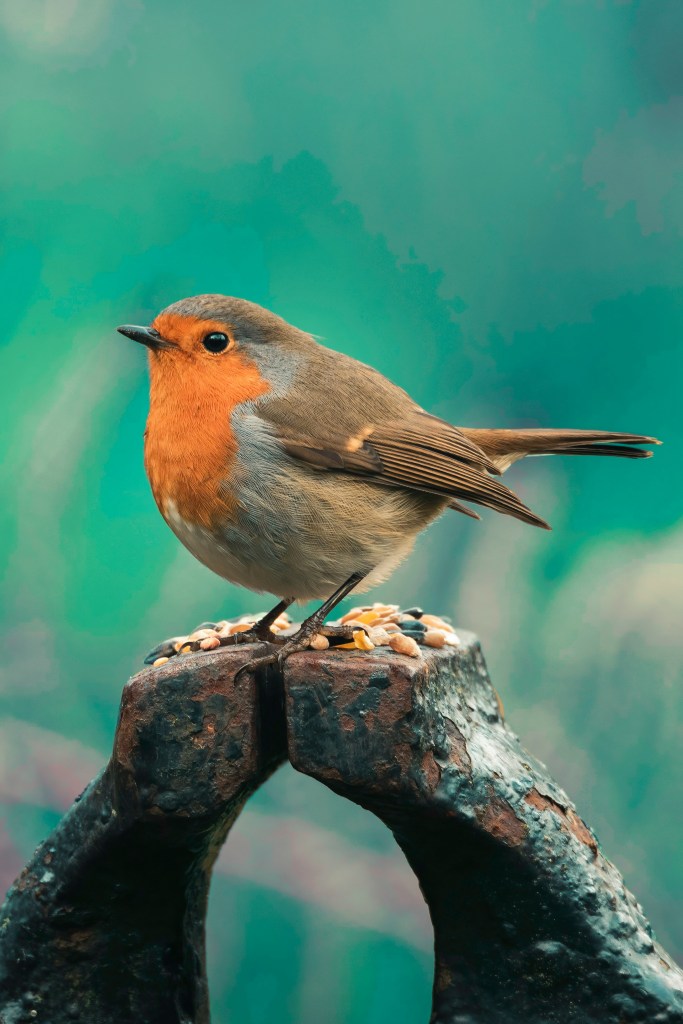
And then there’s the way robins run. They always make me smile.

It wasn’t always like this. It wasn’t always birds. Historically speaking, I’ve always been enthralled by the sight of the moon. I’ve even been known to lose my focus to a particularly striking moon while driving. And I’m delighted by young babies, those soft squishy little people. It’s hard to engage with an adult if a baby is in the room.

Several years ago it was fractals that beckoned me. I couldn’t stop studying them, thinking about them, talking about them, drawing and redrawing them. Fractals are shapes that repeat themselves on both the large scale and small scale.

In math they’re things like the Sierpinski triangle and the Mandelbroit set, Koch snowflakes and Pythagoras trees. In nature they’re things like clouds, trees, snowflakes, and shorelines that have the same repeating structure from far away and up close. (Fun fact: Humans didn’t begin exploring the mathematics of fractals until at least the late 1800s.)

Interestingly, we now know that the human mind is calmed by fractals. It’s part of why nature walks are so healing, so soothing. Our modern lives are so Euclidean, so basic, all these clean lines and corners.

But God’s good creation is fractal in nature — or even hyperbolic, another form of non-Euclidean geometry that shows up in undersea creatures like corals and sea slugs and that also used to captivate me (but whose math humans didn’t discover until the mid 1800s).

What am I really saying here, in obsessing over the math and science of nature? In the end the point isn’t the math and science — fascinating and fun as it is. The point is that beauty is out there. In the good world God made. So gaze upon it. Smile upon it. Let it calm your spirit and your heart and your breath.

God may have made your brain to delight in different things than me. If so, the question to ask is what things? And once you know what God made you to love, delight in it. Don’t ignore it or pass it by. Perhaps you will pause over the simple beauty of a sunset or the painted majesty of pink and grey clouds. Perhaps you will consider the birds and let them charm your heart, enrapture your soul.

Whatever loveliness draws you in, remember that God made you to be distracted by beauty. Let yourself be.

For more reflections on the walk of faith,
read The Hats We Wear.

A Liturgy for the One Who Knows Where They’re Going But Doesn’t Know the Way There


God,
I long to follow close behind You,
but I often see dully as through a glass.
I cannot envision what I am meant to be in You,
though I catch glimpses from time to time.

Paul told us to imitate him as he imitated Christ,
and You have set examples among Your people
of what it means to be a living sacrifice,
of what it means to be beloved in Christ.

So make me like Mrs. C.,
who believes in the power of prayer
because it set her free and made her new,
who, like You, does not show favoritism
and believes healing from the Holy Spirit is for everyone,
who has a testimony to tell of Your great power
and won’t stop praying till it comes on earth.

And make me like Father T.,
whose deep knowledge of Your love for him over a lifetime
has settled in his breath and in his bones so deeply that
when he walks into a room, everything changes.
Shoulders relax, souls breathe easier, and
people start to grasp that maybe, just maybe, they really are
as loved as You say we are.

But most of all, God, make me like me,
the me I am meant to be,
the one you dreamed of when you knit me together in the dark.
May I become my true self in You
as You become ever more enfleshed in me.

If it takes a lifetime to become a living sacrifice, 
take my life and daily pour it out.
And if it takes a lifetime to become the beloved one,
take my heart and teach me your incomparable, transcendent love.

I am willing to wait.

(Scriptural inspiration: Psalm 63, Romans 12:1; 1 Corinthians 11:1; 1 Corinthians 13:12; Ephesians 3:14-20; Philippians 2:17)

A Prayer for My Amygdala Today (a somatic practice)

Lord,
You know my amygdala—
my emotional danger detector, 
my fear sensor,
my fight-or-flight first responder—
is overactive.

Perhaps this happened naturally,
and I was just born with it.
Perhaps it happened over time
as difficult life experiences accumulated.
More likely it is
some mysterious blending of both.

But I believe You made me moldable, malleable, neuroplastic.
I believe I have the capacity to change through the power of the Spirit.
I believe I can be transformed by the renewing of my mind.
I have seen it happen so many times in my life.

So today
I pray the peace of Christ
over my amygdala.
[place fingers on temples/ears, approximately parallel to amygdala]

Father,
Wrap my limbic system
in the all-surpassing love of Christ.
[wrap fingers around thumbs to simulate God’s love wrapping around the emotional midbrain]

Holy Spirit,
Give me a new heart
and a new mind.
[open hands to God as a symbol of opening heart and mind to His power]

Amen.

//

With gratitude to Dr. Dan Siegel for his hand model of the brain and to the prayer minister at our church, who taught us the power of laying hands on places that need healing, whether in our own bodies or others’ (with permission of course).

Scriptural inspiration: Ezekiel 36:26; Romans 12:1-2; 1 Corinthians 2:16; Ephesians 3:14-20; 2 Timothy 1:7

Road Tripping Through Life

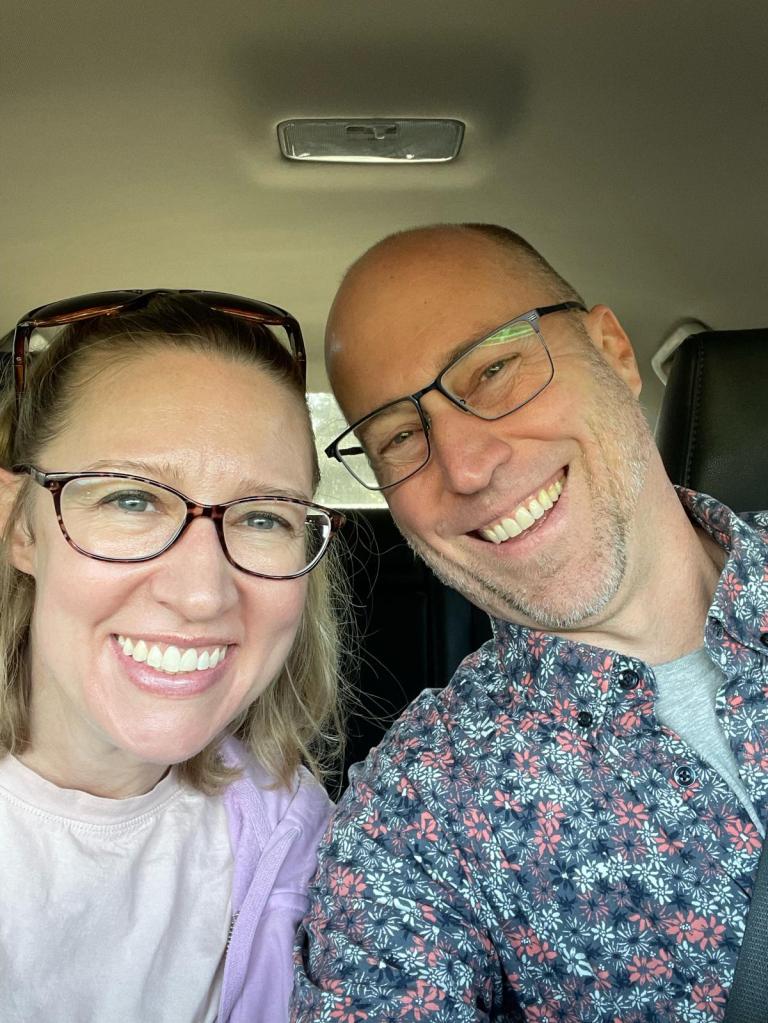
This guy. He leads us so well.

No one else sees the hidden work he does. I do. The way he fixes tech problems at church events, at weddings and funerals. The way he guides people through the process of healing. I may never know the personal stories of his clients, but I get to hear the prayers, theology, practical tools, and existential philosophy behind his counseling approach. 

He’s the one who remains calm when the house is in chaos and somehow brings that calm to everyone else. The one who serves in the background when nobody knows. But I know. I see the sacrifice, the secret labor, the invisible support.

He’s the one with the crazy ideas, and for twenty-six years I’ve been happy to be the armor bearer of the Trotter family (in the mold of 1 Samuel 14). The truth about us is that he has leadership skills I don’t have. He’s farsighted, farseeing, blessed with long vision. I might miss the forest for the trees sometimes, but once I catch that vision, I have implementation skills. And let’s face it, a leader isn’t a leader unless someone else is following. 

I’ve said yes to a lot of crazy ideas not everyone would say yes to, and we’ve made it work. Together. Because he’s never once done something without me or my full support — and because he believes I’m his equal partner, à la 1 Peter 3:7.

We’re getting closer to the empty nest years, close enough that we can almost taste what it’s going to be like. This picture is of a recent road trip without kids. It reminded me of weekends with him when we were younger. We would literally spend the entire weekend together, walking, talking, eating pizza (back when I could eat gluten — oh the days), watching movies. Sharing our hearts. There’s something about spending long periods of time together that unlocks something in both of us, and we can go to the deeper levels of our souls with each other.

These days we try to spend as much time together as possible, but it wasn’t always easy the past few years. In the middle of launching our kids my brain and nervous system was so confused. I couldn’t see it at the time; I can only see it looking back. At the time all I could see was my former life—a life I had loved and poured my whole self into—disappearing. I couldn’t grasp what was next, and what had been was slipping away. 

That middle period was incredibly discombobulating, and sadly I wasn’t the best partner to the oldest friend I have. I’d been so singularly focused while our children were growing up that I couldn’t see past that stage. I didn’t want to “grow old together” because that meant losing this precious part of family life, this defining part of myself.

But this guy. He waited.

He waited for my brain to settle and my hormones to normalize. He waited till the girl he fell in love with came back to him. This most recent road trip didn’t feel like we were entering a new phase. It felt more like returning to the early days of our marriage, to the way this family got started. In a curious mirror of our early years, this life still holds the hope of future babies — though this time they won’t be ours. 

So, my dear Jonathan, I want to grow old with you. Who knows? In the end it might be more like growing young with you, just with more aches and pains. But wherever you go, I’m going too.

For more reflections on marriage and motherhood, read my book, The Hats We Wear.