What is my job, and what is God’s job?

What is my job, and what is God’s job? I’ve asked this question a lot in my life. The balance of grace and works has often befuddled me. If God gets the glory for everything — and we know He should — then do I have responsibility at all? 

I confess I have sometimes felt frozen in place, not knowing what I was supposed to do about a particular struggle, because I thought that somehow God was supposed to do everything. He fights our battles for us, right?? 

This question came up again last fall when I was in the middle of a mental health crisis. Was I just supposed to sit alone in my prayer closet, begging the Lord to deliver me from my anxiety and depression? Or was I supposed to do something about it? And if so, what?

I slowly realized that I did need to do something. And oh how many things can be done about depression and anxiety! It can feel overwhelming to a perfectionist like me. It feels like I need to do all the lifestyle treatments both perfectly and often enough while also depending entirely on God to save me.

I had forgotten that all the things that can be done to help myself are actually invitations from God to participate in my own healing. I’d been in that place before and even written about it, but we humans are such forgetful beings, aren’t we?

Interestingly, I first gained clarity on this question while talking with my therapist about my editing business — because I battle the faith-works tension regarding my job too. I often rely on a belief my hairstylist first expressed to me: “God brings me the clients I need.” Her example of faith was an inspiration to me, and her statement has proven true in my life over and over again.

But do I play any part in this?

My therapist said I do. It’s my job to do a good job, to bring all my dedication and skills to each project. It’s also my job to promote my services online (even though it feels awkward). “God can’t do those things,” she said. “Only you can.” God has given me a body and put me on this earth, and there are certain things only I can do. 

In her book Field Notes for the Wilderness, Sarah Bessey writes about the miracle of the feeding of the 5,000. The miracle didn’t just happen because Jesus multiplied the bread and fish. It happened because someone offered something small, which Jesus used, and because the disciples participated and handed out the food. The people wouldn’t have eaten without them passing out the food. 

I’ve always loved the feeding of the 5,000, and I’ve always connected it to a child’s act of faith. I had never connected it to the attending and waiting skills of the disciples. The disciples wouldn’t have seen the miracle if they’d clustered around Jesus. Only in moving out from the center did they witness the miracle. 

And so it is with us: Jesus invites us to participate in the healing He performs. The power isn’t ours, but we won’t see the goodness of God unless we take part. The man whose friends lowered his paralyzed body through the roof still had to pick up his mat and walk, after all. And in some mysterious, incomprehensible truth, we only partake of the miracle God is waiting to give us when we join Him in His work.
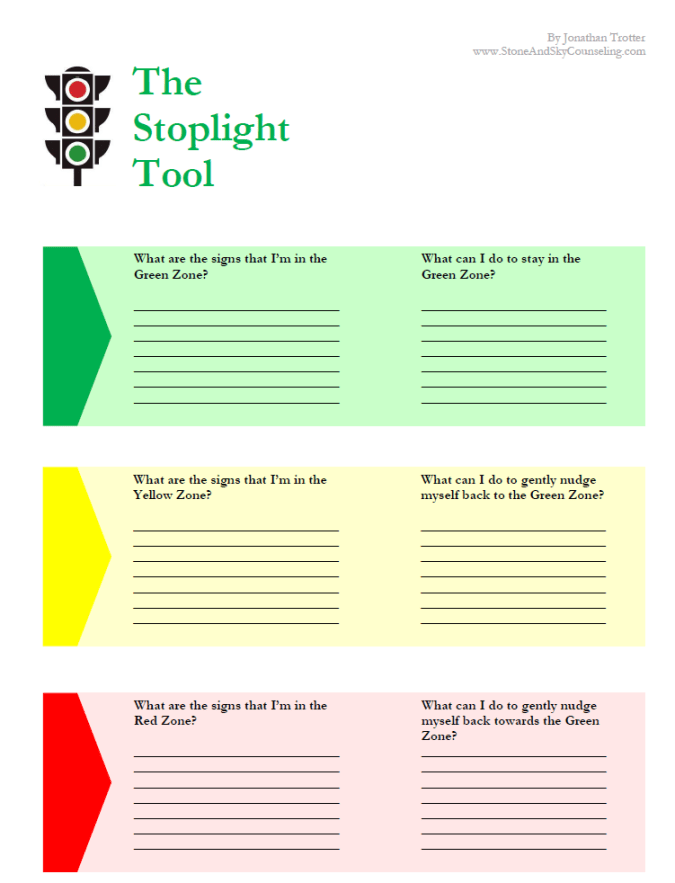
The Stoplight Tool

The idea is pretty simple. First, think about the signs that show that you are doing well in that area. How do you know you’re in the green? What does your friend or partner see when you’re in this color? And then, what are the things that help you to STAY in that color? Keep doing those things.

What are signs that you’re in yellow? What starts to happen when you’re trending in a direction you don’t want to go? The idea is to notice these things earlier than maybe you have in the past. And then, what are some things you might want to think about doing (or stop doing) that would help nudge you back to green?

And then the last one. What are the signs that things are really running hot? That you’re really struggling or not doing well? What are some things that maybe you don’t normally do, but that you might really want to do (or stop doing) that would get you moving back toward the healthy green?

It’s not rocket science, but when we’re really struggling with something, we don’t need rocket science. We need simple. We need straightforward. We need pre-planned.

Filling this out gives you a cheat sheet when you need it. When you’re trending towards red, you’re probably also forgetting all the helpful things. But if you’ve written them down, if you’ve shared them with a friend, partner, or ally, then you can look back, remember, and then maybe implement.

Hope that’s helpful out there, y’all! Take care, and happy Thursday!

Jonathan T.

__________________________________________

I’ve been using these concepts for a few years now, but I finally got around to creating a handout/worksheet for The Stoplight Tool. I’ve used this with folks dealing with OCD, depression, anxiety, and even adult ADHD. If you’d like to use this in your practice or ministry, would you consider purchasing the PDF for $2.99 here? Drop your email address in the comments when paying and I’ll send you the file. Thanks!

My Sex Life Died on the Field {Velvet Ashes}

This week I’m at Velvet Ashes. The title kind of says it all, I guess. It’s a brand new story I’ve never told. But if you’ve been following my journey the past few years, I think this post will weave together a lot of the strands of things I *have* written about: anxiety, depression, dance, PMS, being underweight, etc.

As scary as it is to talk about, Jonathan and I decided together that it was time to start being more open about this difficult season in our life and to maybe, just maybe, be able to offer hope to others in dark seasons of their own.

I don’t know where you are today, but wherever that is, I hope that you will be as gentle with your own story as you are with mine. And if healing is what you need today, what I want you to know is that God wants to walk with you into healing, whatever that journey might look like for you.

Grace and peace, Elizabeth

Episode 3: Anxiety and OCD

In this episode, Jonathan and Elizabeth discuss their experiences with anxiety and OCD, what helped, what didn’t, and why there’s hope.

Listen in via iTunes, Stitcher, or below.

Capture

Listen to Episode 3 here or below:


Resources mentioned in this episode:

Brainlock, by Schwartz

Loving Someone With Anxiety, by Thieda

The Dialectical Behavior Therapy Skills Workbook

The Anxiety Cure, by Hart

Change Your Brain, Change Your Life, by Amen

What to do When Your Brain Get’s Stuck; a Kids Guide to Overcoming OCD

It’s Not All in Your Head

For a list of counseling centers that serve cross-cultural workers, visit the Resource page on A Life Overseas.

For more from Elizabeth for Velvet Ashes, on fear.