Taking Out the Trash {a toolkit for fighting fear}

Here are some practical ways to fight fear that I’ve never shared publicly before. I talked about them during this year’s Velvet Ashes online retreat and wanted to post them here in the hopes that someone out there might find them helpful in their battle against fear. I’ve reprinted all the quotes and Bible verses for easy reference, or you can simply scroll to the bottom for the video testimony. ~Elizabeth

garbage-can-1111449_960_720a

I used to take my pulse to make sure I was still alive. Because the ability to breathe and move my fingers to my neck weren’t evidence enough of life?? Thankfully by the time I realized why I did that and could verbalize it, I could see the humor in it.

And it was mostly health reasons that made me not want to come to the field in the first place. I’m a recovering hypochondriac [read: I’m still a hypochondriac, but it’s not out of control anymore].

Living here still plays tricks on my mind sometimes, and I have to consciously choose not to follow the rabbit trail my fears are digging. But I’ve got more practice at it now, and someone to keep me accountable (my husband), so it doesn’t take over my daily life the way it used to.

My go-to passage on fighting fear was always Matthew 6:25-34. I even committed it to memory 13 years ago when I was pregnant with my firstborn and finances were uber-tight, and I’ve returned to these words of Jesus again and again throughout the years:

That is why I tell you not to worry about everyday life—whether you have enough food and drink, or enough clothes to wear. Isn’t life more than food, and your body more than clothing? Look at the birds. They don’t plant or harvest or store food in barns, for your heavenly Father feeds them. And aren’t you far more valuable to him than they are? Can all your worries add a single moment to your life?

And why worry about your clothing? Look at the lilies of the field and how they grow. They don’t work or make their clothing, yet Solomon in all his glory was not dressed as beautifully as they are. And if God cares so wonderfully for wildflowers that are here today and thrown into the fire tomorrow, he will certainly care for you. Why do you have so little faith?

So don’t worry about these things, saying, ‘What will we eat? What will we drink? What will we wear?’ These things dominate the thoughts of unbelievers, but your heavenly Father already knows all your needs. Seek the Kingdom of God above all else, and live righteously, and he will give you everything you need.

So don’t worry about tomorrow, for tomorrow will bring its own worries. Today’s trouble is enough for today.

But what really helped me several years ago was reading a book designed to help kids with OCD. It’s called What To Do When Your Brain Gets Stuck, and it teaches kids (or in this case, me) to identify “brain junk,” which is basically the thought patterns we have that are false and hurtful and don’t belong in our mind. After we identify the brain junk (the lies, the fears, the negative self-talk), we can throw it away, literally discarding it from our lives.

For me, following the advice in the OCD book has been a working out of the truths of Hebrews 5:14, which says the mature have trained themselves to distinguish good from evil, and Titus 2:11-12, which talks about the grace of God that teaches us to say “no.”

I had to practice distinguishing the good from the evil (or unhelpful) thought patterns. But I recognize that it is the grace of God that helps me to say no to those irrational thought patterns. And it all came about from a children’s book on OCD.

Another thing that helped tremendously was a section in a book that Cindy Morgan wrote, Barefoot on Barbed Wire, which was all about fighting fear. I “randomly” picked it up at the library when I was pregnant with my 3rd child (when the fears were the most out of control they’d ever been).

“Fear can have so many faces. We can never really escape from the things that cause us to be afraid. For everyone we secure ourselves against, there will be another waiting to take its place. The world is not under our control. So it all comes down to learning to trust God.”

Her book and this quote in particular really convicted me that fighting fear wasn’t about addressing my specific fears and trying to talk myself down from them and over-researching on the internet and reminding myself of the science.

No, my fear was actually something broken inside me. It didn’t come from risk factors on the outside. It came from within. The OCD strategies helped enormously in fighting my fear on a practical level, but I also needed this heart-level truth as well.

I talk about these things (and more) in my 10-minute testimony for Commune, Velvet Ashes’ 2016 online retreat, which is re-published here with permission. If you missed the retreat earlier this spring, Velvet Ashes plans to make the entire thing available again sometime in the future. And if you’ve been blessed through the ministry of Velvet Ashes, consider donating to them here

The Screeching Voice of Lack and the Bounty of Jesus

by Elizabeth

orange-tree-1149584_960_720

I’ve been stumbling around for weeks now, gathering my identity from the things other people might say about me. I’ve been scooping it up from my deepest fears of failure, harvesting it from my ripening field of inadequacies. But you know the thing is, I know better than this. I know better than to do this; yet I did it anyway. I listened to the voice of darkness, that screeching voice of lack inside my own head, and I flagrantly disregarded the bounty of Jesus and the abundance of His love.

I didn’t know where to begin again. I knew I’d misplaced my identity, but I was scared to approach God with my missteps of belief and doubt. How could I lose that precious gift of identity in Christ, after searching so long and so hard to find it before?? But one day last week I finally worked up the courage to ask God what He thinks of me. Sincerely expecting a reply, I ventured a quiet and tentative, “God, who do you say I am?” And Jesus, mysterious Son of Man that He is, simply and immediately asked back, “Who do you say I AM?”

“Who do YOU say I AM???”

Not an answer did the Promised One provide; merely, like so many instances in the Gospels, another question. Who do I say Jesus is?? Because maybe that’s where I went wrong, forgetting who Jesus is. Because maybe I don’t have to ask so many questions about myself, if I know the answer to the question about Jesus. And maybe I don’t have to get lost in my own dark, dangerous head, if I can get lost in the majesty and glory of the Creator, of the Redeemer, of the Comforter, of the Trinity.

Don’t get me wrong: it’s a legitimate question to ask “Who does God say I am?” But now I know it’s just as legitimate to be asked by Him — as Jesus asked Peter and the other disciples — “Who do you say I AM?” Because maybe, just maybe, that’s the question that can transfer my focus from Self onto Savior. And maybe, just maybe, the moment I answer that question is the moment the clouds will start to lift.

Turns out, the way up out of the pit isn’t to believe in myself better, it’s to believe in Someone Better. For as Peter answered, I believe Jesus is the Christ, the son of the living God, and HIS identity alone is what holds sway over the clinging darkness.

Linking up with Velvet Ashes

A Letter for the One Who’s Waiting {Velvet Ashes}

by Elizabeth

waiting-shortcuts-detour-726x484

You in the waiting,
Yes, you
And yes, me too —
For we are all waiting for something —
Dear sister,
Beloved one,
You in the waiting,
This much I know:
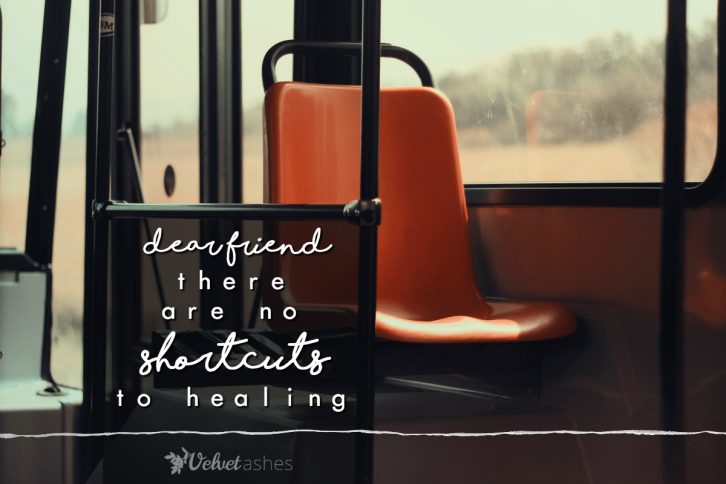
There are no shortcuts to healing.
There are no shortcuts to wholeness.
For we can’t know God as Healer without first being wounded.
And we can’t know God as guide without first being lost.
We can’t know Him as counselor without first being confused.
And we can’t know Him as comforter without first sustaining pain.
We can’t know Him as intimate companion without first feeling abandoned.
And we can’t find our identity in Christ alone without first losing it elsewhere.

You in the waiting,
Dear One,
This much I know:
There is no way around the ache of the human soul.
There is no detour through the pain.
When we walk through the valley —
And we will all walk through the valley —
None of us gets to skirt around the edges.
We are completely baptized in sorrow,
Fully immersed in its grief.
For there are no shortcuts to healing,
No shortcuts to joy.
There is only Jesus.
If anything, He is the short cut:
He is, after all, our Way home
Even if that way be long and broken.

So you in the waiting,
Keep waiting.
Keep seeking,
And keep asking,
Even in the silence —
For there may be silence —
And even in the darkness —
For there may be darkness —
But don’t you give up Hope.
Hold on to Hope.
Hold on to the name of our Jesus.
This waiting, it takes time.
It takes space.
And, I wish I didn’t have to say this, but —
It takes hard work too:
The hard work of shedding the lies we believe about God,
The hard work of shedding the lies we believe about ourselves,
The hard work of being honest with Him about the injuries,
And the hard, Spirit-assisted work of letting go of our entangling sins.

So you in the waiting,
Yes you —
And yes, me too —
For we are all waiting for something —
Dearest sister,
Beloved One,
You in the waiting,
This much I know:
There are no shortcuts to healing,
But in Jesus there is healing.
And there are no shortcuts to wholeness,
But in Jesus there is wholeness.
So we hold on to Him,
We hold on to Hope,
And together, we wait.

Originally published here, reprinted with permission.

7 Tips for Stayers and Goers

by Elizabeth

7-tips-stayers-goers-726x484

As a military kid I grew up hearing about these things called “Hail and Farewells.” I didn’t really know what they were; I didn’t even know it was two separate words. I thought of it more as “hailenfarewell” and was at a complete loss as to what it was.

But as I began to contemplate this upcoming season of expatriate goodbyes, I couldn’t get the phrase out of my mind. So naturally I went to my mom and asked her to tell me everything she remembered about Hail and Farewells. Her answers blew me away with their spiritual applications.

Let’s have a look, shall we?

1. “Hail and Farewells were an integral part of military life. Whether we were stationed at a military installation or a university in the States, or were stationed abroad, we all took part in these monthly events.” Hellos and goodbyes happen at regular intervals, and they touch the entire community. Nobody gets to skip out on the goodbyes (or hellos), and nobody is immune to the transience – either the Leaver or the Stayer.

2. “It always involved food, whether it was at someone’s home and everyone brought food, or at a restaurant and we purchased our meal.” Ok, so we need food. It’s perhaps kind of obvious, but this answer stood out to me. As humans we celebrate—and mourn—with food.

3. “They were usually more dressy events, except those that were barbeques, etc. There was always a gift, usually a memento that represented your unit and also some kind of plaque that commemorated your time there.  Oftentimes others would gift you with items that spoke personally to the officer leaving.” Whether we’re leaving or whether we’re staying, we honor our friends with something special. Whether it’s a physical gift representing our relationship or our country of service (for the gift-givers among us), a special event (for the quality-timers among us), or something else, we don’t let them fade away without that special honor.

4. “The commanding officer would do the introductions of new people, and we would find out where they came from and a little about them and their family. Then the farewells were saved for last with the usual good things said about people. Those that worked closest with the departing officer would also have an opportunity to share about them.” We honor the newcomers by trying to find out a little about them. And we honor the Leavers by sharing our cherished memories about them.

5. “Something I always saw in the groups we were in was the total willingness to accept and ‘get behind’ a new commanding officer. Oftentimes the departing commander was beloved and the idea of someone else coming in and taking over could be hard in a way, but your dad and I and others were intentional about welcoming and following new commanders just as we followed the departing one.” This gets to the heart of welcoming new people, whether they’re in leadership over us or not. Being new is hard, and the least we can do is welcome new people even as we say a painful goodbye to beloved friends. Whether we’re the Leaver or the Stayer, no one can replace our friends, but our hearts can expand to love more people.

6. “We were usually notified about 6 months in advance of our new duty station, and something strange and wonderful always happened after we found out where and when. Usually it was met with, ‘Uh, okay,’ but that time in between notification and actually leaving, our minds turned it into something good that we were actually looking forward to, and we were very ready to leave.” If circumstances allow (and I know they don’t always allow), we plan time between the decision to leave and the actual leaving. That time gives us the space to say goodbye well to people and places, to mentally and physically prepare ourselves for the next step, and to physically and mentally prepare our friends and co-workers for our departure. We realize that nothing can completely prepare us for our next stage, but a little time to reflect and say goodbye is helpful.

7. “It was sad to say goodbye, but many times we figured we’d meet up again.” To a certain extent, expatriate life also allows us to meet up again. (And I’m always thankful when that happens!) But even if we never see each other again on earth, as Christians we know we will meet again in Heaven, and (at least for me) that reminder does cheer the aching heart.

 So to recap my mom’s advice:
  1.  We accept that hellos and goodbyes will happen regularly.
  2.  Sharing food is a good way to commemorate these hellos and goodbyes.
  3.  Whether we’re departing or staying, we need to honor our friendships at each goodbye.
  4.  We need to welcome new people into our lives too.
  5.  We accept that goodbyes are hard.
  6.  When possible, we need to make space and time for these goodbyes.
  7.  We remember we will meet again, whether on earth or in heaven.

This time of year is painful. I will not deny that. April and May are months of many tears for me. I’ve written about these heart-rending goodbyes before. Each year I feel the feelings afresh, and sometimes I fear they will break me. But I do want us, as the Body of Christ, to carry on in a way that honors both our earthly fellowship and our faith in a mysterious God. With that in mind I offer you my Expat Manifesto:

We acknowledge that we will always have Hail and Farewells. We will bid farewell to our people. We will honor them with our tears, with our laughter, with our food, with our stories, with our hugs, and with our time. And we will bid farewell to seasons, whether satisfying or sad. We will welcome new people. We will honor them with our open (though sometimes wounded) hearts and remember that they may one day be our old people. We will remember that in Christ goodbye is never forever, but only for a time. And with Christ as our Anchor, we will embrace each new season, whether dreaded or longed for. We will Hail, and we will Farewell: This is how we carry on.

What traditions do you have for Hailing and Farewelling?

How do you carry on?


(Originally published at Velvet Ashes and reprinted here with permission.)

Bleeding for Dust Like Us

by Elizabeth

the-story-of-jesus-726x484

I worked at a Christian summer camp when I was a teenager. We attended Hymn Sing every morning, and at the end of every Hymn Sing we wandered off to our Bible classes while singing these words from Fanny Crosby: “Tell me the story of Jesus, write on my heart every word. Tell me the story most precious, sweetest that ever was heard.”

I didn’t realize at the time just how central that prayer-song is to our Christian walk. For what is theology but the stories we tell ourselves about God? So we cry: Tell me the story of Jesus. Tell me the story of a God-become-flesh, a God-who-dwells-among. Tell me the story of a God who sacrifices of self, who pours out His life-blood for dust like us.

Tell me the story of a God who sets captives free and makes blind people see. Tell me the story that never gets old or grows stale. Tell me the story that revives my weary soul, the story that brings new life to all. Tell me the same story I’ve been hearing for thirty years, the same story people have been telling for two thousand years: Tell me the story of Jesus.

I love this story. Truly I do. It doesn’t matter how many times I hear the story, I can’t get enough of it. And it never gets old. But. Sometimes I forget. And sometimes I need a reminder. Last month my reminder came in the form of C.S. Lewis’s children’s novel The Lion, the Witch, and the Wardrobe. For when I read it with my children, I read words like these:

“Please – Aslan,” said Lucy, “can anything be done to save Edmund?”
“All shall be done,” said Aslan, “but it may be harder than you think.”

As I spoke those words out loud, I remembered the greatest Story ever told: the enormity of Jesus’ sacrifice, the enormity of my need for that sacrifice, the enormity of Jesus’ love for all of humanity. Believe me, I needed the reminder.

Glennon Melton has said that “Grace cannot be personal if it is not universal.” If grace is for me, then it’s for you. And if it’s for you, then it’s also for me. This is a truth about grace that I sometimes forget. Sometimes I need reminding of the personal, and sometimes I need reminding of the universal. Last month I needed reminding of both, and I found them both in the pages of an ageless children’s story.

This week the global Church is preparing for Easter. We’re on a collective journey toward the Cross and toward the Resurrection that follows. As we journey, let us remember the truths immortalized in the Apostles’ Creed. They are the core, the crux, the fundamentals of our faith. They are the words we must remember when we begin to forget. And they are the words I leave you with today.

I believe in God, the Father Almighty,
creator of heaven and earth.
I believe in Jesus Christ, his only Son, our Lord,
who was conceived by the Holy Spirit,
born of the Virgin Mary,
suffered under Pontius Pilate,
was crucified, died, and was buried;
he descended to the dead.
On the third day he rose again;
he ascended into heaven,
he is seated at the right hand of the Father,
and he will come to judge the living and the dead.
I believe in the Holy Spirit,
the holy catholic Church,
the communion of saints,
the forgiveness of sins,
the resurrection of the body,
and the life everlasting.
Amen.

~~~~~~~~~~~~~~~~~~~~~~~~~~~~~~~~

When you forget the Story, what helps you remember??

(Originally published at Velvet Ashes.)