unamerican?

by Jonathan

Is it un-American to critique parts of our heritage and certain elements of our country’s founding?

Is it un-Patriotic to peacefully protest against perceived deficits in our application of justice (and mercy)?

Or are those things de facto BAD, evidence that you hate America and everything she stands for?

Was it un-Hebrew for the prophets of old to call out religious rot among their own people?

Was Paul a traitor when he shined a light on the wide open gates that led into the Kingdom?

Was Christ un-Christlike when he forcefully admonished churches for forgetting their first love, for sliding into comfortable, pleasurable idolatry?

I’ve been wrestling for a while now with this dissonance: American Christians, with a rich Scriptural record that’s so full of self-assessment, of national critique, of an obvious willingness to hold national (and ecclesial) leaders up to judgment, seem at times the most allergic to the same. Why is that?

Democracy needs healthy debate, to be sure. But what I see over and over is the inability to hold any critique for any length of time without devolving to name-calling, crap-slinging, contempt, which is not love.

But what if we loved?What if we disagreed vehemently with grace? What would that even look like?

Is it possible for someone to critique the church with love? Or will the church crucify them?

Is it possible for someone to critique the Republicans with love? Or will the Right destroy them?Is it possible for someone to critique the Democrats with love? Or will the Left annihilate them?

The Gospel is counter-cultural in every culture. I learned that during our eight years in Cambodia. I’m learning it still.

If you’re a follower of Jesus, would you join me in inviting Christ to reveal to us the parts of our ethnic, religious, and national culture, that are good and wonderful and Christlike? And would you consider inviting Christ to reveal to us the parts that are not so good, and in fact are maybe evil?

Let us love one another.

I Was Stuck in the Past. Counseling Couldn’t Help Me.

by Elizabeth

Re-entry is messy. So messy, in fact, that much of what transpired in my life in the last year did not end up here on the blog. I was in emotional and situational chaos, and I had absolutely zero mental margin to publish – or even process – what was happening to me.

I think that’s as it should be. Not every difficult thing that happened in Cambodia was meant for public consumption either. And I’m not sure the value of platforming topics when they’re as raw as they were this last year and a half.

But I can tell you that in the middle of this mess of mine, I was meeting with a counselor. I’ve been raving about the benefits of counseling ever since 2006 when I first met with a Christian counselor. Over the years I’ve met with counselors off and on, whenever issues in my life popped up and kept me from functioning (the most recent being in early 2019 when my life was so rudely interrupted by anxiety and OCD). So, over the past year during our tumultuous repatriation, I thought I was doing the right thing by talking to a counselor.

Except I wasn’t getting anywhere.

On some level, I knew I wasn’t getting anywhere. Processing the past wasn’t helping me to accept my present circumstances the way it had helped me before, and it wasn’t helping me to move forward in life either. It seemed like nothing was helping. But the only construct I had for getting better (or “bettering,” as my friend Amy Young likes to call it) was Christian counseling, so I kept at it.

In February, fueled by a historic midwestern snow and ice storm, my spirits hit an all-time low. I knew I needed more help than I was currently getting, so I reached out to someone for debriefing. She’d been highly recommended to me by others. Meeting with her was helpful, and after a few sessions, I thought I was stable enough to make it to our formal week-long debrief in August.

I was much more forward-facing by that time, and even my debriefer noticed it. I still had questions about how in the world I was going to thrive in America, but she assured me that the week-long debriefing would help me move forward – and that if I still needed help figuring out the future after the big debrief, I should come and see her again. (I’ve been told that one of the purposes of “debriefing” is to move the past into the past so that you can walk forward into the future.)

Soon after I debriefed with her, my agency suggested Christian coaching as a way to get “unstuck” and move forward in life. It sounded intriguing. I’d never done coaching before, and in fact, I’d never been drawn to the idea. I’d always figured that when my emotions were a mess, I needed a treatment that addressed the emotions. But since counseling wasn’t currently working, I thought I could at least try the coaching.

I’m glad I did. Coaching is the reason I started writing again (I have several more blog posts in the works). It’s the reason I finally created a webpage for my freelance editing. It’s the reason I started working on a few other background projects. It’s the reason I started dreaming about the future again and the reason I’m living in the present instead of the past. I just didn’t have enough motivation for any of these things before coaching.

During the sessions my coach asks a lot of targeted questions, and I really have to think through my problems and the possible solutions to those problems. It’s hard work, and it’s practical (though come to think of it, the last time I sought counseling in Cambodia, my sessions were highly practical, immediately applicable, and pulled me out of my head, where I’d been stuck for the previous six months).

It’s also comforting not to have to figure out the past, at least for now. Perhaps I was trying too hard to process my past. Perhaps I needed to stop looking in the rearview mirror. Perhaps I needed to, along with Paul, forget what is behind and strain towards what is ahead. Don’t get me wrong. I’m still a huge proponent of counseling. It’s helped me so much in the past. It’s just that in my particular circumstances this year, I’m beginning to think I needed something else.

I’m not done with the coaching process, so I’m sure I have a lot more learning and growing to do. For instance, I’m still figuring out how to live in the tension of unsolved problems. I can, however, attest to its efficacy in moving me out of a very stuck place. I’m curious if any of you have ever been helped by either coaching or counseling — or some other avenue — and which life circumstances were particularly suited for the varying helping professions.

We Went to Church

by Elizabeth

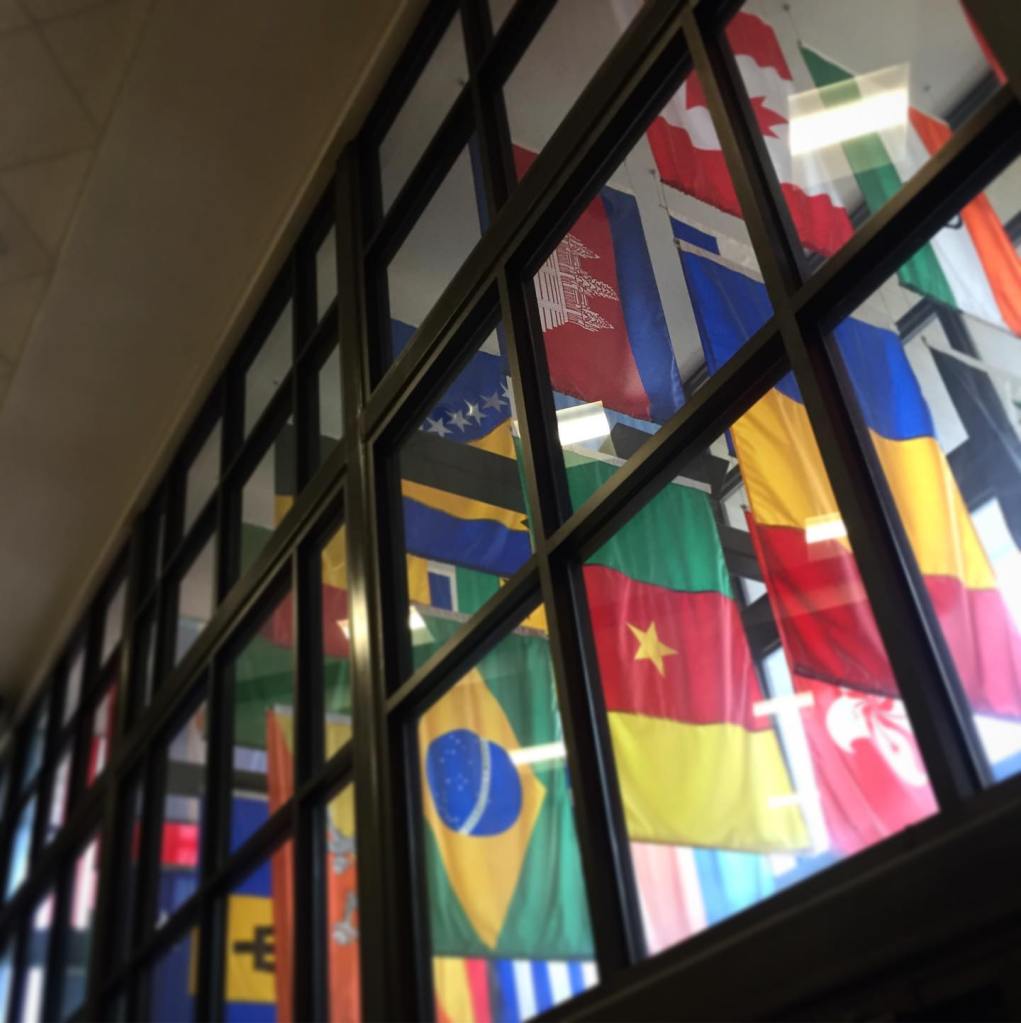
Jonathan knew the first time he walked through those doors. When he saw flags from all around the world hanging up in the foyer – including the Cambodian flag — he knew he’d come home.

I wasn’t so sure. In theory, I knew this church could be a good fit for us. But I didn’t really want to be here. I didn’t want to be at an American church. My heart was still back home in Cambodia, worshipping with people from 40 nations.

At that point we’d been out of church for over a year, waiting out this interminably long covid season. We’d had our vaccines, but our children hadn’t yet had theirs. We brought them to church once and then decided to leave them at home until they could achieve full vaccination status right along with us.

But it feels strange not to attend church as a family, so over the next few months we were in and out of services. It was just as well, though, because I had a lot of unfinished emotional and spiritual business to take care of.

Just last night I was telling the kids about Jeremiah 29. Not the overused verses 11 through 13 promising only good things to the Lord’s people, but the less familiar ones from just a bit earlier, in verses 5 through 7. The ones about building houses and settling down, the ones about planting gardens and eating what they produce, the ones about seeking the peace and prosperity of the city into which we have been carried.

I told my family I was ready to follow the instructions in Jeremiah 29, that I felt like I finally was following them. We’d settled into a house and made it a home. We’d planted gardens and even eaten a bit of what they’d produced. It was time to seek the peace and prosperity of the city.

This morning we walked all over the church campus, dropping children off at their various Sunday school classes. We found one for ourselves, too — one recommended by a friend. And as I sat there listening to the teacher talk about his heart for God and his heart for the world and about some of his church background and about some of the authors he’s read, I closed my eyes to blink back the tears.

I knew I had come Home.

It was the same feeling I’d had the first Sunday I walked into our international church in Cambodia and cried through the whole service. I knew I’d come home that day, and today I experienced the feeling again.

Mysteriously, both today’s Bible class and today’s sermon touched on Jeremiah 29, the earlier verses. They were written to a people in exile, a people separated from the land they’d been given. Missionaries often feel like exiles. We leave our passport countries to sail into the unknown. We don’t quite fit in our host countries, but we no longer fit in our first homes either. In time we settle into our secondary homes, but we must one day leave those too. In some way or another, we always feel like exiles.

You don’t have to be a missionary to feel like an exile, of course. We are all exiles in Babylon. None of us really belongs here, no matter which city each of us lives in. We belong to a different country, a better country. But sometimes when we’re with other citizens of that country, we can get a taste of home. This morning reminded me that I don’t have to be with citizens of a couple dozen earthly countries to feel like I’ve come home – although it was wonderful to live that reality for eight years.

All I have to do is find citizens of the Other country to which we all belong.

Introducing Stories Set Free

by Elizabeth

I am so excited to announce my freelance editing business! It’s called Stories Set Free, and you can read about it here. I’ve been editing in the background for a while now, and Jonathan has been encouraging me to set up a page on our website. I finally took his advice and set it up.

As a chemical engineering major in college, I never thought I’d discover a passion for either writing or editing. I never knew I could get such a thrill from helping other people publish their best work. That’s something our eight years in Cambodia showed me. (You can read more details on the About page.)

If you or someone you know is writing a book and is in need of an editor, or if you or someone you know is wanting editorial feedback on articles and essays, I’d love to be considered. You can contact me personally or simply forward my new webpage or contact information to people.

To read what a few of my clients have to say about Stories Set Free, click here.

And Then Our Cat Died

by Elizabeth

I’m not even sure how to write about this. Four months ago we bought a cat for our children. He was a beautiful stray who had been rescued by the Humane Society, and we fell in love with him. He was our little Lion King. He filled our yard with life and light. And we thought he’d be a part of our family for a long time.

But it wasn’t to be.

Gryff was a wanderer. He was constantly trying to get into other people’s houses. Sometimes he succeeded. He left us often, and most of the time he came back on his own. But nearly as frequently, we received calls from people as far as 3 streets away to come pick him up at their house.

Still, we were ridiculously in love with this cat. The kids liked to study outside with him. They liked to draw pictures of him. They liked to snuggle him. People often commented on how sweet of a cat he was.

He had started staying out at night and not coming back till the next morning. We were expecting this; he was supposed to be an outside cat. But then he didn’t come back, and we also didn’t receive a call from anyone. Eventually a neighbor stopped by to tell us what had happened — another neighbor had seen the accident and told her.

A car hit him on the road near our house. We weren’t at home when it happened. But when we found out, Jonathan went looking for the body and helped us bury him. We cried and even wailed over Gryff’s death. It was a deep pain and a deep loss. He was our first pet. We didn’t know how sad it would be to lose a pet.

Now we know.

A mom doesn’t want her kids to suffer, but she can’t stop the suffering. I wish my kids didn’t have to lose Cambodia. I wish they didn’t have to lose their cat. But as much as I wish to prevent them from experiencing pain, I have no power to do so. It’s one of the most difficult parts of being a parent. All I can do is walk through the pain with them.

So we held a funeral for him. We talked about the silly things he did. We talked about the annoying things he did. We talked about how much we loved him. We honored his place in our lives for just a short time. He helped us settle our hearts in America, and for that I will be forever grateful.

It’s been a week since we buried him, and there’s still an empty spot in our hearts. In the beginning we couldn’t bring ourselves to spend time in the yard without him. It was too sad and lonely. The first few days without him were especially rough. We watched with our own eyes as my husband shoveled dirt onto his body. Still, we kept expecting him to show up at the back door, begging for food. Other times we thought we could hear him meowing.

For days we couldn’t bring ourselves to clean up his water bowl and food bowl. I still haven’t put away the blanket he slept on. And at first I didn’t think I could ever buy my family another cat. I could not give my heart to another creature, only to lose it again so soon after. But after visiting some friends whose cats are just as loveable as ours was and learning how many cats they’ve lost over the years, I’m beginning to think I could possibly welcome another cat some day. But not yet.

So we are slowly adjusting to life without our beloved kitty. After all, there are still birds to feed and plants to water. God’s good, green earth still grows even in the midst of death. Through the pain — and maybe because of the pain — our hearts and souls grow along with it.