AI Doesn’t Scare Me Anymore

A year or two ago when I started hearing more about AI, my immediate reaction was fear. I’m anxious by nature, especially regarding technology, but this affected my livelihood. I feared I would lose my job to AI. No one was going to pay me to edit their work if a computer program could do it for them.

I thought to myself, These are the only skills I have! What am I going to do when I can’t get a job?! Fear about money and provision has plagued me much of my life.

As usual, I knew I was probably freaking out prematurely. I tried to quiet my amygdala and just keep going. I tried pretending like vocational Armageddon wasn’t just around the corner.

I leaned on my go-to statements of faith for dealing with money fears. I’ve got the Lord’s prayer—”Give us this day our daily bread.” I’ve got manna in the desert—God brings us what we need now, not for the future, and we don’t stock up because it will spoil. I’ve got decades of testimonies of the Lord providing jobs or clients or supporters just when we need them.

But I didn’t seem to be able to trust God when new technology was involved. It seemed too human-controlled, as though artificial intelligence were somehow out of God’s control.

Fast forward to today, and AI is still forging ahead. I’m not sure anyone really knows where it’s heading, but honestly, I no longer care. I decided that I was going to use the talents God had given me for as long as they were useful. If He sent me clients, I would serve them. If He gave me projects, I would tackle them. And if He gave me ideas, I would write them.

Now I think that not only will my profession (writing, editing, book coaching) survive, but that the main future for creativity is in faith-based writing and art. Faith-based writers aren’t looking for a shortcut. They’re looking for the Holy Spirit, and so are their readers. 

They want to tell a true story about what God has done in their lives. They want to pass the peace of Christ to their readers. They want to tell stories of meaning and hope and purpose, and they want it to be their own personal words, based on their own experiences and their own inner life with God. 

AI can never do that for them.

AI might be able to write news and business and economics and current events (albeit poorly at this point). But it can never tell of the transformation God has wrought in your heart. It can never touch the heart of God because it wasn’t made in the image of God. Only humans were made to reflect God’s heart back to Him. A computer program — even a large, sophisticated one — can never do that. 

Part of the thrill of writing and even editing is participation with the Spirit. And part of the satisfaction in the creative process is the work God does in us when we wrestle with the words, with the stories, with the truths He wants us to tell. We honor God not only with our words, but by submitting to this process.

We draw near to God when we write and also when we hold space for other people’s writing. Somehow our words touch the Father’s heart. He is the Word, and we are His children after all. When we write, when we read other writers’ work, we walk on holy ground. And faithful Christian writers — and readers — still want to tread there.

To the Young Person Wondering How to Live Your Life

Dear young person wondering how to live your life,

Now is the time when you have energy and passion. So do the work. Pour out your heart. You won’t regret the castles you build in this phase of life.

Someday your energy will wane, and you’ll have children and mortgages and responsibilities — and all of that is good. But you can build something now that you’ll be proud of later. 

So work hard, in whatever you do, as working for the Lord.

And build your life on Jesus Christ. You’ll never regret laying that foundation. But don’t be afraid to question, to doubt, to seek God in your questions. He will meet you there, purify you, strengthen you.

I heard someone talking about the house they built, a metaphorical house that crumbled in midlife. They listed all the things that house was built on and then asked if it was any wonder the house fell down in the storm? It had been built on the wrong things — the inessential things.

And I thought to myself, Your house doesn’t have to crumble in the storm. Not if you build it on the essential one, Jesus. And allow Him to prune you of the inessentials as you go. 

I look back and am glad I built my life on faith and examined my beliefs and expectations as I went. That purity culture that my husband and I taught so earnestly in the early 2000s? By the 2010s, gone. Those American-centric assumptions? Pulled out of us by preparation for the field and life on the field itself. 

That works-based understanding of sanctification? Dross that was burned away by grief work (with the help of a Christian counselor) in the early 2000s. Beliefs about the equality of men and women in the church? Whittled away by the realities of marriage and life in an international church. Beliefs about how the Holy Spirit works? Slowly expanded as I learned to trust God more.

Now, in my 40s, I look back and am so glad I built my life on something that will last and that I let that Someone prune my belief system as I went. My faith is sturdier and calmer than it was before, but I started in the right place, with the right Person.

It’s not that I haven’t had faith struggles. I have. And that’s the point — we have to keep pressing in. It is through those struggles that faith is strengthened, if we surrender to the process.

The truest, most important thing about you is your soul. Neglect that, and you’ll lose yourself, lose touch with the person God created you to be and still calls you to be. Return to your first love, and you’ll return to yourself — even if you have to evaluate a few beliefs along the way.

When I struggled during re-entry, when I veered away from my foundation, my first love, I also strayed from my true self, my true nature.

Only when I returned to my first love did everything in my life click into place. And I was so glad that I had built that foundation so long ago. It was something sturdy to fall back on, to return to, to rebuild with. 

I’m so glad I committed Scripture to memory and planted hymns in my heart when I was young, when my mind was young and pliable. Truth embedded in the brain will not fail to bear fruit as the calendar years pile up. Your body may feel the wear and tear of more trips around the sun, but your spirit can keep growing stronger. 

So take your young energy and do something meaningful with it. Pour into your community, pour into others, give of yourself. And in the background quietly build your faith. Commit Scripture to memory when you’re young. Carve out time to talk to God. Practice listening to the Spirit. Spend your life on something worthwhile.

You’ll be so glad you did.

~~~~~~~

Don’t let the excitement of youth cause you to forget your Creator. Honor him in your youth before you grow old and say, “Life is not pleasant anymore.” Remember him before the light of the sun, moon, and stars is dim to your old eyes, and rain clouds continually darken your sky. Remember him before your legs—the guards of your house—start to tremble; and before your shoulders—the strong men—stoop. Remember him before your teeth—your few remaining servants—stop grinding; and before your eyes—the women looking through the windows—see dimly.

Remember him before the door to life’s opportunities is closed and the sound of work fades. Now you rise at the first chirping of the birds, but then all their sounds will grow faint.

Remember him before you become fearful of falling and worry about danger in the streets; before your hair turns white like an almond tree in bloom, and you drag along without energy like a dying grasshopper, and the caperberry no longer inspires sexual desire. Remember him before you near the grave, your everlasting home, when the mourners will weep at your funeral.

Yes, remember your Creator now while you are young, before the silver cord of life snaps and the golden bowl is broken. Don’t wait until the water jar is smashed at the spring and the pulley is broken at the well. For then the dust will return to the earth, and the spirit will return to God who gave it.

That’s the whole story. Here now is my final conclusion: Fear God and obey his commands, for this is everyone’s duty.

Ecclesiastes 12:1-7,13 NLT

Don’t Bury the Talent

A man going on a trip entrusted three servants with separate portions of his wealth, each according to their abilities. To one he gave five talents, to another he gave two talents, and to a third he gave one talent.
(Paraphrased from Matthew 25)

An enduring truth in my life has been that I have two talents, while my husband has five. God has given him gifts in many areas, and He has given me gifts in a few areas.* God has also given him more energy with which to grow his talents. I have always had less energy, though it’s especially pronounced in my forties.

But God gives us both the same task: to nurture the talents we have been given and to pour them out for others. To make my talents grow, I have to steward my energy well, which often looks like saying “no” when others with more energy talents might be able to say “yes.” Investing my God-given gifts means honoring my God-given limitations.

In biblical times a talent had enormous value. Some calculations indicate that a single talent was worth about seventy-five pounds of silver, while other sources say it was about twenty years of wages. We don’t know for sure, but we do know that a talent was worth a lot.

And so it is with us today. Each talent that God gives a person is valuable. Gifts aren’t worth more or less in the kingdom — though God may appear to give some of us more than He gives others. 

Not that I’m accusing God of giving me too little or my husband too much. The differences between us don’t usually bother me anymore. I know the God who made me and in whose image I was created. I know the One who knit me together in my mother’s womb just the way He intended. And I know He’s given me talents that He calls me to use in encouraging others and bringing Him glory. 

Still, I have fewer talents than some, and far less energy than many. My talents aren’t very flexible; if I’m pulled too far in one direction or simply in too many directions at once, I don’t stretch. I don’t bend or spring back. I just crack. In my forties I am brittle.

Sometimes I wonder why God made me with such limitations, which have always been present but which are exacerbated in midlife. But when I get alone with God and quiet my soul, I find I know the answer to this question. God has given me limitations so that I will depend on Him. So that all the glory He gets from the talents He has given me? I’ll know He’s the source of it all — the gifts and the talents and the time and the energy and even the discernment to steward them well.

Accepting the reality of our limitations is key to investing our talents in the economy of the kingdom. The servant with the single talent didn’t really understand his own fear or the heart of his master. He didn’t understand that the master wanted him to do something, even if that something was small or yielded only small growth. And he didn’t understand that his fear was keeping him from doing the small things he could do.

As a lower-energy person, I must be careful not to slide into the mindset of that lone servant, burying my talents in the fear of being completely poured out. I have to imitate the mindset of the servant with two talents, content with what I’ve been given and determined to make it count. To do this, I have to depend on God for my every morning, my every afternoon, my every evening. It’s the only way I’ve found to actually spend the gifts I’ve been given.

Because I’ve tried in times past to live my life apart from God. I’ve rejected dependence on God, resentful that I need Him so much, jealous of those in the world who seem to live just fine apart from Him, able to accomplish and achieve without dependance on a holy God. But I’m apparently incapable of that. I have cut myself off from the life-giving vine before, and everything in my life withers and dies.

How thankful I am that God offers His Spirit to help navigate the difficulties of life. How thankful I am that He gives of Himself to guide us through valleys and mountains and plains. How thankful I am that He doesn’t leave us alone to figure out how to invest our talents. He will show us, every second of every day if that’s what we need.

So you’ll find me honoring God by saying “no” to lots of good things so that I can do the things He’s actually calling me to. You’ll find me honoring God by monitoring my energy and listening to my body and to my emotions. You’ll find me honoring God by asking Him for help every morning and thanking Him when He gives it — as a good Father delights to do.

*The situation as I see it, not as my husband sees it.

Individual and Couples Counseling Now Available in the Joplin/Webb City Area!

Hello there, and thanks for stopping by!

I’m so excited to offer individual and couples counseling in Southwest Missouri! If you’re interested in setting up a session, please visit Stone and Sky Counseling or see my listing on Psychology Today. Three-day individual and couples counseling intensives are also available.

Background
Since 2014, I have had the privilege of walking alongside hundreds of couples and individuals in dozens of countries. As a pastoral counselor, empathetic coach, Nationally Certified Counselor (NCC), and Provisionally Licensed Professional Counselor (PLPC), I have experience journeying with people through issues such as grief and loss, life transitions, anxiety, ADHD, depression, trauma, OCD, abuse (spiritual, sexual, physical, emotional), debriefing, Autism, ministry burnout, addictions, and more. With all clients, I take a person-centered, trauma-informed, experiential approach.

Before moving to Cambodia in 2012, I worked bi-vocationally as an ER/trauma nurse and youth and worship pastor. I am also a licensed attorney in California and hold a master’s in clinical mental health counseling from Colorado Christian University. As a PLPC, I am supervised by Dr. Karl Wendt, LPC #001808.

For Pastors and Ministry Folks
My wife and I have been involved in local church ministry, in one form or another, since 2000. Before moving abroad, I was a youth and worship minister for about ten years. From 2012 to 2020, my family and I lived as cross-cultural missionaries in Phnom Penh Cambodia and I served the community as a pastor at an international church and as a pastoral counselor at a local counseling center, working with folks from over thirty nations.

I’ve led trainings, seminars, or coaching sessions in China, Thailand, the Czech Republic, Italy, Kyrgyzstan, Cambodia, Laos, the US, England, and Myanmar.

For Marriages
With couples, I utilize an attachment-based, emotionally-focused approach. I also greatly appreciate the evidence-based tools and resources from Dr. John Gottman. Since 2014, I’ve had the privilege of meeting with several hundred couples who were trying to overcome unhealthy patterns in their relationship, boost communication, improve their sex life, prepare for married life, and more. I am trained to administer the Prepare/Enrich relationship assessment. See the “Roadmap” I often use with couples here.

For Medical Professionals and First Responders:
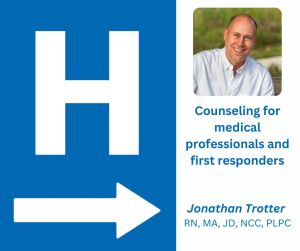
It is my privilege to offer specialized care for for medical professionals and first responders. If that’s you, keep reading.

If you’re looking for a counselor who understands what a Level 1 Trauma Center feels like during a full moon; if you’re looking for a therapist who’s assisted Kansas City police officers in subduing violent patients; if you want to visit with someone who knows the unique stressors and pressures of dealing with life and death situations during a normal Tuesday, keep reading!

With a background in ER/trauma nursing, law, ministry, and counseling, I now provide individual and couples counseling at Mount Hope Christian Counseling Center in Webb City.

Visit www.stoneandskycounseling.com for more information or to book an initial session.

Stone and Sky Counseling, LLC

with Jonathan Trotter, RN, MA, JD, NCC, PLPC

at Mount Hope Christian Counseling Center

2830 Mt. Hope Road, Webb City, MO 64870

(417) 624-9659 · jonathan@stoneandskycounseling.com

Sex, Missions, and Listening to God {book recommendations for you}

by Elizabeth

This spring I read three of the best books I’ve ever read. One in particular I couldn’t stop talking about for weeks – but it wasn’t the sex book! I had to start with that word, though, because I knew it would grab your attention. 

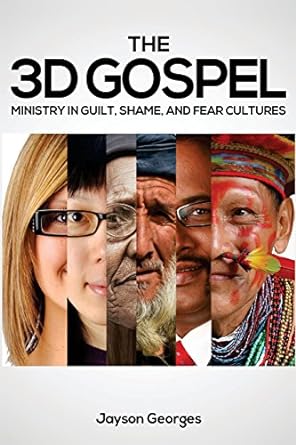
Up first, the best book on missions EVER: The 3D Gospel: Ministry in Guilt, Shame, and Fear Cultures by Jayson Georges.

When Christine Paterson of FieldPartner recommended the book and mentioned that it was only $3.99 on Kindle, I figured I’d give it a try. I intuitively knew that American culture held more than just a guilt/innocence worldview and that shame/honor and fear/power comes into our thinking as well, and I was eager to learn the specifics of each worldview.

What I didn’t expect was for the book to so thoroughly rewrite my understanding of culture. I underlined nearly the entire book. At only 80 pages in paperback, there’s no fluff here. Every word seems essential, and every sentence sheds light on world cultures and their differing assumptions and thinking processes. I began to understand shame/honor and fear/power cultures more fully, and I began to see how the Bible beautifully addresses all three cultural concerns (guilt, shame, and fear). 

Once my eyes were opened to this, I even began to see these three concerns addressed in most of our worship songs. In Western cultures we tend to tell the gospel story only through a guilt-innocence lens, and while that’s not wrong, it is incomplete. We look to God for help with our problems regarding fear and shame, but we don’t tend to bring these perspectives into our telling of the Gospel story, and this hinders our spiritual growth. 

Thankfully, we can offer people a more three-dimensional gospel, one that has the power to redeem their day-to-day struggles with fear and shame, whether in our passport culture or a host culture. God knows the human heart and has offered a solution for all our problems in Jesus Christ. 

This book made me fall in love with God all over again.

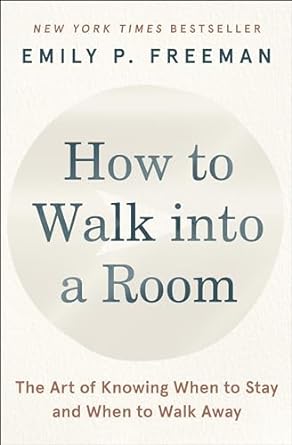
Next up, the best book I’ve read in a long time about listening to God: How to Walk into a Room: The Art of Knowing When to Stay and When to Walk Away by Emily P. Freeman

I remember resonating so deeply with Emily’s podcast episode, “How to Walk Out of a Room,” a couple years ago. The episode was mercifully devoid of details so that her principles could apply to all sorts of situations. When I heard she was writing a book based on that episode, I knew I would want to read it.

Emily is a spiritual director and has a master’s degree in spiritual formation, and she has a way of walking with people in discernment that is quiet and calm. She offers a “non-anxious presence,” as they say in spiritual direction circles. (Full disclosure: I’ve been meeting monthly with a spiritual director for about the past year, and it’s been a huge part of drawing my heart back into conversation with God after some dry, lonely years.)

I had a feeling this book would be important, and so I decided not to mark it up but to leave it empty and, in a way, sacred. Instead, I would rewrite meaningful sections in my journal. This helped slow me down and really savor Emily’s words. It helped me process the past, it helped me learn how to make better decisions, and it gave me peace in the decisions I was making. Then one day I looked around and realized I was making decisions much more easily than I had in the past, even small daily decisions, and I had to wonder if this book had something to do with it. 

The thing I love about this book – and that sets it apart from other books purporting to help people recover from restrictive religious environments and explore a more expansive relationship with Christ – is that Emily gives tangible steps people can take to process the past and discern their present and their future. To walk with Emily is to learn together how to listen to God.

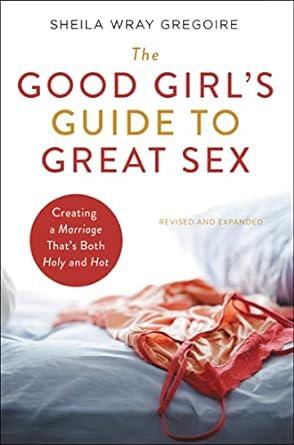
And lastly, one of the best books I’ve ever read about sex: The Good Girl’s Guide to Great Sex: Creating a Marriage That’s Both Holy and Hot by Sheila Wray Gregoire.

This is the book every woman needs to read before she gets married – or after, if things in the bedroom aren’t working, whether she got married a year ago or 30 years ago. Sheila co-wrote The Great Sex Rescue with two other authors, and it’s a great research-based book that helps people untangle their unhealthy and unbiblical beliefs about sex, but The Good Girl’s Guide really gets into practicalities. 

I heard it recommended by a Bible college professor who teaches classes about sexuality, and I wanted to check it out myself. There was an earlier version of the book, but just this year it was revised and expanded, so I read the revised version. This is the book I will give to my daughters when they are engaged or newly married. I still recommend Aanna Greer’s Darling: A Woman’s Guide to Godly Sexuality for those who are quite innocent or naive about sex and their bodies, but Sheila’s book is a necessary follow-up.

Sheila, along with her pediatrician husband, also wrote The Good Guy’s Guide to Great Sex: Because Good Guys Make the Best Lovers. I haven’t read that one, but I’m assuming it’s good because that same Bible college professor recommended it and because it’s from an author I trust.

I hope these books will help you or someone you love.