Sex, Missions, and Listening to God {book recommendations for you}

by Elizabeth

This spring I read three of the best books I’ve ever read. One in particular I couldn’t stop talking about for weeks – but it wasn’t the sex book! I had to start with that word, though, because I knew it would grab your attention. 

Up first, the best book on missions EVER: The 3D Gospel: Ministry in Guilt, Shame, and Fear Cultures by Jayson Georges.

When Christine Paterson of FieldPartner recommended the book and mentioned that it was only $3.99 on Kindle, I figured I’d give it a try. I intuitively knew that American culture held more than just a guilt/innocence worldview and that shame/honor and fear/power comes into our thinking as well, and I was eager to learn the specifics of each worldview.

What I didn’t expect was for the book to so thoroughly rewrite my understanding of culture. I underlined nearly the entire book. At only 80 pages in paperback, there’s no fluff here. Every word seems essential, and every sentence sheds light on world cultures and their differing assumptions and thinking processes. I began to understand shame/honor and fear/power cultures more fully, and I began to see how the Bible beautifully addresses all three cultural concerns (guilt, shame, and fear). 

Once my eyes were opened to this, I even began to see these three concerns addressed in most of our worship songs. In Western cultures we tend to tell the gospel story only through a guilt-innocence lens, and while that’s not wrong, it is incomplete. We look to God for help with our problems regarding fear and shame, but we don’t tend to bring these perspectives into our telling of the Gospel story, and this hinders our spiritual growth. 

Thankfully, we can offer people a more three-dimensional gospel, one that has the power to redeem their day-to-day struggles with fear and shame, whether in our passport culture or a host culture. God knows the human heart and has offered a solution for all our problems in Jesus Christ. 

This book made me fall in love with God all over again.

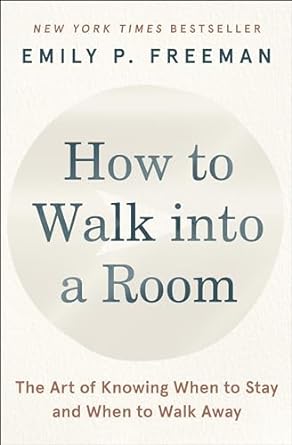
Next up, the best book I’ve read in a long time about listening to God: How to Walk into a Room: The Art of Knowing When to Stay and When to Walk Away by Emily P. Freeman

I remember resonating so deeply with Emily’s podcast episode, “How to Walk Out of a Room,” a couple years ago. The episode was mercifully devoid of details so that her principles could apply to all sorts of situations. When I heard she was writing a book based on that episode, I knew I would want to read it.

Emily is a spiritual director and has a master’s degree in spiritual formation, and she has a way of walking with people in discernment that is quiet and calm. She offers a “non-anxious presence,” as they say in spiritual direction circles. (Full disclosure: I’ve been meeting monthly with a spiritual director for about the past year, and it’s been a huge part of drawing my heart back into conversation with God after some dry, lonely years.)

I had a feeling this book would be important, and so I decided not to mark it up but to leave it empty and, in a way, sacred. Instead, I would rewrite meaningful sections in my journal. This helped slow me down and really savor Emily’s words. It helped me process the past, it helped me learn how to make better decisions, and it gave me peace in the decisions I was making. Then one day I looked around and realized I was making decisions much more easily than I had in the past, even small daily decisions, and I had to wonder if this book had something to do with it. 

The thing I love about this book – and that sets it apart from other books purporting to help people recover from restrictive religious environments and explore a more expansive relationship with Christ – is that Emily gives tangible steps people can take to process the past and discern their present and their future. To walk with Emily is to learn together how to listen to God.

And lastly, one of the best books I’ve ever read about sex: The Good Girl’s Guide to Great Sex: Creating a Marriage That’s Both Holy and Hot by Sheila Wray Gregoire.

This is the book every woman needs to read before she gets married – or after, if things in the bedroom aren’t working, whether she got married a year ago or 30 years ago. Sheila co-wrote The Great Sex Rescue with two other authors, and it’s a great research-based book that helps people untangle their unhealthy and unbiblical beliefs about sex, but The Good Girl’s Guide really gets into practicalities. 

I heard it recommended by a Bible college professor who teaches classes about sexuality, and I wanted to check it out myself. There was an earlier version of the book, but just this year it was revised and expanded, so I read the revised version. This is the book I will give to my daughters when they are engaged or newly married. I still recommend Aanna Greer’s Darling: A Woman’s Guide to Godly Sexuality for those who are quite innocent or naive about sex and their bodies, but Sheila’s book is a necessary follow-up.

Sheila, along with her pediatrician husband, also wrote The Good Guy’s Guide to Great Sex: Because Good Guys Make the Best Lovers. I haven’t read that one, but I’m assuming it’s good because that same Bible college professor recommended it and because it’s from an author I trust.

I hope these books will help you or someone you love.

Is the primary danger “out there”?

by Jonathan Trotter

Note: this post was inspired by this article by David French.

As a homeschooled-in-the-80s kid, I’m well versed in the terrified cry, “The danger is out there! The danger is out there!” I can remember watching The Village and feeling like M. Night Shyamalan had just made a film about my life. (My parents didn’t yell this too loudly, but we were Gothardites.)

But is the primary threat “out there”? No. It is not.

Over the past couple of years, I’ve received a fraction of the pushback that David French has, but still, I resonated deeply with this:

“I get an enormous amount of criticism for not critiquing the secular left more than I do. Yet if I’m concerned for the health of the church, then corruption at the highest levels of the world’s largest Christian university, sexual predation by arguably Christianity’s most influential apologist, widespread conspiracy theories, and disproportionate disregard for the health and well-being of neighbors do more harm than the worst of Joe Biden’s culture war regulations or the most radical developments in the sexual revolution.”

The whole article is excellent, but here are a few more quotes worth pondering:

“If your reaction is that the greatest threat to human souls or to the church itself comes from without—from the external forces attacking Christianity or from the cultural temptations buffeting our children—then that dictates a very different posture to the world and approach to politics than if you believe the true threats lie within.”

A different posture indeed.

I have seen this fear, this alarm:

“If you believe the most dangerous threats come from without, fear can rise in your heart. As you lose political and cultural power, and you see others shape the environment in which you live, then you start to have genuine alarm that other people are destroying the souls of those you love. What a terrifying idea.”

There is hope, of course.

At the end of the day, the Church remains his, and he still loves her. He still calls her to remember her first love. I want to still love her too. I want to build more than I tear down. I want to heed with every fiber of my being Jesus’ call: “Your business is life, not death. Follow me. Pursue life.” (Matthew 8:22)

I want to love more than I fear.

I haven’t always done this, for sure. But I want to. I want to know Jesus more. I’m a few chapters in to Dane Ortlund’s new book, Gentle and Lowly, and it’s helping. It’s not about The Chosen, but it’s explaining, in theological terms, why the Jesus portrayed in The Chosen is so fascinating and healing and loving. He’s helping me understand why I cry every.single.episode.

Turns out, it’s because the stories are real. Ortlund writes, “Jesus is not trigger-happy. Not harsh, reactionary, easily exasperated. He is the most understanding person in the universe. The posture most natural to him is not a pointed finger but open arms.” He goes on to say that Jesus’ “deepest impulse, his most natural instinct, is to move toward” sin and suffering, not away from it.

Jesus is really like that.

And that is Good News indeed.

*Contains Amazon affiliate link.

Would You Even Like Jesus?

by Jonathan

Would you even like Jesus?

Would you like him if he came into your church and started yelling about houses of prayer? Or would you call him just another angry man?

Would you like him if he told you to sell even some of your stuff and give the proceeds to the poor? Or would you call him a socialist?

Would you like him if he told you to stop sleeping with people you weren’t married to? Or would you call him a legalist?

What if you realized he wasn’t a Republican?

Or a Democrat?

Or white?

Would you like him if you found him crying by himself on a hillside, talking about a rebellious city? Or would you call him an emotional wreck?

I don’t know, would I even like him?

What about the time he let those guys chop up an innocent man’s roof?

Would you like it if he hadn’t planned ahead and all of a sudden asked you to feed a few thousand people?

What would you think when he dozed off during a life-threatening storm?

He is not as tame as we make him, after all.

Would you like him when he let the prostitute get a little too close? Or would you start to wonder about his dedication to purity?

Would you like him when he befriended your political enemy, visiting his house and sharing a meal? Or would that be a red (or blue) line crossed?

You see, we sanitize and sanctify Jesus, stripping him of context and personality, until he looks (we think) like us.

But he’s not like us. Thank God.

So, would you like him?

What if he showed up in your deepest pain and you saw his eyes, red with mercy and compassion? Would you like him then?

What if you heard him cry, “Forgive them!” And you knew he was talking about you? Would you like him then?

Would you run to him, grasping his sleeve for acceptance and love?

He’d let you.

He’d love you.

He’d heal you.

After all, he liked you first.

photo-1522774832635-430f6deecd28

He’s just a…

He’s just a carpenter. A blue-collared day laborer. And he’s the one who builds mountains and stars.

He’s just a carpenter. A townie, a long long ways from cosmopolitan. And he’s the King of kings.

But he’s just a carpenter, uneducated, the son of nobodies. And he’s the dearly loved son of the Father.

The crowds are blind, eyes filled to the brim with scoffing, incredulous. They can’t see beyond their own limiting words.

It is true. He is a carpenter. But he is not just a carpenter. He is so much more.

And by his grace, we are too.

We are not just sinners.
We are not just failures.
We are not just inadequate.

We are loved.
We are saved.
We are sought after and enjoyed by our God.

So when people see us and laugh, saying we’re “just a” whatever, we smile and nod and run to Jesus.

And there we sit among the wood chips, remnants of a Roman cross, and we belly laugh with the Carpenter who saved the world.

~~~~~~~~~~~~~~~~~~~~~~

Jesus left that part of the country and returned with his disciples to Nazareth, his hometown. The next Sabbath he began teaching in the synagogue, and many who heard him were amazed. They asked, “Where did he get all this wisdom and the power to perform such miracles?” Then they scoffed, “He’s just a carpenter, the son of Mary and the brother of James, Joseph, Judas, and Simon. And his sisters live right here among us.” They were deeply offended and refused to believe in him. 
Mark 6:1-3

andrej-lisakov-545642-unsplash

Avoiding Platitudes, Accepting Influence, and Loving Jesus (John 11:1-44)

Last Sunday I had the privilege of preaching at the ICF here in Phnom Penh, Cambodia.

To listen to the message, click here, or view on iTunes.

We looked at how Jesus allowed his emotions to be influenced (by a woman!), we talked about platitudes and why to NEVER use them, and we considered the different ways Jesus empathized with Mary and Martha.

He mirrored each woman and responded very uniquely, in fact.

We also talked about the one thing we must remember for this story to make sense: I am NOT the center of Christ’s universe. The Father is. Christ’s love for me is secondary and derivative. His primary goal is NOT to relieve my suffering or heal my disease.

So, although he loves, he sometimes “stays.”

— Jonathan T.


church-pews-2401405_960_720