
When fear strikes at night, here’s something you can do

by Elizabeth

photo-1470406385593-bb0110c681a9

I was talking with a friend recently when the subject of fear came up – specifically, nighttime fears. And all of a sudden I remembered the nameless, faceless fears of my early twenties. These were the fears that were irrational and nonspecific, feelings more than words. I didn’t always know what I was afraid of, I just knew I was afraid and couldn’t sleep.

Back then, all I knew to do was to sing the name of Jesus, over and over again, until I fell asleep. I had a few songs on repeat in my head. Later I would sing those same songs over my babies as I rocked them. This practice became so much a part of who I was that I didn’t consciously think about it as a weapon for fighting fear until I was in the middle of this recent conversation.

As we were talking, my friend said, “It’s like singing yourself a lullaby. We sing lullabies over our children, why wouldn’t we sing them over ourselves?” That was such a great description of the practice. So I’m going to share with you my lullabies. They’re calming to me but may not do anything for you. However, I think it’ll give you a starting point to find (or remember) your own evening songs.

The first and main song is one we used to sing in college with our friends. This version sounds fairly close to the way we used to sing together. I used to sing the “Jesus” chorus over and over to myself till I calmed down and fell asleep. There’s something so powerful about lifting your eyes up, away from your problems and even away from petitions for help, and focusing on the name of JESUS.

Here’s another one that helped me, though I can’t find any music for it anywhere. It was written by a lady in our Church of Christ circles who sang in a group called Free Indeed:

“Lord give me peace,
I’m feeling all alone,
calm my spirit,
still my mind,
fill my heart with peace.”

It had a really simple melody that I learned one Saturday morning from my youth minister’s wife. She used it when she needed peace and patience as a mama of young children; I used it at night when I couldn’t sleep.

And this last one might seem kind of strange, so bear with me. In middle school choir we sang a song set to words that had been scrawled on a cellar wall during WWII’s Holocaust:

“I believe in the sun even when it is not shining
And I believe in love even when there’s no one there
And I believe in God, even when He is silent
I believe through any trial, there is always a way

But sometimes in this suffering and hopeless despair
My heart cries for shelter, to know someone’s there
But a voice rises within me, saying ‘Hold on my child,
I’ll give you strength, I’ll give you hope. Just stay a little while.'”

The melody and the lyrics are both haunting, and the song has stayed with me all these years. It gives me comfort – though I’m not entirely sure why. Maybe it’s when I’m in the dark, alone and afraid, that I need its message most. And it represents the undaunted faith I want to pass on to my children.

I was only 12 when I first learned the song, so I couldn’t understand the full soul-depth of its cries, but I remember watching people in the audience weep as we performed it. Now I know why they were crying. They were living in – or had lived in – a world where the sun wasn’t shining, a world where God was silent, a world where it seemed no one was there. Yet they still wanted to believe.

The version below is the closest I could find to the song I learned:

These days, I rely more on the “Doxology” and the “Gloria Patri” for peace and calm. Many years ago in a ladies’ Bible class I listened to one woman talk about how her mentor had taught her to center herself with the “Doxology” when she felt anxious. (Did you catch that? That was a long stream of women passing on wisdom that I’m now passing on to you.) So now in times of stress, I tend to fall back on:

“Praise God from Whom all blessings flow
Praise Him all creatures here below
Praise Him above ye heavenly hosts
Praise Father, Son, and Holy Ghost”

And this:

“Glory be to the Father
And to the Son
And to the Holy Ghost.
As it was in the beginning
Is now and ever shall be
World without end
Amen, amen.”

If you’ve never sung to yourself at night, I hope this post gives you a new weapon for fighting fear and anxiety. The songs that speak to you in the middle of the night may be different from the ones that speak to me, but I pray you can find your own nighttime lullabies and start singing yourself to sleep.

If you already sing away your nighttime fears, consider blessing someone else by sharing your own songs in the comments.

The Screeching Voice of Lack and the Bounty of Jesus

by Elizabeth

orange-tree-1149584_960_720

I’ve been stumbling around for weeks now, gathering my identity from the things other people might say about me. I’ve been scooping it up from my deepest fears of failure, harvesting it from my ripening field of inadequacies. But you know the thing is, I know better than this. I know better than to do this; yet I did it anyway. I listened to the voice of darkness, that screeching voice of lack inside my own head, and I flagrantly disregarded the bounty of Jesus and the abundance of His love.

I didn’t know where to begin again. I knew I’d misplaced my identity, but I was scared to approach God with my missteps of belief and doubt. How could I lose that precious gift of identity in Christ, after searching so long and so hard to find it before?? But one day last week I finally worked up the courage to ask God what He thinks of me. Sincerely expecting a reply, I ventured a quiet and tentative, “God, who do you say I am?” And Jesus, mysterious Son of Man that He is, simply and immediately asked back, “Who do you say I AM?”

“Who do YOU say I AM???”

Not an answer did the Promised One provide; merely, like so many instances in the Gospels, another question. Who do I say Jesus is?? Because maybe that’s where I went wrong, forgetting who Jesus is. Because maybe I don’t have to ask so many questions about myself, if I know the answer to the question about Jesus. And maybe I don’t have to get lost in my own dark, dangerous head, if I can get lost in the majesty and glory of the Creator, of the Redeemer, of the Comforter, of the Trinity.

Don’t get me wrong: it’s a legitimate question to ask “Who does God say I am?” But now I know it’s just as legitimate to be asked by Him — as Jesus asked Peter and the other disciples — “Who do you say I AM?” Because maybe, just maybe, that’s the question that can transfer my focus from Self onto Savior. And maybe, just maybe, the moment I answer that question is the moment the clouds will start to lift.

Turns out, the way up out of the pit isn’t to believe in myself better, it’s to believe in Someone Better. For as Peter answered, I believe Jesus is the Christ, the son of the living God, and HIS identity alone is what holds sway over the clinging darkness.

Linking up with Velvet Ashes

A Letter for the One Who’s Waiting {Velvet Ashes}

by Elizabeth

waiting-shortcuts-detour-726x484

You in the waiting,
Yes, you
And yes, me too —
For we are all waiting for something —
Dear sister,
Beloved one,
You in the waiting,
This much I know:
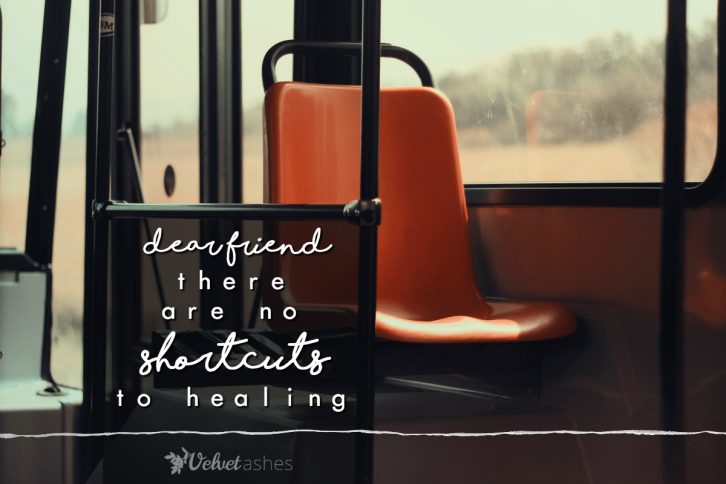
There are no shortcuts to healing.
There are no shortcuts to wholeness.
For we can’t know God as Healer without first being wounded.
And we can’t know God as guide without first being lost.
We can’t know Him as counselor without first being confused.
And we can’t know Him as comforter without first sustaining pain.
We can’t know Him as intimate companion without first feeling abandoned.
And we can’t find our identity in Christ alone without first losing it elsewhere.

You in the waiting,
Dear One,
This much I know:
There is no way around the ache of the human soul.
There is no detour through the pain.
When we walk through the valley —
And we will all walk through the valley —
None of us gets to skirt around the edges.
We are completely baptized in sorrow,
Fully immersed in its grief.
For there are no shortcuts to healing,
No shortcuts to joy.
There is only Jesus.
If anything, He is the short cut:
He is, after all, our Way home
Even if that way be long and broken.

So you in the waiting,
Keep waiting.
Keep seeking,
And keep asking,
Even in the silence —
For there may be silence —
And even in the darkness —
For there may be darkness —
But don’t you give up Hope.
Hold on to Hope.
Hold on to the name of our Jesus.
This waiting, it takes time.
It takes space.
And, I wish I didn’t have to say this, but —
It takes hard work too:
The hard work of shedding the lies we believe about God,
The hard work of shedding the lies we believe about ourselves,
The hard work of being honest with Him about the injuries,
And the hard, Spirit-assisted work of letting go of our entangling sins.

So you in the waiting,
Yes you —
And yes, me too —
For we are all waiting for something —
Dearest sister,
Beloved One,
You in the waiting,
This much I know:
There are no shortcuts to healing,
But in Jesus there is healing.
And there are no shortcuts to wholeness,
But in Jesus there is wholeness.
So we hold on to Him,
We hold on to Hope,
And together, we wait.

Originally published here, reprinted with permission.

Anyway

by Jonathan

photo-1439792675105-701e6a4ab6f0a

They were unclean and unwell, with oozing sores and wounded hearts.
He touched them anyway.

They were dirty and uncouth, sinners all.
He ate with them anyway.

They disbelieved, decried, and occasionally denied.
He loved them anyway.

He knew that nine out of ten wouldn’t say thanks for his regenerative gift.
He healed them anyway.

The tax man and fisherman weren’t looking for a revolution, or a teacher.
He called them anyway.

The rebel man was looking for revolution and a leader, but the wrong kind.
He called him anyway.

They were religious and in charge, with Abraham their father and Law their protector.
He challenged them anyway.

They were cruel and foreign, warrior oppressors gambling for his last shred of dignity.
He forgave them anyway.

They locked his corpse behind stone and guard and seal, ensuring that death and darkness held their catch.

He rose anyway.

~~~~~~~~~~~~~~~~~~~~~~~

Christ is Risen.
He is Risen Indeed!

But I’ve done all these good things . . .

by Elizabeth

train-tracks-1081672_960_720

The question came as Jesus was beginning His last journey to Jerusalem. It came as He was heading toward His most heart-rending task, as He was starting the long descent toward death: “Good teacher, what must I do to inherit eternal life?”

We all know the story. A young, rich, religious man calls Jesus good and then asks Him how to achieve eternal life. Jesus first scolds him for calling anyone “good” but God. Then, feeling genuine love for the man, Jesus tells him to follow the commandments and proceeds to list several of them.

The man defends himself. “I’ve obeyed all these commandments since I was young,” he says. But Jesus informs him that there is still something he hasn’t done – namely, to sell all his possessions, give the money to the poor, and follow Jesus. The man’s face falls when he hears this, and he goes away sad, for he was a very wealthy man.

I’d always glossed over this incident, thinking it might not apply to me. (I’d also neglected to notice until now that it occurred just before Jesus enters Jerusalem for the last time.) But this month as I again worked my way through the end of Jesus’ earthly ministry, it suddenly struck me: the story of the rich, young ruler is my story.

“I’ve obeyed all these commandments since I was young” — once upon a time I said those words out loud, too. I’d just been confronted by my own sin, and I was shocked. I remember protesting, “But I’ve spent my whole life trying to follow God!” My statement was just another version of the rich, young man’s statement; it was just another version of pride.

And like the man, my face fell too. When I saw my attitude for what it was — sin — I did an abrupt U-turn. I interpreted my sin as the worst of all sins and became very depressed. My sin wasn’t a sin that could be forgiven, you see. A sin like mine didn’t deserve God’s grace and forgiveness. Where before I had thought I was better than others, I now thought I was worse.

I rolled around in my sorrow and self-pity until a friend gently pointed out that I was exhibiting reverse pride: the kind of pride that says my sins are so bad they can’t be forgiven. I had flipped from the regular old pride of thinking I was a good person to the insidious, upside-down version of pride that said I could never deserve God’s forgiveness.

But my goodness was never good enough anyway, and reverse pride is a sin to repent of, too. So Jesus basically said the same thing to me that He said to the young man: “There is something you still lack.” That something was a humble awareness of grace. Because in the end, Jesus didn’t ask me to give up all my possessions. (Moving to Asia isn’t the same thing.)

What Jesus has asked me to give up is the idea of myself as someone who has done good things. He’s asked me to give up the idea that I’ve followed the commands well. Because I haven’t. And He’s asked me to give up the idea that any sin is beyond His reach, including the prideful belief that I have no (or very small) sins.

As Jesus watched the man in this story walk away, He explained to His disciples how difficult it is for a rich person to enter the Kingdom of heaven. His announcement left the disciples wondering who in the world could be saved – because to a certain extent, we all trust in both riches and our own good works.

But here is where the story gets good, because Jesus told His disciples that “What is impossible for people is possible with God.” And He kept walking toward Jerusalem to make the impossible, possible. He kept walking toward Jerusalem to make the man’s question irrelevant. He kept walking toward Jerusalem to demonstrate His genuine love for us and to give a very un-good humanity the goodness that belongs to God alone.

Whether we’ve done “all these things” since our youth or not.

(Originally published at A Life Overseas.)