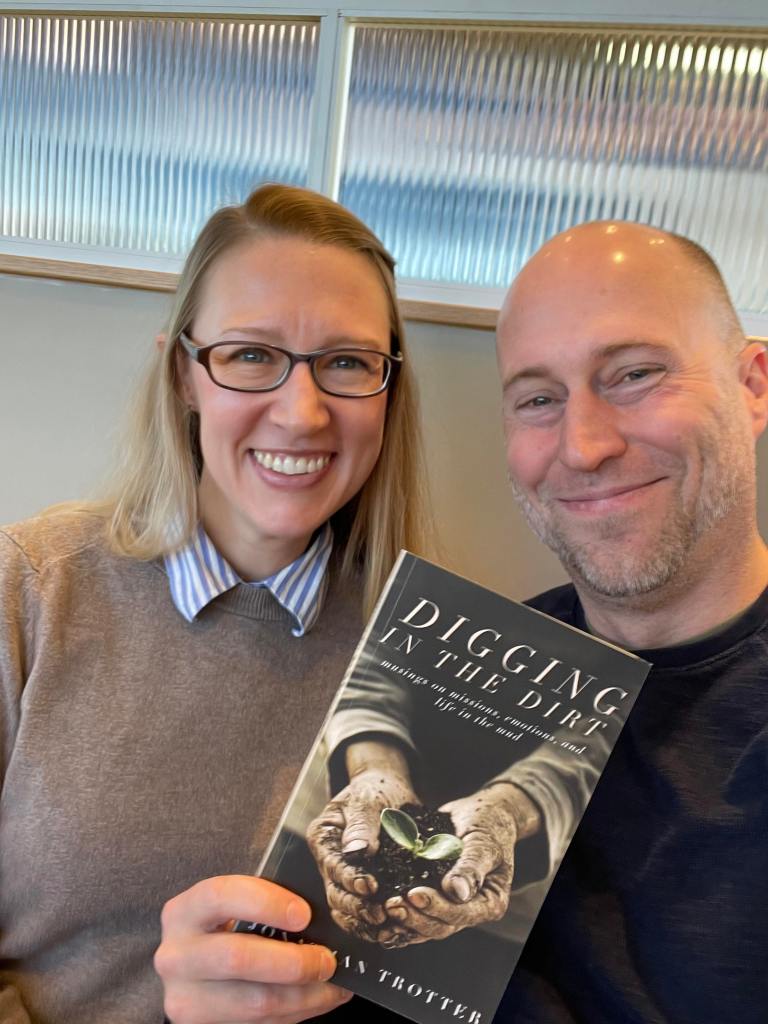
BOOK LAUNCH! Digging in the Dirt is here!

Buy it here!

From the back cover:

Welcome to ground level, to the dirt and the mess.

We like the mountain tops and the sunshine. We like green grass under a clear blue sky. We like victory and breakthrough and answered prayers. But sometimes it rains, the shadows deepen, and life turns muddy. Sometimes God seems quiet. What then? What happens when depression descends, or anxiety hangs like a sword overhead? What happens when loneliness suffocates, the thief steals more than stuff, and you get blood on your shoes?

In Digging in the Dirt, Jonathan Trotter delves into the disasters, the darkness, and the deluge, and he offers comfort, presence, and a gentle invitation to hope.

With humor and prose, with poetry and Top Ten lists, Jonathan welcomes us to the dirt, to the places where we actually live. He invites us to boldly see life as it is, with eyes wide open, and reminds us that even when the digging is scary, we are never alone.

To the ones who are dealing with devastation and distress, welcome. To the ones who need to uproot, to pull out, to clear ground, welcome. To the ones who seek desperately to plant seeds of grace and hope in once barren soil, welcome. To the missionary abroad and the believer at home, welcome. Receive the invitation, and join with Jonathan here at ground level, together.

Come, dig in the dirt.

From the preface:

Hello and Welcome!

I’m Jonathan, and it’s such a pleasure to meet you. I look forward to journeying with you through these pages. Together, we’ll delve into the dirt of life and relationships, of sorrows, pain, and loss. And maybe we’ll plant some things too.

Perhaps, along the way, we’ll see small, green stalks of life and hope begin to poke through, watered with the tears of the journey. Digging like this can be messy, but it can be good too.

These musings will meander from the hot dirt of Cambodia to the sticky mud of American politics. Some of these musings are inspired by international missionary life; some of them are firmly rooted in an American context. But whether you’re American or not, whether you’re a missionary or not, I hope that you find them all a blessing, an encouragement, and perhaps sometimes a challenge. I wrote them for you, and I share them with you with my whole heart.

Start reading Digging in the Dirt wherever you’d like, and feel free to skip ahead or go backwards. Are you a cross-cultural missionary? Start there if you want. Are you interested in developing emotional intelligence, or are you exploring whether or not Christians are allowed to have feelings? Consider starting in the Emotions section. Are you reeling from recent life events that have left you feeling like you’re choking on the mud and muck? First of all, I’m so sorry. Second, breathe a slow, deep breath, look over the Table of Contents, and start wherever you need to start.

Wherever you are, and whatever your story, welcome to ground level, to the dirt. It is here that the real work happens; the good, hard, sweet, healing work. It is my deepest hope that here, among these musings, you may find grace, peace, and a hope that just might be strong enough to crack through the crust.

All for ONE,

Jonathan Trotter

What people are saying about Digging in the Dirt:

A genuine book where no topic is off limits, Digging in the Dirt hits you right where you are regardless of location or vocation. This book is a must-read for anyone who is or is thinking about serving in missions and ministry! – DeAnna Anderson, former Director of the Launch Team for Wycliffe Bible Translators and missionary

Digging in the Dirt is a breath of fresh air for Christians. – Kim H.

Jonathan has such an authentic insight into life on the field, and he addresses the hard things in such a real and tangible way that helps you to know you are not alone. I would totally recommend this book for anyone who is serving overseas, sending someone overseas, or remotely interested in mission life. – Sydney, PI Leader for Southeast Asia

Rarely does an author bring the perspective of a missionary, nurse, theologian, pilot, counselor, parent, and gardener to cross-cultural ministry, family dynamics, depression, grief, politics, and the church, all in one book. Even rarer is a book that combines all of those things in a way that rings authentic and meaningful. Digging in the Dirt manages to do both, bringing thought-provoking and heartfelt lessons out of an incredible range of real-life experiences. – Reuben James

Digging in the Dirt is a must-read for anyone in missions or ministry. It’s refreshingly humble and vulnerable, and no matter what stage of life and ministry you’re in, you’ll walk away with some wisdom and new insight. – B.W., Stateside missions support worker

__________________________________________

Check it out on Amazon here!

*Amazon affiliate links

When the Blooper Turns Into Something Bigger {Velvet Ashes}

When I signed up for the Velvet Ashes’ “Bloopers” theme, I expected to write a light-hearted story poking fun at myself. After I wrote it, I realized the story was much heavier than I had initially thought. You’ll find the original anecdote in the first half of the article, with my further reflections in the second half of the article. ~Elizabeth

Trigger Warning: this post discusses violence and includes a story featuring a gun.

“Hit the floor.”

I learned that particular phrase in pre-field training. We had just gone through the first of two simulated hostage situations. As it concluded and we began debriefing the experience, one of our trainers instructed us to “hit the floor the moment you hear gunfire.” The two simulations impacted me deeply, and although I never had need of her words during my life abroad, I never forgot them.

Fast forward ten years to 2020, the year a tiny strip of RNA brought the world to its knees – and our lives to a screeching halt. Covid-19 may not be all-powerful, but it was still powerful enough to bring us “home” prematurely. My family is now living stateside for the foreseeable future.

A year of bicontinental transition meant living in four houses in the span of ten months. My pre-field training came flooding back to me just days after we moved into our third house of the year. We had just settled in for a family movie night, when all of a sudden a man walked around the back corner of the house.

Finish reading the article at Velvet Ashes.

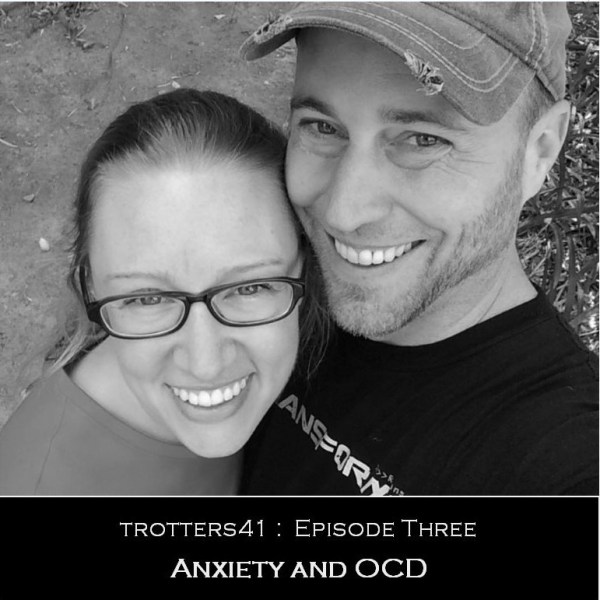
Episode 3: Anxiety and OCD

In this episode, Jonathan and Elizabeth discuss their experiences with anxiety and OCD, what helped, what didn’t, and why there’s hope.

Listen in via iTunes, Stitcher, or below.

Capture

Listen to Episode 3 here or below:


Resources mentioned in this episode:

Brainlock, by Schwartz

Loving Someone With Anxiety, by Thieda

The Dialectical Behavior Therapy Skills Workbook

The Anxiety Cure, by Hart

Change Your Brain, Change Your Life, by Amen

What to do When Your Brain Get’s Stuck; a Kids Guide to Overcoming OCD

It’s Not All in Your Head

For a list of counseling centers that serve cross-cultural workers, visit the Resource page on A Life Overseas.

For more from Elizabeth for Velvet Ashes, on fear.


Dancing in the Darkness

by Elizabeth

photo-1500206329404-5057e0aefa48

A year ago I found myself in a deep well. This well was so deep I couldn’t see the sky. Even if I could have seen it, I wouldn’t have tried to look up. That’s how dark it seemed down there.

In the midst of this darkness, a friend invited me to attend a dance class with her. I hesitated. I didn’t have the right clothes. I didn’t have enough time. I wouldn’t know what I was doing; I might embarrass myself.

My friend told me I could easily find the appropriate clothes, and that it wouldn’t matter that I didn’t know what I was doing. Her whole life, she said, she’d never been an exerciser, and she could follow along in class. She assured me I could too. She gave me the courage to try.

That first class found me in tears. I don’t remember what happened. I only know that whatever the teacher (who is a believer) was saying, it matched what God had been teaching me in my prayer times. The second class was the same as the first: more echoes of the whisper of God. And more tears.

The third class, same story. Clearly dance was touching deep, tender places inside me, but at least by that third week, the tears didn’t take me by surprise as much.

I’m a “words” person. Words are how I communicate with the world. They’re how I communicate with God. They’re how I communicate with myself. But after this last year, more and more I find myself agreeing with Jacob and Sarah Witting in Skylark that “sometimes words aren’t good enough.”

Dance speaks a different, wordless, type of language that wordy people like me need. We need to come back to ourselves, to live in our bodies again. Too often I live solely in my head. Thoughts, especially of the dark dreary kind, circle round and round and never find a resting place.

I’d been disconnected from my own body for so long. I didn’t know any other way to live. By the 5th grade I was already stuck in my head; I had already intellectualized everything. At church, women’s bodies were something to be wary of, an ever-present temptation for men. In my own life, a small set of breasts had still attracted the attention of a predator at church and church camp.

These early experiences taught me that the body was sinful, and we must transcend it by the Spirit. The body did no good, only bad. By the 9th grade I had developed an eating disorder. Is it any wonder?

But reconnecting with my body was what dance class was about. Because in that deep, dark well, something was missing, and that something was me. I had gone missing. And in some mysterious way, I met God on the dance floor and came back to myself.

I still remember the first time I could actually execute the turn I’d been practicing unsuccessfully for weeks. I felt a thrill that my body, not just my mind, could learn something new.

I still remember the first time I could actually look at my face in the mirror. All the other experienced dancers were looking in the mirror, but I couldn’t bring myself to do it. It seemed vain somehow.

I still remember the first time I implemented a correction on the first try and started to think, maybe I can trust this body of mine. My body had seemed so untrustworthy for so long.

A funny thing happened when I started trusting my body: I became frightened. I had never trusted it before. Trust was what I’d been working towards, but the first time I felt it, it was so unfamiliar that it scared me.

I still remember the class when the teacher kept insisting that we “take up the space.” That we enlarge our movements and really take charge of the dance floor. It made me think about all the ways in which I live my life small, not daring to take up any space, physically or metaphorically.

This was an entry point into the rest of my life. I’m a writer, but even words were lost to me in that dark time. I had shrunk into myself, and I barely wrote anything that year. I wasn’t taking up space anywhere. But dance class challenged me to change that.

Attending class each week got me out of my head and into my body and – importantly – into the company of other people. Because sometimes healing isn’t a solitary venture. Healing is something that happens to us when we’re with people.

Sometime in the course of the year I stopped feeling ashamed of where I was (it’s easy to feel discouraged when you look at others much more skilled than yourself), and I began to better accept myself where I was.

My favorite part of last year’s dance classes, by far, was dancing to the hymn “Amazing Grace.” I couldn’t contort my body into many of the movements, and I could barely remember the order of the choreography. But this one thing I remember: “I once was lost but now am found.”

During this phrase we would fall to the floor flat on our backs, and then reach up for God. We repeated that movement over and over again throughout the spring months. There was something about confessing my lostness and declaring my foundness again and again that undid me every single week.

I knew I’d been lost that year – lost in anxiety and depression and health struggles and poor emotional choices. I lay on the dance floor the same way I lay at the bottom of the well – alone and in need of help. But each time I danced this song, I was also reminded that I had been found by a loving Father. There were times during that year when I refused to talk to God because He wasn’t healing me fast enough. Yet through all my confusion and stubbornness, He still found me.

Somehow week after week I met God on that dance floor. I never expected to meet God on a dance floor. I expected to meet him in an early morning quiet time. Or maybe a mountain top, or an ocean front. Certainly not a sprung laminate floor.

We broke for the summer and returned to class a few weeks ago. Those first few classes were enough to remind me that I am still a beginner. But you know what? That’s ok. When I first started dancing, the instructor told me that “dance is a journey.”  It’s not about arriving or finishing. He repeated himself to me just last week: this is a journey.

I’ve been on a healing journey this last year. Maybe you’re on a healing journey too. Maybe you need physical healing. Maybe you need emotional healing. Maybe the healing is slow in coming. Maybe you feel God is too slow in healing you. Sometimes God heals us in big, sudden ways in an experience or an event, but sometimes He heals in slow, nearly inconspicuous ways.

And sometimes He reaches down into a deep, dark well and week by week gently pulls us up.

And then we see the sky.

And then we dance.


Originally appeared at Velvet Ashes; reprinted with permission.

Saying Goodbye to the Automatic No {how I learned to have fun again}

by Elizabeth

70358890_10162153521195621_7282361068934922240_o

This photo. It looks so simple and sweet, the picture of a woman enjoying herself on holiday. But it’s more than that. Much more. This photo also represents a victory in a long-standing tug-of-war with the AUTOMATIC NO.

Are you familiar with the Automatic No? It’s an old acquaintance of mine, a seemingly comfortable companion. It’s cunning. It’s clever. But it’s actually a traitor to happiness.

The Automatic No sneaks into relationships and slowly poisons them. Someone, usually a family member, will ask you to do something fun with them, and you decline. How many times have I done this?? How many times has a loved one asked me to play with them, and I said no without really thinking about it?

I’d been obeying the Automatic No for a long time without ever knowing it. Sometimes there’s an underlying fear — I’m afraid of this or that germ, afraid of this or that injury. Sometimes there’s an underlying laziness — I just don’t want to move or get up. And sometimes there’s an underlying assumption that “fun is for kids.”

I wouldn’t generally articulate my reasons. I would just say no and stay out of the activity. Over and over again, I chose to remove myself from the merriment without ever asking why.

But then last year happened. A colleague of my husband’s helped us pinpoint OCD as the cause of so much mental anguish in my life. Obsessive-Compulsive Disorder: it made so much sense. At last, I had a label for my oddities. Finally, we had an explanation for my eccentricities.

So I dove into the literature on OCD. Some of the most helpful work came from Dr. Jeffrey Schwartz, author of Brainlock. Brainlock describes what happens in the brain of a person with OCD, and it prescribes a plan for changing your brain by changing your behavior.

And let me tell you, this plan works. Of course, it only works if you implement the strategies, but the strategies are highly effective. (Watch this 30-minute video for an introduction to the four-step plan for treating OCD.)

Basically what happens in that the gear-shifting system in the brain (the cingulate system) is “sticky.” It doesn’t shift well. So when a thought, usually something bothersome, dangerous, or anxiety-provoking, comes into an OCD mind, it literally cannot leave. The thought is physically stuck on a loop. The brain can’t move from anxiety to safety because the gear shift is faulty.

It takes a lot of work to shift gears, especially at the beginning of treatment. And it is this lack of ability to flex that causes us to say no automatically. We don’t think through our answers; we just say no. We can’t shift our attention very easily, and NO is always an easy answer to give.

My husband, who works as a pastoral counselor, has a lot of books on mental and emotional health laying around the house. One of them is Dr. Daniel Amen’s Change Your Brain, Change Your Life. I picked it up and flipped to the sections on fear & anxiety and on worry & obsessiveness.

It was in the section on worry & obsessiveness that I discovered the name of my adversary: the Automatic No. It was in the pages of that chapter that I came face to face with my tendency to destroy fun in a relationship.

When invited into the fun, I don’t explore it. I don’t get curious. I don’t ask myself if I really want to do something. I just say no. I don’t even consider it. I just say no to getting in the water and swimming with my family, even though I always enjoyed it as a child. I don’t play ball games with my family. I stay on the sidelines and watch. I don’t do that fun thing my husband is asking me to do. I opt out.

Because why should I say yes, when I could just as easily say no instead?

But I recognized myself immediately in the description of the Automatic No, and it scared me. So I determined to alter my customary no’s. To at least try to fight back against my familiar, well-trodden brain paths. To give myself time before answering the invitation. Time to think about whether I really have to say no, or whether I could possibly say yes. I never knew I could say yes, that I could try it and see. Maybe I’ll like it, and maybe I won’t. But I’ll never know unless I try.

So I started saying yes more often. It was a tentative “yes?” at first. But soon my yeses became firmer. The first picture below was nearly an Automatic No. It was a recent holiday, and we were at the mall. I was watching the kids play Skeeball at the arcade. I was cheering them on when out of the blue, my husband asked me if I wanted to play. He had enough coins if I wanted.

Initially I told him, “Nah.” But then I stopped myself. I asked myself what I really wanted, and it turns out, I DID want to play. I hadn’t been thinking through the offer. I had just been offering that dread Automatic No again.

But when I took a moment to mull it over, I remembered that Skeeball was my favorite arcade game as a child. It was the only game I ever played at Chuck E. Cheese, in fact. I had just assumed that “arcade games are for kids.” I never considered playing as an adult (even though my husband plays these games all the time).

So a minute later I nudged him and said, “Actually, I think I DO want to play this game.” And I did. He took this photo after I had just made a 40-point score. That look is not posed; it’s pure joy.

After Skeeball, we all played at the basketball machines — that’s the bottom photo. But I would never have tried my hand at basketball had I not rethought my original Skeeball “no.”

It’s hard at first to say “no” to the Automatic No, but it gets easier with practice. And with time, rejecting the Automatic No leads to a lot more fun in life. Little yes by little yes, we change our brains, and we change our lives.

So if you, like me, say NO to the fun far more frequently than is good for you, I dare you to go out and say YES to something today. Who knows? One little yes may be all that it takes to change everything.

71080482_10162153522105621_4777571111531446272_o