
What is a Woman Worth?

This post was originally written for and published in The Light Times Magazine, with Khmer translation done by the magazine editors. Download a PDF of the article (in English and Khmer) here. — Jonathan

wiaww3

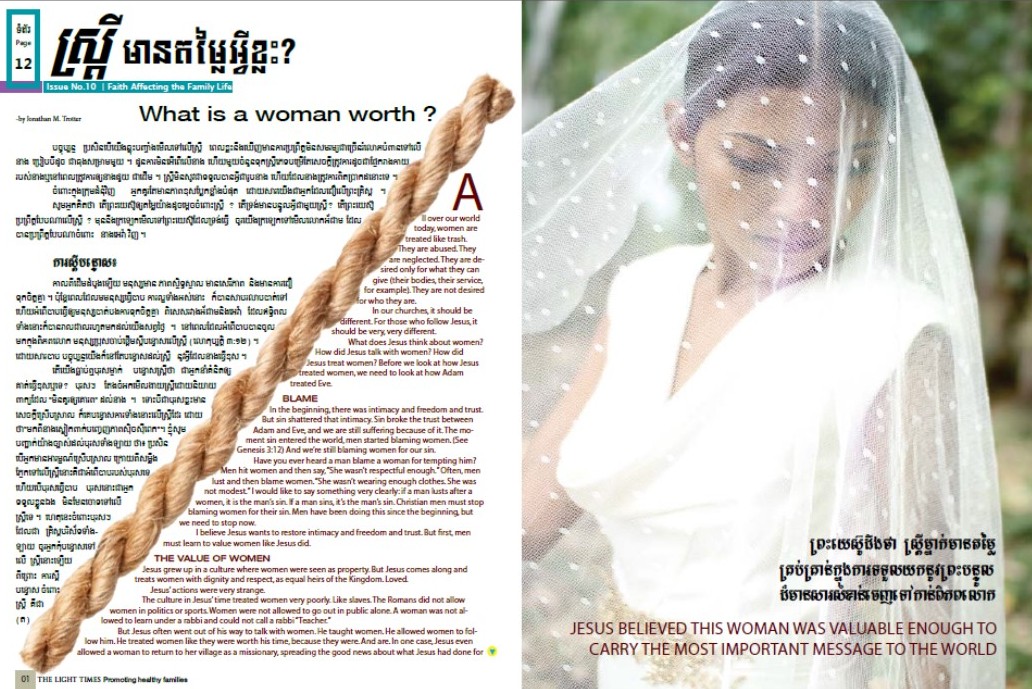
All over our world today, women are treated like trash. They are abused. They are neglected. They are desired only for what they can give (their bodies, their service, for example). They are not desired for who they are.

In our churches, it should be different. For those who follow Jesus, it should be very, very different.

What does Jesus think about women? How did Jesus talk with women? How did Jesus treat women? Before we look at how Jesus treated women, we need to look at how Adam treated Eve.


Blame
In the beginning, there was intimacy and freedom and trust. But sin shattered that intimacy. Sin broke the trust between Adam and Eve, and we are still suffering because of it. The moment sin entered the world, men started blaming women. (See Genesis 3:12) And we’re still blaming women for our sin.

Have you ever heard a man blame a woman for tempting him? Men hit women and then say, “She wasn’t respectful enough.” Often, men lust and then blame women. “She wasn’t wearing enough clothes. She was not modest.” I would like to say something very clearly: if a man lusts after a women, it is the man’s sin. If a man sins, it’s the man’s sin. Christian men must stop blaming women for their sin. Men have been doing this since the beginning, but we need to stop now.

I believe Jesus wants to restore intimacy and freedom and trust. But first, men must learn to value women like Jesus did.


The Value of Women
Jesus grew up in a culture where women were seen as property. But Jesus comes along and treats women with dignity and respect, as equal heirs of the Kingdom. Loved.

Jesus’ actions were very strange.

The culture in Jesus’ time treated women very poorly. Like slaves. The Romans did not allow women in politics or sports. Women were not allowed to go out in public alone. A woman was not allowed to learn under a rabbi and could not call a rabbi “Teacher.”

But Jesus often went out of his way to talk with women. He taught women. He allowed women to follow him. He treated women like they were worth his time, because they were. And are. In one case, Jesus even allowed a woman to return to her village as a missionary, spreading the good news about what Jesus had done for her. Jesus believed this woman was valuable enough to carry the most important Message the world has ever seen. (See John 4)

And when it was time for people to find out that he was alive again, the first people to know were women. Women were the very first people to announce the resurrection of Jesus. This was very strange. In that culture, women could not be legal witnesses in a court of law, but now, they are witnesses of the greatest event in history. And they’re telling men all about it. (See John 20)

There is one more story that we must talk about. In John 8, a very vulnerable woman is in front of very powerful men. And Jesus stands in between. Because that’s where he always stands. Jesus always positions himself between religious men and hurting women. When the men want to throw stones, Jesus stands there, protecting, wanting to heal hearts.

We must follow his example.

Ladies, hear what Jesus says to you,

You are loved,
You are valuable,
You are precious to me. 

I made you on purpose, and I love you.
If you have been hurt or abused, I am so sorry.
If you feel shame, remember that I came to erase shame.
When I see you, I do not see shame.
I see the girl I Iove, the girl I died for. 

My daughters are shameless and blameless.
Perfect in my sight.

It is my hope and prayer that the Church in Cambodia would be a place where all people are respected and loved and cherished. Old and young. Rich and poor. Men and women.

Amen. Come, Lord Jesus.

~~~~~~~~~~~~~~~~~~~~~~~~~~~

[page 1 of 2]

Our Journey to Finding Joy in Marriage (and the things we lost along the way)

by Elizabeth

photo-1438707207584-d9fcda4a60e7b

We were in a diner eating pizza. The young couple sitting across the table from us had just asked us how we’ve sustained the joy of our relationship over the years. I wasn’t exactly expecting that question, so my first answer was pretty simple: we spend a lot of time together. Talking, dreaming, laughing, debriefing. Companionship and intimacy require time, and lots of it.

When we were first married, we retreated together to cheap lawn chairs overlooking bushes that barely shielded us from the highway on the other side. We walked all over that university town, in all kinds of weather, for our date nights. We might walk to the library for a free movie and share an order of breadsticks from Papa John’s, where even with the sauces, our meal totaled a mere $3.69.

Later we added children, and enough disposable income for Jonathan to buy me a porch swing. We’d sit in that thing and talk while our children played. At night, we’d tuck them into bed and sneak back out to talk some more, with hot chocolate or bug spray as our companions, depending on the weather.

Even after losing both the yard and the porch swing in our move to Cambodia, we found a way to escape together. We’d head up to our roof and sit in bamboo chairs (with bug spray as our definite companion), watch the city skyline, and share soul secrets. These days you’d be more likely to find us sipping coffee at our kitchen table, the kitchen door conveniently locked behind us.

But the more I pondered this young couple’s question about joy in marriage, and the more I traced our marital history over the years, the more I realized that finding joy was about losing things too. On the journey to find joy in marriage, we’ve shed some surprising baggage.

Who’s in charge here??

I went into marriage spouting ideals of male headship. My husband Jonathan would be in charge and make the final decisions, and I, as the wife, would submit. In any disagreement, his opinion would count for more. We thought we believed that premise, and because we didn’t have a lot of conflict, we thought we were pretty good at following it.

In real life, however, I don’t think we ever actually practiced male headship (or what is sometimes called complementarianism, a term I didn’t know at the time). We thought we did, because we loved God and wanted to obey His Word. And male headship is what the Bible instructs, right??

But Jonathan never pulled the “I’m in charge” card on me. Never. Not even once. Not even when he felt led overseas and I didn’t. I put pressure on myself to submit to his call, but it never came from him.

A little premarital advice from my mom

Growing up, I watched my mom honoring her husband, and she taught me to do the same. When it came to practical advice, though, she focused on “talking things out.” She told me that in her marriage to my dad, if one of them cared about something more — whoever it was — they went with that. The next time it might be different, and that was ok, because nobody was keeping track. She said if they didn’t agree, they just kept talking until they did agree. Practically speaking, my mom and dad were on equal terms in their marriage.

One day my mom told me about a conversation with some other Army wives. One of the women turned to my mom and told her that she must really love her husband. Mom was a bit confused; she hadn’t been raving about how wonderful Dad was or how much she loved him. But something in the way she talked about him (or not talked about him, as the case may have been) spoke her love loud and clear to those fellow Army wives.

Now I know that the type of marriage my mom was describing follows the mutual submission outlined in Ephesians 5:21: Submit to one another out of reverence for Christ. Now I know that people call this type of relationship “egalitarian.” But it’s almost as if back then, we had no vocabulary for the Biblical marriage conversation.

The priesthood of all believers

Even in the early days of our marriage, whenever we needed to make a big decision, Jonathan and I would always pray together. We assumed that God would impress the same thing on our hearts, and that we would be united in both seeking God and obeying Him.

Looking back now, I can see that the path to egalitarianism begins with the priesthood of all believers. We went into marriage saying we believed in male headship, yet in decision-making, we fully expected God to speak to both of us. We believed we could, and would, both hear from God, and that God would say the same thing to both of us. Blame it on the Experiencing God craze of the 1990’s if you want, but this is how we approached God from the very beginning of our marriage.

photo-1439396874305-9a6ba25de6c6c

Love and Respect??

Several years into our marriage I heard about the idea of “Love and Respect,” which claims that a woman’s biggest need is to be loved by her husband and that a man’s biggest need is to be respected by his wife. That seemed like good, solid, Biblical advice. In our marriage I felt loved, my husband felt respected, and we were happy. “Hmm,” I thought, “love and respect must be the key to marital happiness.”

Then I read the book (which is a long one for being built on the foundation of only one verse). About halfway through, I had to put it down. It was so tedious I couldn’t finish it. How many more stories and examples could there be?? The book seemed to be repeating itself.

Besides, I felt like something was missing. I need my thoughts, ideas, and intellect valued: I need respect. Almost as much as love. And my husband needs love, perhaps more than respect. He can’t survive without my compassion, empathy, and listening ears.

(In all fairness to the author of these ideas, he has elsewhere stated that men and women need both love and respect, though in differing amounts. It’s just that I didn’t get that impression from reading his book or from watching his videos.)

Lest you get the wrong idea here, let me make one thing clear: I deeply respect my husband. I value his opinions and consult him on everything. I turn to him for counsel, guidance, and perspective. I trust his advice and regularly defer to him in decision-making. He most certainly has my respect.

But for him, although my respect is nice, if I did not also care about his feelings, his dreams, and his deepest longings, and if I did not tenderly take care of him, he would shrivel up and die (his words, not mine). He needs my open-hearted love. And if he loved and cared for my deepest hurts and feelings, but did not also value my gifts and abilities, I’d be crushed. In fact, if I didn’t have his respect, I wouldn’t actually feel loved by him.

Receiving only love or only respect isn’t good enough for Jonathan and me. We need both love and respect. The teaching of “Love and Respect” was a nice start, but for us, it didn’t go far enough. As a wife, yes, I respect my husband, and as a husband, yes, Jonathan loves his wife. It’s in the Bible; it’s good. But God isn’t going to be offended if wives also love their husbands, and husbands also respect their wives.

In the book of Ephesians, Paul was improving upon the pagan hierarchies of the day. Neither Paul nor Jesus – who demonstrated both love and respect for women repeatedly in the Gospels – is going to be upset if we take these instructions that much further, if we add more love and respect, and more imago dei, to our relationships. On the contrary, I think it pleases Him.

jb2

“A marriage where either partner cannot love or respect the other can hardly be agreeable, to either party.” — Jane Bennett in Pride and Prejudice (Sorry, just had to get my Austen on for a minute.)

Encountering Jesus as healer

The more I considered this young couple’s question, the more I kept coming back to the same answer: emotional healing. Emotional healing is what happens when Jesus walks into our pain and binds up the wounds of our hearts. Emotional healing is what draws us closer to each other than ever before.

It’s what enables us to answer Karen Carpenter’s velvet-voiced, pain-tinged question: “Why do we go on hurting each other, making each other cry, hurting each other, without ever knowing why?” Emotional healing shows us both why we hurt each other and also, how to stop hurting each other.

Pursuing emotional wholeness is a journey Jonathan and I have been on for four years now. And though we walk together, our paths look different. The healing Jonathan needed came in the form of expressing long-hidden grief. For me, it meant beginning to feel long-hidden feelings.

For both of us, the path to healing has trodden straight through pain, but it’s been worth it, for the healing we’ve found has deepened our intimacy and intensified our joy.  

IMG_2393

Celebrating 15 years of marriage

Perhaps the honeymoon should have worn off by now, but it hasn’t. We have more joy and intimacy after 15 years of the “daily grind” than we ever dreamed possible.

Along the way, we’ve shed strict interpretations of gender roles and lost deep emotional wounds. In their place, we’ve welcomed emotional healing and embraced mutual love and respect.

We are co-heirs with Christ and co-leaders in our home. We lead each other closer to Jesus, closer to love, closer to wholeness. We give each other space to grow, and we say the hard truth to each other, too.

This is what our Joy looks like.

Related:
A Prayer for Marriage
The Purpose of Marriage is Not to Make You Holy
Marriage as confinement or freedom: notes from a wedding

Open letter to trailing spouses {A Life Overseas}

Elizabeth is over at A Life Overseas today, offering words of encouragement for marriages struggling through a trailing spouse issue.

ts4

“Feeling so fearful and alone since moving as a trailing spouse”

Last month someone found my blog because they did an internet search for that phrase. It reminded me how much pain a trailing spouse endures. I remember the struggle; I remember the suffering. And while whoever typed those search terms is actually not alone, I can attest to the fact that it very much feels that way. I remember how dark it felt, how black the future seemed. I remember how much pressure I was placing on myself not to ruin my husband’s dreams. I remember being afraid that nothing would ever be OK again and that it would all be my fault.

Telling my trailing spouse story has opened up conversations with women all over the world, both before and after they reach the field. (A trailing spouse doesn’t have to be a woman, but women are the ones who have reached out to me.) So with that in mind, I’m going to share parts of emails I’ve sent to women who have asked for more of my story. I’ve deleted identifying details to protect their privacy. These are the things I would say to any marriage dealing with a trailing spouse issue.

Finish reading the post here.

When Ministry and Marriage Collide

by Elizabeth

Jonathan and I have been married almost 15 years now, and I can honestly say being married to him is the best thing that has ever happened to me. We were friends first, then fell madly in love our senior year of high school. Even our first year of marriage – considered by some to be quite difficult – was pure bliss. And I can honestly say that every year after that has grown more joyful and more intimate. This is not to say, however, that we haven’t ever struggled.

I’ve shared before about two of the major struggles in my marriage. I’ve talked about how I didn’t want to move overseas in the first place and how Jonathan and I were at an impasse until God got a hold of me. I’ve also shared my struggle to believe God loves me as much as my husband, since he seemed to have so many more gifts than I have.

There is another difficult season in my marriage that I’ve never discussed online. The two stories I mentioned earlier represent enormous works God wanted to do in my heart and in my spirit. They also had enormous implications in the way I lived everyday life alongside my husband. The struggle I’m going to talk about today might seem more earthy than spiritual, but it still looms quite large in the landscape of my memory.

ministryandmarriage1

Some of you know we served in youth ministry in the States for 10 years. At one point we lived in a Parsonage next door to the church building, and we hosted summer youth meetings in our house. Initially we only invited juniors and seniors to our house on Tuesday nights for Bible study, and I thoroughly enjoyed it. Later we started hosting all ages in our house every Wednesday night during the summer. And every Wednesday night without fail, teenagers trashed my house.

This went on for two whole summers. My house was a disaster every Wednesday night, and I had a breakdown every Wednesday night. Jonathan and I could not see eye to eye on this issue and often fought over it. He felt we needed to have the teens in our home, and that I needed to want to have them in our home, and that furthermore, he believed the teens would perceive my reluctance to welcome them into our home, so I needed to check my attitude.

This, as you can imagine, led to lots of stress in our marriage. I wasn’t confident enough to instruct the teens how to throw trash in the trash cans or how to avoid spilling coke all over my white living room carpet. I’m more confident now and would be able to teach teenagers in that way, but I was too intimidated back then. (Also I was much more uptight about cleanliness when I only had two kids as opposed to now, with four.) I just wanted my husband to kick the teenagers out; I wanted him to do it for me. At the same time I felt an intense pressure to let them in my house every Wednesday, or else I’d be a “bad ministry wife.”

Conflict can happen, even when you’re married to your best friend, even when you are absolutely convinced he’s the only one for you, even when you love practically everything about him. We shouldn’t be surprised when we have disagreements with our spouses. We’re different people, and we’ll see the world differently. And when we feel our own point of view so strongly, it can be difficult to imagine someone else’s point of view.

For any of my old darling youth group members who may be reading here today, please know I love you. And I want you to know I miss you all so dreadfully. I’m recounting a problem that was mine, not yours. Probably any of you who still like me enough to read my blog wouldn’t have been the ones tearing it apart in the first place, but either way, it doesn’t matter. This conflict wasn’t about you.

Two years and many, many fights later, we finally got creative in our problem-solving. We finally thought outside the box. This wasn’t either/or. It wasn’t: have them at our house, or they won’t feel the love. It wasn’t: have them at our house, or I’m a failure. It was: let’s have them at our house and not in. We didn’t cancel Wednesday nights at the Parsonage. Instead, we invited teens into our yard (but outside our house).

We gathered around the fire pit for hot dogs and marshmallows, for long chats and pyromaniac adventures. We played volleyball with the teenagers and let all the youth volunteers’ kids play in our kiddie pool. We swung on the bag swing and climbed up the rope on the oak tree. And it was a great compromise. It was hotter outside than in, that’s for sure, but my husband didn’t have to give up teens at his house, and I didn’t have to give up my sanity, my privacy, or my clean house.

I share this story to illustrate that compromises around ministry stressors are possible. For a long time, I saw the problem one way, and Jonathan saw it another way, and as long as we did that, there was no meeting in the middle. We had to get desperate enough to think about things in a different way, desperate enough try something new. I’m such a black and white thinker that our eventual solution never occurred to me (or my husband). In the end he must have figured he had to do something about his unhappy wife, no matter the ministry cost.

Now I look back and think how silly we were that we couldn’t find a compromise sooner. At the time, though, it didn’t feel silly at all. It felt deadly serious, as I’m sure all marriage conflicts do at the time. It took me a long time, but it was a good lesson to learn: sometimes there’s a solution that isn’t either/or. Sometimes there’s a solution that meets both spouses’ needs at the same time. Sometimes we just need to consider other options.

Jesus Loves Me, This I Sometimes Know {Velvet Ashes}

This article by Elizabeth was originally published at Velvet Ashes, and is reprinted here in full, with permission.

1j416

I used to think trusting God meant trusting Him for the circumstances of my life. I used to think it meant trusting God for my future. But this past year God has completely overhauled my understanding of Trust.

I’m married to a man who has all the gifts. Seriously. You name it, he’s got it. And as he and his gifts have grown more public these past few years, I began to believe nobody valued my gifts or even noticed them. Nobody saw me, I told myself; they only saw him. I convinced myself the world didn’t want anything I had to offer; they only wanted what he had to offer.

I felt myself disappearing, fading into nothingness. Very soon, I told myself, I would be invisible. Am I important? Do I matter? Does anybody see me, truly see me? In agony I flung these questions into the cosmos, only to have them answered time and again with a resounding NO. No, you’re not seen; no, you don’t matter; no, you’re not important.

I was certain the problem was my marriage. If only I weren’t married to such a massively talented man, I wouldn’t feel this way. If only he would stop shining, I would feel better about myself. I accused him of erasing me and told him I wanted to die. We kept repeating the same irrational conversations.

Then one Sunday last fall I awoke with the sudden realization that the bitterness I held toward my husband was actually directed at God. None of this was my husband’s fault — it was God’s. He was the One who hadn’t given me the desirable gifts. He was the One who was withholding from me. This was no longer about my marriage: it was about my trust in God’s goodness.

Why does the Giver of gifts seem to pick favorites? Why are some people more highly favored? If God loves us all equally, why are His blessings so unequal? Since (by my reckoning) God hadn’t given me the good gifts, I concluded that He must not love me.

That sounds ridiculous, I know. Learning that Jesus loves us is one of the first things we do in Sunday school. When we belt out Jesus loves me, this I know, for the Bible tells me so, we’re supposed to believe it. Except here I was, and I didn’t believe it.

I prayed a half-hearted prayer: God, please, meet me at church today. I’m not even sure I meant it. Then at church the speaker began talking about how God doesn’t pick favorites. From my seat I remember hearing, “He doesn’t like Ernie more than Ann.” I looked up in astonishment and told God, I think You just answered my prayer.

God had spoken to my mind that morning, but my heart still had its doubts. My solution was to try grunting my way into belief. I thought if I just.tried.hard.enough, I could force myself to believe God’s love for me. But head knowledge has a hard time filtering down into heart knowledge, and I was groping in the dark.

A few months later I found myself in a counseling office to debrief my first few years overseas. Conversation soon came to a standstill. I was stuck. The counselor wisely handed me some colored pencils and asked me to draw. I’m an abysmal artist, but I did as she asked: I drew a purple mountain’s majesty, a part of Creation that draws me closer to God.

The counselor asked me what that mountain might say to me. The first words that came to me were “Just Sit.” Then she asked what else that mountain might say to me, and the word “Believe” immediately flooded my soul.

“Believe what?” she asked.

Through tears, I croaked, “Believe that God loves me as much as He loves my husband.”

And with that one word from God, months of striving to grasp His unconditional, all-surpassing, non-partisan Love evaporated. God used a poor colored-pencil sketch to short-circuit my rational brain and reach inside my heart. It was a breakthrough of belief that took me deeper into the love of God than I ever dreamed I’d go.

Shortly after my time with the counselor, I encountered I John 4:16 in the New International Version: “And so we know and rely on the love God has for us.” I stopped cold. For me, knowing God’s love came first, and relying on it came afterwards. How could this verse so perfectly sum up my experience of God’s love when it had been written some 1,900 years earlier??

I loved this verse so much I looked it up in other versions. The English Standard Version reads, “And so we have come to know and to believe the love God has for us.” When I looked it up in the Greek, I discovered that “know” implies a personal experience, and “believe” means to trust. I John 4:16 is most definitely my story. First I had a personal experience of God’s love, and now I find I can trust it.

My Brute Force Method had failed. Trying to trust had failed. It was only when I let go and stopped striving that I could actually trust His love for me. So maybe trust is more of a release than a grip. Maybe it’s more of an invitation than an instruction. Maybe radical Trust in God isn’t about my circumstances, but about His love.

Psalm 13:5 declares, “I trust in Your unfailing love.” Trust in His unfailing love is life to me now. I no longer believe the lies that tell me my husband is more valuable than I am. I know I’m loved, and I no longer need to slice through my husband’s heart with my perfectly-practiced, precision-cut lies.The most broken part of our marriage has been made whole. I never thought I’d be able to proclaim that.

I am daily living Paul’s prayer in Ephesians 3:17-19. I’m experiencing the love of Christ, and He is filling my life with His love. I’m trusting in Him, and He’s making His home in my heart. I feel my roots growing down deep into God’s love, and I trust its width, length, height, and depth like never before.

This is the cry of my heart for you today. I pray along with Paul, that “Christ will make His home in your hearts as you trust in Him. Your roots will grow down into God’s love and keep you strong. And may you have the power to understand, as all God’s people should, how wide, how long, how high, and how deep His love is. May you experience the love of Christ, though it is too great to understand fully. Then you will be made complete with all the fullness of life and power that comes from God.”

 ~~~~~~~~~~~~~~~~~~

Further resources that helped me know and rely on the love God has for me:

The life and ministry of Rich Mullins, especially his song “The Love of God

Anything by Brennan Manning, especially “Reflections for Ragamuffins

Beth Moore’s Beloved Disciple Bible Study or book

    ~~~~~~~~~~~~~~~~~~

What is the thing in your life that makes you doubt that God loves and values you as much as He loves other people??

What is God inviting you to trust Him for?