Confessions of a Lost Sheep

by Elizabeth

urban-998216_640

Sometimes I feel a bit lost. Not in an eternally-lost-and-I-don’t-have-a-Savior kind of way, but an I-don’t-know-where-I-am-and-I-don’t-think-anyone-else-does-either kind of way.

Because life keeps on going, unchecked and unthrottled. I feel confused, out of touch with myself. So much is happening, what do I even think or feel about any of it? I’m here, but I’m not really here. And I don’t quite know where the real me is.

I don’t know where I am. I’ve lost my way. Who is going to find me? Can anyone find me?

So I cried out, “God, I feel so lost! So lost, so lost, so lost. Jesus, find me. Will you find me? Will you please find me?”

And Jesus, sweet Jesus, He directed my mind to the parables of the lost sheep and the lost coin.

I figure that as long as He’s talking to me, I should probably listen.

So off I went to Luke 15, where Jesus says, “If a man has a hundred sheep and one of them gets lost, what will he do? Won’t he leave the ninety-nine others in the wilderness and go to search for the one that is lost until he finds it? And when he has found it, he will joyfully carry it home on his shoulders.

When. Not if. But when he has found it.

A few moments later Jesus tells us, “Suppose a woman has ten silver coins and loses one. Won’t she light a lamp and sweep the entire house and search carefully until she finds it? And when she finds it, she will call in her friends and neighbors and say, ‘Rejoice with me.’”

Again, not if, but when. When she finds it.

All this searching and sweeping, all this tracking and seeking and lighting of the lamps. All these details and all this grunt work, just to find one who’s been lost.

And I remembered, all over again. I remembered I have a Shepherd. A Shepherd who is good. A Shepherd who knows His sheep.

I may not know where I am, but I have a Good Shepherd who knows where I am. Better yet, He knows me, and He wants to find me.

Even when I feel lost, He knows where I am. When I can’t find my way out, when I can’t find my way back home, He can find me.

It’s time to trust that He’s going to.

Failing at Fatherhood {A Life Overseas}

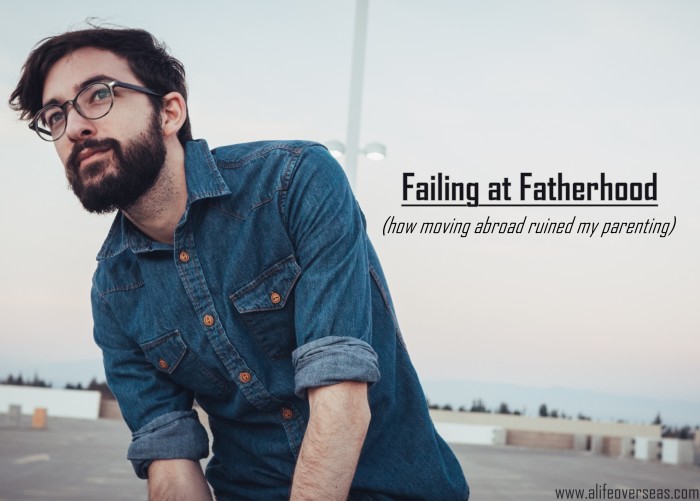
Jonathan is over at A Life Overseas today, talking about how moving abroad ruined his parenting.

faf2-700x501

I sat on the floor, weeping.

I was two whole days into living abroad, and I was already losing it.

Those tears portended more, and in our first year overseas, the thing that knocked me down the most, the thing that discouraged and distracted and depressed me the most, was the sense that I was failing at fatherhood.

I loved being a dad. It was a very core part of my identity, and something I really cherished. Moving to Cambodia, I had expected cross-cultural stress. I had expected transition tension and unmet expectations. I had even expected conflict with other missionaries and nationals. But I never thought I’d feel like my identity as a father was being shredded up and burned in the furnace of a cross-cultural move. That was a surprise.

We moved overseas when our boys were six and seven and our girls were one and three.

I suppose my fathering style could have been characterized as, um, B I G. I loved playing with our kids in wide open spaces, throwing things, kicking things, climbing things. We played loud and we took up a lot of space, and that’s how we liked it.

And then we moved to a concrete box with bars on the windows in an urban capital of a developing country. No grass. No yard. No large spaces.

For me, the shift from wide open spaces to urban jungle was rough. I had to adjust, but first I got depressed. Often, it’d happen on a Saturday; I’d wake up just wanting to go outside and throw a football with my kids.

And with the clarity of thought that overwhelms at times like this, I felt like I had moved from a garden to a prison. A prison that was 95 degrees and thick with humidity!

I had traded acres of green for walls of grey. En Gedi for Sheol.

I watched my kids hang from metal bars on windows when they used to hang from giant limbs on oaks. They were happy, but I was dying.

I missed being able to step outside and kick a soccer ball. I missed our fire pit on cold autumn nights. I missed our porch swing. I missed our yard. I missed the way I used to father.

But thank God the story doesn’t end there, with a depressed dad missing what once was. No, the story definitely doesn’t end there…

To read the rest of the story, click here.

A Prayer For My Third Culture Kids

Earlier this week I shared my expat parenting philosophy on Velvet Ashes. Today I’m linking up with The Grove on Velvet Ashes with a prayer for my TCKs. ~Elizabeth
wbb4

I remember reading The Witch of Blackbird Pond together and feeling such a kinship with the main character Kit. She’d lived a life of privilege with her wealthy English grandfather on the island of Barbados, but when he died, she discovered his large debts. In order to pay them all, she then sold all his belongings.

After that she didn’t know what else to do, so she booked a passage to New England, where some of her Puritan relatives lived. Her cousins’ conservative lifestyle and religious customs were completely alien to her. When the ship docked on the shores of Connecticut, Kit realized “There was something strange about this country of America, something that they all seemed to share and understand and she did not” — a TCK moment if ever I saw one.

Kit suffers intense culture shock. She’s already grieving the loss of her grandfather, and she now doesn’t fit into Puritan culture. In some ways she’s even rejected by the community. She doesn’t understand their religion or their worldview, and friends are hard to find. Her uncle is particularly cold towards her, and she’s never performed such difficult, backbreaking labor before. New England winters are brutally cold and long. She misses leisurely tropical island life in Barbados: the heat, the sunshine, swimming in the ocean, her grandfather’s extensive secular library.

But she grows to love her extended family. She even grows to love the beautiful fields nearby. Towards the end of the book, Kit attends a wedding. She thinks about how she doesn’t fit in in New England, even though she loves the people and the place: “An almost intolerable loneliness wrapped Kit away from the joyous crowd. She was filled with a restlessness she could not understand. What was it that plagued her with this longing to turn back?”

wbbShe had previously decided to return to Barbados and search for work there, but as she continues reflecting on both her old life and her new life, she realizes she can’t go back to the way life was with her wealthy grandfather. Her two cousins have both fallen in love, and she realizes that she has as well — only the man she loved wasn’t a Puritan permanently rooted to the Connecticut soil. He was a sailor, a migratory man, a man of good character, a free spirit like herself. And he loved her back. “Home” for her would be anywhere he was. Marrying him would mean continually traveling between Barbados and Connecticut, always on the move, but always with him. Literally, and not just figuratively, she was going to live in the In Between.

Our Sonlight curriculum chose this novel for its relation to the Salem Witch Trials in early American history, but for me it turned out to be a metaphor for the life of the TCK. Crossing cultures, never completely identifying with one culture, never fully belonging, always grieving a loss of some sort, but needing, so desperately needing, someone to love, care for, and understand her. So with that story in mind, I offer this prayer:


My child, I’m well aware that in this life, not everyone gets married.

But should you happen to marry, first and foremost I pray you will marry a fellow lover of Jesus.

And then — oh then I pray you will marry someone who feels at home in the In Between spaces, who knows how to live in the margins of life, who’s comfortable crossing over and blending in, even if never quite fully.

I pray you will marry someone with a wide view of the world, who doesn’t think you’re crazy for your wide view, either.

I pray you will marry someone who looks to God for full identity and belonging, someone who will understand your need to do so as well.

I pray you will marry someone who understands the pain of separation and of goodbyes, someone who shares your yearning for heaven.

I pray you will marry someone who understands that love is the best kind of medicine for a hurting heart and who knows how to give it.

That person doesn’t have to be a TCK, though they might be. Your Papa isn’t a TCK, but he understands loss and living in the fringe. He understands love and nuance.

So I pray for you to experience what I have experienced myself: that your heart will be fully understood and accepted, fully loved and wanted, fully celebrated and cared for.

I pray you will have many years of adventure together, tasting of a perfect heaven here on a very imperfect earth, each year growing ever closer to our God and to each other.

wbb2

When Grief Bleeds {A Life Overseas}

Today Jonathan is pondering grief over at A Life Overseas. . .

gb

Grief is a powerful thing, echoing on and on through the chambers of a heart.

Loss singes the soul, and death does indeed bite.

We are not the only ones who grieve, to be sure, but those who’ve lived abroad certainly know this to be true: it hurts to leave. It hurts to return. And when others leave, whether by death or call or transfer, that hurts too.

Our stories are the ones written with contrails, straddling continents and seas. And these stories, the good and the bad, the ones that heal and the ones that hurt, must be written. And remembered.

You can finish reading the post here.

How Do You Write Your Name in the Land? {A Life Overseas}

Here’s an excerpt from Elizabeth’s recent post on A Life Overseas:

Sarah, Plain and Tall tells the story of a woman from Maine who moves to Kansas as a mail-order bride for Jacob, a widower with two children. Jacob and Sarah fall in love, and by the beginning of the movie Skylark, they’ve been married for a couple years.

The people of Kansas are now facing a drought. The prairie dries up a little more each day, and it has truly become a “dry and thirsty land.” But Sarah comes from a place by the sea — a cool, wet place, where drought is unknown — and she’s never experienced a season like this before.

When the wells run dry, the people of the community travel to the river, hoping to find water there, but the river is nearly dry. In desperation, Sarah’s closest friend Maggie, and her husband Matthew, tell Jacob and Sarah that they are considering leaving the prairie and settling somewhere else. Sarah is so frustrated by this possibility that she blurts out:

I hate this land. No, I mean it. I don’t have to love it like Jacob, like Matthew. They give it everything, everything, and it betrays them. It gives them nothing back. You know, Jacob once told me his name is written in this land. Well, mine isn’t. It isn’t.

Maggie replies in a thick Scandinavian accent:

“You don’t have to love this land. But if you don’t, you won’t survive. Jacob is right. You have to write your name in it to live here.


To read more, visit A Life Overseas here.

DSC00169a