Third Culture Thoughts Part 1 (On My Kids)

— By Elizabeth 

A Third Culture Kid (TCK) is a person who has spent a significant part of his or her developmental years outside the parents’ culture. The TCK frequently builds relationships to all of the cultures, while not having full ownership in any. Although elements from each culture may be assimilated into the TCK’s life experience, the sense of belonging is in relationship to others of similar background. (Definition from the book Third Culture Kids by David C. Pollock and Ruth Van Reken)

Third Culture Kids don’t live in their passport country, or the country of their parents’ culture. They live in a host country. They don’t belong to their parents’ culture (the first culture), nor do they truly belong to their host culture (the second culture). They are in a culture all their own, a third culture. Their life is both global and mobile. My kids are TCK’s now. In early May I recorded some of my concerns for them:

———-

It’s still a common occurrence for our kids to talk about missing people and places “back home,” but they are becoming happier here as well. They get sad A LOT about missing home, Grandma mostly, but also saying that our new home will NEVER be as good as our old home.

I recently learned more about missionary kids (MK’s) from another missionary who is himself an adult MK and currently works with teenage MK’s.  He said that the culture that most affects an MK’s stability and happiness is the culture of the family’s home, not the host culture. He also told me that 8 out of 10 times, an MK’s attitude toward language learning and the host culture comes from the mom, simply because of the extra time kids spend with their mom. He said those pieces of information are either encouraging to parents, or discouraging to parents, depending on their situation. I found it to be encouraging because our home is a happy place — Jonathan and I work hard to make our family fun, open, and loving — and because I am no longer the “trailing spouse,” as of 2 years ago this month.

Sometimes, however, I wonder what I am doing wrong and why my good attitude isn’t rubbing off on my kids like it should. I like it here, why don’t they?? That other missionary said they would, right!!??  But then I realized that I have been in the process of transferring my heart from America to Cambodia for the last 2 years. Although our family talked a lot about Cambodia and why we were going, their little hearts simply lived where they had always lived until they stepped on that plane in mid-January.   I sent my heart ahead of my body, so I’m a bit ahead of them in my adjustment.  Their bodies travelled first, leaving their hearts in America with friends and family. They need time, and I will give that time to them.

I tell them a lot that nothing will ever replace home, or Red Bridge, or Grandma, or Susan, or cheese bagels, or our awesome yard. Just because we were happy in America, it doesn’t mean we can’t be happy here. We won’t ever try to take away from the good of our life in America, but I want them to have hope that life can be good here as well.

———-

In our training we were told to say goodbye well, and that it’s ok to grieve the loss of people and places when we make an international move. We’ve tried to be very understanding when our kids get sad and talk about home. We let them talk, we look at old pictures, we let them Skype family.  We hug them when they’re sad. At the same time we are making new memories here. We take them to the park, we take them swimming, we play badminton on our roof. We make jokes and laugh uncontrollably around the dinner table. Our kids’ lives have changed drastically, but one thing has not changed: they know they are immensely loved.
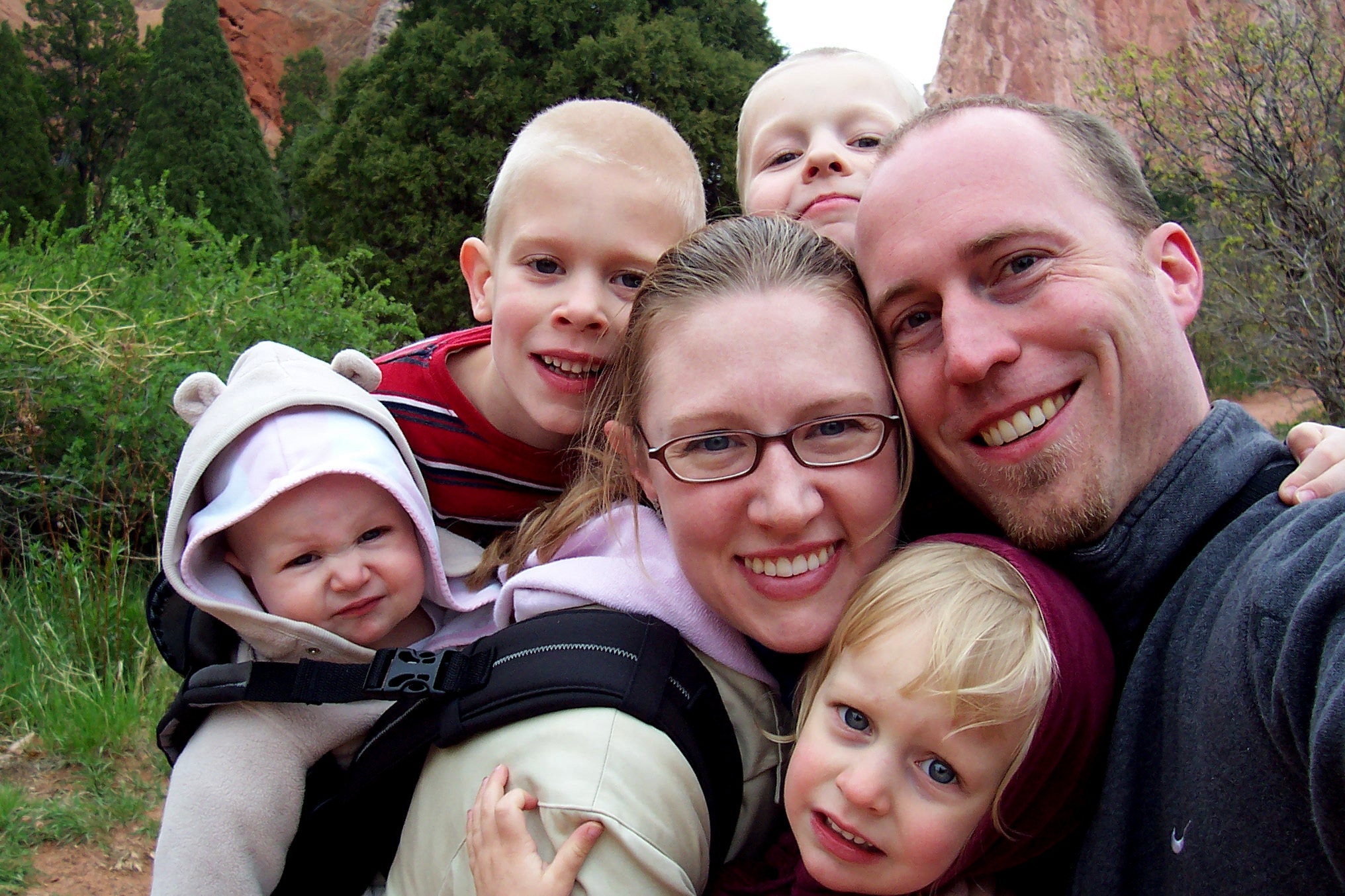
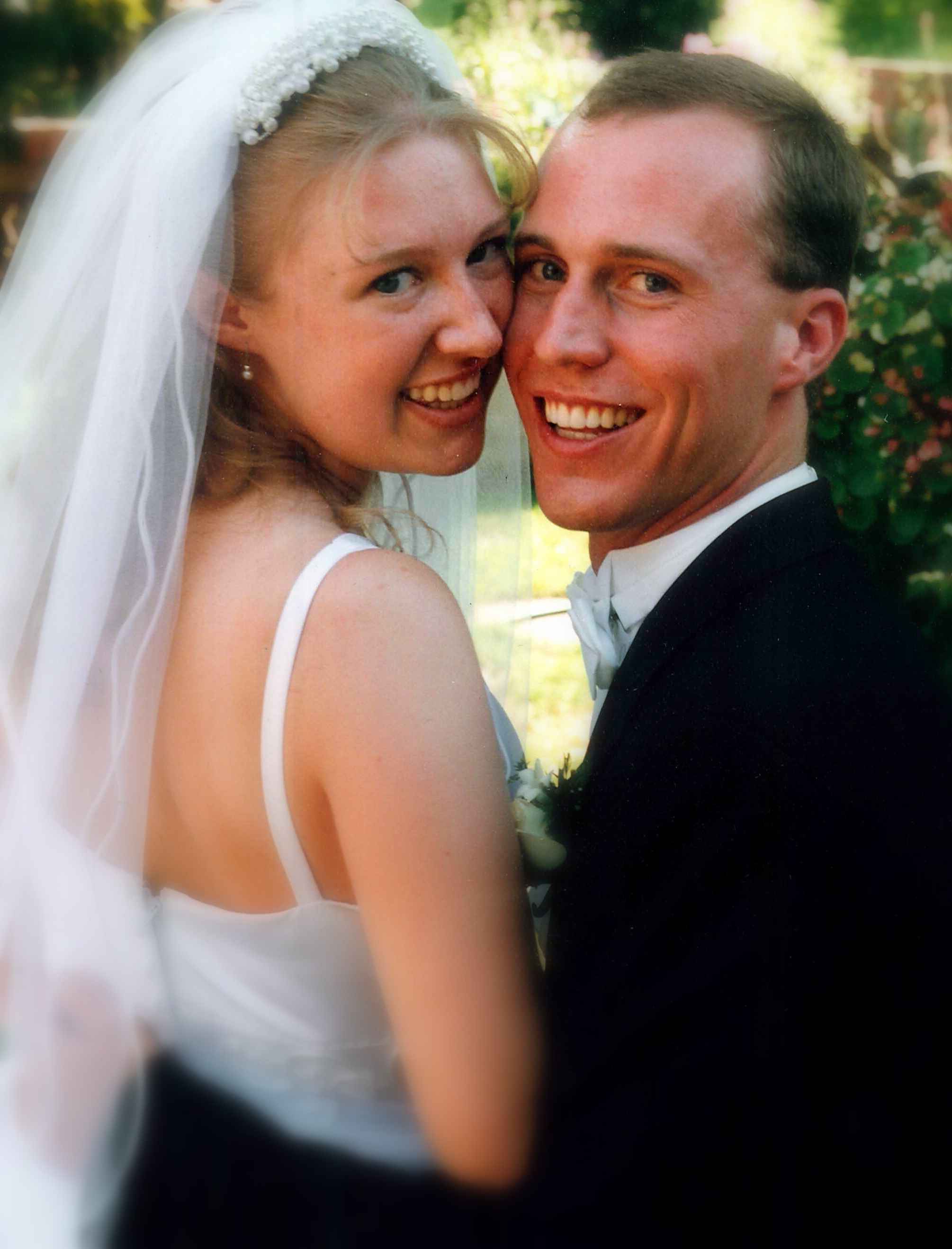
Our family in America
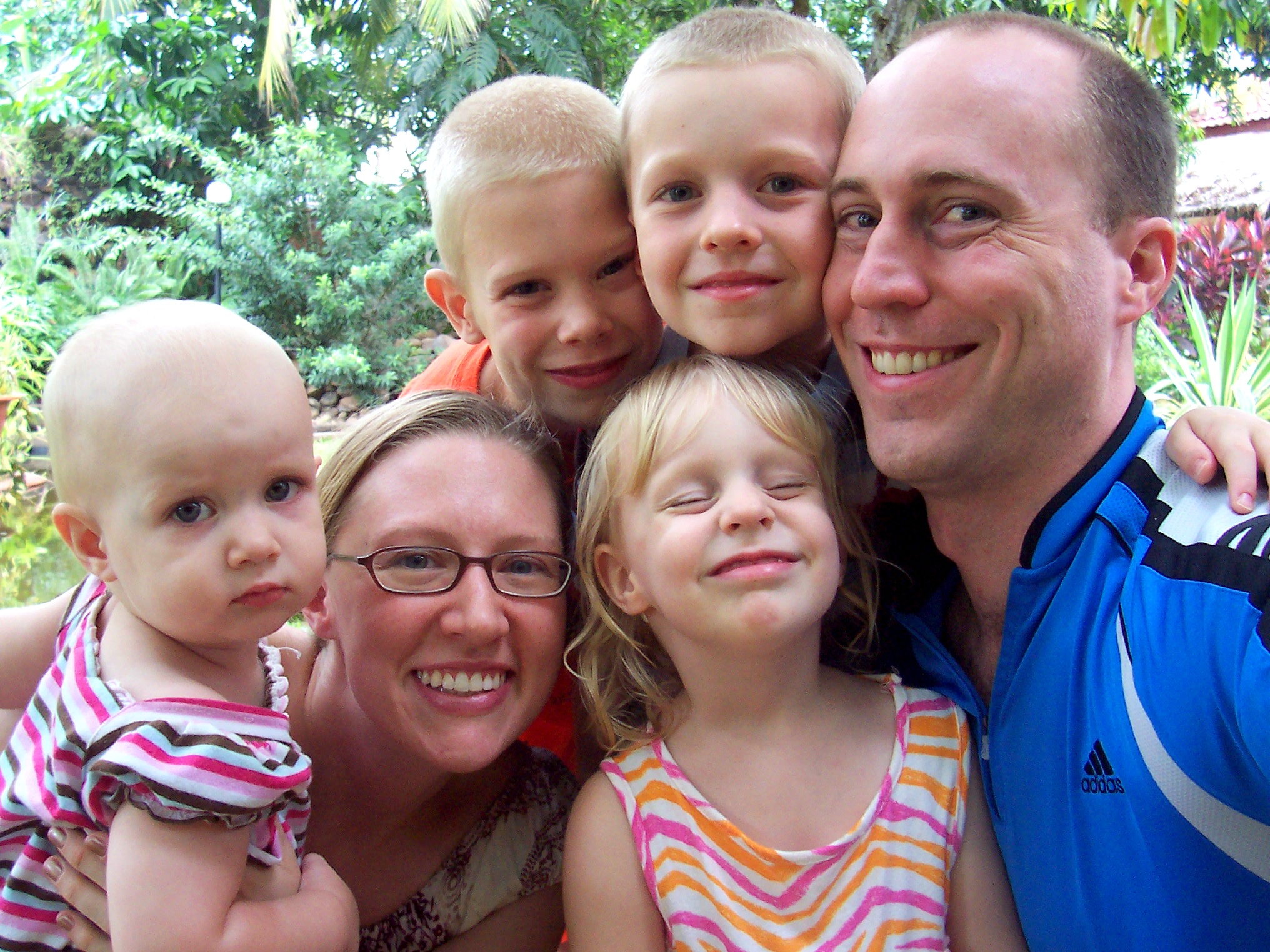
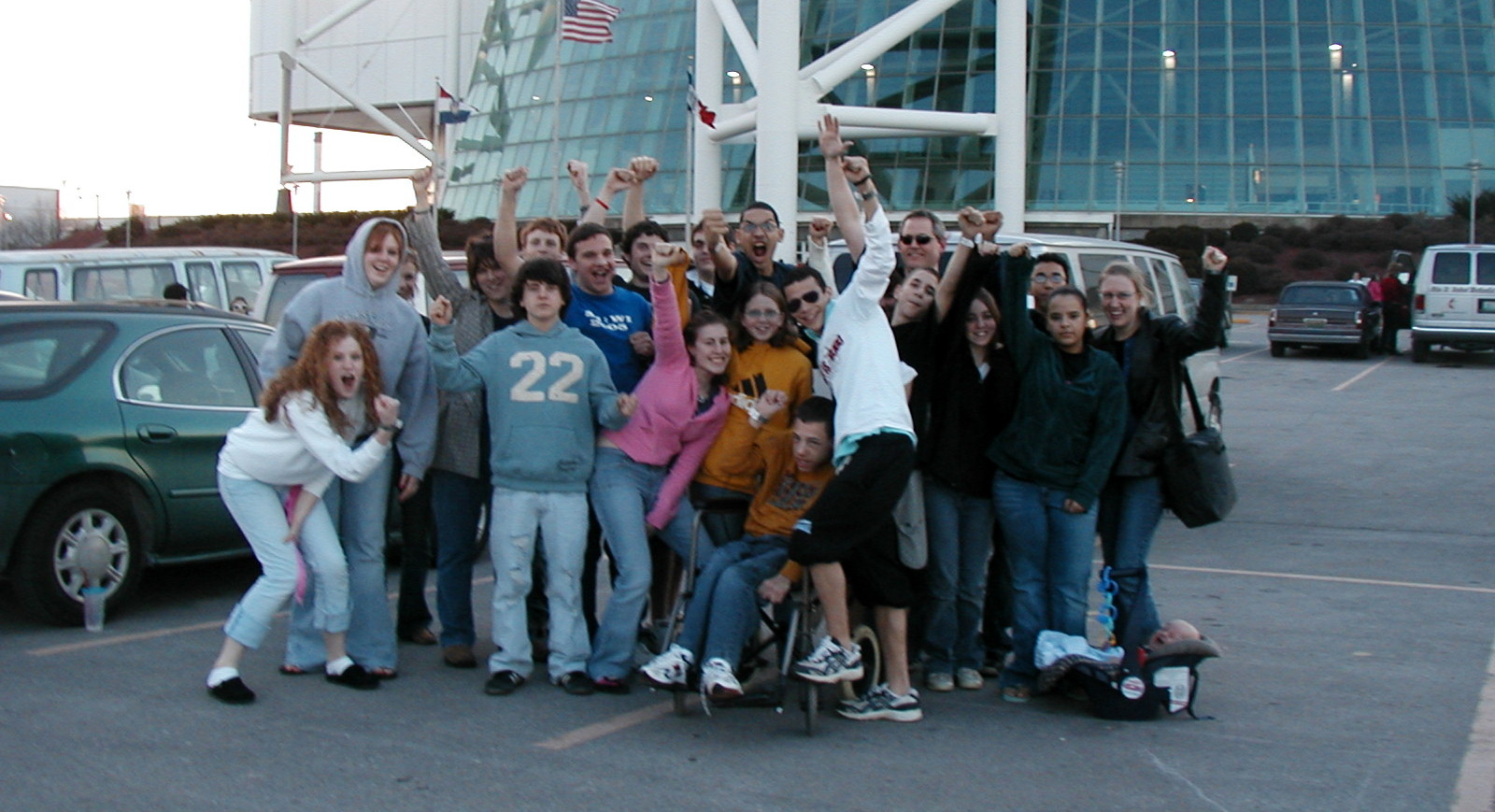
Our family in Cambodia
Climb Every Mountain (Or, How I got to the Top of Mt. Meru & Back Down Again)

by Elizabeth

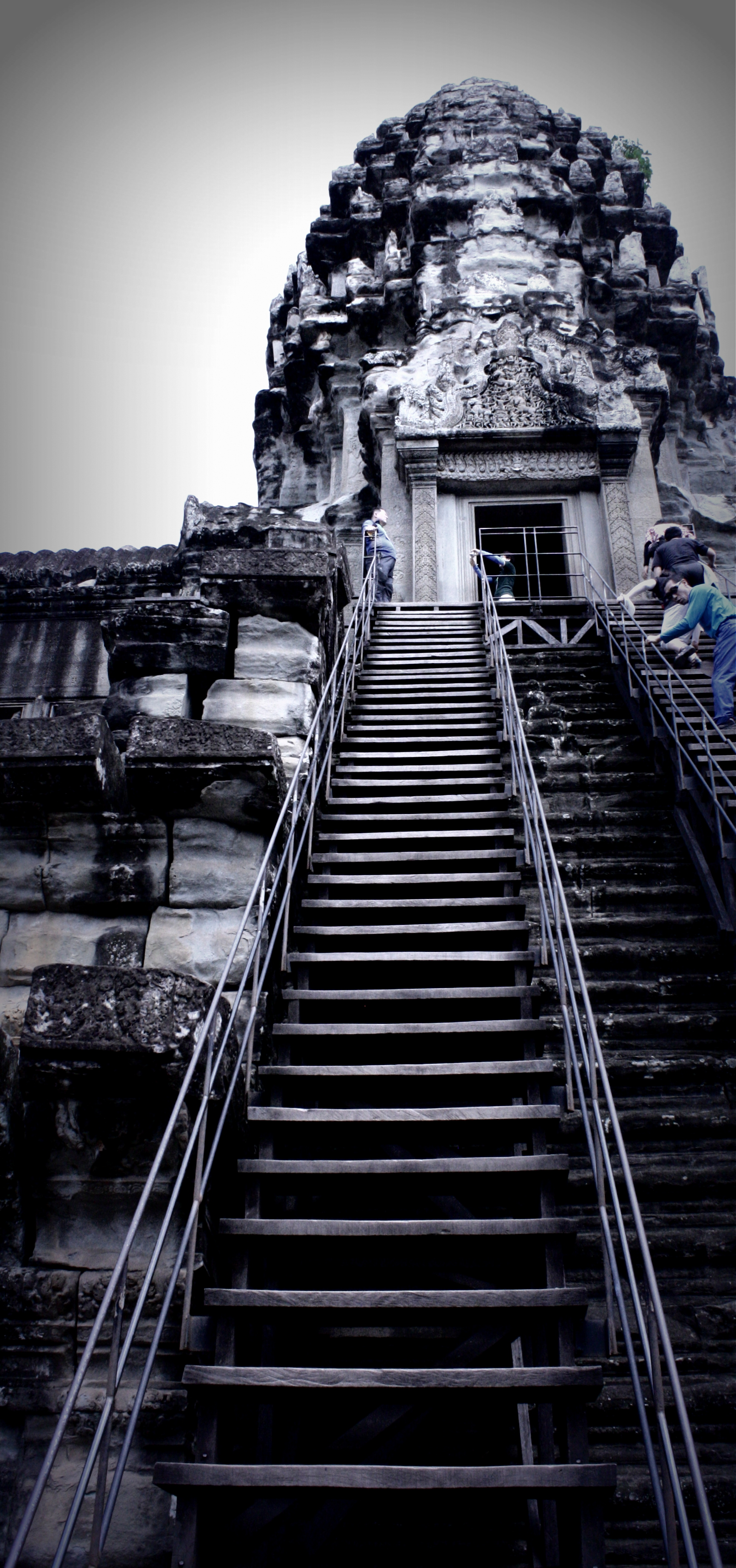
Recently our family traveled to Angkor Wat, an ancient Hindu temple in Cambodia. The center of the main temple represents the mythical Mt Meru (the Hindu center of the universe), and to get to the top you must climb treacherously steep stairs (read: nearly vertical).  This design illustrates the difficulty of aspiring to the home of the gods, and in essence, it requires the climber to crawl up those stairs, prostrate before the gods.

Since it was my first time to Angkor Wat, I figured I wanted to climb to the top of that central tower. I decided to do that without thinking how high or steep it would be.  This is my view from the bottom.

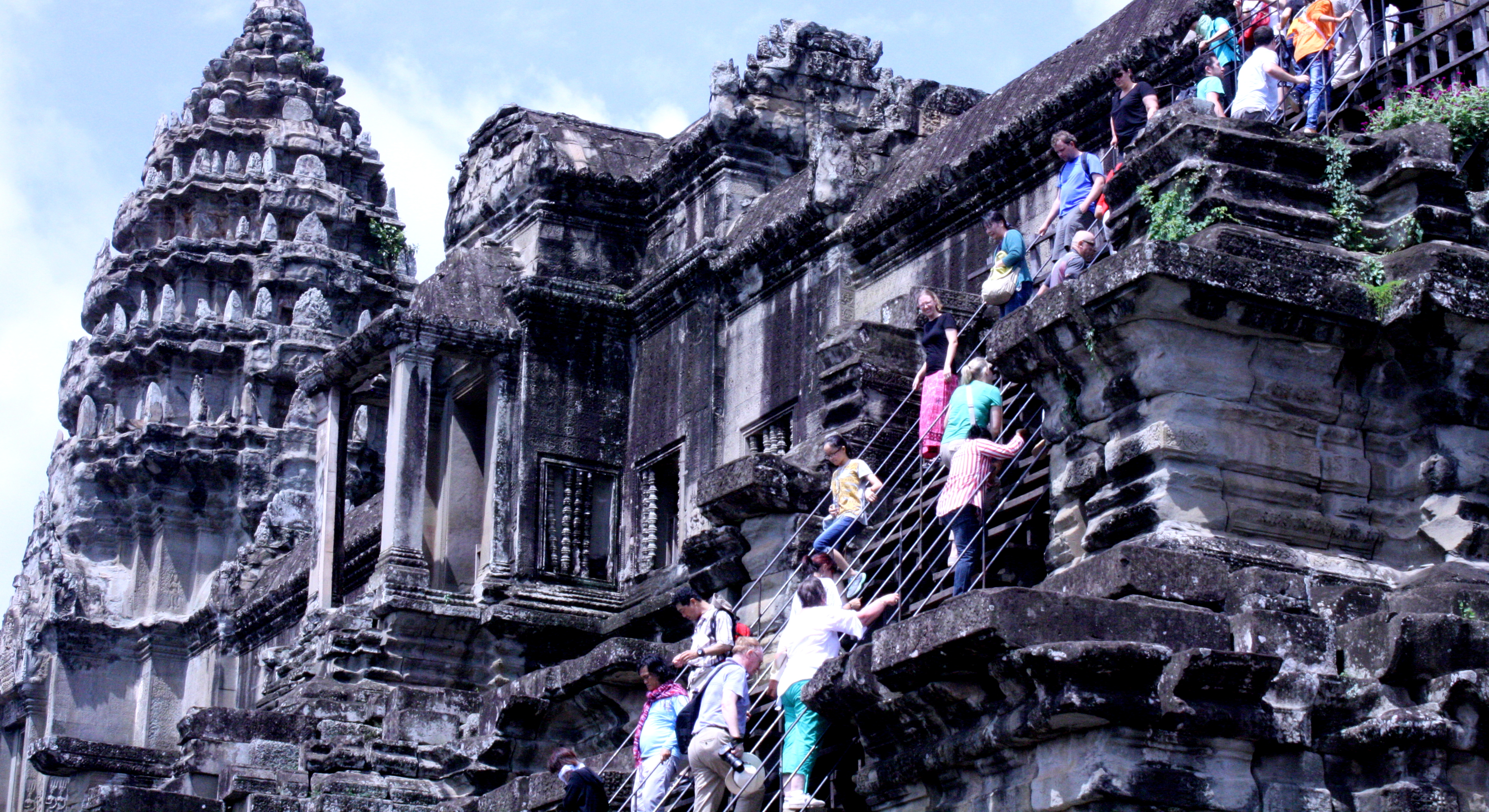
For safety purposes, the original stone steps have been covered with wooden steps, but they are still quite steep. Tourists also have the benefit of a hand rail. Unafraid, I stand at the bottom and start climbing. A few steps up, I realize just how high I am going to get, and just how fast that’s going to happen. I tell myself not to look down. I tell myself not to look up. I tell myself just to look at the steps in front of me. I whisper one of Elisabeth Elliot’s favorite quotations to myself: “Do the next thing.” So I do the next thing: I take the next step.

When I get to the top I’m a little shaky because I know I will eventually have to climb back down. But I follow the tourist signs around the tower, and in only a few minutes I find myself back at the stairs. I tell myself to do the next thing: focus on each step and don’t forget to hold on to the rail.  This is me on my way down.

I had to climb the “mountain” one step at a time. I couldn’t look at the big picture of what I was really attempting. It was too scary. Each step was still scary, but it wasn’t as terrifying as looking at the entire wall I had to climb.

My life with God has been like that.

I’ve never had a Master Plan for my life. At each step of the way I just asked Him what to do next, and I felt He answered.

I asked Him whom I should marry. He led me to marry Jonathan.

Together we asked Him what to do at our first church home in Rolla, MO. He led us to work with youth.

We asked Him when to start a family. And He said “now.”

We asked Him what to do and where to go after I graduated from university. He led Jonathan to go to nursing school in Kansas City.

We asked Him to supply a job in Kansas City, and He led us to work as youth ministers at Red Bridge.

We asked Him to supply a nursing job for Jonathan, and He led him to Truman Medical Center’s Emergency Department.

We asked Him whether we should apply with Team Expansion, and He said “yes.”And even though I was scared out of my mind, we followed Him. Each step of the application process was scary. But I only had to finish one step at a time.


Now that I’m in Cambodia, it doesn’t seem so scary. But if you had told me when I was saying “I do” to Jonathan Trotter, that in 12 years we would take 4 young children across the Pacific to a 4th world country as missionaries . . .

Thankfully, God has been gracious to me. He knew I couldn’t follow Him if I knew the Master Plan. He knew my fear would paralyze me. So He gave me an incremental plan, and now I can look back and say, “Oh, so that’s why You led us to do ____________!” Each piece of our life puzzle prepared us for where we are now. That’s the amazing grace of God, that He can script our life story if we will only “do the next thing.”

Sorry for the Construction Mess

Elizabeth just finished going through our blog to re-categorize stuff that I mis-categorized sometime in the near or distant past.  If you received too many e-mails, feel free to drop by our house and we’ll give you a consolation prize.  Thanks.  ; )

Jonathan T.

Ministry Lessons . . . from a French Catholic Priest and a Khmer Worship Service

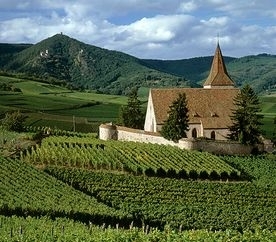
A scene from the Alsace region

Earlier this week we invited one of Jonathan’s language school friends to our house for dinner. He is a newly ordained French Catholic priest who has been assigned to Cambodia for life. He hails from the Alsace region of France. When Jonathan asked him about the most beautiful place he’s ever been, he answered that it was his own region. His home in Alsace, the place of his roots.

He told us he believes that if you cannot love the place you come from, you cannot love the place you go to. So I dropped out of the dinner conversation for a few minutes to contain my emotion. What a beautiful thing to say. He loves his home, but he has sacrificed living there because of love for his God, and his heart is open to love this place and its people as well.

I am not sure whether it is the French-English language difference, or simply because he comes from a different faith tradition than me, but his words were filled with grace and meaning for me. Tears welled up in my eyes. Yes, I love my home. Yes, I love the people who live there. Yes, I love my God, and yes, I love this place. I fully intend to love the people of this place. I want my heart to be open to love.

Then this Sunday I experienced my first non-English church service. Jonathan had attended non-English services before — in Cambodia and also in Russia and Germany — but I had not. I had not expected it to impact me quite so much (not because I thought I was immune to such things, but because I had not taken the time to think about it, silly me, mother of 4 young children, too busy getting ready for church to stop and think).

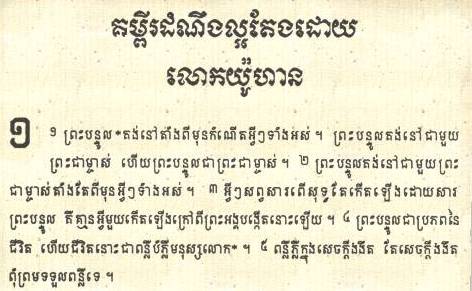
John 1:1-5

I could reliably understand only a few words: “thank God,” “Jesus,” “love,” and “hallelujah.” I could not read the Cambodian song books; I did not recognize the melodies. But I worshipped all the same. It was at this service that I finally understood, at my very core, that Jesus does not speak only English. His offer of salvation is for all nations. Oh, of course I “knew” that before, but there, in that small gathering of Cambodian believers, I truly realized that God speaks all languages with the same perfect skill. He understands each Christian across the globe, no matter their language. He does not understand me better than He understands a Khmer Christian — even if I do not understand that same Khmer Christian.

What I said to my kids later was, “Isn’t it neat that everyone can talk to Jesus? Isn’t it neat that Jesus can understand everybody?” I hope they can grow up strongly convicted of what I am just now learning.

I haven’t blogged for a while. I tend to wait until something significant happens, something that really affects me. I had two of those events this week and wanted to share them with you. As always, thank you for praying for our family and for the people whose language we are trying to learn. We want to communicate the Gospel to them in their own words. We want to communicate the Gospel to them with much love. And this week God sent me those two little reminders, much-needed missionary lessons.

On the Road Again (Trotter Traveling Troubles)

Two Christmases ago Kansas City was blanketed with snow. We set out cautiously from our home at the Red Bridge Church of Christ Parsonage for a Christmas morning with the Raymore Trotters. Less than a mile into our journey we watched a car spinning in the snow, unable to drive onto Wornall from the side road. A man was pushing the car, to no avail, so Jonathan stopped and pushed with him and helped them onto the main road.

Just this week Nathaniel remembered that experience. Jonathan confidently replied that a car would never get stuck in snow here in Cambodia.

It is precisely because we never get snow in Cambodia that we can go swimming any time we want.  Our favorite pool is at the Kingdom Resort 20 minutes out of Phnom Penh – where the street signs aren’t in English anymore. We’ve been planning to take the kids swimming for a couple weeks now, and they were excited to wake up this morning and get on the road. After applying copious amounts of sunscreen (Moms and Grandmas, I know you care about this detail!) we buckle up and start out, keeping a close eye on the temperature gauge. On our last Resort excursion, the radiator overheated, and Jonathan was forced to wait by the side of the road for 2 hours while a providentially placed mechanic “fixed” it. I took the kids ahead of him to the pool via tuk-tuk, but Jonathan missed out on the water fun.

So naturally, we watch the temperature gauge with appropriate levels of fear.

After an uneventful drive TO the pool, we enjoy ourselves for a few hours. When we are homeward bound again, I think to myself, in 20 short minutes we will be home for lunch and nap time. What a wonderful world!

My hopes are shattered 5 minutes down the road when we find ourselves trapped in Cambodian Gridlock.  Cambodian Gridlock is not the same as American Gridlock. Cambodian Rules of the Road do not require distinct lanes (although lines are painted on the roads). Whoever is bigger, more expensive, honks his horn first, or flashes his lights first, has the right of way, even if it means he is driving into oncoming traffic. Whoever is smaller, less expensive, or slower to honk horn or flash lights, MUST yield, even if he is in his own lane of traffic. Motos seem to be able to fit anywhere.  They fill in the cracks of traffic and keep moving even when all other vehicles are stopped. Like water molecules in a jar of rocks.

Here is a picture of traffic, the “normal, natural, right, and good” way – the American Way. See how the 2 lanes go in opposite directions but don’t interfere with each other? It’s so pretty.

                                            <————————————

                                            <————————————

                                            ————————————->

                                            ————————————->

Here is a picture of traffic the Cambodian Way. It is Cambodian Free-For-All, Every-Driver-For-Himself, as each lane expands to cover all lanes, in all directions. See how it would be nearly impossible to break up? Of course you do.

                                             —————->  <——————-

                                             —————->   <——————-

                                             —————->   <——————-

                                             —————->   <——————-

We saw construction on our way to the pool, and by now it has totally blocked the flow of traffic as cars on both sides try to barge past the block. We’re on a national highway, which means we are often driving through or avoiding pot holes that have the dimensions of car tires.  The road isn’t very wide, and the “shoulders” are mud.  But these muddy shoulders are exactly where the cars are heading in an attempt to push through Cambodian Gridlock. You know it’s bad when even the motos can’t move or when the Cambodian drivers turn off their engines, get out of their cars, and look around as if to say someone should fix this mess.

Indeed.

Our kids are tired, hot, and thirsty. I’m tired, hot, and hungry. Fellow drivers and passengers like to stare at my 4 white kids — we’re always a comical sight here.  For a while we turn off our engine to avoid overheating (we’re still scared of that radiator, because it still leaks every single night), but the heat and engine exhaust suffocate us. We turn the engine back on. We’re all a bit bored. We start to sing.  Old favorites like “Sing Hallelujah to the Lord,” “There is, Beyond the Azure Blue,” and “Jesus, You’re My Firm Foundation.”

A big truck is pushing us out of his way, so we scoot over. Remember, he’s bigger, so he has the right of way. A Lexus or two (emblazoned with the letters LEXUS) passes by us. Remember, they’re expensive so they can do whatever they want. I get this funny churning feeling in my stomach that says I’m surrounded by too many cars.  Claustrophobia is closing in. Then we hear some whistles. We see several uniformed men directing traffic.  Slowly, the car in front of us moves. We follow it. Thank you Mr. Police Men!  I realize it’s the first time I’ve had a positive thought about police officers in 4 solid months.

After a bit of zippering from 3 city-ward lanes to 2, we find ourselves behind Gourd Man. He drives a moto and pulls a wagon brimming with gourds. Enough to overflow the bed of a pickup truck.

It’s a lot of gourds. A lot of big, green gourds. Gourd Man gets stuck in the mud. Directly in front of us. He eyes Jonathan. Jonathan puts the car in park and gets out. Straight from the pool, he is wearing Old Navy floral swim trunks and University of Missouri Tiger flip flops. (Hey! No judging please. They were the only flip flops on sale in the middle of December when we were packing to move to Asia.) He wades into the mud and pushes the gourd-wagon while Gourd Man pulls with his moto. Triumph! He is unstuck. But wait, that’s a lot of mud up ahead of us. He will get stuck in the mud again, we just know it. We follow Gourd Man until he does get stuck again, but this time there’s enough “shoulder” to drive around him.  Bumpy, muddy shoulder. At this point we’re desperate to get home. Every-Driver-for-Himself, right??  We leave Gourd Man in the dust, er, mud, as it were.

Thank you, Cambodian Gridlock, for eating an hour and a half out of my precious Saturday afternoon. You will not be easily forgiven.

As it turns out, that Christmas morning with the car stuck in the snow is not unrelated to this story. It was not the last time Jonathan had to push a stuck vehicle. The only thing that has changed is the material in which the vehicle gets stuck.