Pay the Same (a feminist’s diatribe)

by Jonathan

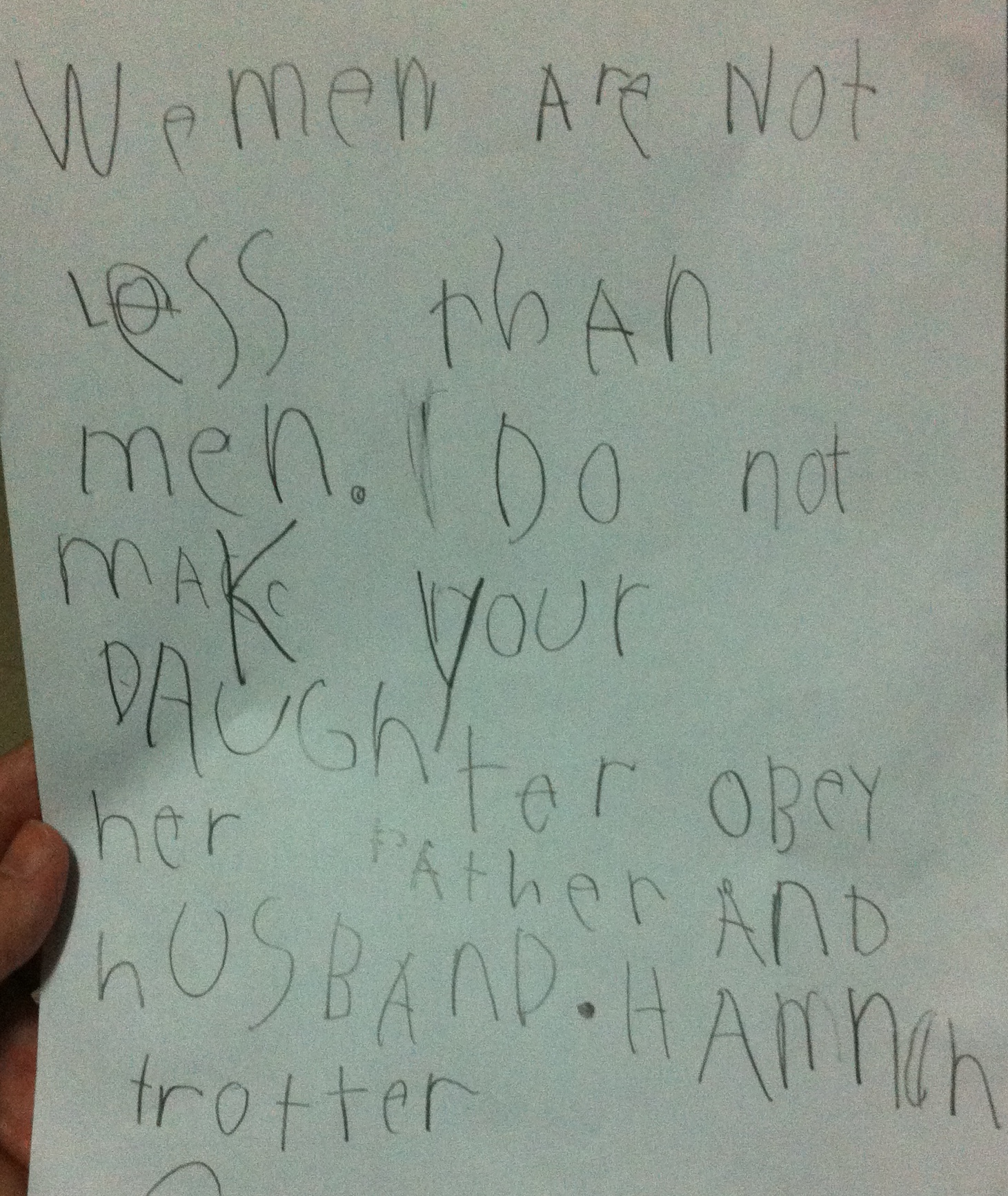
Hannah’s mouth gaped open. My six-year-old couldn’t believe it. After learning that women often make less than men, even when doing the same work, and then hearing that some people make their adult daughters obey them until they get married, at which point “authority” shifts and they have to obey their husbands, she said with shock, “But women are people too!”

The discussion went on for a while, with Hannah asking for more and more details. She seemed pretty disturbed, so I told her, “Hannah, if you really feel strongly about this, write a blog.” Ten minutes later she handed me this…


IMG_2413

IMG_2410

I’m so grateful my daughter has a mother who exemplifies what it means to be strong and kind, bold and gentle, smart and sweet. Elizabeth, thanks for raising my daughters (and sons) to see themselves and others as equally valuable. I love you.

Angry, Mean, and Redeemed {A Life Overseas}

Elizabeth is over at A Life Overseas today, talking about bitterness and repentance. . .

amr

I lost my mind this hot season. Became unglued. Went a little nuts. Whatever you want to call it. Yes, everyone’s crabbier and more uncomfortable this time of year, and it would be mighty convenient to blame my meltdown on the heat. It would also be unfair, for I can’t in good conscience blame the external temperatures for my roiling internal mess.

I’d been angry at some disappointments in my life for a while, and it was spilling out into irritability and rudeness with my husband and children, who did not deserve my unkindness and snappiness. I refused to talk to God about these things because I was convinced He couldn’t change any of the circumstances anyway, and I didn’t want to be even more disappointed by His lack of intervention. So I just kept getting angrier and angrier, more and more irritable, and more and more distant from God.

Finish reading here.

Worthless {A Life Overseas}

Jonathan is over at A Life Overseas today, talking about his feelings of worthlessness and the hope that carries him through.

worthless.b-700x500

I feel worthless.

The feeling rises and crests like an impending wave barreling towards the surface of my heart. And with each wave of worthlessness comes an intense weariness of soul, a near drowning.

The breakers seem to rise from nowhere. I can’t predict them, and that makes me mad. They’re not tied to whether my work or ministry is going well or faltering. They don’t seem to be related to whether or not folks approve of (or agree with) me. They just come. And break.

I wonder if I’m alone. Am I?

Finish reading here.

Paradox and the Hope of Progress

by Elizabeth

The paths of subatomic particles in a bubble chamber.

The paths of subatomic particles in a bubble chamber. Photo source: CERN

A few months ago I came across the phrase “No paradox, no progress” in a science magazine. The quote was attributed to quantum physicist Niels Bohr and immediately grabbed my attention. (Bohr made breakthroughs in understanding the structure of atoms, among other things.) No paradox, no progress?? This statement is as true of quantum mechanics as it is of life.

The phrase really stuck with me and came to mind as I was writing my last installment in the Parsonage Heresies series at A Life Overseas. I didn’t have space in the article to contemplate this beautiful quote the way I wanted to. And at any rate, I couldn’t remember in which article I had found the words “no paradox, no progress,” so I let the idea go. Until now.

When I went searching for the quote in the Place Where All Lost Quotes Reside (also known as The Internet), I discovered that Bohr’s actual words were more akin to “How wonderful that we have met with a paradox. Now we have some hope of making progress.” I love the sentiment from this scientist: we need to give ourselves permission to embrace paradox.

Paradox, that discomfiting feeling we experience when opposites happen at once. Paradox is living in a place where it smells so bad and smells so good all at the same time. Paradox is feeling hope and despair in the same moment. Sometimes we struggle when we cannot reconcile our contradictory facts and feelings, or, in the arena of theology, reconcile seemingly contradictory Biblical passages.

We Western Christians are not very good at making peace with Paradox, are we? Yet without Paradox, our faith gets stuck. Without Paradox, we cling so tightly to our confusion and our contradictions that we can’t move forward in life.

I’ve found that it’s easier in the end — though definitely not in the beginning — to simply accept the paradox of two seemingly opposing truths than to attempt to force them into one truth and lose my faith. It’s better to accept both the good and bad in life and within myself rather than rationalizing any of it away.  After all, Niels Bohr is also quoted as having said “The opposite of a profound truth is another profound truth.”

Bohr’s kind of thinking has strengthened my love for God (He’s so much bigger than I could imagine!) and enriched my study of the Bible (I don’t have to understand it all!). It’s illuminated my past and enabled me to offer grace more fully to other people. I think the more liturgical among us call Bohr’s motto “Mystery.”

Mystery is holding two truths together lightly in our imperfect, human hands, and releasing the need to have one Perfect Answer. Mystery is the reason I’m troubled by extremist theology. Why is it so hard for us, in a trusting embrace of the Father, to hold two truths at the same time? Why can we not hold both that God is mercy, and that He is justice? Why can we not hold both that God is sovereign, and that we have free will (because He gave it to us)?

This Mystery I speak of, it consoles me.  I don’t have to have all the answers. I don’t have to get it all right. I can still believe. Mystery: it’s such a comfort. And in the words of Laura Hackett Park below, what Mystery can give back to us is a Life Abundant.


Now love’s a choice I know it’s true

He never forced my heart to move

But therein lies the mystery

That He reached first in choosing me

He spoke my name the sweetest sound

And to this day I still resound

Now death has lost its hold on me

Now life springs up abundantly

When Ministry and Marriage Collide

by Elizabeth

Jonathan and I have been married almost 15 years now, and I can honestly say being married to him is the best thing that has ever happened to me. We were friends first, then fell madly in love our senior year of high school. Even our first year of marriage – considered by some to be quite difficult – was pure bliss. And I can honestly say that every year after that has grown more joyful and more intimate. This is not to say, however, that we haven’t ever struggled.

I’ve shared before about two of the major struggles in my marriage. I’ve talked about how I didn’t want to move overseas in the first place and how Jonathan and I were at an impasse until God got a hold of me. I’ve also shared my struggle to believe God loves me as much as my husband, since he seemed to have so many more gifts than I have.

There is another difficult season in my marriage that I’ve never discussed online. The two stories I mentioned earlier represent enormous works God wanted to do in my heart and in my spirit. They also had enormous implications in the way I lived everyday life alongside my husband. The struggle I’m going to talk about today might seem more earthy than spiritual, but it still looms quite large in the landscape of my memory.

ministryandmarriage1

Some of you know we served in youth ministry in the States for 10 years. At one point we lived in a Parsonage next door to the church building, and we hosted summer youth meetings in our house. Initially we only invited juniors and seniors to our house on Tuesday nights for Bible study, and I thoroughly enjoyed it. Later we started hosting all ages in our house every Wednesday night during the summer. And every Wednesday night without fail, teenagers trashed my house.

This went on for two whole summers. My house was a disaster every Wednesday night, and I had a breakdown every Wednesday night. Jonathan and I could not see eye to eye on this issue and often fought over it. He felt we needed to have the teens in our home, and that I needed to want to have them in our home, and that furthermore, he believed the teens would perceive my reluctance to welcome them into our home, so I needed to check my attitude.

This, as you can imagine, led to lots of stress in our marriage. I wasn’t confident enough to instruct the teens how to throw trash in the trash cans or how to avoid spilling coke all over my white living room carpet. I’m more confident now and would be able to teach teenagers in that way, but I was too intimidated back then. (Also I was much more uptight about cleanliness when I only had two kids as opposed to now, with four.) I just wanted my husband to kick the teenagers out; I wanted him to do it for me. At the same time I felt an intense pressure to let them in my house every Wednesday, or else I’d be a “bad ministry wife.”

Conflict can happen, even when you’re married to your best friend, even when you are absolutely convinced he’s the only one for you, even when you love practically everything about him. We shouldn’t be surprised when we have disagreements with our spouses. We’re different people, and we’ll see the world differently. And when we feel our own point of view so strongly, it can be difficult to imagine someone else’s point of view.

For any of my old darling youth group members who may be reading here today, please know I love you. And I want you to know I miss you all so dreadfully. I’m recounting a problem that was mine, not yours. Probably any of you who still like me enough to read my blog wouldn’t have been the ones tearing it apart in the first place, but either way, it doesn’t matter. This conflict wasn’t about you.

Two years and many, many fights later, we finally got creative in our problem-solving. We finally thought outside the box. This wasn’t either/or. It wasn’t: have them at our house, or they won’t feel the love. It wasn’t: have them at our house, or I’m a failure. It was: let’s have them at our house and not in. We didn’t cancel Wednesday nights at the Parsonage. Instead, we invited teens into our yard (but outside our house).

We gathered around the fire pit for hot dogs and marshmallows, for long chats and pyromaniac adventures. We played volleyball with the teenagers and let all the youth volunteers’ kids play in our kiddie pool. We swung on the bag swing and climbed up the rope on the oak tree. And it was a great compromise. It was hotter outside than in, that’s for sure, but my husband didn’t have to give up teens at his house, and I didn’t have to give up my sanity, my privacy, or my clean house.

I share this story to illustrate that compromises around ministry stressors are possible. For a long time, I saw the problem one way, and Jonathan saw it another way, and as long as we did that, there was no meeting in the middle. We had to get desperate enough to think about things in a different way, desperate enough try something new. I’m such a black and white thinker that our eventual solution never occurred to me (or my husband). In the end he must have figured he had to do something about his unhappy wife, no matter the ministry cost.

Now I look back and think how silly we were that we couldn’t find a compromise sooner. At the time, though, it didn’t feel silly at all. It felt deadly serious, as I’m sure all marriage conflicts do at the time. It took me a long time, but it was a good lesson to learn: sometimes there’s a solution that isn’t either/or. Sometimes there’s a solution that meets both spouses’ needs at the same time. Sometimes we just need to consider other options.