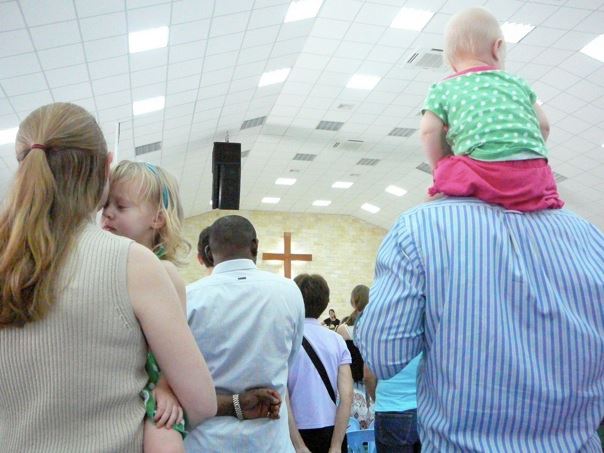
Long before a certain first lady popularized the phrase, the Church has known “it takes a village” to raise a child, to make a disciple. Whether we are parents hoping to shape the soul of a child or adults seemingly in charge of our own spiritual formation, discipleship is not an individual sport. We simply cannot do it on our own. We need help.
Yesterday morning our church held a baby dedication. What a gift to be part of a body whose love for children overflows into the need for once-yearly baby dedications. I’ve seen it before — anyone fellowshipping with Red Bridge Church of Christ in the 1990s witnessed it too — but it doesn’t happen just anywhere.
Watching those parents walk on stage with their little ones, I remembered my own baby dedications. The fresh hope of new parenthood. The weary fog of sleepless nights and never-ending laundry. The overwhelming determination to be a better follower for your son or daughter. And of course those sweet baby kisses.
At the time I didn’t realize that baby dedications are about so much more than committing to raise your kids in church. They’re also about leaning on the wisdom and guidance of others as you muddle through family life. About knowing you have people in your corner, people who believe in what you’re doing and are willing to help you when times get hard.
Now that our kids are older, I find myself able to be that village for younger moms, even as older moms offer the same for me. Just yesterday, in fact, someone ahead of me on the journey checked in on me and encouraged me. I, in turn, did the same for a younger mom — as though our auditorium interactions were illustrating the point of that onstage baby dedication.
During the service, the pastor first asked the parents for their commitment to raising their children in the faith. Then he asked the church to commit to supporting these parents in both spiritual and practical ways. One of the commitments particularly moved me:
“Do you commit, as brothers and sisters in Christ, to continually and lovingly welcome these children into the family of God and affirm their participation in the Kingdom of God, so that they never doubt their belonging amongst His people?”
My eyes welled with tears. Only in the church is this kind of intrinsic, never-fading belonging possible. To be sure, the church gets it wrong sometimes. We have hurt people terribly. I have been hurt. You have been hurt. But when it’s working as God intended, the church is a place for deep, unquestioned belonging. No manmade organization can rival it.
Anna Danforth, Lauren Wells, and the rest of the team over at TCK Training call this “multi-generational belonging.” Kids who receive it feel more grounded and secure, and it helps to offset the difficult things that inevitably happen in life. And it’s something the church has been doing for thousands of years, long before the modern research on Positive Childhood Experiences.
But it’s also something we must commit to in every season, in every generation. For every new baby that’s born, for every new beginning. This kind of belonging doesn’t happen automatically. It happens when we take Christ at His word and welcome a child into our life. It happens when we commit to supporting young moms and dads and when we ask older believers to help illuminate the path for us.
Intergenerational faithfulness is about more than just a baby dedication. It’s about the church being the church for every member, from newborn babe to great-grandmother and everyone in between. Because you belong here — but only if we live like we believe it.