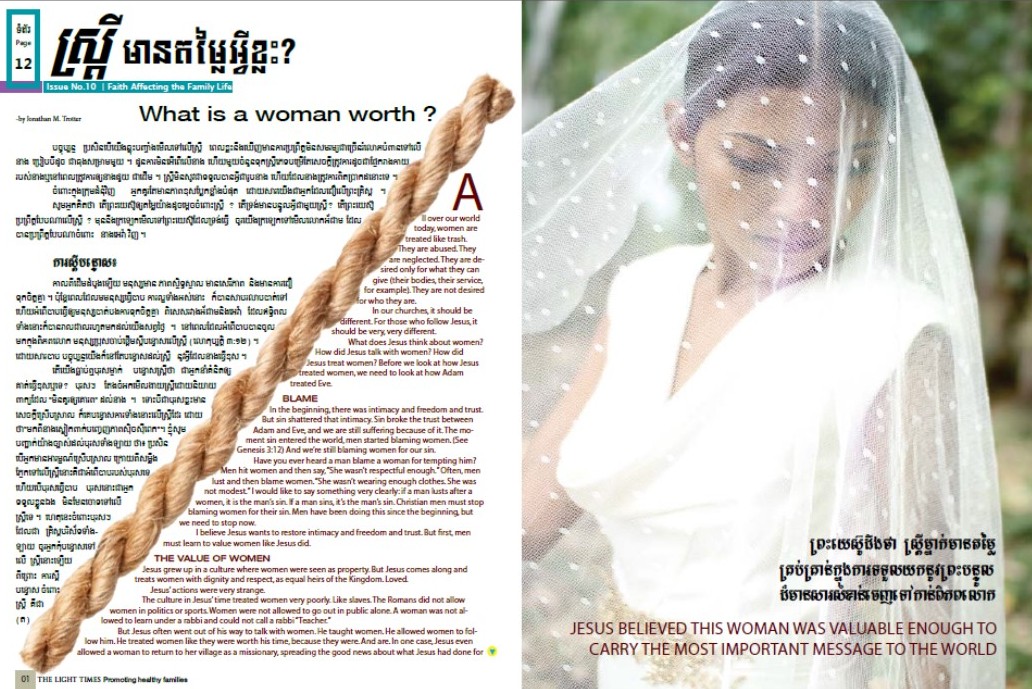
What is a Woman Worth?

This post was originally written for and published in The Light Times Magazine, with Khmer translation done by the magazine editors. Download a PDF of the article (in English and Khmer) here. — Jonathan

wiaww3

All over our world today, women are treated like trash. They are abused. They are neglected. They are desired only for what they can give (their bodies, their service, for example). They are not desired for who they are.

In our churches, it should be different. For those who follow Jesus, it should be very, very different.

What does Jesus think about women? How did Jesus talk with women? How did Jesus treat women? Before we look at how Jesus treated women, we need to look at how Adam treated Eve.


Blame
In the beginning, there was intimacy and freedom and trust. But sin shattered that intimacy. Sin broke the trust between Adam and Eve, and we are still suffering because of it. The moment sin entered the world, men started blaming women. (See Genesis 3:12) And we’re still blaming women for our sin.

Have you ever heard a man blame a woman for tempting him? Men hit women and then say, “She wasn’t respectful enough.” Often, men lust and then blame women. “She wasn’t wearing enough clothes. She was not modest.” I would like to say something very clearly: if a man lusts after a women, it is the man’s sin. If a man sins, it’s the man’s sin. Christian men must stop blaming women for their sin. Men have been doing this since the beginning, but we need to stop now.

I believe Jesus wants to restore intimacy and freedom and trust. But first, men must learn to value women like Jesus did.


The Value of Women
Jesus grew up in a culture where women were seen as property. But Jesus comes along and treats women with dignity and respect, as equal heirs of the Kingdom. Loved.

Jesus’ actions were very strange.

The culture in Jesus’ time treated women very poorly. Like slaves. The Romans did not allow women in politics or sports. Women were not allowed to go out in public alone. A woman was not allowed to learn under a rabbi and could not call a rabbi “Teacher.”

But Jesus often went out of his way to talk with women. He taught women. He allowed women to follow him. He treated women like they were worth his time, because they were. And are. In one case, Jesus even allowed a woman to return to her village as a missionary, spreading the good news about what Jesus had done for her. Jesus believed this woman was valuable enough to carry the most important Message the world has ever seen. (See John 4)

And when it was time for people to find out that he was alive again, the first people to know were women. Women were the very first people to announce the resurrection of Jesus. This was very strange. In that culture, women could not be legal witnesses in a court of law, but now, they are witnesses of the greatest event in history. And they’re telling men all about it. (See John 20)

There is one more story that we must talk about. In John 8, a very vulnerable woman is in front of very powerful men. And Jesus stands in between. Because that’s where he always stands. Jesus always positions himself between religious men and hurting women. When the men want to throw stones, Jesus stands there, protecting, wanting to heal hearts.

We must follow his example.

Ladies, hear what Jesus says to you,

You are loved,
You are valuable,
You are precious to me. 

I made you on purpose, and I love you.
If you have been hurt or abused, I am so sorry.
If you feel shame, remember that I came to erase shame.
When I see you, I do not see shame.
I see the girl I Iove, the girl I died for. 

My daughters are shameless and blameless.
Perfect in my sight.

It is my hope and prayer that the Church in Cambodia would be a place where all people are respected and loved and cherished. Old and young. Rich and poor. Men and women.

Amen. Come, Lord Jesus.

~~~~~~~~~~~~~~~~~~~~~~~~~~~

[page 1 of 2]

I’m Only Here for the Food

by Elizabeth

bread-608920_640

As I’ve worked my way chronologically through the Gospels, I’ve noticed how Jesus keeps telling His disciples that they don’t understand. For instance, when Peter asks Jesus to explain a parable about unclean food in Matthew 15, Jesus replies, “Don’t you understand yet?”

And just a little bit later, when the disciples start arguing about the yeast of the Pharisees, Jesus says in exasperation, “Don’t you understand even yet? Why can’t you understand that I’m not talking about bread?”

Then in Mark 6 after Jesus walks on water, gets into the disciples’ boat, and calms the wind, the text says that “They were totally amazed, for they still didn’t understand the significance of the miracle of the loaves. Their hearts were too hard to take it in.”

Now if I had been one of Jesus’ disciples, I might have started taking offense at His constant accusations. What do you mean, Jesus? My heart is too hard to take in this miracle? Just how stupid do You think I am??

So by the time I got to Jesus’ words in John 6:26 — “I tell you the truth, you want to be with Me because I fed you, not because you understood the miraculous signs.” — I started to think that for all the thousands of years and countless sermons and Bible commentaries standing between me and those poor dense disciples, perhaps I don’t understand the big picture, either. Maybe I don’t understand the significance of it all.

Because His miracles still amaze me. And because His power still impresses me. And because, truthfully, I can only echo the words of Jacqueline in the movie Ever After: “I’m only here for the food.”

All I know is that I keep coming back to Jesus because He feeds me.

In this passage Jesus is talking to some of the 5000 He’d fed the day before. They had witnessed His wonders. They had seen His signs. Yet Jesus knew they weren’t there for the right reasons; they were only there for the food.

And I start to wonder, do I really understand this Jesus business?? Or am I completely missing the point?? If I’m only here because He feeds me, what is it that I’m not quite getting??

But then Jesus seems to go off the deep end in verse 35 and claim that He’s the bread of life. Huh?? The bread of life? As in, getting my nourishment from Jesus? You mean that maybe, just maybe, the way I survive is the way Jesus actually wants us to survive??

So maybe I’m not too terribly far off base here. Maybe it’s ok that I’m only here for the food, that I’m only here for the Bread of Life. I still might not understand the true significance of the miracles, but He feeds me, and that’s all I care about.

I’m with Peter, who, when asked just a little while later if he was going to desert Jesus like so many others had, answered, “Lord, to whom would we go? You have the words that give eternal life.”

Amen to that, Peter. I’m putting a stake in the ground along with you. For truly, Lord, to whom would we go? You are our food and You are our drink. You are the True Bread that came down from Heaven, and we’re only here for You.

Sometimes I Hoard God’s Love

by Elizabeth

bitter-chocolate-230307_640

I’m always ready to receive good gifts from the Father. Then again, who isn’t??

And in using the word gifts, I don’t mean material possessions, but rather the little (and big) evidences of God’s Love in my life.

I know God loves me. I know He made me and that He wants to give me good gifts.

Then, in a total disconnect, I look at people who’ve hurt me, and I don’t want them to receive good gifts. That’s not fair. They don’t deserve that, you see. They’ve hurt me.

I know this way of thinking is wrong, yet I cling to it anyway — until one day I was driving along the scant Kansas countryside and the words of Jesus came to me. HARD.

“You parents—if your children ask for a loaf of bread, do you give them a stone instead? Or if they ask for a fish, do you give them a snake? Of course not! So if you sinful people know how to give good gifts to your children, how much more will your heavenly Father give good gifts to those who ask Him.” — Matthew 7:9-11

I’ve hurt other people, yet He still bestows loving gifts upon me. Then I turn and I don’t want Him to lavish His love on other people.

But I realized: I don’t deserve those good gifts from my Father either. And doesn’t He love other people as much as He loves me?? Doesn’t He want to give good gifts to them as much as to me??

God loves everybody equally; I universally believe this. 

In my head. 

But my head needed shaking and my heart needed stirring.

Because He wants to give good gifts to people who have hurt me, in the same way I want to give good gifts to all my children equally, no matter what they’ve done and regardless of how they treat one another.

I can have a pretty rotten heart sometimes, yet not only does God want to give me good gifts, He follows through on it: He actually gives me those gifts. Gifts I receive with an open heart and an open hand.

But I clench my hands back up again when I think about Him giving good gifts to other people.

So right then and there on a sunny day on the open highway, I opened up my hands again and said, “I’m glad you are a good Father to me. And I know You want to give good gifts to people who’ve hurt me. I think I want to be glad about that now, too.”

Because if I’m not glad about that, about a loving Father who takes good care of an imperfect child, then I can’t possibly expect to receive good gifts for myself, a fellow imperfect child.

These logical-sounding words describe what was actually a very palpable shift in my heart. A shift of love towards those who have trespassed against me. A new understanding of God’s parental love. And another release of bitterness from my soul.

So I thank Him. I thank Him for the good gifts He’s given me. I thank Him for the good gifts He’s given others.

I choose not to hoard God’s love for myself. 

For He is a good Father to all. And I am glad.

Confessions of a Lost Sheep

by Elizabeth

urban-998216_640

Sometimes I feel a bit lost. Not in an eternally-lost-and-I-don’t-have-a-Savior kind of way, but an I-don’t-know-where-I-am-and-I-don’t-think-anyone-else-does-either kind of way.

Because life keeps on going, unchecked and unthrottled. I feel confused, out of touch with myself. So much is happening, what do I even think or feel about any of it? I’m here, but I’m not really here. And I don’t quite know where the real me is.

I don’t know where I am. I’ve lost my way. Who is going to find me? Can anyone find me?

So I cried out, “God, I feel so lost! So lost, so lost, so lost. Jesus, find me. Will you find me? Will you please find me?”

And Jesus, sweet Jesus, He directed my mind to the parables of the lost sheep and the lost coin.

I figure that as long as He’s talking to me, I should probably listen.

So off I went to Luke 15, where Jesus says, “If a man has a hundred sheep and one of them gets lost, what will he do? Won’t he leave the ninety-nine others in the wilderness and go to search for the one that is lost until he finds it? And when he has found it, he will joyfully carry it home on his shoulders.

When. Not if. But when he has found it.

A few moments later Jesus tells us, “Suppose a woman has ten silver coins and loses one. Won’t she light a lamp and sweep the entire house and search carefully until she finds it? And when she finds it, she will call in her friends and neighbors and say, ‘Rejoice with me.’”

Again, not if, but when. When she finds it.

All this searching and sweeping, all this tracking and seeking and lighting of the lamps. All these details and all this grunt work, just to find one who’s been lost.

And I remembered, all over again. I remembered I have a Shepherd. A Shepherd who is good. A Shepherd who knows His sheep.

I may not know where I am, but I have a Good Shepherd who knows where I am. Better yet, He knows me, and He wants to find me.

Even when I feel lost, He knows where I am. When I can’t find my way out, when I can’t find my way back home, He can find me.

It’s time to trust that He’s going to.

The God Who Wants to Hear Your Story {Velvet Ashes}

Elizabeth is over at Velvet Ashes today. Here’s a preview. . .

genesis-16-8.2-726x484

I’ve always loved the story of Hagar. I simply thrill at her proclamation of “the God who sees me.” I scoop that name up and tuck it into my heart, and I pull it out when I feel alone, lonely, and unseen: El Roi.

I’m sure you all know the story. Sarai’s inability to conceive had prompted her to give her servant girl Hagar to her husband Abram, hoping to have children that way. When Hagar became pregnant, her prideful attitude embittered her mistress Sarai, who in turn treated Hagar so harshly that she ran away. When we meet Hagar in Genesis 16, she was probably heading back to her native Egypt.

Until recently, my main take-away from this story had always been Hagar’s name for God. But there’s something else going on in this passage too, something I’d never noticed before. In verse 8 the Angel of the Lord asks Hagar, “Where have you come from, and where are you going?” God is basically asking her, “What’s your story?”

Read the rest of the post here.