
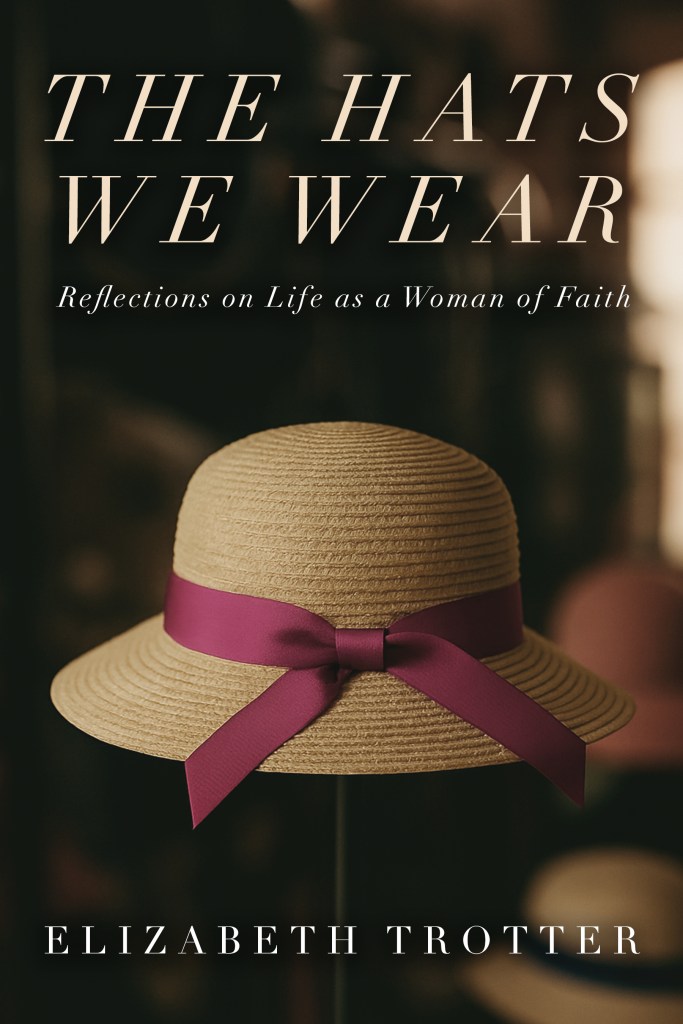
The Hats We Wear (introducing Elizabeth’s new book!)

Now available in print, Kindle, and on Audible! Check it out on Amazon here.

I’m so excited about this book. For the last few years, I’ve been dreaming of publishing an updated version of my original Hats: Reflections on Life as a Wife, Homeschool Teacher, Missionary, and More, and it’s finally happening!

There’s tons of new material in this book. It’s nearly twice as long as Hats, but I also took out about half the original material, as it was reprinted in Serving Well. I reorganized the sections and fully edited each chapter, so this is very much a brand-new book.

Matthew Stock designed this beautiful cover, coordinating it to Jonathan’s Digging in the Dirt while also reflecting the original Hats cover that Jonathan created for me.

So that you can get a better idea for what this book is all about, I’m going to share the back cover material for The Hats We Wear, along with the new preface and the original preface from 2018. Enjoy!

Back Cover

Little girls don’t know they’re going to grow up to be women who wear so many hats. Daughter, sister, friend. Professional, mother, wife. Our hats can weigh us down, and our vocations can exhaust us. The roles we inhabit stretch us in so many directions that we sometimes fear we will break.

Sometimes we even forget who we are.

In The Hats We Wear, Elizabeth Trotter takes us back to the beginning, to the foundation of our faith and who we are as children of God and daughters of the King. She explores our intense emotional worlds and the work of embodied living, then leans into the three specific hats of marriage, motherhood, and homeschooling.

Join Elizabeth on this journey of reflection. Walk with her as she seeks God amidst the hats of female life. Sit with her in the mundane and the sacred. Wrestle with the practical and philosophical implications of living life as a woman of faith.

As you read, you’ll meet someone who frequently does things the hard way first, flailing around worrying and wasting time on unnecessary details. But in seeking the Lord and listening to the wise people in her life, she eventually finds a path forward. 

She invites you to do the same.

Preface to The Hats We Wear (2025)

In the spring of 2018, my husband Jonathan decided to surprise me with a sweet Mother’s Day gift: a book of my writings about womanhood. He gathered articles I’d written on theology, marriage, motherhood, and homeschooling and published the collection on Amazon. He called it Hats: Reflections on Life as a Wife, Mother, Homeschool Teacher, Missionary, and More. I loved the cover he designed and was grateful to have a lot of my writing in one place.

The next year, however, Jonathan and I published Serving Well: Help for the Wannabe, Newbie, or Weary Cross-cultural Christian Worker, and much of the material in Hats was republished there. Over the years, I kept writing, and eventually I realized I wanted to update Hats, adding some newer content and removing duplicate material, much of which related more to my life as a missionary in Southeast Asia than to the broader conversation of Christian womanhood.

So for this version of the book, I removed a dozen chapters and added over twenty-five more, keeping only sixteen from the original twenty-nine. I wanted to distinguish this book from Serving Well, which focuses on ministry life, though I did keep a few chapters which are too foundational to my life and faith to remove. I’ve thoroughly edited and rewritten each chapter, so this is basically a new book.

The first three sections are hats that all women wear, regardless of whether they are married or have children: the practical theologian, emotional human, and embodied woman hats. Then in the second section I dig into the more specific hats of wife, mom, and homeschool teacher. I hope that the words contained in these pages will resonate with your lived experience and that we will forge a bond across space and time.

In preparing this book for publication, I was struck by how similar my struggles have been throughout my life. How wise my past self seemed, fresh from the fires of learning a lesson I find myself re-learning in the present. We are forgetful creatures, and so the Lord must teach us again and again. Is it any wonder He tells us so often to remember?

And so I offer these stories to you, trusting that they will speak to your heart and mind through the goodness of the God who calls us to Himself. May we seek Him first, above all others.

Preface to Hats (2018)

No matter your background or experiences, being a woman is hard. That’s partly because being a human is hard. It’s also due to the many roles we women tend to carry in life. Daughter, sister, friend. Professional, mother, wife. Marriage and motherhood are indeed holy vocations, and they require much of a woman. Whether we work outside the home or from within it, our vocations sometimes stretch us so much that we fear we will break.

The truth is, there’s not a lot of preparation for marriage or motherhood. Certainly, we can read books. We can read books on how to have a great sex life or how to build a godly marriage or how to live out biblical submission, but when it really comes down to it, we marry a human person, not a book, and our husbands also marry a human person—us. A lot of marriage is simply trying new ways of doing things and seeing if they work (including, at times, seeking professional or pastoral help).

It’s the same with motherhood. We can read books on natural childbirth, healthy homemade baby food, and the most godly parenting—or the most logical. But nothing can really prepare us for meeting our child, some mysterious arrangement of our own DNA, or someone else’s. No one can prepare us for their likes or their dislikes, their strengths or their weaknesses. We have to discover these things for ourselves, over time.

What follows in this book is precisely that: the things I’ve discovered over time. There are articles and essays on marriage, motherhood, homeschooling, and the Christian life. In case you don’t know me, here’s a bit of background: As of this writing I’ve been married for nearly eighteen years, having gotten married at the age of eighteen. I’ve been a ministry wife almost that entire time and have been living overseas as a missionary wife for the past six years. I’ve been a mom for fourteen years and have been homeschooling for nine. This book is my lived experience wearing all those hats.

Find The Hats We Wear on Amazon in ebook, paperback, and audio book versions.

When Your Baby Dies | A Mother’s Journey, part 2

Read part 1 here.

~~~~~~~~~~ September 12, 1987 ~~~~~~~~~~

Laura died September 1. We brought her home Friday, August 28 after taking her off the ventilator. Everyone expected her to die then.

I know there is much comfort in having the memory of her dying in my arms at home rather than hooked up to the equipment in the hospital. It was very peaceful and I’m really grateful for these memories of her last days and final hour.

I have hesitated to write down my deepest feelings — somehow writing them down will make them more painful; like setting them in stone or something. Our house is still full and active and bursting with children’s activities (soccer, etc.) and music and friends.

The baby things are slowly being put back in the attic and that has not been as painful as anticipated. The things were used (the mobile) for 3 days and that makes packing them up easier.

My body is the worst reminder. Big and fat, ready to nurse a baby — 30 pounds overweight. It’s the worst reminder of all. Usually I have an unsightly body for 3 months but it’s balanced with the joy of a beautiful baby — not a high price to pay. Now it’s just the thought of having to lose the weight, wanting to get pregnant again.

My body, however, is so strong and healthy I hate to be too critical of it. After all, I had a baby, left the hospital three hours later, and went nonstop for three weeks. How can I hate a body that serves me so well?

Tomorrow is church. I’m already dreading it.

People don’t know what to say — what do I say? I’m fat, what will I wear? It’s terrible to feel like everyone is looking at you wondering “how you really are.” Are you going to crack up? I don’t think so. I hope I can reassure them of that.

Yesterday I went out with a friend and her new baby. A lady at the store asked me when my baby was due. I said I had had her and she had died. It wasn’t hard to say — it was just a bleak reminder of the truth.

I went through a pregnancy (never a fun event), had a baby, and now I don’t have one in my arms. And that is the saddest part.

Laura couldn’t have survived; I didn’t even want her to. Her body was not compatible with life and I was actually very much at peace with her going on to God and getting a new body. But that still has left me with empty arms. And I will live through that too. My hope is so strong for another baby. I don’t know when, but I feel like I know God has promised me a healthy baby and that hope gives me comfort and energy to get through these next weeks.

11700914_10155799979470621_7058433992366189007_n (2)

Laura Beth Trotter

August 14, 1987 — September 1, 1987

A Master List of My Home School Posts

by Elizabeth

roller-skates-381216_960_720

Hello fellow moms and home educators! The following is a master list of the articles I’ve written on motherhood and home education, now conveniently in one place, with motherhood skewed toward the top of the list and homeschooling skewed toward the bottom, and with missionary life sprinkled in here and there.

You might also be interested in my new book, The Hats We Wear: Reflections on Life as a Woman of Faith, which addresses six different aspects of being a woman of faith, with sections on spirituality, emotions, and embodied living, as well as marriage, motherhood, and homeschooling.

And if you’re feeling stuck on the homeschool journey, I’d love to help! I also offer homeschool consulting.

I’m a Proverbs 31 Failure

I have this vague notion that the modern Proverbs 31 woman stays at home with her (many!) children, educates them at home, makes all their (organic!) meals from scratch, enthusiastically serves her church community, and, after all that, is still (frequently!) romantically available to her husband. And while there is certainly nothing wrong with any of these endeavors individually, I personally cannot live up to all these expectations at once.

Intensity and Intentionality {a note about marriage and motherhood on the field}

In many ways marriage and parenting on the field is the same as it is in my home culture, but its intensity level is higher. Missionary life simply requires more of me, and in order to match its intensity, I have to be intentional about taking care of both myself and my family. I have to daily turn my heart toward them and toward God. When I don’t, the consequences are great. But when I do, the reward is greater still.

“Me Too” Moments

I always feel so discouraged about motherhood on Sundays. Sundays completely wear me out, taking care of my youngest children’s needs. I feel so out of my league. I think about all the mom blogs out there and wonder how these women have all this energy just to spend on their kids’ intellectual and spiritual development? I’ve got sin issues of my own that need working out; how can I give 110% to each kid???

What I Want to Give My TCKs

There’s something else I want to give my TCKs, and that’s privacy. I’ve chosen a very public profession; my children, however, have not. They may go wherever I go and live wherever I live, but they didn’t choose to live a public life the way I did. Perhaps when they’re grown, they will. I don’t know. I only know I want to give them the luxury of choosing it for themselves.

A Prayer For My Third Culture Kids

My child, I’m well aware that in this life, not everyone gets married. But should you happen to marry, first and foremost I pray you will marry a fellow lover of Jesus. And then — oh then I pray you will marry someone who feels at home in the In Between spaces, who knows how to live in the margins of life, who’s comfortable crossing over and blending in, even if never quite fully.

On Not Being the Casserole Lady

Sometimes I think about people with the gift of hospitality and get this gnawing, guilty feeling. Why can’t I be more like them? I wish I could, for hospitality seems like the Real Spiritual Gift. Delivering meals to doorsteps, inviting large groups into your home for meals, hosting people long-term as part of your family — this all sounds so very first century Christian. I sigh and start to think I must not measure up.

I’m Not Supposed to Have Needs

The idea that “other people’s needs are more important than my own” sounds very spiritual. It sounds very sacrificial and giving. But we are all of us humans, created and finite beings with limited resources. Our lives are powered by the Holy Spirit, true, but none of us can survive if we think we are only here for others, or if other’s needs are always more important than our own.

These are the (Mon)days of Our Lives

The boys were screaming, “Her finger! String! Her finger’s stuck on some string!!” I ran in, and looked, and sure enough, my other daughter had wrapped a string around her finger. The top third of her index finger was already dark purple, and the threads looked deep. I told the boys to go get the scissors, but I was able to untangle it before they returned.

Sometime We Eat Cereal For Supper

Sometimes I bemoan the fact that I can’t do everything all the time. That I can’t seem to get my life in order and pull myself together and balance all the needs. But maybe I’m not supposed to. Maybe every day isn’t supposed to contain every thing. Maybe each day is only supposed to contain some of the things. Maybe something is always going to fall through the cracks.

The Little Word That Frees Us

We talk a lot about Missionary Kids (MKs) being Third Culture Kids (TCKs), but we talk less often about another aspect of their lives, the Preacher’s Kid (PKs) aspect. These MKs of ours, these kids we love so fiercely, are both TCKs and PKs. They deal with both the cultural issues of TCKs and the potential religious baggage of PKs. It’s the religious baggage that I want to talk about today.

That Time Paul Talked About Breastfeeding

You need a lot of stamina. You don’t sleep through the night for months on end. Sometimes you get painful mastitis or yeast infections. You have to keep up your water and calorie intake. To your embarrassment, you leak milk everywhere. Or you have to work hard to make enough milk. Sometimes you can’t figure out for the life of you how to make this child stop crying, but somehow you have to stay calm while you do it. On top of that, you’re basically tethered to your child because you don’t know when they’ll need to eat again. You sacrifice many things for this child, this child whom you love so tenderly and so fiercely.

The Thing That Happened While I Was Scrubbing the Kitchen Floor With a Toothbrush

For me today, obedience means looking at the people who are already in my life, and saying yes to THEM. It means saying no to certain other things. I’m finding that as I practice my yeses and nos, I’m more content in each moment. I’m more joyful in each moment. I’m more present in each moment.

On Your High School Graduation: A Letter to My Third Culture Kids

I must say goodbye to you like this, no matter where in the world I live. And when you do leave, there are things I want to tell you. Things like. . . You are my child. You are now an adult, and I’m proud of who you are, but you will always be part of my family. Our home can always be your home.  No matter where we live, we will always welcome you into it.

7 Thoughts for Graduating TCKs

If you let them, the questions of home, belonging, and identity that your TCK childhood has asked you to answer can take you deeper into the heart of God than ever before. If you’ll take the time to look for Him, you’ll find Jesus on the other side of every question you have. Only Jesus can help you live an unhindered life. His is the face of love, and He is the answer to every question you’ll ever ask. So go with Him: there is redemption on this road.

You Don’t Have to Home School Preschool

Here is what you actually need for the preschool years: a home full of life and love. And books. Lots and lots of books. Kids learn so naturally at this stage, and they’re interested in so many things, that there’s no need to do anything formal.

Dear Homeschool Mother of Littles: Don’t Give Up

One of these days it’s going to be worth it. You’re going to turn around and find that everything you’ve been working towards and everything you’ve been longing for is finally coming to fruition. It’ll all be right here, right now, today. Just keep going.

The Home School Manifesto

We will commit to seeing our children as whole, integrated beings and not as students only, and we acknowledge that their scholarship — whether high, low, or somewhere in between — is only one aspect of their personhood.

6 Things I’ve Learned From 6 Years of Homeschooling

When I was first exploring the idea of homeschooling our children, a woman at church told me very matter-of-factly that in order to homeschool, the mom has to really want to. She told me how her husband had wanted them to homeschool. She wasn’t opposed to it and thought she would try it out for him, but she just wasn’t all that interested in it. She was the one who had to do the teaching, not her husband, who had originally wanted it. Eventually, they quit, but it wasn’t the end of the world. They just sent their kids to school, and mommy was happier.

Let Me Tell You About Kassiah Jones

That Friday I took the first of what I’m now calling a “Kassiah Jones Day.” I canceled home school. I played games with my kids. We watched sciences videos in the air conditioning. I read more than usual to them. I’m with them all the time, but I don’t always share enjoyable activities with them. Instead I focus on finishing our lessons, and then in my “free time,” I work.

After 8 Years of Homeschooling, I’m Giving Up

For years I avoided the way “expert” homeschoolers scheduled their school year, with six weeks on and one week off. I was afraid that kind of rhythm would make the school year last forever and that I wouldn’t have a significant enough summer break to recharge. Who wants to do school all the time?? And school all the time is exactly what that approach sounded like. I opted for the “traditional” school schedule instead.

Two Sanity-Saving Home School Practices

Later I spoke with my husband – who was himself homeschooled – about these things. He agreed that my expectations had been ridiculously high and supported my effort to find more reasonable expectations.

8 Practices That Are Revolutionizing My Parenting

I’m understanding more fully that we are not looking for perfection – in ourselves or our children. We’re looking for progress. For growth. My husband likes to say, “All learning happens one step at a time.” It’s plastered on the wall of our home school, in fact. But though we had pounded that fact into our children’s heads (with varying degrees of success), it had not yet reached down into mine.

Unrealistic Expectations (Home School Burnout Part 1)

I got to the end of most school days and didn’t want any more kid-interaction. I just wanted to quit and go hide somewhere. I wasn’t playing games with my kids anymore, I wasn’t reading aloud to them, I wasn’t enjoying them. I felt guilty about my lack of interaction. I complained to my husband that homeschooling was stealing my motherhood. This wasn’t what all the home school speakers and writers promised would happen if I chose to home school. Everything was supposed to be peaches and cream! Rainbows and butterflies! Pony rides in May sunshine!

“Mom Fail” (Home School Burnout Part 2)

So when the first Monday of summer break came around, I took a break from parenting — almost literally. I let myself be a “bad” mom: I locked myself in my bedroom and let my children watch movies. All.day.long. I didn’t talk to them, I didn’t read to them, I didn’t play with them. It was a total “mom fail.”

The Mean Mommy (Home School Burnout Part 3)

I began to see that I was aggravating the homeschool stress through my reactions and attitudes. Busted! God was convicting me big time. You mean this all came back to me? You mean I’m the problem here? I didn’t want to admit that. I would rather blame my issues on something outside me. I really couldn’t though.

Resources for the New and the Weary (Home School Burnout Part 4)

For me, recovering from home school burnout was about addressing spiritual and emotional issues, as well as practical issues. Here are some resources that helped.

How to be a Temporary Trailing Spouse

As many of you know, Jonathan was homeschooled, and I wasn’t. When we started our family, I just figured we would homeschool because Jonathan would want that. After a few years as a mom, however, I wasn’t quite so sure anymore. I was afraid I’d do it poorly. I was afraid I wouldn’t enjoy being with my kids ALL DAY. I was afraid that life would consist of only one thing: schoolwork.

Going Back to (Home) School

This year in our curriculum, we studied ancient history, from the first recorded accounts in Mesopotamia, to the fall of Rome. This means our studies covered the entire time period of the Bible, including both testaments. And I discovered: I did not know as much as I thought I knew.

Daughter

We’d been studying China, and the art materials came from our curriculum’s China Kit. We mixed the ink ourselves, used special brushes on special paper, and stamped our work in red at the bottom.

Homeschool Math Curriculum Reviews from an Engineering Mom

I LOVE math. I got so excited when my oldest started studying the coordinate plane in algebra that I began drawing on the walls and talking about trigonometry and calculus (see photo below). That was way too much, way too soon, and my husband had to pull me back from my adventure in Mathland before my student’s brain melted down. Now I know not to get too ahead of myself.

Thoughts on Teaching Writing from a Writer/Editor Mom

I remember something Susan Wise Bauer said once. It was something to the effect of, “Good writers intuitively know how to construct sentences, paragraphs, and papers that are beautiful and logical, but they’re not sure exactly how they do it.”

That means that if writing comes easy for you, you might not know how to explain the process to someone else. But students who struggle with writing need explicit guidance. And so do their teachers.

Some Liturgies You Can Add to Your Morning Times

I don’t know if you do a “morning time” in your homeschool or if you have evening devotionals with your family. But I do know a few liturgies that have been helpful to our family, and I wanted to share in case you want to add any of them to your worship times.

Two Questions I Always Ask Homeschool Moms

The two questions I always ask young moms are the two questions they sometimes forget to ask themselves. These two areas are the bedrock upon which a healthy, happy homeschool is built.

What Subjects Should a Busy Homeschool Mom Prioritize?

Homeschool moms often tell me how difficult it is to squeeze every subject into every day. This is especially true when it comes to families with multiple children or families on the field, where ministry can take up a chunk of each day.

And I tell their worried hearts that it’s ok not to do every subject every day. But I also tell them that there are certain subjects they do need to do every day.

What You Need to Know About Homeschooling High School

When I speak with moms who are nervous about homeschooling high school — whether their kids are in middle school or even in upper elementary school — I tell them two things. 
8 Practices That Are Revolutionizing My Parenting

by Elizabeth

heart-826933_960_720

The speaker at church was encouraging us to look to God for mercy and healing, and then when God has healed you, to remember to thank Him. And suddenly I stopped, because I thought about all the things I’ve asked God for in the past, and I realized that I’m currently in a season where I’m living into some long-awaited dreams and receiving help for some long-asked-for requests.

Most of those prayers have to do with my parenting. I’m always praying to be a better mother — because I so often feel like a failure of a mother. Looking back that day, I started seeing that I am a different Mom than I used to be. And I’m a different wife. Not in every way and not in every moment, but I’m a person much more at peace in myself and in my circumstances. This is the fruition of long-awaited prayers.

The changes were slow and imperceptible, and I didn’t even know it was happening at the time. I didn’t even set out for it, I don’t think. But I think I know some of the ways it was birthed. Many of the changes I’m going to talk about relate to homeschooling, but much of what I’m learning could probably apply to all parenting if you change some of the verbiage.


1. I started listening to different voices, and slowly I started thinking differently. I used to keep up on a lot of post-fundamentalist news like the falls of Bill Gothard, Doug Phillips (of Vision Forum), and the oldest Duggar son. I was obsessed with needing to know, after having read a book on fundamentalist home school cults several years ago. I feared being part of the same “machine” that created these home school disasters. I got lost in cyberspace any time I had the chance. I would fall down an endless rabbit hole of meaningless blog posts and podcasts.

I don’t do that anymore. Not that I don’t occasionally get lost in cyberspace, but that I am much more selective with my influencers. I don’t need knowledge of the most recent evangelical disasters in order to mother my children well, to nourish my own spiritual life, to connect with my husband, or to serve in local community. Instead I need encouragement and inspiration for the day at hand.

Now I listen to Sarah Mackenzie (of the Read Aloud Revival podcast and the book Teaching From Rest, which continues to do its work on me), Brandy Vencel (of Afterthoughts blog and the Schole Sisters podcast), Cindy Rollins (of the Mason Jar podcast and the book Mere Motherhood), and their influencers: the speakers and writers at the CiRCE Institute (my favorites are Angelina Stanford, Christopher Perrin, and Andrew Pudewa).

They’ve changed my thinking on education, its purpose, and its practical implications. They’ve stirred in me a hunger for discovery that I used to have, that got lost along the box-checking, high-performing, competitive way. They’ve inspired me to start reading poetry again.

And I listen to the artists and makers at the Rabbit Room (my favorites are Rebecca Reynolds and Andrew Peterson). They have pressed me further into the reality that I’m an image-bearer of God, and they’ve fortified my understanding of creativity and art. I’ve followed their lead in embracing the physical world, and as I’ve done so, I’ve become more fully human — and a more complete human makes a better mother.


2. I’m wrestling my perfectionism even more heavily than before. It pops up in the unlikeliest of places, doesn’t it? You think you’ve conquered it, but then you realize you are still drowning in lies. I was trapped in lies about what it meant to be a successful mother. I was trapped in lies about what it meant to send well-educated young people off into the world. I thought it had to be perfect. I thought there had to be zero educational gaps. I thought I had to prove my intellectual worth through my children’s performance. That’s a lot of pressure to live under.

I’m understanding more fully that we are not looking for perfection – in ourselves or our children. We’re looking for progress. For growth. My husband likes to say, “All learning happens one step at a time.” It’s plastered on the wall of our home school, in fact. But though we had pounded that fact into our children’s heads (with varying degrees of success), it had not yet reached down into mine.

I’m trying to put school in its proper place by giving it neither too much mental weight nor too little time. A bad day doesn’t bother me as much anymore. (A bad week, yes. But a bad day or two, no.) So what if the math assignment bombed? So what if the writing assignment took half the day? We’re not looking for perfection here, just steady work and steady improvement over time – and that means accepting setbacks with calm and patience.

Even if a child “loses it,” I don’t think the day is a bust. I know every day is a learning opportunity, and the days stack up to years, and there’s always tomorrow to try again. I’m staying calmer and speaking more gently so I can look back at the end of a hard day with less dissatisfaction and fewer regrets. But I remember that even if I lose it, I can acknowledge it, seek forgiveness, and start again tomorrow.

[BONUS TIP: Their education will have holes. Yours does. Mine does. Everyone’s does, no matter where or how their education took place.]


3. I’ve stopped putting my educational trust in curriculum. I used to want to find a curriculum that was “perfect” (see the pattern here?). And I wanted that curriculum to basically be the teacher. I wanted to leave it alone and let my children become educated by it. I was saving my brain space for writing, you see. It was all about checking boxes so I could get away and get alone and fulfill my “real” calling.

But over and over again, I became frustrated by published resources. They’re never exactly what I want, so I go looking elsewhere for perfection. It has taken me the greater part of 8 years to figure out that not only can I adapt a resource, but I must. I must tailor my children’s education to them. They are individuals. I have to use my brain. I can’t “save” it for later. I can’t get lazy.

I have to engage with where my children are at that moment, both scholastically and emotionally. Where they are is the only place to begin, the only place to build from. And in truth, my children are my real calling. Not writing. They, and any human being placed in my path. [Note: this also explains why I publish much less frequently than I used to.]

How I teach now is much more akin to coaching or tutoring — which is always what I said I enjoyed more anyway. And it’s much more satisfying. I see the struggle; I see the progress. I see the child. I’ve learned I don’t even need curricula for some subjects – I can make them up myself (like writing), be a more hands-on teacher, and even get to experience the joy of better results. I’m leaning into these ways and gaining confidence that I can do these things. I don’t have to trust a boxed curriculum.

[BONUS TIP: I had to stop thinking of my children en masse. They are not a herd. My family is a collection of individuals with differing temperaments and abilities. It’s easy to think of children as a group when they’re young, but as they grow, it becomes more and more important to see each child as an individual.]


4. I’m broadening my understanding of education. I touched on this in #1, the voices I’m listening to. I used to put my children’s education – or at least my contribution to it – in a box. Education equaled core work only. Education wasn’t art or creativity or movement or theology or finances or health or real life. I didn’t “do” real life. I did academics. But I’m realizing that these things are part of organic family life, part of all life.

If I’m engaged and not locked in a corner, I will naturally teach these things (alongside my husband who is already a natural teacher). I will encourage their creativity in art and architecture and storytelling. I will not think of these things as adjunct or auxiliary. They are central to becoming a fully human being. I don’t need to be afraid that art or sports or relationship will steal from my children’s robust-enough education. I can welcome them into our home and into our life.


5. I’m beginning to embrace assessment, and we’ve sought outside help for certain difficulties. I used to despise standardized testing as I thought it unnecessarily stressed students out. And I still believe it does, for young students. But for older students, it can be a learning experience in which they learn how to take a test that can give some reassurance to both parent and child for work well done.

Separately, we reached a point with certain issues where we needed some outside perspective. Reaching out for help was the beginning of a journey to accept my children for who God created them to be, not who I imagined they would be. These assessments have given me the grace to accept my children as they are, while also gently stretching their capacities. And armed with new knowledge, I have better strategies for teaching my students.

The testing gave me the courage to take a long, hard look at myself and see my own difficulties reflected in my children. It allowed me to embrace differences between how I assumed my children would behave, and how they actually behave. It’s helped me to better accept children who are the same as me as well as those who are different from me. And we have a lot more joy and connection.


6. I’ve purified the schedule, and I continually work to keep it that way. As is my custom, I chose a word for the year. This year the word was “Purify.” After last year, in which I “flirted with burnout,” I wanted to purify my schedule. And I did. What I didn’t realize was that God would also work to purify my beliefs, challenging me to confront and remove those lies of perfectionism I was still clinging to (see point #2). Believe me, that purification did not happen without intense times of prayer and many, many tears.

But anyway, back to the schedule. I’ve simplified my own schedule and commitments, along with our school schedule. I’m combining subjects, chucking some altogether, and giving ourselves much more manageable weekly assignments. We have more time to rest, relax, renew, and reconnect. And to ensure that this happens, I’m learning better how to unplug from the internet.


7. I’m remembering the importance of pre-teaching and review. Why I neglected this before, I’ll never know. One of my professors in college used the entire first 15 minutes of a 75 minute class to review the last class. Why didn’t I catch on to his tactic? We humans, we forget so easily. Minds need to be prepared to remember, to function, and to learn. I don’t need to get so frustrated by forgetfulness. I should expect forgetfulness. Why else would God tell us so often in His word to Remember?

Forgetfulness is in me, and I seem to be able to live with myself just fine. It makes me think I can learn to live with my children’s forgetfulness, too. I can work to reinforce their memory through review. Not rushed, exasperated review, but easy-going, happy review. I forget. You forget. Our children forget. It’s part of our nature, so take a deep breath and remember it will be OK.

I now allow more time for new concepts to sink in before I get frustrated with a child. Of course they don’t know understand the concept yet. It’s a tricky concept. And of course they can’t perform those operations yet. They can’t do it with ease yet; they haven’t been doing it for decades like I have. They’re not robots. They can’t look at or hear a concept once and understand it. Most people can’t. Rather, we must be exposed to it in different ways and at different times, preferably with a calm and unworried teacher. It’s my job to be that kind of teacher.

I give more encouragement over progress than I used to. I used to desire perfection and quick mastery and treat anything less as unsatisfactory. Now I see the mental effort and praise it. Now I see the improvement and point it out. I’m also more attentive to their signs of distress, and I don’t always push through. Tears, anxiety, hunger, fatigue, it’s more at the front than at the back.

[BONUS TIP:  I do more emotion coaching too. If someone had a poor night’s sleep, or the power is out, or it’s hot, or the work is just plain hard, I might say, “I know we feel like being cranky today. I feel like being cranky today. But let’s try not to.” I might repeat an old camp director’s saying: “Make it a good day.” I might tell them to switch subjects or get a snack or take a shower or do something creative or active for a while.]


8. And finally, I’ve started sharing and confessing in real life community. I see how other people deal with their issues, and they see how I deal with mine. I know what other people’s struggles are, and they know mine. And we don’t judge each other. In fact we are here to remind each other of all these things that I’ve talked about so far.

Looking back, I think partaking of closer-knit community probably predates these other changes. Being with other women who are on the same journey (cross-cultural living, ministry life, and homeschooling) has been the impetus I needed to make other changes in my life and in my outlook. I can’t speak highly enough about this. Parenting and homeschooling should be community efforts. We don’t need to fly solo.


I am by no means done learning how to be a better mother. And I will never, ever be perfect. I’ve called these 8 points “practices” precisely because I am not done learning how to walk in these ways. They are most certainly directional changes for me, paths I must choose to walk over and over again; I must keep practicing them. And I say they are “revolutionizing” my life because although the changes happened slowly over time, family life is markedly different for all of us now. It feels like a revolution, especially when I slip back into old habits and immediately know they are not how I want to live, because I’ve tasted the fruit of a different tree and felt the light of a different sun.

Dear Homeschool Mother of Littles: Don’t Give Up

by Elizabeth

trike

Dear Homeschool Mother in the Little Years: please don’t give up. Don’t quit, not yet. Just keep going.

One of these days you’re going to look around and find that everything you’ve been working towards, everything you’ve been yearning for, it’s happening. Right here, right now. Today.

One of these days you’re going to turn around and find your children reading on their own. For fun. And yes — even the kid who struggled to learn how to read.

One of these days you’re going to turn around and find your children teaching themselves things for the pure joy and curiosity of it all. And then they’re going to turn around and tell you about all the things they’ve been learning and reading.

One of these days you’re going to turn around and hear the sound of those instruments you’ve been making them practice. And one of these days, you’re going to turn around and find that the excitement and wonder you carry for the natural and supernatural worlds, your children carry it, too.

One of these days you’re going to turn around and find your children able to play board games and card games that you actually find interesting. {Yes, even your favorite word games.} And then you’re going to turn around again and watch them invent new games to play with each other.

One of these days you’re going to turn around and find your children making up imaginary worlds that have imaginary languages and imaginary cultures. And then, when they invite you to visit, you’ll go to those places, too.

One of these days you’re going to turn around and find that your children are actually helpful in cleaning up after dinner and taking out the trash and cleaning their rooms. And you’re going to depend on them to help run your household.

One of these days you’re going to turn around and hear them cracking jokes. Like, actual funny jokes. And you’re going to hear new one-liners dropped at the dinner table nearly every day. {And then you’re going to thank God for giving your children the sense of humor that may or may not have skipped over you.}

One of these days you’re going to turn around and find yourself having deep theological discussions with your children, discussions that hold their interest. And you’re going to be able to talk about the Sunday sermons, because they were actually listening.

I tell you these things because this past month as we closed out the school year and started our summer vacation, I’ve been reflecting on the state of my home school. Sometimes reflection can be a dangerous pursuit: it can lead to despair over an apparent lack of progress.

But this month something very different materialized for me: satisfaction and delight. Because all those things I mentioned? They’re happening for us. All of a sudden. Even after I’d given up on some of them EVER happening.

So dear Homeschool Mother in the Little Years, don’t give up. Don’t quit. Not yet. Nurture your little family. Plant those seeds and water them, then place them in the sun to warm. One of these days you’re going to look around and find that those seeds have sprouted and are bearing fruit — maybe even all at once.

Experienced home school mothers used to tell me this too, and I didn’t believe them. I didn’t think that promise was for me. And you might not think it’s for you, either. But take it from someone who can despair with the best of them: this promise IS for you, and your efforts are NOT in vain. So don’t give up.

One of these days it’s going to be worth it. You’re going to turn around and find that everything you’ve been working towards and everything you’ve been longing for is finally coming to fruition. It’ll all be right here, right now, today.

Just keep going.