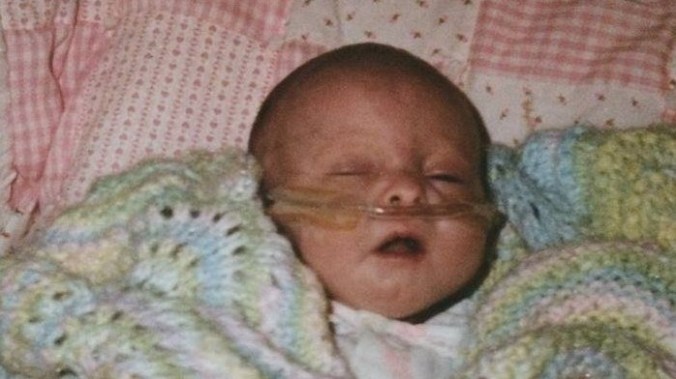
Laura died September 1. We brought her home Friday, August 28 after taking her off the ventilator. Everyone expected her to die then.
I know there is much comfort in having the memory of her dying in my arms at home rather than hooked up to the equipment in the hospital. It was very peaceful and I’m really grateful for these memories of her last days and final hour.
I have hesitated to write down my deepest feelings — somehow writing them down will make them more painful; like setting them in stone or something. Our house is still full and active and bursting with children’s activities (soccer, etc.) and music and friends.
The baby things are slowly being put back in the attic and that has not been as painful as anticipated. The things were used (the mobile) for 3 days and that makes packing them up easier.
My body is the worst reminder. Big and fat, ready to nurse a baby — 30 pounds overweight. It’s the worst reminder of all. Usually I have an unsightly body for 3 months but it’s balanced with the joy of a beautiful baby — not a high price to pay. Now it’s just the thought of having to lose the weight, wanting to get pregnant again.
My body, however, is so strong and healthy I hate to be too critical of it. After all, I had a baby, left the hospital three hours later, and went nonstop for three weeks. How can I hate a body that serves me so well?
Tomorrow is church. I’m already dreading it.
People don’t know what to say — what do I say? I’m fat, what will I wear? It’s terrible to feel like everyone is looking at you wondering “how you really are.” Are you going to crack up? I don’t think so. I hope I can reassure them of that.
Yesterday I went out with a friend and her new baby. A lady at the store asked me when my baby was due. I said I had had her and she had died. It wasn’t hard to say — it was just a bleak reminder of the truth.
I went through a pregnancy (never a fun event), had a baby, and now I don’t have one in my arms. And that is the saddest part.
Laura couldn’t have survived; I didn’t even want her to. Her body was not compatible with life and I was actually very much at peace with her going on to God and getting a new body. But that still has left me with empty arms. And I will live through that too. My hope is so strong for another baby. I don’t know when, but I feel like I know God has promised me a healthy baby and that hope gives me comfort and energy to get through these next weeks.
It was Holy Week when the breach happened. A seemingly small incident that tore something wide open in my heart. It was a wound I didn’t know I still had, and it ripped right apart. It was a wound I thought had healed. And actually, I’m not sure I had ever identified it as this kind of wound: a father wound.
It feels strange to say that, because it didn’t come from my earthly father. While no man is perfect, this particular father wound wasn’t inflicted by him.
Rather, it came from someone who was like a father to me. A man who promised me home and then ripped it away. A man who promised me love and then withdrew it. A man who accepted me and then turned around and took it all away.
The sun was shining, and then it wasn’t. And it never shone again.
I trusted this man. I believed in this man. I loved this man. And his change of heart was both confusing and devastating. It insidiously taught me things about a Father’s love that I never should have learned. Lessons like:
Someone can offer you love and then completely withdraw it. You are never safe in love.
Someone can offer you home and then kick you out. Home and belonging are never forever.
Someone can accept you at one point in time and then for seemingly no reason at all completely reject you.
You can be worthy of someone’s love and then suddenly unworthy of love, forever expelled from their life.
So you must always work to earn people’s love, because you never know what little inconsequential thing might trigger love’s loss.
This father wound of mine, it’s a situation I knew was unfair. I’d been angry about it for years, but I hadn’t let myself hurt too much over it. I just let myself stay angry. That was easier, more cerebral. Anger doesn’t hurt nearly as badly.
But the wound was there, always festering, never completely healing. Until something ripped it open this spring. I was shocked — I hadn’t thought it was still there. But when you cry so hard you can’t breathe and you begin to think the emotional pain might literally kill you, well, that’s an experience that begs for the healing power of Christ.
It was Holy Week, and I went to Maundy Thursday service. I went expecting to meet God. In fact, on the way there I told God, This thing hurts so bad it feels like I’m going to die, so if you don’t show up tonight, I don’t know what I’m going to do.
There was plenty of space to meet God that night, and God descended into several of those spaces with me. A couple different people prayed for me. The songs, the prayers, the sermon, they were all good. But the most important part for me was the Watch at the end.
The service closes in silence and allows people, as they feel led, to stay in prayer, in the same way that Jesus asked his disciples to keep watch with him. I planted myself in prayer. I was almost undone at this point, desperate, my head hung low.
I wondered if the place to start wouldn’t be in asking for healing, but in asking for the faith to believe in healing. Because what if I asked the God of the universe to heal my heart, and He didn’t come through? What if I asked Him to fulfill his promises, and He let me down too, just like the man who was a father to me? I didn’t want to be hurt by the Lord of everything, our true Father.
So I stayed and prayed. I stayed, and I stayed, and I stayed, until I heard the answer in the form of one of the evening’s songs:
O come to the Altar, the Father’s arms are open wide. Forgiveness was bought with the precious blood of Jesus Christ.
I stared at the newly cleansed and stripped-down altar, with its small cross inscribed into the wood now visible, and it dawned on me that a father wound is healed through the love of the Father. That my Father’s arms are open wide. The man who inflicted my father wound held arms open wide at one point, and then closed them forever. But the Father’s arms are open wide, always and forever.
I had stayed and pressed in, until I heard some sort of answer from God. And when I received it, I knew I was free to go. I packed up my bag, smiled in thanksgiving, and stood up to leave. I turned around to find no one in the room – no one except the ministry team cleaning up. I had been in the front row. I hadn’t realized I’d stayed that long. Everyone leaves the service so quietly, and I’d been praying so intently, that I hadn’t noticed.
I wasn’t healed on Maundy Thursday. But I knew where my healing would come from – the Father’s love. The Father’s arms are open wide. “How deep the Father’s love for us, how vast beyond all measure.” On that night, the knowledge of the source of my healing was enough for me. And I was on the watch for more healing.
A few weeks later I went to a special Saturday evening worship service, and God was so sweet to remind me of His truth. We sang songs about God’s goodness and faithfulness. It was good to remember everything God has done for me in my life, how He has always been with me.
That night we also sang Hillsong’s “Who You Say I Am.” It’s a song I’ve heard before but that hasn’t spoken to the deepest parts of me before. This time was different.
Who am I that the highest King
Would welcome me?
I was lost but He brought me in
Oh His love for me
Oh His love for me
Who the Son sets free
Oh is free indeed
I’m a child of God
Yes I am
Free at last, He has ransomed me
His grace runs deep
While I was a slave to sin
Jesus died for me
Yes He died for me
Who the Son sets free
Oh is free indeed
I’m a child of God
Yes I am
In my Father’s house
There’s a place for me
I’m a child of God
Yes I am
I am chosen
Not forsaken
I am who You say I am
You are for me
Not against me
I am who You say I am
In my Father’s house, there’s a place for me. I am chosen, not forsaken. The highest of Kings welcomes me. I needed to hear those truths over and over again.
A couple weeks ago we sang this song at church again. This time I sang it not through pain, but with joy. I sang, and I realized that the Father’s love had been busy at work in the undercurrents of my life, convincing me that there’s always a place for me, that my Father’s love will never fail. It will never run out, will never run dry.
The Father’s arms are always open wide. Earthly fathers may forsake, but we have a Father in heaven who never will.
The funny thing is, I thought I knew God as Father. As a child, I first learned of God as Father. “Dear Heavenly Father” is how all my childhood prayers were modeled. I was comfortable addressing God as Father. My dad was someone I could easily talk to, and God seemed like Someone I could easily talk to, too.
In the last decade I have explored God as Spirit and God as Son. This was healthy and healing, but I had neglected to keep pursuing God as Father. I thought I already knew God as Father. But I was wrong. There was more to know, more to learn. With our Triune God, it’s always that way. “Farther up and farther in,” right?
We’ve now lived all the way through Easter season and have even slipped past Pentecost. I’ve let the love of the Father wash over me the last few months, and I’m more sure of His love than before. I know that there’s a place for me in the Father’s love. I know the pain of a father wound will not kill me, even if it sometimes feels as though it might. And I know the love of the Father truly heals old wounds. Even the wounds we didn’t know were there.
What’s to be done about all the things that “never should have happened”?
I look at my life, and I look at the lives of the people I love, and I think about all the things that really never should have happened.
Things I never should have done, whether mistakenly or naively or even willfully. Things that never should have been done to me, whether accidentally or willfully. And things that never should have happened to the people I love most — never ever, not even in a million years.
Sometimes I replay these things over and over in my mind and think, “if only.” If only, if only, if only. If only that thing or that series of things had never happened. Then life would be better. It would be more full of joy and less full of pain.
I sit and wish I could go back in time, back before that event, before that pain, and I wish I could change what happened, either for me or for the people I love.
Sometimes I think about the “never should have beens” TOO frequently.
Because I cannot go back and change what happened. No one can. It’s no use wishing for a different past or a different present. It won’t ever happen.
But sometimes, the thing that happened is so terrible, so dreadful, that I honestly don’t know how we can move on. What then? What do we do then?
I sat with this question this week, and here is the place I landed: CHRIST.
The only thing I know to do, amidst senseless and brutal suffering, is look to Christ. This is why we need Christ — for all the millions and billions of things that “never should have happened.”
This was the very purpose for which Christ was sent into our world. He is here today, with us and in us, precisely for the things that never should have happened. Yes, even when those choices were made and those actions were committed by Christ followers. Christ is here for ALL these things.
Maybe you don’t have any nagging questions about God’s goodness or why God let something happen to you. Maybe you never kick yourself for what you have done in the past.
But maybe sometimes you, like me, loop around all the “what ifs” and “if onlys” and “never should have happeneds.”
When I think of these unanswered and unanswerable questions, I’m reminded of some of the parting words in C.S. Lewis’s “Till We Have Faces.” The main character Orual is so like me, so prone to bitterness, so prone to questioning. But then she has an encounter with the Divine and responds:
“I know now, Lord, why you utter no answer.
You are yourself the answer.
Before your face questions die away.
What other answer would suffice?”
I’m reminded of Job’s response to the Lord near the end of their very long conversation, and I’m reminded of the disciples’ confession in John 16:30:
“Now we understand that You know everything, and there’s no need to question You.”
I don’t know what these questions and regrets looks like in your life right now. I don’t even know what they are going to look like in my life, moving forward.
All I know is that as I sat with the anguish and with the questions this week, that I knew, all over again, that Christ would be the antidote to the poison. That He would be the answer. For me and for the people I love.
Because we all need Christ for the “never should have beens.” No matter who did them.
And in the end, after all our questions and maybe even in the middle of all our questions, I pray we will be able to proclaim along with the modern hymn:
“Christ is enough for me.
Christ is enough for me.
Everything I need is in You.
Everything I need.”
Elizabeth and I are thrilled to introduce you to our new book, Serving Well. It is our deepest hope that this 400+ page book will encourage and equip cross-cultural folks through the various seasons of life and ministry.
It’s available in print and Kindle version here. Our publisher is also selling the book with a 20% discount here.
You can read the Serving Well press release (with book excerpt) here.
From the Back Cover Are you dreaming of working abroad? Imagining serving God in another land? Or are you already on the field, unsure about what to do next or how to manage the stresses of cross-cultural life? Or perhaps you’ve been on the field a while now, and you’re weary, maybe so weary that you wonder how much longer you can keep going.
If any of these situations describes you, there is hope inside this book. You’ll find steps you can take to prepare for the field, as well as ways to find strength and renewal if you’re already there. From the beginning to the end of the cross-cultural journey, Serving Well has something for you.
Early Reviews for Serving Well
“Serving Well is an important voice in the search for honest, experienced conversation on living and working cross-culturally in a healthy and sustainable way. Dig in!” – Michael Pollock, Executive Director, Interaction International and co-author of Third Culture Kids
“Serving Well is more than a book to sit down and read once. It is a tool box to return to over and over, a companion for dark and confusing days, and a guide for effective and long-lasting service. Elizabeth and Jonathan are the real deal and Serving Well, like the Trotters, is wise, compassionate, vulnerable, and honest. This needs to be on the shelves of everyone involved in international, faith-based ministry.” – Rachel Pieh Jones, author of Finding Home: Third Culture Kids in the World, and Stronger Than Death: How Annalena Tonelli Defied Terror and Tuberculosis in the Horn of Africa
“Serving Well is a must-read book for missionaries and for those who love them. This is a book you really need if you are ‘called to go, or called to let go.’ In Serving Well we read both the spiritual and practical, simple and profound, funny and compelling in chapters written by Elizabeth and then Jonathan Trotter; hearing from each their voices and their hearts, the struggles and the victories, ‘the bad days and the good days’ of preparing to go and serving well overseas. Their down-to-earth yet godly insights were born from living overseas and from authentically wrestling with the ‘yays and yucks’ of missionary life. They draw wisdom from both Scripture and sci-fi authors, Psalms and funny YouTube videos, encounters with Jesus and encounters with cops looking for a bribe. Take two books with you to the mission field: the Bible, and Serving Well.” – Mark R. Avers, Barnabas International
“Serving Well is deep and rich, covering all aspects of an international life of service from multiple angles. It is full of comfort, challenge, and good advice for anyone who serves abroad, or has ever thought about it, no matter where they find themselves in their journeys. It is also really helpful reading for anyone who has loved ones, friends or family, serving abroad–or returning, to visit or repatriate. Jonathan and Elizabeth Trotter are both insightful and empathetic writers, full of humility and quick to extend grace–both to themselves and to others. Their writing covers sorrow and joy, hope and crisis, weariness and determination. Best of all, from my perspective as someone who has worked with TCKs for over 13 years, it contains an excellent collection of important advice on the topic of raising missionary kids. Choose particular topics, or slowly meander through the entire volume piece by piece, but whatever you do–read this book!” – Tanya Crossman, cross cultural consultant and author of Misunderstood: The Impact of Growing Up Overseas in the 21st Century
“Overseas workers face a barrage of junk when they arrive on their field location: identity issues, fear/anxiety issues, and faith issues. I have worked with missionaries for well over a decade now and see how these common themes cry out for a grace-filled approach to truth and authenticity. The Trotters live this out loud, intentionally seeking a way to minister out of their own pain, striving, humor, and failure. Keep this reference close at hand!” – Jeannie Hartsfield, Clinical Counselor, Global Member Care Coordinator, World Team
“This book is the definitive guide to thriving in cross-cultural ministry. The Trotters have distilled years of experience into pithy chapters filled with helpful tips and wise insights. Put it on your must-read list.” – Craig Greenfield, Founder, Alongsiders International, author of Subversive Jesus
“In this must-read missions book, Jonathan and Elizabeth unearth the underlying motivations of the cross-cultural call. Penned with copious compassion and startling transparency, Serving Well is sure to make you laugh, cry, and, in the end, rejoice as you partner with God in His global missions mandate.” – David Joannes, author of The Mind of a Missionary
“The thief comes only to steal and kill and destroy; I have come that they may have life, and have it to the full.” ~ Jesus
Thieves steal. Sometimes the impact is NOW; you know it immediately and you feel it deeply. Other times, it takes some time; the bomb’s on a delay. And then it blows and you begin to realize all that was taken. All the time lost, the lives shattered, the relationships fractured. It feels like the wind gets knocked right out of you and you can’t even tell if the crater in your soul feels like anger or sadness or some other concoction of pain. But it’s definitely pain.
Sometimes the thief steals stuff, but often it’s more. Much more.
Maybe the thief looked like a robber on the back of a moto, or a home invader. Maybe the thief was a corrupt government, stealing freedom, opportunities, and futures. Maybe the thief was a cruel family member, or someone from your church or mission, a “friend.”
Whoever they were, they stole, they destroyed, and they killed. Or at least they tried.