Sex, Missions, and Listening to God {book recommendations for you}

by Elizabeth

This spring I read three of the best books I’ve ever read. One in particular I couldn’t stop talking about for weeks – but it wasn’t the sex book! I had to start with that word, though, because I knew it would grab your attention. 

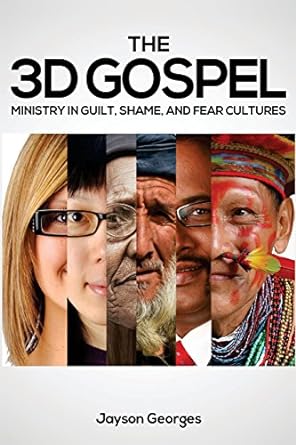
Up first, the best book on missions EVER: The 3D Gospel: Ministry in Guilt, Shame, and Fear Cultures by Jayson Georges.

When Christine Paterson of FieldPartner recommended the book and mentioned that it was only $3.99 on Kindle, I figured I’d give it a try. I intuitively knew that American culture held more than just a guilt/innocence worldview and that shame/honor and fear/power comes into our thinking as well, and I was eager to learn the specifics of each worldview.

What I didn’t expect was for the book to so thoroughly rewrite my understanding of culture. I underlined nearly the entire book. At only 80 pages in paperback, there’s no fluff here. Every word seems essential, and every sentence sheds light on world cultures and their differing assumptions and thinking processes. I began to understand shame/honor and fear/power cultures more fully, and I began to see how the Bible beautifully addresses all three cultural concerns (guilt, shame, and fear). 

Once my eyes were opened to this, I even began to see these three concerns addressed in most of our worship songs. In Western cultures we tend to tell the gospel story only through a guilt-innocence lens, and while that’s not wrong, it is incomplete. We look to God for help with our problems regarding fear and shame, but we don’t tend to bring these perspectives into our telling of the Gospel story, and this hinders our spiritual growth. 

Thankfully, we can offer people a more three-dimensional gospel, one that has the power to redeem their day-to-day struggles with fear and shame, whether in our passport culture or a host culture. God knows the human heart and has offered a solution for all our problems in Jesus Christ. 

This book made me fall in love with God all over again.

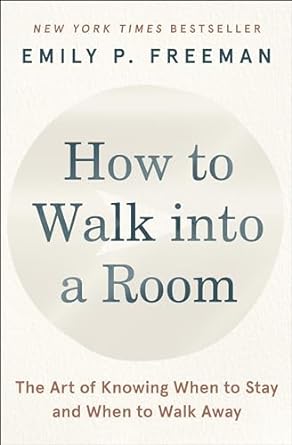
Next up, the best book I’ve read in a long time about listening to God: How to Walk into a Room: The Art of Knowing When to Stay and When to Walk Away by Emily P. Freeman

I remember resonating so deeply with Emily’s podcast episode, “How to Walk Out of a Room,” a couple years ago. The episode was mercifully devoid of details so that her principles could apply to all sorts of situations. When I heard she was writing a book based on that episode, I knew I would want to read it.

Emily is a spiritual director and has a master’s degree in spiritual formation, and she has a way of walking with people in discernment that is quiet and calm. She offers a “non-anxious presence,” as they say in spiritual direction circles. (Full disclosure: I’ve been meeting monthly with a spiritual director for about the past year, and it’s been a huge part of drawing my heart back into conversation with God after some dry, lonely years.)

I had a feeling this book would be important, and so I decided not to mark it up but to leave it empty and, in a way, sacred. Instead, I would rewrite meaningful sections in my journal. This helped slow me down and really savor Emily’s words. It helped me process the past, it helped me learn how to make better decisions, and it gave me peace in the decisions I was making. Then one day I looked around and realized I was making decisions much more easily than I had in the past, even small daily decisions, and I had to wonder if this book had something to do with it. 

The thing I love about this book – and that sets it apart from other books purporting to help people recover from restrictive religious environments and explore a more expansive relationship with Christ – is that Emily gives tangible steps people can take to process the past and discern their present and their future. To walk with Emily is to learn together how to listen to God.

And lastly, one of the best books I’ve ever read about sex: The Good Girl’s Guide to Great Sex: Creating a Marriage That’s Both Holy and Hot by Sheila Wray Gregoire.

This is the book every woman needs to read before she gets married – or after, if things in the bedroom aren’t working, whether she got married a year ago or 30 years ago. Sheila co-wrote The Great Sex Rescue with two other authors, and it’s a great research-based book that helps people untangle their unhealthy and unbiblical beliefs about sex, but The Good Girl’s Guide really gets into practicalities. 

I heard it recommended by a Bible college professor who teaches classes about sexuality, and I wanted to check it out myself. There was an earlier version of the book, but just this year it was revised and expanded, so I read the revised version. This is the book I will give to my daughters when they are engaged or newly married. I still recommend Aanna Greer’s Darling: A Woman’s Guide to Godly Sexuality for those who are quite innocent or naive about sex and their bodies, but Sheila’s book is a necessary follow-up.

Sheila, along with her pediatrician husband, also wrote The Good Guy’s Guide to Great Sex: Because Good Guys Make the Best Lovers. I haven’t read that one, but I’m assuming it’s good because that same Bible college professor recommended it and because it’s from an author I trust.

I hope these books will help you or someone you love.

For Podcast Lovers! Two new episodes…

I had the chance to talk about a bunch of ideas from Digging in the Dirt on a couple of different podcasts recently. Read about what we discussed, and check ‘em out!

The Clarity Podcast with Dr. Aaron Santmyire: We talked about married sexuality, the danger of centering America in the story of global Christianity, why not to call our kids “world changers,” the uniqueness of having a work spouse, Shiny Happy People, and more.

Spotify: https://open.spotify.com/episode/0xHJ0ksF3Z8pc3W6G8fkJh…

Podcast website: https://the-clarity-podcast.captivate.fm/

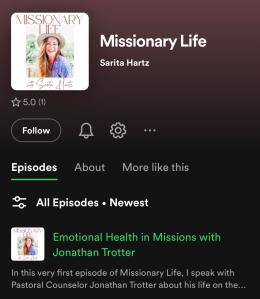
Missionary Life with Sarita Hartz: We talked about the fun stuff like depression, anxiety, the “missionary life cycle,” and the important distinction between anger and aggression. It’s a vital conversation for those in missions and pretty much everyone else too. 😊

Spotify: https://open.spotify.com/episode/3uUrZYPmrWn5MaW2I85fN6…

Apple Podcasts: https://podcasts.apple.com/…/missionary-life/id1719722593

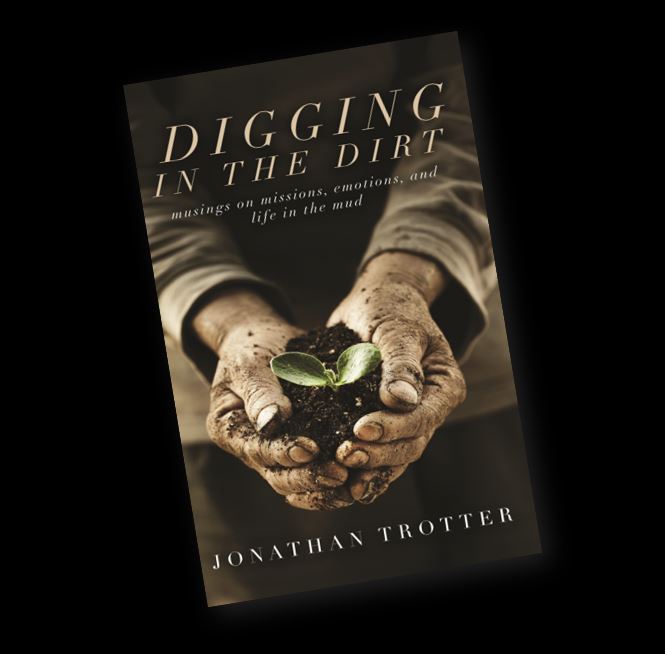
If you’re interested, you can buy Digging in the Dirt here: https://amzn.to/4a5O3Bf

Happy Friday, y’all, and MERRY CHRISTMAS!

[Amazon affiliate link helps support the work of A Life Overseas]

BOOK LAUNCH! Digging in the Dirt is here!

Buy it here!

From the back cover:

Welcome to ground level, to the dirt and the mess.

We like the mountain tops and the sunshine. We like green grass under a clear blue sky. We like victory and breakthrough and answered prayers. But sometimes it rains, the shadows deepen, and life turns muddy. Sometimes God seems quiet. What then? What happens when depression descends, or anxiety hangs like a sword overhead? What happens when loneliness suffocates, the thief steals more than stuff, and you get blood on your shoes?

In Digging in the Dirt, Jonathan Trotter delves into the disasters, the darkness, and the deluge, and he offers comfort, presence, and a gentle invitation to hope.

With humor and prose, with poetry and Top Ten lists, Jonathan welcomes us to the dirt, to the places where we actually live. He invites us to boldly see life as it is, with eyes wide open, and reminds us that even when the digging is scary, we are never alone.

To the ones who are dealing with devastation and distress, welcome. To the ones who need to uproot, to pull out, to clear ground, welcome. To the ones who seek desperately to plant seeds of grace and hope in once barren soil, welcome. To the missionary abroad and the believer at home, welcome. Receive the invitation, and join with Jonathan here at ground level, together.

Come, dig in the dirt.

From the preface:

Hello and Welcome!

I’m Jonathan, and it’s such a pleasure to meet you. I look forward to journeying with you through these pages. Together, we’ll delve into the dirt of life and relationships, of sorrows, pain, and loss. And maybe we’ll plant some things too.

Perhaps, along the way, we’ll see small, green stalks of life and hope begin to poke through, watered with the tears of the journey. Digging like this can be messy, but it can be good too.

These musings will meander from the hot dirt of Cambodia to the sticky mud of American politics. Some of these musings are inspired by international missionary life; some of them are firmly rooted in an American context. But whether you’re American or not, whether you’re a missionary or not, I hope that you find them all a blessing, an encouragement, and perhaps sometimes a challenge. I wrote them for you, and I share them with you with my whole heart.

Start reading Digging in the Dirt wherever you’d like, and feel free to skip ahead or go backwards. Are you a cross-cultural missionary? Start there if you want. Are you interested in developing emotional intelligence, or are you exploring whether or not Christians are allowed to have feelings? Consider starting in the Emotions section. Are you reeling from recent life events that have left you feeling like you’re choking on the mud and muck? First of all, I’m so sorry. Second, breathe a slow, deep breath, look over the Table of Contents, and start wherever you need to start.

Wherever you are, and whatever your story, welcome to ground level, to the dirt. It is here that the real work happens; the good, hard, sweet, healing work. It is my deepest hope that here, among these musings, you may find grace, peace, and a hope that just might be strong enough to crack through the crust.

All for ONE,

Jonathan Trotter

What people are saying about Digging in the Dirt:

A genuine book where no topic is off limits, Digging in the Dirt hits you right where you are regardless of location or vocation. This book is a must-read for anyone who is or is thinking about serving in missions and ministry! – DeAnna Anderson, former Director of the Launch Team for Wycliffe Bible Translators and missionary

Digging in the Dirt is a breath of fresh air for Christians. – Kim H.

Jonathan has such an authentic insight into life on the field, and he addresses the hard things in such a real and tangible way that helps you to know you are not alone. I would totally recommend this book for anyone who is serving overseas, sending someone overseas, or remotely interested in mission life. – Sydney, PI Leader for Southeast Asia

Rarely does an author bring the perspective of a missionary, nurse, theologian, pilot, counselor, parent, and gardener to cross-cultural ministry, family dynamics, depression, grief, politics, and the church, all in one book. Even rarer is a book that combines all of those things in a way that rings authentic and meaningful. Digging in the Dirt manages to do both, bringing thought-provoking and heartfelt lessons out of an incredible range of real-life experiences. – Reuben James

Digging in the Dirt is a must-read for anyone in missions or ministry. It’s refreshingly humble and vulnerable, and no matter what stage of life and ministry you’re in, you’ll walk away with some wisdom and new insight. – B.W., Stateside missions support worker

__________________________________________

Check it out on Amazon here!

*Amazon affiliate links

I love my job so much that…

I love my job so much that I’m trying to get better at it. Want to help?

Thanks to the generous support of so many churches and individuals, I’ve served as a pastoral counselor and coach to missionaries for about nine years now. Last week alone I met online with missionaries serving in or returned from Kyrgyzstan, Kenya, west Africa, Japan, Cambodia (six clients), Bulgaria, Dominican Republic, and Tanzania.

Shortly after our return to the States, Elizabeth and I decided that I should go back to school. I’ve been in grad school studying clinical mental health counseling for one year now, and I have a year and a half to go. I hope to use this education to continue serving missionaries around the world for many years to come. So…

Here’s the request

Like many companies and churches, our missions agency provides an educational reimbursement benefit up to $5,000 per year. This is fantastic and could be extremely helpful! However, because Team Expansion is a missions agency, and because we serve in a support-based position, we have to raise our own benefits.

In other words, we won’t get the benefit if we don’t raise it. Maybe that sounds weird to you, but we’re super grateful for even the chance of this benefit, and that’s just sort of how things are done in the missions world.

So, we’d like to invite you to consider giving especially for this educational need. (It’s tax-deductible for folks in the US.) Some have already given, so we’re only $3,700 away from our goal!

Many of you gave towards this last year, and we are soooo grateful! It was immensely helpful in deferring some of the school fees!

If you’ve been blessed over the years by our writings or pastoral counseling ministry, or if you’d like to support this preparation for future ministry, would you consider giving through PayPal (preferred) or Team Expansion’s giving portal here? Note: if you donate through Team Expansion’s website, please add “education” to the notes section.

Team Expansion has taught us to invite boldly, so here we are. We’re not using regular donations to fund this education benefit — only money raised specifically for it.

As I’ve said over and over, we couldn’t have gotten this far without y’all, and we can’t get a whole lot farther without y’all. If you have any questions, please let me know.

In the meantime, we’re going to keep trying to “follow close” behind Him, serving missionaries and cross-cultural workers around the world, equipping them to see the hearts of the hurting people around them, for his glory and for the growth and health of the global Kingdom.

All for ONE,

Jonathan T.

One of the counseling rooms at Mt. Hope Christian Counseling Center here in Joplin. I started my part-time internship here last week!
Living Well, Cambodia
Counseling room at our international church in Phnom Penh, Cambodia.

Politics, Plumeria, and the Kingdom of Heaven

“I miss Ima,” my daughter tells me. “I miss her singing, and I miss her flowers.”

Ima was one of the best worship leaders I’ve ever known, and I’m so glad our paths crossed at an international church in Phnom Penh, Cambodia.

Originally from the islands of Fiji, Ima always led worship with a tropical flower in her hair. Usually, she chose a frangipani (plumeria), the bright yellow satiny flower that smells like the most luscious citrus dessert and is the mainstay of Hawaiian leis.

Cambodia has a tropical climate and wonderful people, but even so, the country has suffered much as a result of war, genocide, and corruption. Cambodia is not a tropical paradise, but the church is growing, and Ima is helping.

With her global team she led our global church. Typically, she shared the stage with a Filipino on keys, a Pakistani on percussion, an Australian on guitar, and a Malaysian on drums. Together, they helped lead a rag tag group of Jesus followers from over 30 nations in worship. They helped us declare, week after week, the hope of the cross and the certainty of God.

Our church was full of missionaries and businesspeople, those involved in anti-human trafficking work, and those serving in the relief and development sector. Many of us came to church on Sundays tired, exhausted, and poured out. We traveled by motos and tuk tuks, buses and cars, to be reminded of our Hope. We came to drink of Life, and we came to declare the death and resurrection of our Lord, until he comes again.

I hadn’t grown up in a church like this. I hadn’t grown up in a church with pastors from China, New Zealand, the Philippines, India, Canada, Cambodia, and the United States.

I thought the church was primarily American.

I mean, I didn’t really think that; it’s just that growing up in the Midwest in a standard evangelical church, the church just was pretty American. And Caucasian too. Our authors were American, our musicians were American, everyone was American.

Typically, the only non-American folks I ever came across were the ones we were sending missionaries to. We were the ones sending the gospel, and they were the ones receiving it.

As believers in America we’re taught, often accidentally, that to be a Christian is to be American, or at least to look like it. Even if not purposeful or intentionally racist, the trickle-down effect of this theology is dangerous and thieving, denying us connection to the breadth and depth of the global church.

But here was Ima, a Fijian woman, singing the gospel with power. She was pouring her heart out in prayer, and she was ushering a global community into the throne room of God. The Kenyan sister was dancing, the Samoan brother was singing, and the Australian guy was jumping up and down with a huge smile.

The global church was so much more beautiful and diverse than I had ever known. Christ’s people had come from all over the place, they were going all over the place, and they were worshiping.

I love the American church. But I’m afraid that somewhere in our history, we began to believe that we Americans held the keys to the Kingdom. We would never say it like that, but we sometimes act like that.

So long ago, our spiritual forefathers rightly declared that Rome was not the central hub of global Christianity. But I’m afraid we’ve drifted into our own hubris and begun to believe that the American church is the hub, the main gospel force in the world. It is not.

That vision is too small. That church is too claustrophobic.

I want to be brothers with the Swiss guy who runs a climbing gym in Cambodia. I want to serve alongside a Chinese businessman who converted himself (as far as that is possible) by picking up a Bible someone left behind in a hotel room in Nepal.

I want to rejoice with the Pakistani couple who opened their hearts and kitchen to us, telling stories of the faithfulness of God and how they escaped to safety. The unique flavor of homecooked samosas will always remind us of our friends’ faith and our Father’s faithfulness.

I want to honor the Japanese man providing care and education to disabled Cambodians. I want to join in with Cambodian pastors who continue to teach God’s word to God’s people in difficult times and challenging places.

Christ is the King, and his church is global.

We must remember: the church existed before America.

We must remember: the church will endure long after America.

We must remember: the church is older than Western civilization.

The church is global, and she is not dying.

And while the church is global, the gospel always gets worked out locally. That’s the beauty of it. The church can be local precisely because it’s so stunningly global. The church is big enough to be local everywhere.

As citizens of America, we should celebrate and honor and cherish the church in the United States. She remains beloved and part of the Bride. But as citizens of the Kingdom, we should celebrate and cherish and love the global Church too, wherever she may be found.

A Fijian worship leader with a flower in her hair helped me learn that.

When I finally get home and meet Jesus face to face, I will not be surprised at all if he bellows out the Fijian greeting: “BULA!” which means, “Life to you!” I hope to hear him say on that day, “Welcome home, my son. Here is the life you’ve been searching for! Well done.”

And then I will wander.

I will find a frangipani tree. I will inhale its cheerful citrus fragrance, I will smile, and I will look out on the nations that God has brought together, and I will declare, “This looks familiar; look at what the Lord has done!”

And then I will find Ima, and I will thank her for what she gave our church and what she gave my daughter. I will thank her for what she gave me. With her uniquely Fijian flair and a frangipani flower in her hair, week after week, she led God’s people to paradise.